

Special Reports are longer, often more technical, documents consisting of entire articles, government statements, and other documents relevant to security and peace in Northeast Asia.
NAPSNet, Special Reports
A Substitute for Broad Extraterritoriality: Recognizing an Experienced Player Armed with Modernized Tools
Larry L. Burton, attorney and former Acting Deputy Director at the World Customs Organization, writes, “there is no question but that as the entities controlling and administering the international movement of goods, the world’s customs administrations are uniquely positioned to provide increased security to the global supply chain…In recognition of the stark new global realities of terrorism and its aims, the World Customs Organization, in concert with its membership, has developed and made available a suite of instruments and programs designed to arm the world’s customs administrations to meet such threats.”
Go to the articleThreat Convergence and International Cooperation: Indicators and Challenges
Rita Grossman-Vermaas, Senior International Policy Advisor in the Persistent Surveillance Division at Logos Technologies, provides an overview of what threat convergence is and the opportunities for international cooperation to mitigate the security challenges it presents.
Go to the articleExtradition and Prosecutorial Difficulties Using Extra-Territoriality
Arvinder Sambei, Director, Sambei Bridger & Polaine Legal and Law Enforcement Specialists, draws on collective experiences to highlight the difficulties in apprehending, extraditing, and prosecuting individuals who have engaged in proliferation related behaviour salient to both counter-terrorism and to controlling WMD proliferation. Her report also highlights cases where extra-territorial jurisdiction and international legal cooperation has worked, where it has failed, and the conditions under which these outcomes were achieved.
Go to the articleNorth Korean Trade with China as Reported in Chinese Customs Statistics: 1995-2009 Energy and Minerals Trends and Implications
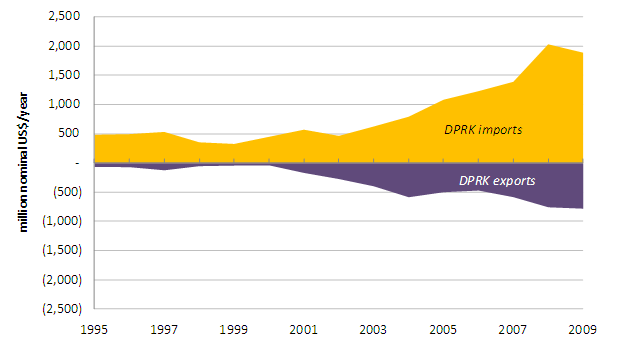
Nathaniel Aden, Senior Research Associate with the Lawrence Berkeley Lab China Energy Group, writes, “China is North Korea’s largest international trading partner…Whereas North Korean electricity and iron ore exports are sold at sub-market “friendship prices,” Chinese coal and oil products have been sold to North Korea at premium prices. Chinese Customs data suggest that Beijing is taking a pragmatic, market-oriented approach to trade with its reclusive neighbor, while the increasingly asymmetrical energy embodiment of bilateral trade may reflect dilapidation of North Korea’s non-military industries.”
Go to the articleBetween Centrifugal and Centripetal World Forces: Extra-Territoriality of Resolution 1540 and Southern Perspectives
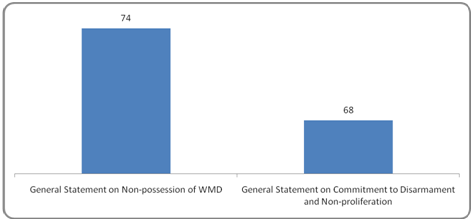
This report, by Rodrigo Alvarez V., Executive Manager of the Global Consortium on Security Transformation and Coordinator of the Non-Proliferation and Disarmament project, asserts that Latin America must keep supporting all types of WMD non-possession, disarmament and non-proliferation initiatives. The paper analyzes the southern perspective on WMD proliferation, develops the current vision for Resolution 1540 in the region, and analyzes the resolution with respect to Latin America’s nuclear energy dilemma.
Go to the articleNon-State Nuclear Proliferation: A Factsheet on the De jure and De facto WMD Control Regime in South Asia
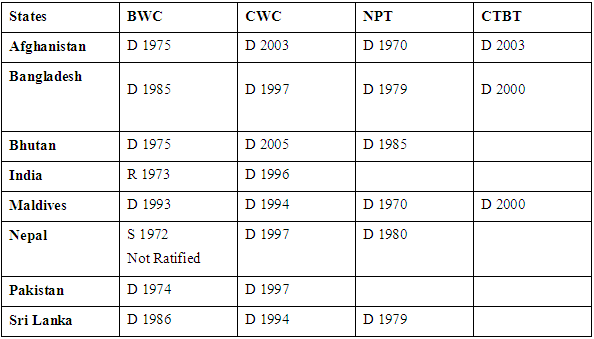
Debi Prasad Dash, Additional Director-General, Government of India, examines the efficacy of the legal and enforcement systems in South Asia, with particular focus on India, in preventing and combating the possible use of WMDs by the non-State actors.
Go to the articleSupporting Online Material: North Korean Nuclear Statements (2002-2010)
This report is a collection of selected North Korean statements on their nuclear program. This material was assembled to support the report, “North Korean Nuclear Nationalism and the Threat of Nuclear War in Korea” by Peter Hayes Professor, RMIT University and Executive Director of the Nautilus Institute and Scott Bruce, Nautilus Institute Director. These sources are meant to show the change in DPRK statements on its nuclear program between October 2002 and the present. Statements from the Korean Worker’s Party (KWP), Korean People’s Army (KPA), and DPRK Cabinet are labeled as such so that the distinctions between the views of these different institutions in the DPRK can be observed.
We invite our audience to send us other relevant statements that may compliment and expand this study.
Go to the article(South) Africa and the Control of Non-State Nuclear Proliferation: Extra-Territorial Jurisdiction with Reference to UNSC Resolutions 1540 and 1373
Noël Stott, Senior Research Fellow at the Institute for Security Studies, offers an overview of UN Security Council Resolutions 1540 and 1373 in the African and South African contexts with specific recommendations for implementation, including “streamlining the various counter-terrorism committees, including those established pursuant to Resolutions 1267 (1999), 1373 (2001) and 1540 (2004), so that together they could form a coordinated UN Security Council body for the prevention and combating of terrorism.”
Go to the articleA Code of Conduct for Transfer of Nuclear Power Plant Technology to Consumer Countries
This report by Gordon Thompson outlines a code of conduct for transfer of nuclear power plant (NPP) technology to consumer countries. The term “consumer” is used here to refer to a country that is a party to the Nuclear Non-Proliferation Treaty (NPT) and has not developed an indigenous capability to design or manufacture the major components of an NPP. The code outlined here would apply to the transfer of Generation III nuclear power plant technology during the next few decades. Relevant items of technology would pertain to light-water reactors or CANDU reactors. Before outlining the content of a potential code, this report provides background regarding codes of conduct, sustainability, and trends in the use of nuclear power. It then discusses ten issue areas for a code of conduct, and outlines a process for constructing a code that accounts for each issue area.
Go to the articleRegional Responses to Extra-Territoriality and Non-State Nuclear Actors: A Perspective From Southeast Asia
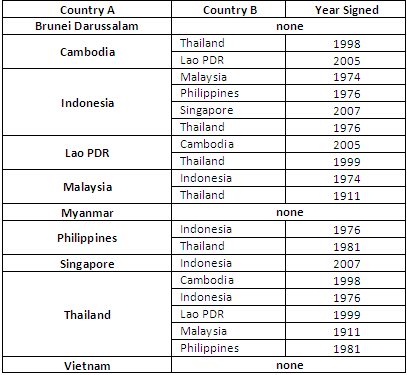
Raymund Jose G. Quilop, Associate Professor of Political Science at the University of the Philippines
and Secretary of the Philippine Political Science Association, writes “In making Southeast Asian states more receptive to the practice of extraterritoriality particularly in regard to preventing non-state actors from having access to WMD, it would be helpful to fully utilize existing mechanisms for exchanging information including the numerous platforms that bring together leaders, foreign and defense officials as well as making existing treaties such as the SEANWFZ adapt to the changed regional environment where nuclear proliferation is no longer solely the result of state action but involves non-state actors too. Indeed, the complexity of the challenge of terrorism is eventually pushing governments to become more receptive to the idea of working together, not merely in having their efforts coordinated but in finding ways to collaborate with one another.”
Go to the article