Daily Report Archives
Established in December 1993, the Nautilus Institute’s *N*ortheast *A*sia *P*eace and *S*ecurity *N*etwork (NAPSNet) Daily Report served thousands of readers in more than forty countries, including policy makers, diplomats, aid organizations, scholars, donors, activists, students, and journalists.
The NAPSNet Daily Report aimed to serve a community of practitioners engaged in solving the complex security and sustainability issues in the region, especially those posed by the DPRK’s nuclear weapons program and the threat of nuclear war in the region. It was distributed by email rom 1993-1997, and went on-line in December 1997, which is when the archive on this site begins. The format at that time can be seen here.
However, for multiple reasons—the rise of instantaneous news services, the evolution of the North Korea and nuclear issues, the increasing demand for specialized and synthetic analysis of these and related issues, and the decline in donor support for NAPSNet—the Institute stopped producing the Daily Report news summary service as of December 17, 2010.
Donald P. Gregg, National Security Adviser to Vice President George H. W. Bush from 1982 to 1988, Ambassador to Korea from 1989 to 1993, and Chairman Emeritus of the Korea Society, writes, “Mr. Carter, known for his independence and his willingness to enter into controversy, may well have come back with more than Mr. Gomes. The insights he will have picked up from his talks with top leaders other than Kim Jong-il should coincide with an emerging realization within the Obama administration that its current stance toward the North, featuring sanctions and hostility, is having little positive impact, and that a return to some form of dialogue with Pyongyang needs to be considered… There also is a growing realization in Washington that alienating China is an inordinately high price to pay for putting pressure on Pyongyang. So the White House, in choosing to send Mr. Carter at this time, may deserve credit for seeking to change a hostile stance toward North Korea into a more effective policy.”
Go to the article
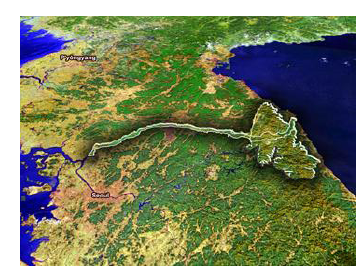
This article by Peter Hayes, Executive Director of the Nautilus Institute, was delivered at the 2010 DMZ Peace Congress in Seoul on August 12-14, 2010. The paper reflects on how indirect and incremental social and political engagement may be a necessary attribute of strategies that build ecological security in a conflict zone. It concludes by contrasting this approach to the characteristics of what the author terms “nuclear insecurity” and suggests that a Northeast Asian Nuclear Weapon Free Zone may be a form of nuclear insecurity that relies less on balances of terror, and thereby is more conducive to the creation of sustainable security in this region.
Go to the article

