

DPRK (NORTH KOREA) CHRONOLOGY FOR 2025
Compiled by
Leon V. Sigal
Northeast Asia Cooperative Security Project
Contact:
1/6/25:
North Korea fired a suspected hypersonic missile into the East Sea today, the South Korean military said, marking its first provocation this year ahead of U.S. President-elect Donald Trump’s inauguration. The Joint Chiefs of Staff (JCS) said it detected the launch of a suspected intermediate-range ballistic missile (IRBM) at about 12 p.m. from the Pyongyang area and it flew some 1,100 kilometers before splashing into the sea. While the missile’s flight distance fell shorter than the conventional IRBM range of 3,000 to 5,500 km, it is believed to be similar to North Korea’s IRBMs tipped with hypersonic warheads that were launched in January and April last year, a JCS official said. If confirmed to be a hypersonic missile, it would be the farthest distance covered by a North Korean missile of its kind. The missile is also believed to be theoretically capable of striking U.S. military bases in Guam — about 3,400 km from Pyongyang — if fired at full range. The latest launch took place as U.S. Secretary of State Antony Blinken was visiting Seoul for talks on efforts to deter North Korean threats amid political turmoil in South Korea stemming from President Yoon Suk Yeol’s failed martial law bid. The launch raised speculation that it could be aimed at testing the South Korean military’s readiness in the aftermath of Yoon’s short-lived declaration of martial law on December 3 and his subsequent impeachment. Last month, the JCS said the North could stage a surprise hypersonic missile launch, citing various internal and external political events, including Trump’s inauguration, and recent signs of missile-related activity. The North last fired multiple short-range ballistic missiles into the East Sea on November 5, just ahead of the U.S. presidential election. (Chae Yun-whan, “N. Korea Launches Suspected Hypersonic Missiles Weeks before Trump’s Inauguration,” Yonhap, January 6, 2025)
KCNA: “The Missile Administration of the Democratic People’s Republic of Korea successfully conducted a test-fire of new-type intermediate-range hypersonic ballistic missile on January 6. Full General Jang Chang Ha, general director of the Missile Administration of the DPRK, and leading officials of the defense science institute guided the test-fire on the spot. Kim Jong Un, general secretary of the Workers’ Party of Korea and president of the State Affairs of the DPRK, oversaw the test-fire through a monitoring system. The test of the new strategic weapon system is part of the plans for the development of the national defense capabilities to raise the durability and effectiveness of the strategic deterrent against the potential enemies in conformity with the changing regional security environment. A new composite carbon fiber material was used in the manufacture of the engine body of the missile and a new comprehensive and effective method based on the already-accumulated technologies introduced in the flight and guidance control system. Expressing great satisfaction over the result of the test-fire, the respected Comrade Kim Jong Un, with regard to the new weapon system, said: The current test-fire proved without doubt that we are steadily upgrading the powerful new-type weapon systems like the intermediate-range hypersonic ballistic missile to cope with different security threats posed by the hostile forces against our state at present. A few countries in the world might possess such a weapon system. Just like the intended purpose of all military powers, the development of the new-type hypersonic missile is aimed mainly at steadily putting the country’s nuclear war deterrent on an advanced basis by placing the means of changing the war situation, a weapon system to which no one can respond, at the core axis of our strategic deterrence. This is clearly a plan and effort for self-defense, not an offensive plan and action. As shown by the result of today’s test-fire, the effectiveness of the missile system that fully meets the expected military specifications has been confirmed. The performance of our latest intermediate-range hypersonic missile system cannot be ignored worldwide, and the system can deal a serious military strike to a rival by effectively breaking any of its dense defensive barriers. Through the current test of the strategic weapon, we fully demonstrated the potentiality and development speed of our inexhaustible self-defensive technical forces capable of fully coping with even the prospective threats and clearly showed the enemies what we are doing and that we are fully ready to use any means to defend our legitimate interests. The hypersonic missile system will reliably contain any enemies in the Pacific region that can affect the security of our state. We have acquired a technical force which is by no means easy to achieve.” (KCNA, “DPRK Missile Administration Succeeds in Test-fire of New-type Intermediate-range Hypersonic Ballistic Missile,” January 7, 2025)
Van Diepen: “On January 6, North Korea test-launched a Hwasong-16B (HS-16B) solid-propellant intermediate-range ballistic missile (IRBM) carrying a hypersonic glide vehicle (HGV) payload. This was the third apparently successful flight of the HS-16 booster (two with HGVs, the other with a maneuvering reentry vehicle (MaRV) payload), probably meaning that the North considers the booster ready for operational deployment. The success of the HGV payload, however, cannot be confirmed, marking three apparently lackluster MaRV flights (one on a liquid booster); several successful flights over at least a few years probably will be needed before the HGV is ready for deployment. The HS-16 would be deployable in the near-term with the previously-flown MaRV or a yet-to-be-seen traditional reentry vehicle. The North reported using “new composite carbon fiber material” in the HS-16 booster and updated guidance technology, but the nature of these improvements and their effect on system performance are unknown. The latest test underscores North Korea’s continuing commitment both to IRBMs to strike Guam and other farther-flung theater targets, and to HGVs as an eventual means of further challenging US missile defenses in Guam and the western Aleutians. But the high cost of HGVs and the limited set of targets for which they offer comparative advantages (mostly key ground-based missile defense sensors) mean that relatively few will be deployed. Japan’s Ministry of Defense reported on January 6 the launch that day of a ballistic missile from North Korea to the northeast, falling into the sea at a distance of about 1,100 km with a maximum altitude of about 100 km after about a ten minute flight. The South Korean military confirmed the range of what it termed a “midrange missile” but did not report the altitude, claiming that launch preparations had been detected in advance. (It is not clear whether this detection was in addition to the military’s December 23 warning that the DPRK could launch an IRBM with a hypersonic warhead around its end-of-year plenum.) On January 7, North Korean press reported the previous day’s “test-fire of [a] new-type intermediate-range hypersonic ballistic missile” that demonstrated a “first peak height of 99.8 kilometers and the second peak height of 42.5 kilometers at the speed amounting to twelve times of the speed of sound, and accurately landed on the simulated target waters in the open sea 1,500 kilometers away.” This missile reportedly used rocket motors incorporating “a new composite carbon fiber material” and its guidance system included “a new comprehensive and effective method based on the already-accumulated technologies.” The test was said to have confirmed “the effectiveness of the missile system that fully meets the expected military specifications” and “the successful development of the new-type strategic weapon system.” Accompanying photos and video showed the “cold launch” from a canister mounted on a seven-axle road-mobile launcher of a solid-propellant missile tipped with a wedge-shaped HGV payload. The images generally matched those of the HS-16B solid-propellant IRBM that was last launched on April 2, 2024 and also carried an HGV. On January 7, the South Korean military characterized North Korea’s announced performance as an exaggeration, reporting that South Korea, Japan, and the US agreed the missile flew about 1,100 km with no second apogee (peak height) reached during the flight. The ROK military assessed the North’s claims as “highly likely deception.” The IRBM booster. This is the third apparently successful flight of the solid-propellant booster portion of the HS-16 system, including the April 2024 test and the January 2024 test that carried a MaRV rather than an HGV. (Moreover, the HS-16 booster is based on that of the HS-18 solid intercontinental ballistic missile [ICBM], which was tested successfully three times in 2024.) By traditional North Korean standards, that would be sufficient for the booster to be considered ready for operational deployment. This may be what the North was referring to in announcing “successful development” of the system. The HGV payload. This is the third known test of the HGV, including on the April 2024 HS-16B test and a September 2021 flight on a version of the Hwasong-12 liquid-propellant IRBM booster that the North dubbed Hwasong-8 and later HS-12B. There is no clear open-source evidence that any of the three HGVs flew successfully after release from the booster. Indeed, reminiscent of the latest flight, the ROK in April 2024 claimed the US agreed with its assessment of a shorter range and fewer maneuvers than claimed by North Korea. If the US did in fact agree with the ROK assessments, then we can be highly confident the last two HGV flights failed given Washington’s substantial missile detection and tracking capabilities. It should not be surprising that North Korea is struggling with the HGV. This is a very demanding technology given the need to cope with the temperatures and pressures of sustained hypersonic flight, which are compounded by the maneuvering needed to evade missile defenses (the comparative advantage of HGVs over other payloads), as well as the challenges of accurate guidance in such an environment. China and Russia needed numerous flight-tests over several years to successfully develop deployable HGVs, and the US is still working on it. Pyongyang likely has at least several successful flight-tests yet to go, even if it were to obtain assistance from Russia or China. Although the HGV is clearly not ready for prime time, North Korea might choose for political and propaganda reasons, or in an effort to complicate allied planning, to claim the payload is deployed even if remains under development. (For example, North Korea released a photo in October 2024 in conjunction with Kim Jong Un’s visit to “strategic missile bases” showing Kim in an underground missile facility standing next to HGV-equipped HS-12B liquid IRBMs.) In any case, the North could still deploy the HS-16 with the MaRV tested in January 2024, which was also flown twice on the “Hwasong-8” in January 2022, or with a traditional reentry vehicle that has yet to be seen on the HS-16. Composite carbon fiber. There is no open-source information on the nature of the “new composite carbon fiber material” reportedly used “in the manufacture of the engine body of the missile,” much less on whatever material had been used previously. The North’s “engine” phraseology would seem to apply not to the body of the HGV payload, but rather to the solid booster motors. Use of a new motor case or nozzle material might explain why Pyongyang announced in March 2024 the conduct of “a ground jet test [static test] of a solid-fueled engine for a new-type intermediate-range hypersonic missile,” the reported success of which allowed “a timetable for completing the development of the new-type intermediate-range hypersonic missile weapon system” to be set. Composite materials incorporating carbon fiber — and there is no information on what proportion of the North’s new material is carbon fiber, or the quality of that fiber — generally are desirable because they can be stronger than other composites, provide equal strength with less weight, or some combination. Lower-weight motor cases or nozzles would permit using the energy of the solid booster to propel the payload farther, to loft a heavier payload, or some combination of the two. Although it is possible that the purpose of using a new material would be to strengthen the motor cases to permit putting the booster into more stressful flight trajectories, it is at least as likely that the original HS-16 booster was sufficiently sturdy to handle HGV flights (as North Korea did with that booster in April 2024) but Pyongyang now is looking to provide that sturdiness at lower weight and thus with more boost performance. Improved guidance. Obtaining satisfactory accuracy while engaging in hypersonic maneuvers is one of the main challenges in HGV development, so it certainly makes sense that North Korea would want to improve its HGV accuracy. That said, there is no open-source information on what the guidance system or accuracy of the North’s previously-tested HGVs was, what technological improvements were made in the latest payload, or what effect those improvements had on accuracy. Indeed, given the apparently checkered flight-test history of its HGVs, Pyongyang itself may currently lack information on the degree of any improvement. Although the latest HS-16B test underscores that the booster portion of the system probably is regarded by North Korea as ready for deployment, the HGV payload has several successful flight-tests and thus probably at least a few years to go. The nature and impact of the “new composite carbon fiber material” and updated guidance technology used in the latest test are unclear. The test does show Pyongyang’s continued commitment to IRBMs, which pose a deterrent threat to US territory in Guam and the southwest Aleutians and can disrupt bases in Guam, the Philippines, and farther-flung reaches of Japan that could support US operations against North Korea. The test also shows continued commitment to the HGV development program, which if successful, will offer another means of combatting US missile defenses in Guam and the Aleutians. Moreover, the HGV is invoked by North Korea as a sign of technical sophistication (“a technical force which is by no means easy to achieve … a remarkable achievement” that only “a few countries in the world might possess,” as the media claimed on January 7) and of deterrent credibility and resolve (“through the current test … we … clearly showed the enemies what we are doing and that we are fully ready to use any means to defend our legitimate interests”). Even if successful, the high cost of HGVs and the limited set of targets for which they offer comparative advantages (mostly key ground-based missile defense sensors) mean that relatively few will be deployed to fulfill niche roles revolving around missile defense suppression. The HS-16 likely will end up being deployed in larger numbers with MaRVs and perhaps even traditional reentry vehicles, especially if North Korea eventually develops sufficient accuracy to make conventionally armed IRBMs militarily feasible. (Vann H. Van Diepen, “Half a Loaf: Third Hwasong-16 Solid IRBM Test Shows Booster Is Ready but HGV Payload Needs Work,” 38 North, January 9, 2025)
U.S. Secretary of State Antony Blinken said today that Russia is willing to provide North Korea with its advanced space and satellite technology in exchange for the North’s provision of weapons and other equipment to Moscow in support of its war against Ukraine. Blinken made the remark after talks with Foreign Minister Cho Tae-yul in Seoul, calling it a concern for the United States and its key allies, like South Korea and Japan. “We have reasons to believe that Moscow intends to share advanced space and satellite technology to Pyongyang,” Blinken said in a joint press conference. “Putin may be close to reversing a decades-long policy by accepting DPRK’s nuclear weapons program,” he said. “That concern is very much a focus, not only for the United States, but also Korea and Japan,” he added. Blinken said that the North’s close alignment with Russia underscores the need for greater security cooperation among the U.S., South Korea and Japan, as well as with the North Atlantic Treaty Organization (NATO), as security in the Indo-Pacific and Europe becomes increasingly interconnected. “The United States looks forward to Korea, along with Japan, Australia, New Zealand, continuing to increase cooperation with NATO to stand together to defend international rules and principles,” he said. Regarding President Yoon Suk Yeol’s botched martial law imposition and his subsequent impeachment, Blinken said that Washington delivered its “serious concerns” about the steps Yoon has taken to Seoul. “We communicated those directly to the (South Korean) government,” he said. At the same time, Blinken reiterated the U.S.’ confidence in South Korea’s democratic resilience, saying that responding to challenges is the “the hallmark of any democracy.” (Kim Seung-yeon, “Blinken: Russia May Provide Advanced Satellite Technology to N. Korea,” Yonhap, January 6, 2025)
For four years, President Joe Biden made South Korea a key partner in his effort to contain China’s growing global influence. But following President Yoon Suk Yeol’s thwarted attempt to declare martial law last month, political chaos in Seoul is calling into question whether the outgoing U.S. president was right to place so much trust in a leader who undermined the democratic stability of his nation, officials and analysts say. Secretary of State Antony Blinken kicked off his final tour Monday as the top U.S. diplomat in a South Korean capital riven by protests and division. It was an extraordinary visit to a close U.S. ally given the hour-by-hour events unfolding in the capital and questions over the fate of Yoon, who was holed up in the presidential compound resisting attempts to arrest him, as Blinken visited senior leaders elsewhere in the city. Chants from Yoon’s supporters, who have blocked investigators’ access to their leader, could be heard in the guest rooms of Blinken’s hotel. By virtue of history, geography and politics, South Korea has been a key U.S. partner in the region for generations. “What sets democracies apart from other systems is precisely how we respond to challenges, including internal challenges,” Blinken told reporters after meeting with South Korean Foreign Minister Cho Tae-yul, adding that he had “serious concerns” about what Yoon had done. “When we have challenges to our systems, we don’t pretend they don’t exist. We don’t ignore them. We don’t sweep them under the rug. We confront them,” Blinken said. “Sometimes that’s painful, sometimes that’s not pleasant to look at, but it goes to the very strength of our systems.” Yoon was a conservative leader whose unusual openness to partnership with South Korea’s historical rival Japan offered Washington a chance to build a three-way effort against China and North Korea. But that effort is now in disarray. Yoon gave no warning to the Biden administration before he declared martial law last month, and his subsequent resistance to arrest has further destabilized the nation as it braces for a new approach from President-elect Donald Trump. “The alliance has been resilient — incredibly resilient — but it’s definitely different right now,” said Jenny Town, director of the Korea program at the Washington-based Stimson Center. “This is a unique case that we haven’t seen before, and I think there are a lot of questions of how this ends.” With a recent poll showing that Yoon’s popularity has increased since his efforts to resist arrest, Town said, the looming question of Yoon’s fate and the potential changes in South Korean leadership mean Washington is facing an unpredictable partner in Seoul. Blinken faced unusually sharp questioning on Monday from South Korean reporters, one of whom demanded to know why the Biden administration “was not strong enough” to convince allies to respect democratic principles after framing global affairs as a confrontation between autocracies and democracies. U.S. officials say that they were always aware Yoon could lose power to a less Japan-friendly rival, but that they did not expect his short-lived effort to declare martial law. Last week, Yoon’s presidential guards faced off with investigators for more than five hours, eventually forcing them to suspend their efforts to detain him. The paralysis that has settled on Seoul impedes Washington’s efforts not only to mount an effective defense against China and North Korea, but also its ability to support Ukraine. Yoon had been willing to dig into his nation’s stockpiles of artillery shells to indirectly support Kyiv’s need for the munitions, which have been in short supply. Pyongyang, meanwhile, has sent tens of thousands of troops to Russia to support the other side in the fight. Despite the urgent challenges on the world stage, Seoul’s deepening leadership crisis is expected to continue for many months. The acting president, Choi Sang-mok, whom Blinken also met with today, is the second interim leader to take the helm after Yoon’s impeachment. Ahead of his meeting with Blinken today, Choi convened a meeting with top officials to assess whether South Korea is prepared for the transition to the Trump administration and a Washington led by a president who is skeptical of defense pacts, including with Seoul. Choi acknowledged that the instability in his country is hampering its readiness to cooperate with the Trump administration, according to Yonhap News. Yoon’s supporters are looking ahead to Trump’s inauguration, seeking to align his efforts to cling to power with Trump’s strategy four years ago to deny the results of an election he lost. At pro-Yoon gatherings, protesters have waved English-language “Stop the Steal” signs and said they are hopeful Trump will rally to their side. Some of Yoon’s critics, meanwhile, expressed frustration that Washington has done little to criticize the president’s actions. “We just really haven’t gotten much pushback from the Biden administration for the fact that the ally who they courted and who courted them has gone totally off the reservation,” said Mason Richey, an international relations professor at the Hankuk University of Foreign Studies in Seoul. “And that undermines … the foundation of what they say has been so critical for the alliance ever since Biden took over, which is to say that it’s supposed to be based on a set of liberal values,” Richey said. (Michael Birnbaum and Michelle Ye Hee Lee, “South Korean Turmoil Undermines U.S. Alliance-Building in Asia,” Washington Post, January 6, 2025)
1/8/25:
U.S. senators who have advocated for the redeployment of tactical nuclear weapons to the Korean Peninsula and the Indo-Pacific region have assumed leadership of key committees overseeing the State and Defense departments. Sen. Roger Wicker (R-Mississippi), chair of the Armed Services Committee, and Sen. Jim Risch (R-Idaho), chair of the Foreign Relations Committee, have both called for a bold overhaul of the US nuclear posture to bolster deterrence and safeguard South Korea and Indo-Pacific allies against escalating nuclear threats from North Korea and China. Wicker emphasized the critical need to strengthen deterrence to maintain security and stability, citing North Korean leader “Kim Jong-un’s continued efforts to build more nuclear weapons and ballistic missiles capable of striking the United States and our allies in the Indo-Pacific” in his military investment plan report released in May last year. “Each year, because there is no immediate diplomatic solution in sight, the United States must ensure that deterrence does not erode on the Korean Peninsula,” the report read. “That means maintaining readiness with regular US-Republic of Korea (South Korea) military exercises, keeping a persistent US military presence on the Korean Peninsula, and exploring new options — such as nuclear-sharing agreements in the Indo-Pacific and redeployment of US tactical nuclear weapons on the Korean Peninsula — to bolster deterrence on the Korean Peninsula.” In the report, Wicker also pointed out that the U.S. should “begin discussions with the Republic of Korea, Japan and Australia to gauge their willingness to engage in a nuclear burden-sharing arrangement with the U.S., similar to those existing with NATO allies.” The US stationed tactical nuclear weapons on the Korean Peninsula from 1958 to 1991, but withdrew them in the early 1990s as part of a defense strategy shift as the Cold War came to an end. The move aimed to reduce global nuclear tensions and undermine North Korea’s justification for pursuing nuclear weapons. In December 1991, the two Koreas signed the Declaration on the Denuclearization of the Korean Peninsula, vowing not to produce, possess, deploy or use nuclear weapons. Wicker, however, asserted that the U.S. withdrawal decision had done little to curb North Korea’s advancing nuclear ambitions in a 2024 May commentary for Fox News, justifying the redeployment of tactical nuclear weapons. “U.S. leaders hoped, for example, that removing our nuclear arms from South Korea would incentivize North Korea to stop the production of its own. Instead, the security situation both on the peninsula and in the Pacific has become significantly worse,” Wicker said. Risch also called on the current Joe Biden administration to “deny DPRK goals and strengthen extended nuclear deterrence” by considering the redeployment of US nuclear weapons to South Korea. He made this statement to Voice of America in March 2023. Risch also underscored, “In Asia, extended deterrence is particularly weak,” noting that the US had withdrawn all nuclear weapons from the region, unlike its approach in Europe, during a hearing titled “The Future of Arms Control and Deterrence” in May last year. “East Asian allies not only worry about China and Russia, but a North Korea that is on track to field a diverse nuclear arsenal in the hundreds. The U.S. should modify our nuclear forces to reassert deterrence and reassure our allies,” Risch said. Under the Biden administration, Seoul and Washington established the Nuclear Consultative Group in accordance with the April 2023 Washington Declaration to enhance coordination on Korean Peninsula contingencies by integrating South Korea’s advanced conventional capabilities with U.S. nuclear forces. However, the Biden administration has ruled out the option of redeploying tactical nuclear weapons. “Importantly, we should explore options for returning nuclear weapons to the theater for the purpose of assuring our allies. Discussing this should not be a taboo. Our enemies are watching,” Risch added. (Ji Da-gyum, “U.S. Senators Backing Return of Nukes to S. Korea Rise to Chair Key Committees,” Korea Herald, January 9, 2025)
1/10/25:
The State Department today officially announced Joseph Yun, former US special representative for North Korea, as charge d’affaires ad interim at the US Embassy in Seoul. Yun, who served as the envoy for North Korea from 2016-2018, is set to assume office in the Asian country as former Ambassador Philip Goldberg retired earlier this month ahead of incoming President Donald Trump’s inauguration on January 20. (Yonhap, “State Department Officially Announces Amb. Yun as Charge D’affaires ad Interim in Seoul,” January 11, 2025)
1/14/25:
North Korea launched multiple short-range ballistic missiles toward the East Sea today, South Korea’s military said, in a provocation staged just days before U.S. President-elect Donald Trump takes office. The Joint Chiefs of Staff (JCS) said it detected the launch at about 9:30 a.m. from the Ganggye area in the North’s Jagang Province and they flew about 250 kilometers before splashing into the sea. It did not specify the number of missiles fired. (Lee Minji and Chae Yun-hwan, “N. Korea Fires Multiple Short-Range Ballistic Missiles ahead of Trump Inauguration,” Yonhap, January 14, 2025)
1/15/25:
Secretary of State nominee Marco Rubio stressed the need today for Washington to take a “serious” look at North Korea policy to explore how to lower the risk of “inadvertent” war between the two Koreas and prevent a crisis on the Korean Peninsula without encouraging countries to seek their own nuclear arms. During a confirmation hearing at the Senate Foreign Relations Committee, the Florida senator also accused “rogue states” and “dictators” in the North, Russia and Iran of sowing “chaos,” and China of having “lied, cheated and stolen” its way into a global superpower status at the expense of the United States. “Looking at the policy and seeing what can we now do that (stabilizes) the situation, that lowers the risk of an inadvertent war, be it between South Korea and North Korea, maybe including Japan at this point and ultimately the United States,” he said. “What can we do to prevent a crisis without encouraging other nation states to pursue their own nuclear weapons program. That’s the solution we’d like to get to,” he added. In response to Sen. Brian Schatz’s claims that America’s North Korea policy, including sanctions, is a “broken” one that has only seen Pyongyang doubling down on its nuclear and missile programs rather than slowing them, he highlighted the need to take a “serious” review of Washington’s policy approach. “I think there has to be an appetite for a very serious look at broader North Korean policies,” he said. He admitted that he was initially skeptical about engagement with Pyongyang, but he highlighted what Trump had achieved through his meetings with North Korean leader Kim Jong-un during his first term. Trump had three in-person meetings with Kim, including the first-ever summit in Singapore in 2018. “I’ll be frank. I was one of the people very skeptical about it, but (Trump) sort of reached out to Kim Jong-un, walked away from negotiations twice and ultimately did not reach something enduring. But here’s what he was able to achieve in that engagement,” he said. “He stopped testing the missiles. That didn’t stop the development of the program but at least calmed the situation quite a bit.” Rubio depicted the nature of the North Korean leader’s adherence to its nuclear program based on Schatz’s description of the dynastic ruler’s dogged and defiant pursuit of its weapons programs at the expense of its own people. “But I do think what you are pointing to is the following: You have a 40-something-year-old dictator who has to figure out how to hold down to power for the rest of his life. He has used nuclear weapons as his insurance policy to stay in power,” he said. “It means so much to him that no amount of sanctions has deterred him from developing that capability. In fact, (it) has not even kept him from having the resources to develop it.” (Song Sang-ho, “Rubio Says He’ll Explore How to Lower Risk of ‘Inadvertent’ Inter-Korean War, Keep Other States from Seeking Nuclear Arms,” Yonhap, January 16, 2025)
Investigators detained impeached President Yoon Suk Yeol at his residence today in their second attempt to take him into custody for questioning over his short-lived imposition of martial law. Yoon, the first sitting president to be arrested, underwent questioning for 2 1/2 hours at the headquarters of the Corruption Investigation Office for High-ranking Officials (CIO) in Gwacheon, just south of Seoul, after traveling there in a convoy that left the presidential residence compound shortly after 10:33 a.m., the time the CIO executed its warrant to detain Yoon. “My understanding is that he is currently refusing to testify,” a CIO official told reporters. “The afternoon session is scheduled to begin at 2:40 p.m.” (Lee Haye-ah and Chae Yun-hwan, “Impeached Yoon Detained over Failed Martial Law Declaration,” Yonhap, January 15, 2025)
1/17/25:
DPRK FoMin External Policy Office chief’s press statement “We will contain the planned hostile military provocations and control the unstable regional situation with more thorough exercise of the right to self-defense”: “From the outset of the year the U.S. and its satellites are getting evermore undisguised in their military provocations to pose a grave challenge to the security environment of the DPRK. On January 6 and 9, the U.S. Air Force strategic reconnaissance planes flew over the Korean peninsula several times to perpetrate aerial espionage against the DPRK’s strategic depth. On January 10, the 4th U.S.-ROK “nuclear consultative group” meeting was held in Washington to simulate a nuclear war drill on the Korean peninsula and an increase in the visibility of deploying U.S. strategic assets. On January 15, B-1B strategic bombers of the U.S. Air Force were deployed in the sky over the open sea near the Korean peninsula to conduct a U.S.-Japan-ROK joint air drill. On the same day, the U.S. and ROK air forces staged the first air live-shell firing drill for this year. The U.S. political and military provocations, witnessed day after day in the Korean peninsula where huge armed forces of warring countries are on high alert and the possibility of permanent military conflict is wandering, are the direct root cause of inciting the danger of armed conflict and disturbing the regional stability. The U.S., which spent the end of last year through the largest-ever war drills, entered the new year with military provocations involving its satellite countries. This goes to prove that it is the U.S. which has brought instability to the region, and heralds this year’s development of the military and political situation in the Korean peninsula with a dangerous tendency. The DPRK Foreign Ministry expresses serious concern over the provocations of the U.S. and its allies that add another factor of instability to the very serious tension in the Korean peninsula, and clarifies once again that the DPRK’s exercise of the right to self-defense to defend the sovereign rights and security interests of the state will be conducted more intensively. The DPRK’s access to a more overwhelming war deterrent aimed at countering the U.S.-led hostile states’ military threat is an essential requirement for maintaining the balance of forces on the Korean peninsula and ensuring the security of the regional situation. As already clarified, the DPRK will strongly deter any military provocation planned by the hostile forces and firmly defend the security interests of the state and the regional peace and stability by exercising more thoroughly and perfectly the right to self-defense, pursuant to its toughest counteraction strategy.” (KCNA, “Press Statement of Chief of External Policy Office of DPRK Foreign Ministry,” January 17, 2025)
1/18/25:
Hayes and Sigal: “When driving on a freeway and changing lanes, it is important to glance in the rear-view mirror. The same precaution applies to current U.S. relations with the Republic of Korea (ROK). When President Yoon Suk-yeol invoked martial law on December 3, 2024, he drove ahead recklessly trying to take an exit ramp from Korean democracy at high speed. Yoon was reportedly entranced by faux historical accounts of the blessings bestowed on Koreans during the prior period of martial law, but his action immediately reminded most Koreans of the country’s long experience with dictatorship and military rule. They reacted viscerally to his attempt to shut down the National Assembly by rushing to the streets by the tens of thousands to defend democracy. Elected representatives voted swiftly in the middle of a winter night to reverse martial law and not long after, voted to impeach the president not once, but twice. South Koreans had looked in their rear-view mirror and remembered what Yoon chose to ignore: General Chun Do-hwan’s usurping power and evoking martial law to shut down the legislature in May 1980. Like Yoon attempted, Chun cited rumors of North Korean infiltration, compelled the Cabinet to extend martial law throughout the country, closing universities, abolishing political parties, banning political activity, curbing the press, arresting prominent opposition politicians like Kim Dae-jung along with thousands of citizens, and rigging his election for president. He then crushed a pro-democracy protest in Kwangju, killing hundreds. In 1987, barred from another term as president, Chun anointed his successor, General Roh Tae-woo. This attempt to maintain iron-fisted military rule revived the pro-democracy movement, which staged rallies across the country. In June 1987, Seoul was enveloped in a haze of tear gas attacks that culminated in the killing of Yonsei University student Lee Han-yeol when he was struck in the head by a tear gas canister. Chastened by the citizen uprising, Roh pledged a more democratic constitution and the first direct elections in sixteen years, which he won with a plurality. The South Korean people had struggled to bring democracy to the country and they had won. Last December, the lessons of that history were not lost on South Koreans. Many remembered not only the brutal repression but also that US Forces Korea did not object to removal of Korean special forces from the US-ROK combined command which were redeployed by Chun to Kwangju to put down dissidents leading to a massacre of hundreds of protesters. In contrast to South Korean popular and elite revulsion at Yoon’s declaration of martial law 45 years ago, Washington’s reaction was noticeably tepid. Deputy Secretary of State Kurt Campbell was the first to react on December 3, 2024: “We are watching the recent developments in the ROK with grave concern.” He went on to say, “I do want to underscore that our alliance with the ROK is ironclad, and we stand by Korea in their time of uncertainty. I also want to just underscore that we have every hope and expectation that any political disputes will be resolved peacefully and in accordance with the rule of law. We’ll have more to say as the situation develops.” The State Department spokesman’s response two days later was equally telling: “[W]e were concerned, are concerned about the situation we saw unfold earlier this week on December 3rd. There are many questions that need to be answered regarding the decisions surrounding those developments. We’re encouraged by the democratic resilience of the Republic of Korea during a period of testing and, candidly, uncertainty, and we’re continuing to expect that the Republic of Korea’s democratic system and democratic process will prevail. And most importantly, we reaffirm the accomplishments we’ve made in our bilateral relationship, and will continue to advance all of those priorities with the ROK, as well as advance our robust trilateral partnership with Japan as well. These efforts, in our point of view, they’re at the core of our shared values, and we think that they’re vital to prosperity and stability in the Indo-Pacific.” Washington’s reluctance to condemn martial law as Korean democracy hung in the balance revived doubts that the US-ROK alliance is based on shared democratic values rather than realpolitik calculations of geopolitical security. Indeed, Washington had grounds for concern about the fallout from Yoon’s bizarre declaration of martial law. Its Asia policy—nurtured in particular by Campbell—aimed to promote a trilateral U.S.-ROK-Japan alliance against China. This strategy required firming up South Korean relations with Japan, which Yoon embraced enthusiastically. That policy is deeply unpopular in the ROK, where memories of decades of Japan’s colonial occupation of Korea remain vivid. Although most Koreans support the US-ROK alliance, they also favor a more accommodating policy toward China than Japan or the United States and resent the adverse effects on the ROK of US economic sanctions on their neighbor and leading trading partner. With Yoon now utterly discredited, the trilateral cooperation fostered by the Biden Administration and aimed at buttressing U.S. extended deterrence in the region—including nuclear deterrence—may founder once Donald Trump is sworn in as US president. What is remarkable in all this is the almost complete disinterest in the United States in the historical dimension of the ROK’s reaction to Yoon’s martial law declaration. One would be hard put to find members of Congress, apart from a handful of Korean-Americans, who even know where Kwangju is, let alone what happened there in the 1980s. As Henry Ford put it pithily, for many Americans “History is bunk.” The past forty years suggests that the citizens of the ROK have done more to defend democracy than their American allies—especially when compared to the aftermath of the January 6, 2024 attempted insurrection in Washington. The Trump presidency may further tarnish Washington’s democratic credentials in Korea. Yoon’s impeachment, if confirmed by the ROK Constitutional Court, would free Trump to reshape US policy on the peninsula. Whether or not he intends to withdraw US troops from the ROK, he is unlikely to run the risk of the provocative military exercises that Yoon favored and that could cause a deadly clash with the DPRK. Yoon’s departure would also free Trump to renew his presidential diplomacy with Kim Jong Un. Trump, who cares little about democracy or human rights, clearly sees the opportunity for re-engaging Kim, leaving Seoul out in the cold. Indicative of his possible intentions are appointment of two officials who were intensively involved in negotiations with the DPRK during his first term in the White House—Alex Wong who has been named his principal deputy national security adviser and Joseph Yun who is to be charge d’affaires ad interim in the US embassy in Seoul. Incoming US Secretary of State Marco Rubio prefigured engagement of Kim Jong Un at his confirmation hearing by emphasizing the need for risk reduction to avoid in inadvertent war in the Korean peninsula while Trump nominee Defense Secretary Pete Hegseth called the DPRK a “nuclear state” implying possible belief that denuclearization is no longer plausible and a characterization promptly rejected by the South Korean government. Whatever Trump’s hopes, the terms of trade for negotiating with Pyongyang have undergone fundamental change since Trump left the White House in 2020. Frustrated by Washington’s response, Kim seems to have given up on hedging against China’s rise by reaching out to Washington and instead turned to Moscow. In turn, the U.S. goal of denuclearization seems increasingly remote. Much will depend on the terms of possible U.S.-Russian deals to end the Ukraine war and its effect on Russian-DPRK strategic cooperation which may in turn reduce the value of the DPRK to Putin’s Russia. If negotiating with Kim Jong Un becomes a blind alley, Trump may lose interest and hand off Korea policy to others on his security team who favor the rhetoric of “fire and fury” and actions to promote regime change in the DPRK. This outcome would spark tensions not only with Pyongyang but also Yoon’s likely center-left successor in Seoul. A third possibility for the Trump administration would be to make common cause with progressives in the ROK to change the DPRK’s strategic calculus over time to detach it from its alliance with Russia and China. The latter is the strategy that should in principle be favored by realists such as Elbridge Colby, Trump nominee for Deputy Secretary of Defense for Policy. Admittedly, they may instead choose to recast the alliance and back an ROK nuclear weapons program to put maximum pressure on China and the DPRK at the same time. The former strategy requires combining historical insight with a regional vision of what lies ahead on the strategic freeway. The chance that such a strategy would realize a peace treaty and eventual denuclearization of the Korean peninsula is slim, but even trying to achieve it is likely to reduce the risk of military conflict in Korea. More likely, it would result in a typical muddle-through outcome, a policy gridlock with which freeway drivers in the United States and the ROK are all too familiar. The latter strategy would stimulate nuclear proliferation in East Asia, with massive reverberations in Japan, Taiwan and Australia. Because it would weaken US leadership and increase tension between East Asian allies, especially the ROK and Japan, this pathway would be distinctively unattractive to anti-China hawks and is even less likely to unfold than engagement with the DPRK. Still, such policy paralysis may be a better outcome than resuming the roller-coaster ride of hot rhetoric and nuclear standoffs last seen in 2017, let alone a deadly clash with the risk of escalation to nuclear war in Korea. As noted above, Koreans and Americans have radically different temporal horizons and orientations to the past. Koreans cannot forget their origins and terrible past within living memory. Americans cannot afford to forget or ignore their presence and role in the unfolding of this shared past. It is therefore crucial that Americans have an easy way to access the most important moments of this shared history.” (Peter Hayes and Leon Sigal, “To Drive Forward at High Speed, Look Backwards,” NAPSNet, January 18, 2025)
1/20/25:
President Donald Trump today described North Korea as a “nuclear power” and said that he and North Korean leader Kim Jong-un “got along very well.” Trump made the remarks during a press availability as he returned to the Oval Office to sign official documents following his swearing-in ceremony in the Capitol Rotunda in Washington. “I was very friendly with him. He liked me. I liked him. We got along very well. They thought that was a tremendous threat,” Trump told reporters. “He is a nuclear power. We got along. I think he will be happy to see me coming back,” he added. (Song Sang-ho, “Trump Calls N. Korea ‘Nuclear Power,’ Says He ‘Got along Very Well’ with Kim,” Yonhap, January 21, 2025)
1/22/25:
The North Korean soldiers fighting for Moscow in Russia’s Kursk region are assigned their own patches of land to assault. Unlike their Russian counterparts, they advance with almost no armored vehicles in support. When they attack, they do not pause to regroup or retreat, as the Russians often do when they start taking heavy losses, Ukrainian soldiers and American officials say. Instead, they move under heavy fire across fields strewed with mines and will send in a wave of 40 or more troops. If they seize a position, they do not try to secure it. They leave that to Russian reinforcements, while they drop back and prepare for another assault. They have also developed singular tactics and habits. When combating a drone, the North Koreans send out one soldier as a lure so others can shoot it down. If they are gravely wounded, they have been instructed to detonate a grenade to avoid being captured alive, holding it under the neck with one hand on the pin as Ukrainian soldiers approach. Sent to Russia to join with Moscow’s troops in Kursk, the North Koreans essentially operate as a separate fighting force, the Ukrainian soldiers and American officials said — distinct in language, training and military culture. “It’s partly two different militaries that have never trained or operated together and partly, I think, Russian military culture, which is, shall we say, not highly respectful of the abilities and norms and operations of partner forces,” said Celeste A. Wallander, who until Inauguration Day was the Pentagon’s assistant secretary for international security affairs. The North Koreans are largely special operations troops trained for surgical strike missions, she said, but the Russians have basically used them as foot soldiers. Last fall, North Korea sent about 11,000 soldiers to aid Moscow’s forces in the Kursk region of southern Russia, where the Ukrainians captured territory with a surprise invasion last summer. Since their first combat engagement in early December, roughly one-third of the North Korean soldiers have been killed or wounded, Ukrainian and American officials said. Gen. Oleksandr Syrsky, Ukraine’s top military commander, said this week that North Korean losses continued to climb, estimating that almost half those sent had been either injured or killed, but he warned that they were “highly motivated, well-trained” and “brave.” Reinforcements are expected “within the next two months,” according to one senior U.S. defense official. The New York Times spoke to a dozen Ukrainian soldiers and commanders who are engaged in direct combat with North Korean soldiers, as well as four U.S. defense officials and military analysts, to put together a portrait of how the North Koreans operate on the battlefield. The Times also viewed video of North Korean assaults provided by the Ukrainian military. The American officials requested anonymity to speak frankly about battlefield details. Ukrainian soldiers and their commanders asked to be identified only by their first names in accordance with military protocol. With 1.2 million troops, North Korea’s military ranks among the world’s largest standing armies, and its entry into the war was a profound escalation in a war now approaching its fourth year. Even before it sent troops to Russia, North Korea was a major supporter of Russia’s war effort. It has sent Moscow millions of artillery shells — which now account for about half of the Russian munitions fired daily — and more than 100 short-range ballistic missiles, according to Western and Ukrainian intelligence officials. The Kremlin has denied deploying North Korean soldiers to the battlefield and is taking steps to hide their involvement, officials said. For instance, the North Koreans have been issued what one Pentagon official described as “pocket litter” — documents that register them as being from Russia’s Far East. President Volodymyr Zelensky said that one of the captured soldiers was found to have a military ID in the name of a resident of Tuva, southern Siberia. The fake identity used data from a real Russian citizen, Ukrainian intelligence officials said. Ukrainian claims about attempts to hide North Korean participation could not be independently verified. While North Korean soldiers provide additional manpower, the Russians have struggled to integrate them into the battlefield. The difficulties have ranged from minor issues, like finding uniforms small enough to fit North Korean soldiers, to communication problems that have led at least twice to North Korean and Russian forces clashing directly because of mistaken identity, U.S. officials and Ukrainian soldiers said. The Russians are taking steps to address the issues, Ukrainian soldiers said, but have yet to form a more cohesive fighting force. “Now they’ve started composing groups that include a translator or someone who speaks Russian with a radio, but these groups are not very effective,” said Andrii, the Ukrainian commander. Using video from a drone camera, Andrii described an assault soon after it happened earlier this month, offering a window into North Korean tactics. Viewed through thermal imaging, the North Korean soldiers stood out as small dark specks on the snow-dusted fields. They walked some five miles — with many killed along the way — and were massing in a tree line for an assault on a Ukrainian trench a short distance away. “There are about 50 of them here,” Andrii said. Some were wounded, the video showed, but they did not retreat. They waited for reinforcements and then attacked. Assault groups were made up of five to eight soldiers. The North Koreans take many casualties, Andrii said, but keep sending new units. “It’s just forward, forward,” he said. “It’s motivation, orders and strict discipline.” The “shock brigade” tactic of soldiers advancing with little concern for the mayhem that awaits them is heavily featured in North Korean military training and propaganda. Adopted from the Korean War days, the strategy has caused many casualties in a war fought over open and flat lands with drones, according to South Korean intelligence officials. But they said the North would consider those losses a necessary cost of becoming more skilled in modern warfare. “It feels like they specifically came here to die, and they know it themselves,” said Oleksii, a platoon commander. Ukrainian intelligence officials said two North Korean soldiers captured on January 9 were also providing insights into the deployments in Kursk. And Ukrainian Special Operations Forces have released excerpts from a number of diaries and communications collected from the bodies of North Korean soldiers, which American officials said appeared authentic. In one diary, a North Korean soldier wrote that he was motivated to join Russia’s fight to redeem himself from an unspecified transgression. “I wear the uniform of the revolution to protect the Supreme Commander,” he wrote. “I betrayed the Party that trusted me and committed ungrateful acts against the Supreme Commander. The sins I have committed are unforgivable, but my homeland has given me a path to redemption, a new start in life.” He also included practical details, like how to shoot down a drone. “Simultaneously, the one baiting the drone keeps a distance of 7 meters, while those shooting stay 10-12 meters away. If the bait stands still, the drone will also stop moving. At this moment, the shooter eliminates the drone.” The North Korean tactics have forced the Ukrainians to adapt. For instance, drone pilots said they generally did not target individual North Koreans, hunting for groups instead. And given the density of North Korean assaults, the standard procedure of placing anti-personnel mines about 15 meters apart does not work well. Now, soldiers said, they are trying to leave no more than five meters between mines. Interestingly, Ukrainian soldiers said, the North Koreans try to remove their dead and wounded from the battlefield, which is different from the Russians. Andrii shared drone video of the process, with some dead and wounded soldiers being dragged out — pulled by their arms or loaded on sleds — as others moved into the position. The North Korean forces deployed to Ukraine included around 500 officers and at least three generals, according to Ukrainian military intelligence. The generals are posted at Russian command and control headquarters, U.S. defense officials said, and that is where the objectives are decided. The commanders decide when they need artillery and how long to wait before ground forces maneuver, a senior U.S. defense official said. They synchronize with the troops in the field, so that the troops are not talking to their Russian counterparts, to try to reduce miscommunication. Ukrainian soldiers fighting in Kursk said the North Korean tactics were costly but effective. “The Koreans are starting to push the front lines, targeting less defended areas and wearing out our troops that way,” said Oleksii, the platoon commander. Fighting one of the world’s largest armies was hard enough, he said, but fighting two was “on the edge” of what was possible. Capturing prisoners has proved challenging because North Koreans have been trained not to be taken alive, soldiers said, and Russian drone operators were always watching. “If Russians see Koreans being captured, they use drones to finish them off — killing both the Koreans and our soldiers,” Oleksii said, adding that some in his brigade were recently killed this way. Ukrainian soldiers said the North Koreans should not be underestimated. “They are being tested, really tested,” said Andrii, the drone commander. They did not have combat experience, he said, but “now they are here, gaining it, and they are becoming very strong.” (Marc Santora and Helene Cooper, “North Koreans Going It Alone On Battlefield,” New York Times, January 23, 2025, p. 1)
The joint statement of the first Quad foreign ministers’ meeting since the launch of the Trump administration this week has not included what had mostly been a fixture: the reaffirmation of their commitment to the “complete” denuclearization of the Korean Peninsula. The top diplomats of the United States, India, Japan and Australia released the statement today following their first meeting in Washington since President Donald Trump was sworn in as the U.S.’ 47th president yesterday. The omission came after Trump and his Defense Secretary nominee Pete Hegseth described North Korea as a “nuclear power,” raising concerns in South Korea, a U.S. ally that seeks close policy coordination over the elusive yet crucial goal of the denuclearization of the Korean Peninsula. Tuesday’s relatively short statement consisted of two paragraphs. In it, the top diplomats mentioned their commitment to strengthening a “free and open” Indo-Pacific, and strongly opposed “any unilateral actions that seek to change the status quo by force or coercion.” But it did not mention China or North Korea by name. On most occasions, the Quad grouping included their commitment to the peninsula’s denuclearization in its leaders’ and foreign ministers’ joint statements. In the ministers’ statement released in July, the officials reaffirmed their commitment to the complete denuclearization of the peninsula consistent with relevant U.N. Security Council resolutions, and urged North Korea to abide by all its obligations under the resolutions and engage in “substantive” dialogue. In their joint statement in 2023 and 2022, the top diplomats also reaffirmed the commitment. The Quad leaders’ joint statements released in recent years also included their commitment to the peninsula’s denuclearization. (Song Sang-ho, “Quad Joint Statement Omits Reference to Korean Peninsula Denuclearization,” Yonhap, January 23, 2025)
1/23/25:
President Donald J. Trump said he would reach out to North Korea’s leader, Kim Jong-un, raising the possibility of rekindling their bromance diplomacy five years after their first round of negotiations drew global attention but did little to reduce Kim’s growing nuclear threat. “He liked me and I got along with him,” Trump said during an interview with the Fox News host Sean Hannity, after saying that he would reach out to Kim again in his second term. “He is not a religious zealot. He happens to be a smart guy.” Trump’s comments, aired tonight, were the first time he has expressed an intent to reopen diplomacy with Kim since taking office. It is unclear whether or how Kim, emboldened by a stronger alliance with Russia and his own country’s military advances, will respond to the overtures this time around. Since Trump last met Kim five years ago, North Korea’s missile capabilities have expanded and he could demand a bigger price for making concessions on his nuclear program, analysts say. Trump had voiced interest in the North Korean leader during his campaign, saying at one point that “it’s nice to get along when somebody has a lot of nuclear weapons.” Hours after his inauguration, he also told reporters that Kim was “a nuclear power,” a shift from Washington’s longstanding refusal to recognize North Korea as such. Officials in South Korea, a U.S. ally gripped by a domestic political crisis following the impeachment of its leader, have feared Trump’s return might put the Korean Peninsula on a diplomatic roller coaster ride again. During his first term, Trump and Kim first exchanged personal insults and threats of nuclear war. They then shook hands and held three meetings between 2018 and 2019. Those talks, however, ended without an agreement on how to roll back North Korea’s nuclear and ballistic missile programs or when the United States should ease sanctions imposed on the country. Kim vowed not to engage Washington in dialogue again and has doubled down on building and testing nuclear-capable missiles. Now, South Korean analysts and officials fear that Trump might make a deal with Kim in which North Korea would give up its long-range missiles, but not all its nuclear weapons, in exchange for sanctions relief. Trump’s recent statement describing North Korea as a nuclear power clashed with a long-held agreement between Washington and Seoul that North Korea should never be accepted as such. “We cannot grant North Korea nuclear power status,” South Korea’s Defense Ministry said in a statement after Trump’s comment. Despite Trump’s flattering comments about Kim, it was unclear whether the dictator would warm to the idea of a renewed courtship. Following the collapse of the first round of meetings, Kim has championed a new “multipolar” global order, signing a mutual defense pact with Moscow last year and sending weapons and an estimated 12,000 troops to help Russia in its war against Ukraine. Despite suffering heavy casualties in the war against Ukraine, North Korea was preparing to send more troops to Russia, the South Korean military said on January 24. China has long been the only major buffer between North Korea and American-led international efforts to tame its regime’s military ambitions. In return for helping Russia in its war against Ukraine, Kim has recruited Moscow as another major ally to shield his country from U.S. pressure. North Korea had not commented on Trump’s election or inauguration until yesterday, when its state media carried a two-sentence report. The regime did, however, launch missiles off its east coast in the days before the inauguration. And it is preparing to launch more missiles, according to South Korea’s military, including long-range ballistic missiles powerful enough to reach the continental United States, which tend to annoy American defense officials the most. North Korean state media reported Friday that the nation’s parliament had this week adopted budgets for the year that would “ensure the acceleration of the significant change in the national defense capabilities.” Kim will likely wait until a Workers’ Party meeting in June or another parliamentary gathering in September to react to Trump’s overture, said Hong Min, a senior analyst at the Korea Institute for National Unification in Seoul. “He will react after gauging the Trump administration’s seriousness, intention and calculations behind its North Korea approach,” Hong said. (Choe Sang-hun, “Trump Hints at Reopening Talks With Kim, Though Terms Might Be Steep,” New York Times, January 25, 2025, p. A-7)
1/25/25:
KCNA: “The Missile Administration of the Democratic People’s Republic of Korea conducted a test-fire of sea (underwater)-to-surface strategic cruise guided weapons on January 25. The test was conducted as a link in the whole chain of efforts for carrying out the plan for building up the defense capability of the country, aimed at improving the effectiveness of the strategic deterrence against the potential enemies in conformity with the changing regional security environment. Kim Jong Un, general secretary of the Workers’ Party of Korea and president of the State Affairs of the Democratic People’s Republic of Korea, oversaw the test-fire of the weapon system. He was accompanied by Full General Kim Jong Sik, member of the Central Military Commission of the WPK, and Full General Jang Chang Ha, general director of the Missile Administration of the DPRK. The launched strategic cruise missiles precisely hit the targets after traveling 1 500km-long elliptical and 8-shaped flight orbits for 7 507-7 511 seconds. The test-fire had no negative impact on the security of the neighboring countries. Noting that the means of war deterrence of the armed forces of the DPRK are being perfected more thoroughly, Kim Jong Un affirmed that the DPRK will always make strenuous efforts in a responsible manner to perform its important mission and duty for defending durable and lasting peace and stability on the basis of more powerfully developed military muscle in the future. (KCNA, “Test of Important Weapon System Conducted,” January 26, 2025)
1/26/25:
Prosecutors indicted detained President Yoon Suk Yeol today on charges of leading an insurrection with his short-lived imposition of martial law last month. With the indictment, Yoon, who is also facing an impeachment trial, has become the first sitting president in South Korea’s history to be indicted under detention. Yoon faces allegations of conspiring with former Defense Minister Kim Yong-hyun and others to incite an insurrection on December 3 by declaring an unconstitutional and illegal state of emergency, despite the absence of any signs of war, armed conflict or a comparable national crisis. He is also alleged to have deployed military forces to parliament in an attempt to prevent lawmakers from voting down the martial law declaration. Yoon is also accused of planning to arrest and detain key political figures, including National Assembly Speaker Woo Won-shik and heads of rival parties, as well as officials of the election watchdog. The move comes just one day before Yoon’s detention period was set to end, following his detention by the Corruption Investigation Office for High-ranking Officials (CIO) on January 15. Yoon was formally arrested on January 19. The CIO, which had led the investigation into Yoon, transferred the case to the prosecution last week as the agency does not have a legal mandate to indict a president. Earlier today, senior prosecutors from across the country gathered to discuss the next steps in Yoon’s case without having had an opportunity to directly question him. Prosecutors had sought to question Yoon themselves if his detention was extended but a Seoul court on Saturday rejected the prosecution’s request for the second time to extend his detention period. By law, a suspect must be released if not indicted within the detention period. The prosecution team investigating the case said they have reviewed the evidence and based on the comprehensive review, it was determined that indicting the defendant was appropriate. However, with just two days remaining in Yoon’s detention, prosecutors must now prove his guilt in court without the opportunity to question him directly. “The court’s denial to extend the detention period twice is difficult to understand, as it prevented even the most basic supplementary investigations, such as questioning the defendant in person,” the prosecution said. Despite such challenges, prosecutors said they have indicted Yoon solely on the charge of leading an insurrection, citing concerns that he might destroy evidence. Yoon had also faced allegations of abuse of power, but such charges were dropped, as the law grants a sitting president immunity from indictment for charges other than insurrection or rebellion. Insurrection is punishable by life imprisonment or death. However, South Korea has not carried out an execution in decades. During last week’s impeachment hearing at the Constitutional Court, Yoon and his legal team argued that he never intended to fully implement martial law. Instead, they claimed it was meant as a warning to the opposition party, which Yoon accused of paralyzing state affairs. The court has up to 180 days to decide whether to impeach Yoon or reinstate him. In response to the prosecution’s actions, the presidential office condemned the indictment, describing it as both illegal and fraudulent. The ruling People Power Party echoed similar notes, asserting that the prosecution would ultimately be held accountable for both the legal and political ramifications of what they called a flawed and unjust indictment. Meanwhile, the main opposition Democratic Party urged Yoon to fully engage with the trial proceedings. (Kim Han-joo, “Yoon Indicted over Insurrection Charges in Martial Law Bid,” Yonhap, January 26, 2025)
1/28/25:
President Donald Trump will pursue the “complete denuclearization of North Korea,” a White House official said today, amid questions over whether Trump’s recent reference to the North as a “nuclear power” signaled any policy shift. National Security Council spokesperson Brian Hughes made the remarks shortly after the North’s Korean Central News Agency (KCNA) reported that North Korean leader Kim Jong-un visited a nuclear-material production base and a nuclear weapons institute in an apparent move to highlight its military capability. “President Trump will pursue the complete denuclearization of North Korea, just as he did in his first term,” Hughes said in response to a question from Yonhap. “President Trump had a good relationship with Kim Jong Un, and his mix of toughness and diplomacy led to the first-ever leader-level commitment to complete denuclearization,” the official added. Hughes appears to be referring to the agreement between Trump and Kim during their first summit in Singapore in 2018. Under it, the two sides agreed to work toward the “complete denuclearization” of the Korean Peninsula and setting new bilateral relations. Earlier in the day, a U.S. government official said that there has been no change yet in the United States’ policy toward North Korea. “There has not been any change of policy regarding the DPRK,” the official told Yonhap. Last week, Trump referred to the North as a nuclear power — a term that U.S. officials have mostly refrained from using as it could be regarded as U.S. recognition of Pyongyang’s nuclear weapons. Defense Secretary Pete Hegseth also called the North a nuclear power during his confirmation hearing earlier this month. In what could be a move to raise its leverage ahead of potential talks with the U.S., the KCNA reported that Kim visited the sites related to the North’s nuclear program, where the leader called for “overfulfilling the plan for producing weapons-grade nuclear materials and strengthening the country’s nuclear shield.” (Song Sang-ho, “Trump Will Pursue Complete Denuclearization of N. Korea: White House,” Yonhap, January 29, 2025)
1/29/25:
KCNA: “Kim Jong Un, general secretary of the Workers’ Party of Korea and president of the State Affairs of the Democratic People’s Republic of Korea, inspected the nuclear-material production base and the Nuclear Weapons Institute. He was accompanied by Hong Sung Mu, first deputy department director of the Central Committee of the WPK, and leading officials in the relevant field. The respected Comrade Kim Jong Un highly praised scientists, technicians, workers and officials in the field of nuclear weapons production for achieving remarkable successes in the new long-term projects while putting spurs to the fighting task which the Eleventh Plenary Meeting of the Eighth Central Committee of the WPK additionally assigned to the field related to the nuclear forces after the nuclear-material production field, the Nuclear Weapons Institute and other relevant field registered amazing production results in 2024. Looking round the core processes for producing weapons-grade nuclear materials, he learned in detail about the present production of nuclear materials, the long-term plan and the 2025 plan of the Nuclear Weapons Institute. Noting that the struggle in 2025 is very important as the five-year tasks the Eighth Congress of the WPK assigned to the fields of nuclear weapons research and production should be perfectly carried out, he said that this year is a crucial year as it is an important watershed in which we should carry out the tasks in the important period in the course of implementing the line of bolstering up the nuclear forces, a line which has been propelled by the WPK and the DPRK government, and switch over to the fulfillment of the next duty. He underlined the need to further raise the present surging spirit and thus to achieve epochal successes in overfulfilling the plan for producing weapons-grade nuclear materials and in strengthening the nuclear shield of the country. Noting that the nuclear technical forces of the DPRK growing stronger day by day and the results made by them are a symbol of the incomparable self-respect and valiant spirit of our Party, state and people, he affirmed that guaranteeing peace and security by dint of strength is our mode of struggle and option that are most righteous and an immutable truth. The external situation facing the DPRK remains grave and the challenges of the hostile forces to take the predominance of strength are becoming ever more pronounced, he said, adding that the absolute force capable of thoroughly containing the enemies and taking the initiative to control the situation is not provided by any declaration or slogan, but the stockpiling of the physical strength of practical use and its increase by geometrical progression. The DPRK’s security situation, the world’s most unstable situation in which a long-term confrontation with the most vicious hostile countries is inevitable, makes it indispensable for the country to steadily strengthen the nuclear shield capable of strategically coping with not only the various existing threats but also new prospective security dangers and at the same time reliably guaranteeing the sovereignty, interests and development right of the state, as we should bear the responsibility for not only the present but also the future of the country, he said. And he said that everything should be subordinated to enhancing the prestige of the state and defending its interests and that it is our firm political and military stand and invariable noble task and duty to develop the state’s nuclear counteraction posture indefinitely. He expressed expectation that all the nuclear experts of the DPRK would bear in mind the invariable view of the state, courageously turn out in the sacred struggle to highly develop the self-defensive nuclear war deterrent gained at the dear cost and push forward with the building up of the overwhelming nuclear strategic capability of the DPRK with brilliant increased production. His inspection serves as an occasion that gave great encouragement to all the nuclear scientific and technological forces of the DPRK standing in the vanguard of the struggle for bolstering up the national defense capabilities.” (KCNA, “Respected Comrade Kim Jong Un Inspects Nuclear-Material Production Base and Nuclear Weapons Institute,” January 29, 2025)
2/2/25:
DPRK FoMin spokesman’s press statement titled “The most depraved country in the world is not entitled to take issue with other countries”: “Recently, U.S. Secretary of State Rubio, in an interview with media, talked nonsense by terming the DPRK a “rogue state” while enumerating the foreign policy of the new U.S. administration. The Foreign Ministry of the DPRK deems the U.S. State Secretary’s hostile remarks to thoughtlessly tarnish the image of a sovereign state as a grave political provocation totally contrary to the principle of international law which regards respect for sovereignty and non-interference in other’s internal affairs as its core and strongly denounces and rejects it. In view of Rubio’s political inclination and the U.S. inveterate repugnancy towards the DPRK, his speech is nothing new, and it would be more surprising if he had said good word about the DPRK. But it is necessary to mention how absurd and illogical it is that the most depraved state in the world brands another country a rogue state. The hostile words and deeds of the person who is in charge of the U.S. foreign policy served as an occasion of confirming once again the U.S. hostile policy toward the DPRK which remains unchanged. Rubio’s coarse and nonsensical remarks only show directly the incorrect view of the new U.S. administration on the DPRK and will never help promote the U.S. interests as he wishes. We will never tolerate any provocation of the U.S., which has been always hostile to the DPRK and will be hostile to it in the future, too, but will take tough counteraction corresponding to it as usual.” (KCNA, “Spokesman for DPRK Foreign Ministry Issues Press Statement,” February 3, 2025)
2/6/25:
North Korean ballistic missiles fired at Ukraine by Russian forces since late December have been far more precise than salvos of the weapons launched over the past year, two senior Ukrainian sources told Reuters. At a time when Moscow’s burgeoning ties with Pyongyang are causing alarm from Washington to Seoul, the increase in accuracy — to within 50-100m of the intended target — suggests North Korea is successfully using the battlefield to test its missile technology, the sources said. A military source, who requested anonymity to discuss sensitive information, described a marked improvement in the precision in all the more than 20 North Korean ballistic missiles that hit Ukraine over the past several weeks. A second source, a senior government official familiar with the issue, confirmed the findings when asked by Reuters. Yang Uk, a weapons expert at Seoul’s Asan Institute for Policy Studies, said such improvements in North Korean missile capabilities have troubling implications for its potential to threaten South Korea, Japan and the United States or sell upgraded weapons to “failed” states or armed groups. “That can have a major impact on stability in the region and the world,” he said, in response to questions for this story. North Korea’s military programs have developed rapidly in recent years, including short- and intermediate-range missiles that Pyongyang says can be tipped with nuclear warheads. However, until its involvement in Ukraine, the long-isolated nation had never tested the new weapons in combat. Yang said his security contacts in Ukraine had also independently reported improvements in the latest batches of North Korean missiles. “As they are making missiles and getting feedback from the customers — the Russian army — then they have more experience making more reliable missiles,” he said. The sources and Yang said it was not clear what modifications North Korea had made. The military source said forensic analysis conducted on debris had not identified changes to the design of the missiles, although there had been very little debris left to analyze. Two possible explanations were the missiles being fitted with better navigation systems or with a steering mechanism to help maneuvering, the source said. According to Yang, other factors that could improve accuracy include better targeting information for crews, new guidance system components provided by Russia and improvements based on the data and experience North Korean scientists have gathered in the war. Earlier in the war, the missiles had an accuracy of 1-3 kilometers, but the most recent had an accuracy of between 50 and 100 meters, the military source said in an interview in Kyiv on Jan. 27, disclosing a previously unreported assessment for the first time. The source declined to publicly disclose what had been targeted, where the missiles were fired from or the dates of the attacks, citing military secrecy. Russia began firing North Korean K-23, K-23A and K-24 short-range ballistic missiles at Ukraine towards the end of 2023 and has since fired around 100, the source said. Kyiv says Russia has also received millions of artillery shells and thousands of troops from Pyongyang to help its war effort. North Korea is expanding a complex that manufactures K-23 missiles, Reuters reported in November. The advance in the weapons’ precision appeared suddenly, the source said, after months of inaccurate launches. The new assessment was based on where the missiles — identified as North Korean through examinations at blast sites — fell in relation to the presumed target in the vicinity, the source said. Reuters could not independently verify the sources’ assessment. Though North Korean ballistic missiles account for only a small portion of Russia’s missile strikes they carry a large warhead of up to one tonne and have a range of up to 800 km, the military source said. The Iskander-M, an equivalent Russian missile, carries a smaller payload and has a shorter range of 500 km. South Korea’s national security adviser Shin Won-sik said in November that Russia had provided North Korea with anti-air missiles and air defense equipment in return for troops and weapons supplies. Moscow may also be assisting North Korea with missile parts and financial support, as well as space technology, South Korea’s intelligence agency has said. “North Korea is getting something,” Yang said. (Tom Balmforth, “Ukraine Sees Marked Improvement in Accuracy of North Korean Missiles,” Reuters, February 6, 2025)
2/7/25:
President Donald Trump is open to engaging with North Korea, but it “takes two to tango,” a senior administration official said today, in an apparent call for a recalcitrant Pyongyang to make its own efforts for dialogue. In a telephone press briefing, the official reaffirmed the Trump administration’s commitment to the “complete denuclearization of North Korea” and pledged to remain in “lockstep” with South Korea and Japan over diplomacy toward the North. The briefing came hours ahead of Trump’s summit with Japanese Prime Minister Ishiba Shigeru, where the two sides were set to discuss cooperation in defense, critical technologies, investment, cybersecurity and other areas. “The Trump administration, just as in the first term, is committed to the complete denuclearization of North Korea. President Trump has voiced his openness to engaging with North Korea. That doesn’t mean we will,” the official told reporters. “We won’t get ahead of that. Obviously, it takes two to tango in those situations, but we will remain in lockstep with our partners, both Japan and South Korea, among others, as we move forward on that,” he added. (Song Sang-ho, “Trump Is Open to N.K. Engagement But It ‘Takes Two to Tango’: Senior U.S. Official,” Yonhap, February 8, 2025)
President Trump today said the U.S. will have relations with North Korea, touting his personal relationship with Kim Jong Un. “We will have relations with North Korea, with Kim Jong Un, I got along with them very well,” Trump said during a press conference with Ishiba at the White House. “We had a good relationship and I think it’s a very big asset for everybody that I do get along with him. I get along with him, he gets along with me. And that’s a good thing, not a bad thing,” Trump said. (Laura Kelly, “Trump: We Will Have Relations with North Korea,” The Hill, February 7, 2025)
2/8/25:
KCNA: ” … Kim Jong Un, general secretary of the Workers’ Party of Korea and president of the State Affairs of the Democratic People’s Republic of Korea, paid a congratulatory visit to the Ministry of National Defense of the DPRK on February 8, the 77th founding anniversary of the Korean People’s Army, to encourage the service personnel. … Outlining the features of the world-wide changes in the political, military and geopolitical structure including the surrounding environment of the state, he stressed the need to more highly develop the war response posture of the DPRK’s armed forces to proactively cope with any variable security situation. He continued: The US nuclear strategic means constantly deployed on the Korean peninsula, the US-led bilateral and multilateral nuclear war simulation exercises staged on the level of actual war, the US-Japan-ROK tripartite military alliance system established according to the US’s regional military bloc scenario and the formation of the Asian version of NATO as its axis constitute a basic factor that causes military imbalance and a new conflicting structure on the Korean peninsula and in Northeast Asia, and they are raising a grave challenge to the security environment of our state. It is a correct answer to tell those who worship supremacy of power with the language only they can understand. The DPRK does not want unnecessary tension in the regional situation but will take sustained countermeasures to ensure the regional military balance out of the aspiration for preventing the outbreak of a new war and ensuring peace and security on the Korean peninsula. The Middle East crises including those in the Gaza Strip and Syria and the issue of Ukraine, which were scenes of global geopolitical conflicts and confrontation last year, are expected to flow as the main current of the tense international situation trend this year, too. The geopolitical crises caused by the US in different parts of the world are further increasing the danger of the outbreak of a new world war and having a serious impact not only on international peace and security but also on all other spheres of human activities. Standing in the center behind the war machine, which is stirring up the tragic situation in Ukraine that has lasted for three years amid a serious concern of the world people, is the US, an entity that is carrying the fixed name of the wrecker of global peace and stability, hallucinated by a wild ambition for establishing unipolar hegemony. The reckless behaviors of the US and the Western group of intentionally fostering the prolonged war from the unrealizable dream of dealing strategic setbacks to Russia are arousing a serious concern. It is the invariable stand of the DPRK government to oppose and reject any acts of denying the international justice and disturbing global peace and security, and our army and people will invariably support and encourage the just cause of the Russian army and people to defend their sovereignty, security and territorial integrity, in keeping with the spirit of the treaty on the comprehensive strategic partnership between the DPRK and Russia. The dark shadows of the US, which appear without fail behind the world’s big and small disputes and tragedies of bloodshed at present, prove that the line of our Party and government aspiring to the building of an unlimited defense capability is most just. Our revolutionary armed forces should always and practically be faithful to their supreme duty to defend the Constitution of the DPRK and the state and people. Referring to a series of new plans for rapidly bolstering all deterrents including the nuclear forces, Kim Jong Un clarified once again the unshakable policy of more highly developing the nuclear forces. … ” (KCNA, “Respected Comrade Kim Jong Un Pays Congratulatory Visit to Ministry of National Defense on Day of KPA Founding,” February 9, 2025)
2/9/25:
North Korea is restoring its Cold War-era comradeship with Russia by looking after Russian soldiers wounded in the war against Ukraine, as well as hosting Russian children who lost parents in the fighting, according to Moscow’s ambassador to Pyongyang. The presence of hundreds of wounded Russian troops, as well as an unspecified number of Russian war orphans, in North Korea was revealed by Alexander Matsegora, the Russian ambassador to North Korea, in an interview published today by the state-run Rossiyskaya Gazeta. Matsegora made the revelation, which could not be independently corroborated, while emphasizing the friendly ties between Russia and North Korea. It is also notable as one of the first public admissions by either side of North Korea’s practical support for its ally’s war effort. The bilateral relations have deepened rapidly since Russia’s invasion of Ukraine three years ago, and North Korean troops have recently started fighting alongside the Russian forces. “One of the clear examples of our brotherly ties is the rehabilitation of hundreds of soldiers wounded in the special military operation at Korean sanitariums and clinics,” the envoy said, referring to the war against Ukraine. Last year, North Korea also received Russian children whose fathers died on the battlefield, housing them in the Songdowon children’s recreation center in Wonsan, on the east coast of North Korea, he said. The North Koreans were looking after the Russian soldiers and children free of charge, he said. The Russian envoy offered no details about the children, including how long they planned to stay in North Korea. “When we offered our friends to cover at least some of those expenses, they were genuinely offended and asked us not to do this ever again,” he said. The Songdowon center was originally built as a camp for foreign children, part of North Korea’s international propaganda efforts. Although the idea of Russian troops being rehabilitated in North Korea, one of the poorest and most isolated countries in the world, may sound unusual, communist countries had a long tradition of building solidarity by looking after each other’s wounded soldiers, orphans and widows during war times, said Kim Deog Young, a documentary filmmaker. Kim is the director of “Kim Il Sung’s Children,” a documentary about thousands of war orphans that North Korea sent to countries like Poland, Hungary and East Germany during the 1950-53 Korean War before bringing them home in 1956. “Kim Jong-un is rebuilding the old tradition of solidarity as he sees the emergence of a new Cold War,” Kim said. In June last year, the South Korean cable channel TV Chosun reported that North Korea was treating wounded Russian soldiers in Wonsan before it began sending its troops to Russia later that year. When President Vladimir V. Putin of Russia visited North Korea to restore a Cold War-era mutual defense treaty with its leader, Kim Jong-un, in June last year, he had planned to travel to Wonsan to meet the Russian soldiers, TV Chosun reported. But the planned visit to Wonsan was canceled when Putin’s arrival in North Korea was delayed, it added. It also isn’t clear what type of medical care the Russian soldiers were receiving in North Korea. North Korea’s public health system collapsed in the wake of a famine of the 1990s when doctors were forced to use beer bottles to construct intravenous systems, according to defectors. The country still suffers an acute shortage of medicine. But Wonsan is one of the better developed areas in the country. Kim Jong-un has been building a seaside resort complex there, hoping to attract foreign tourists. In a report published on February 10, the Washington-based Institute for the Study of War cast some doubt on the report that Russia was letting its wounded troops recuperate in North Korea. “The Russian military command has reportedly been sending wounded personnel back into assault groups without treatment, demonstrating a general disregard for soldiers’ health,” it said. Such brutal tactics were “calling into question official Russian claims to be sending Russian soldiers abroad for treatment, particularly to North Korea,” it said. But the institute added that “the arrival of combat-experienced Russian soldiers, particularly if they include officers or noncommissioned officers, to North Korea may allow the Russian military to work with North Korean forces and disseminate lessons from the war in Ukraine while ostensibly recuperating.” (Choe Sang-hun, “North Korea Is Caring For Hurt Russian Troops, Moscow’s Envoy Says,” New York Times, February 14, 2025, p. A-8)
2/11/25:
DPRK MoD spokesperson’s press statement titled “We will make clearer our choice of action and mode of counteraction against the U.S.” today: “The Los Angeles class nuclear-powered submarine Alexandria of the U.S. Navy entered the Pusan operation base of the ROK on February 10 under the pretext of the rest of the crew and replenishment of munitions. The first overt emergence of a U.S. nuclear submarine in the Korean peninsula this year is a clear expression of the U.S. invariable hysteria for confrontation with the DPRK, and it is an undeniable threat to the security environment of the DPRK and an instable factor further escalating the military tension in the region. The U.S. is openly ignoring the security concern of the DPRK. We express grave concern over the U.S. dangerous hostile military act that can lead the acute military confrontation in the region around the Korean peninsula to an actual armed force conflict and strongly warn that the U.S. should stop provocations stirring up the instability any longer. The practical reality clearly indicates why a new step for strengthening the nuclear capability and self-defensive power clarified by our head of state recently is just and which way we inevitably advance. We will not flinch even an inch from the conflicting structure of the outrageous rival state. To thoroughly contain only with corresponding strength the U.S., the hegemonic entity believing blindly in domination by strength, is the answer the reality is giving and the responding principle we have already maintained. Our armed forces are strictly watching the frequent appearance of the U.S. strategic means on the Korean peninsula and are ready for using any means to defend the security and interests of the state and the regional peace. We will make clearer our choice of action and mode of counteraction against our rivals. The armed forces of the Republic always faithful to the constitutional duty to defend the security of the state will do acts of deterring the factors threatening the regional security environment and unhesitatingly exercise the legitimate right to punish the provokers.” (KCNA, “Press Statement of Spokesperson for DPRK Ministry of National Defense,” February 11, 2025)
2/13/25:
Air Force Gen. Gregory Guillot, head of the U.S. Northern Command and the North American Aerospace Defense Command, raised concerns about the intercontinental ballistic missile that North Korea tested in October 2024 during congressional testimony today. The shortened launch time of the solid-fueled Hwasong-19 missile may impact the effectiveness of U.S. early warning systems, he said. He also noted North Korea’s intentions to increase production of its missile systems and warned that this could “narrow [his] confidence” in the Northern Command’s “existing ballistic missile defense capacity in the coming years.” (Kelsey Davenport, “North Korea Rejects U.S. Goal of Denuclearization,” Arms Control Today, March 2025, p. 24)
The South Korean unification ministry said today that North Korea was dismantling a reunion facility for separated families inside its Mount Kumgang tourist area and urged Pyongyang to immediately stop. Koo Byoung-sam, spokesman at the ministry, also voiced “strong regrets” over North Korea’s move, vowing to consider legal steps against Pyongyang’s infringement upon the South’s property rights. The reunion facility for separated families had been the only intact South Korean side-owned structure at the Mount Kumgang resort, as North Korea has demolished all other facilities within the tour zone, once considered a symbol of inter-Korean reconciliation. “We express strong regrets over the unilateral demolition … and sternly urge North Korea to immediately stop it,” Koo said, adding that all responsibilities arising from the incident should lie with North Korea. The spokesperson denounced the demolition as an act against humanity that “tramples upon” the hopes of separated families and violates South Korea’s property rights. “We will review necessary measures, including legal action and cooperation with the international community,” he said. With a budget of 51.2 billion won (US$35.2 million) from South Korea, the 12-story building was completed in 2008 through an inter-Korean agreement to host reunions of families from South and North Korea. The two Koreas have remained separated since the 1950-53 Korean War and the subsequent division of the Korean Peninsula. As of the end of December, 36,941 South Koreans had registered with the government their wish to reunite with family members in the North, while many others have died of old age without ever having the chance to reunite. (Park Boram, “S. Korea Urges N.K. to ‘Immediately Stop’ Separated Family Facility at Mt. Kumgang Resort,” Yonhap, February 13, 2025)
South Korea’s likely next leader would support President Donald Trump’s efforts to restart dialogue with North Korea’s Kim Jong Un — and would even consider nominating him for the Nobel Peace Prize if there was a significant breakthrough, signaling a sharp change from Seoul’s current hardline approach toward Pyongyang. Lee Jae Myung would also temper South Korea’s hawkish approach toward China — potentially putting him at odds with the Trump administration — if he becomes the country’s president and returns a progressive government to Seoul. “It’s an issue of managing a balance,” Lee said in an interview with the Washington Post today. “The problem is that South Korea is on the front lines” of a challenging geopolitical landscape in the Asia-Pacific region. That means South Korea can’t afford to alienate China, he said. However, he stressed that it remained important for Seoul to strengthen its security alliance with the United States and cooperate with both Washington and Tokyo. “The United States does not consistently pursue a solely antagonistic or solely cooperative stance toward China,” he said, adding that Seoul must also adapt its approach to Beijing, its largest trading partner. Lee said he welcomed Trump’s desire to restart dialogue with North Korea, after Trump’s first-term meetings with Kim led nowhere but were remarkable in that they happened at all. If Trump could bring about a significant breakthrough in the eight-decade-long hostilities on the Korean Peninsula, Lee said his Democratic Party might be moved to nominate the American president for one of the world’s highest awards. “I hope there will be a situation within this year under which we as a party officially nominate Trump for the Nobel Peace Prize,” he said. “If there is significant progress on the nuclear and missile issues on the Korean Peninsula, it would be beneficial for everyone.” That could be music to Trump’s ears: When Japan’s former prime minister, Shinzo Abe, nominated him for the same award in 2019, he called it “most beautiful.” But Lee is also conscious that Trump could hit South Korea with tariffs — again — although he said Trump couldn’t wage a trade war indefinitely. A tariff war is “not a desirable or good situation from the South Korean point of view, but what are we supposed to do?” Lee said. “It’s fine and all to pressure foreign companies by hiking tariffs, but it would probably be hard to keep it up when the prices in the United States start to rise.” A victory for Lee would mark a change from Yoon, a conservative who strengthened ties with Washington and Tokyo and aligned more closely with the United States in its strategic competition with China. South Korea’s progressive governments have supported the U.S.-South Korean alliance but have not bent over backward for it, either — preferring to hedge between Washington, which it depends on for its security, and Beijing, which is important for South Korea’s economy and for constraining North Korea. Lee said strengthening the trilateral relationship between the United States, South Korea and Japan was the right thing to do. Washington doesn’t need to “excessively” or “unnecessarily” worry about the strength of the alliance under a Democratic administration, he said. “If the Democratic Party tries to damage the South Korea-U.S. relationship, … what would we gain from that? We would lose more from the deterioration of relations with the United States” than it would gain from only taking China’s side, he said. Lee is taking a markedly more nuanced foreign policy stance than in the past. In 2023, Lee led a 24-day hunger strike to oppose Yoon’s softer stance toward Japan, which occupied the Korean Peninsula, often brutally, from 1910 to 1945. He also sharply criticized U.S.-South Korea-Japan joint military exercises that began under Yoon. Lee’s recent rhetorical shift also reflects his need to appeal to moderate swing voters in a snap election, analysts say. The South Korean public — and particularly younger swing voters — has become more critical of China and North Korea, and warmed toward Japan since the last progressive leader left office in 2022, said Park Sung-min, a veteran political analyst. While acknowledging that South Korea and Japan need to cooperate as neighboring democracies, Lee said South Koreans can’t back down from unresolved historical grievances, including a territorial dispute and the compensation of laborers forced to work for Japanese companies during colonization. “I think this is a problem that Japan should resolve like Germany did. … Germany has seriously reflected, and seriously works hard to make sure history doesn’t repeat, and shows their efforts to the world,” Lee said. But Japan had not properly admitted its colonial-era wrongdoings, he said. Japan believes historical issues were resolved when the two nations normalized relations in 1965 and Japan paid $500 million to South Korea to settle colonial-era claims “completely and finally.” A return to tense Tokyo-Seoul relations would concern policy officials in Washington, who want the neighbors to cooperate against a shared threat: Beijing. (Michelle Ye Hee Lee, “South Korea’s Likely Next Leader Wants Warmer Ties with China, North Korea,” Washington Post, February 14, 2025)
2/14/25:
The U.S. Space Force aims to beef up its fledgling unit in Japan to counter the evolving threats coming from the Indo-Pacific region, where China and Russia are developing space capabilities and North Korea continues to test-fire ballistic missiles, a U.S. commander said. “While there’s only a limited number of personnel today, we’re going to grow that component over the next year or two into the fully capable system that we think we need here in Japan as a part of a larger network in the Indo Pacific,” Lt. Gen. David Miller, head of the U.S. Space Operations Command, told a recent interview in Tokyo. The U.S. Space Force’s field command in Japan was launched at Yokota Air Base in western Tokyo in December to offer space expertise in support of the U.S. military stationed in the Asian nation. It also works in close coordination with Japanese counterparts for the security of space, which has emerged as a new warfighting domain. Miller said space surveillance, missile warning and tracking are among the key mission areas for collaboration with Japan and that he can “anticipate a continued partnership moving forward,” welcoming the Japan Air Self-Defense Force’s plan to reinforce its own team dedicated to space operations. The U.S. Space Force, which was established in 2019 as America’s newest military service branch, has been expanding its footprint in the Indo-Pacific region, with a component also set up in South Korea in 2022. Its elements in Japan and South Korea both fall under the U.S. Space Forces Indo-Pacific. The U.S.-Japan cooperative space efforts marked a milestone when a U.S. space domain awareness sensor was hosted on a Japanese satellite launched earlier this month to deliver the capability to track objects in space and predict potential threats. Miller underscored the importance of investing in a missile warning mechanism as well as in building more space surveillance and awareness capability to help warn about potential debris from “irresponsible actions” by countries such as Russia. In 2021, Moscow conducted an anti-satellite missile test to destroy one of its derelict satellites in orbit, creating massive and long-lasting space debris that could put other satellites and space missions at risk, according to the U.S. Space Command. Anti-satellite tests are conducted to develop weapons systems that are intended to deny adversaries’ ability to use their space capabilities, such as by destroying satellites that are crucial to national security. Also touching on China’s demonstration of anti-satellite weaponry and North Korea’s firing of ballistic missiles, some of which have flown over Japan, Miller said, “Over the recent decades, particularly in the Indo Pacific, the threat landscape is ever changing and ever evolving.” “What I see in the future is, as much as we would hope that we see a proving stability and security across the globe, the reality of it is there is a pacing threat that we are concerned about in the People’s Republic of China. There is an existing threat that we have seen in our NATO border with the Russian Federation in Ukraine,” said the head of the U.S. Space Operations Command who has been in the post since January last year. Miller said part of the work of the new Japan component of the U.S. Space Force is to ensure that the two countries are “ready for any potential crisis” by deepening their partnership through training and exercises. As Japan builds out its space domain awareness, missile warning and tracking capability, there are “opportunities for partnership and training at the tactical level as well,” he said. (Hidema Shohei, “U.S. Space Force to Beef up Japan Unit amid Growing Threat in Region,” Kyodo, February 14, 2025)
2/15/25:
President Donald Trump said on Thursday he still has a good relationship with North Korean leader Kim Jong Un, with whom he held several summits during his first term, and referred to North Korea once again as a “nuclear power.” Asked by reporters during an Oval Office meeting with NATO Secretary-General Mark Rutte whether he had plans to reestablish relations with Kim, Trump said: “I would … I have a great relationship with Kim Jong Un, and we’ll see what happens, but certainly he’s a nuclear power.”
DPRK MoD Policy Office chief’s press statement titled “The DPRK’s bolstering of its self-defensive capabilities is an essential requirement for deterring rivals’ ever-increasing various provocative attempts and ensuring the security of the state”: “Some days ago, the commander of the U.S. Northern Command said that the DPRK has secured the capability to strike the whole of North America with nukes, adding that the DPRK’s ICBM forces are posing a threat to the security of the U.S. mainland and its missile defense system. The U.S. is bringing a serious threat to the security environment of the Korean peninsula and the rest of the world while seeking reckless arms buildup and radical modernization of nuclear force. Therefore, the U.S. talking about the “threat” from someone is a brigandish sophism like a guilty party filing the suit first, making profound confusing of right and wrong. The strategic armed forces of the DPRK are the ones for defense to guarantee the security of the state and the strategic balance of the region. The U.S. describing this as a “threat” only proves that it is hostile to the DPRK. We express serious concern over the U.S. military’s confrontational behavior to build up public opinion about the non-existent “threat” from the DPRK and justify the adventurous military ambition to gain the superiority of strength in the region under its pretext. The present U.S. administration is advocating the establishment of an offensive missile defense system aimed at preemptive attack on other countries and weaponization of outer space under the pretext of defending its mainland. Timed to coincide with this, the commander of the U.S. Northern Command is talking about “the threat from the DPRK”. This clearly shows what its real purpose is. Shortly ago, the U.S. nuclear submarine openly entered the Korean peninsula, interested persons of the U.S. Space Force conspired with the Japanese and the ROK military gangsters to share information for detecting the ballistic missiles of the DPRK and conduct joint space exercises and the U.S. and the ROK militaries are planning to enforce the large-scale war drill Freedom Shield in March. All these facts become a good reason for the DPRK’s bolstering of its corresponding defense capabilities to cope with the escalating military threat by rival states. If the U.S. has real concern about the security of its mainland, the only way to remove it is to thoroughly abandon its military threat and hostile policy toward independent and sovereign states. It is the just self-defensive right of a sovereign state to steadily develop the self-defense capability capable of effectively containing all the security threats of the present and future and ensuring the security of the state and the strategic balance of the region. The armed forces of the DPRK will as ever fully deter and control all kinds of challenges and threats from its rival countries by dint of powerful self-defense capability and faithfully discharge their mission for reliably defending peace and stability on the Korean peninsula and in the region.” (KCNA, “Press Statement by Chief of Policy Office of DPRK Ministry of National Defense,” February 15, 2025)
Foreign Minister Cho Tae-yul has affirmed that South Korea has “no doubts” about the United States’ unwavering security commitment under President Donald Trump, citing strong bipartisan support from the U.S. Congress. Speaking at a panel session during the Munich Security Conference in Germany on Saturday, Cho addressed concerns about whether Trump’s foreign policy approach could impact Washington’s security commitments to Seoul. “President Trump has been dealing with the foreign relations from a transactional point of view, but there is a strong bipartisan support in Washington about the ironclad Korea-U.S. alliance and the importance of the Korea-U.S. alliance not only in dealing with the regional but also the global security issues,” Cho said in English. “We have no doubts about the U.S. commitment to the ironclad and robust alliance,” he added. Cho acknowledged that Washington is likely to demand that Seoul take on a greater role in dealing with regional security challenges, particularly in response to increasing military cooperation between Russia and North Korea. In response to growing calls for South Korea’s nuclear armament, Cho said it remains premature to discuss “Plan B,” which would have broader security implications beyond the Korean Peninsula. “I think it is somewhat premature to talk about the Plan B,” Cho said, though it is not “on the table for now, but that does not mean it will be off the table.” (Kim Eun-jung, “FM Says S. Korea Has ‘No Doubts’ about U.S. Security Commitments,” Yonhap, February 16, 2025)
2/18/25:
DPRK FoMin spokesman’s press statement “The anachronistic and futile attempt to challenge the inviolable sovereignty and the prestige of the DPRK will entail self-destructive results”: “Recently, the U.S. revealed again its sinister intention to put extreme political and military pressure on the DPRK in collusion with its vassal states, while viciously taking issue with the DPRK’s just exercise of independent right with the international security conference held in Munich of Germany as an occasion. The U.S. secretary of State held a confab with The Diplomatic authorities of Japan and the ROK on February 15 to cook up and make public a “joint statement” full of groundless mud-slinging and provocative rhetoric against the DPRK, talking about the “complete denuclearization of the Democratic People’s Republic of Korea.” The Foreign Ministry of the DPRK expresses serious concern over the adventuristic and foolish act of the U.S., Japan and the ROK inciting collective confrontation and conflict in the Korean peninsula and the region and strongly warns that any provocation and threat of the hostile countries will face an overwhelming and decisive counteraction. The U.S. is pursuing an outdated and absurd plan of “denuclearization,” which is now getting more impossible and impracticable even in terms of practice and conception from the actual point of view. As for the shortsighted “goal” of the U.S., it is no more than the height of stupidity that arouses the astonishment of the world people as if ignorant primitives ask the moderns to return to their society. The U.S. is not yet awakened from the failed old dream of “denuclearization,” the phrase of which dimmed in memory at present. It is the official stand of the DPRK government that it is not worth consideration to respond to such escapist stand of the U.S., and we condemn and reject the U.S. action in the most resolute tone. The U.S. will have to think itself first what kind of result the futile attempt of the imperialist forces, maintained for the past three decades to unilaterally hurt the security of the DPRK in disregard of the cause of origination and existence of the nuclear issue on the Korean peninsula, has brought today. Explicitly speaking once again, to the DPRK nukes represent peace and sovereignty and a means for legitimate self-defense entrusted by its Constitution as long as there exists the hostile threat from the U.S. and its vassal forces. If the U.S. continues to resort to the ineffective means of pressure against the DPRK, failing to face up to the reality, the DPRK will continue to take a new opportunity for the upward coordination of its strategic force and hold further favorable position in the DPRK-U.S. conflicting structure. The DPRK will as ever consistently adhere to the new line of bolstering up the nuclear force clarified by the head of state and thoroughly control the threat and blackmail of the U.S. and its vassal forces violating the former’s sovereignty and security interests, by making use of all its own political and military tools, and perfectly attain its strategic goal.” (KCNA, “Press Statement of Spokesperson for DPRK Foreign Ministry,” February 18, 2025)
2/20/25:
South Korea and the United States today held combined air drills, involving at least one B-1B bomber, the South’s defense ministry said, in a show of force against North Korean military threats. South Korean F-35A and F-15K fighter jets and U.S. F-16 fighters also took part in the combined drills, which marked the first such exercise between the allies this year. (Lee Minji, “S. Korea, U.S. Stage Joint Air Drills Involving B-1 Bomber,” Yonhap, February 20, 2025)
2/21/25:
DPRK MoD Information Office chief’s press statement “We will counter the enemies’ strategic threat with our strategic means”: “Since the emergence of the Trump administration, the U.S. and its vassal forces are getting evermore pronounced in their military provocations threatening the security environment of the DPRK. On February 20, the U.S. staged a provocative joint air drill with the ROK by dispatching B-1B strategic bomber into the sky over the Korean peninsula. Earlier, on February 19, it test-fired the ICBM Minuteman 3 at the Vandenberg Space Force Base towards the target in the Pacific. Such military muscle-flexing of the U.S. clearly show the invariable supremacy ambition of the present U.S. administration to gain an overwhelming edge of strength through the maintenance and updating of military capabilities capable of mounting a nuclear attack on any country and region of the world without prior warning. The U.S. provocative military moves in the vicinity of the DPRK in less than two months this year are a clear answer to where the real threat increasing the world’s concern over peace and security originates from. Since February 3, the U.S. military has waged a provocative joint live-shell firing drill with the ROK military gangsters, mobilizing thousands of troops and 150-odd pieces of military hardware of various missions in the area just 30 km away from the southern border of the DPRK. The U.S. deployed a nuclear submarine in the Pusan operation base from February 10 to 15, and on February 13 in the ROK Bombardier BD-700 Global Express, the latest reconnaissance plane of a new generation which underwent a flight-test last year. It has also conducted air espionages on the DPRK’s areas from February 15 with the mobilization of various tactical and strategic reconnaissance planes including P-8A sea patrol plane and RC-135V. The U.S. is also mulling again staging the large-scale joint military exercises Freedom Shield, which includes seven rounds of brigade-level joint field maneuvers more compared to that of last year, in March in collusion with ROK in order to push the military tension in the region to an extreme phase. The typical Yankee-style arrogance and shameless and gangster-like double-standards logic of the U.S., which brands the DPRK’s nuclear deterrence for self-defense as an injustice means and places “legality” and “regularity” on former’s moves for bolstering up nuclear force for hegemony, can never work on the DPRK. The DPRK’s nuclear force is a means for legitimate defense to safeguard the national sovereignty and the security of the region. Its rapid and accelerated bolstering up is a realistic requirement for coping with the military threat of the U.S. and its satellite countries which are getting more rampant recently. The adventuristic military moves of the U.S. premised on the use of nuclear strike means in an actual war are getting brisk and the hostile forces’ attempt at military confrontation is getting ever more undisguised. This reality clearly proves why the DPRK armed forces’ building up of the capability to fight a war with nuclear deterrence as a pivot is a just and inevitable option. The DPRK’s solution to the military threat and challenge to the security being posed by the U.S. is clear and consistent. The DPRK will counter the strategic threat of the U.S. and other enemies with strategic means and continue its responsible military activities to control and manage the unstable security environment on the Korean peninsula with powerful deterrence.” (KCNA, “Press Statement of Information Office Chief at DPRK Ministry of National Defense,” February 22, 2025)
2/26/25:
KCNA: “A relevant sub-unit of the Korean People’s Army’s combined missile unit in the western area conducted a strategic cruise missile launching drill on the West Sea of Korea on the morning of February 26. The purpose of the launching drill was to let the enemies, who are fostering and escalating the confrontation environment while seriously violating the security environment of the Democratic People’s Republic of Korea, know the KPA’s counterattack capability in any space and the readiness of its various nuke operation means, to demonstrate the reliability of the state nuclear deterrent and to make the strategic cruise missile sub-units get adept in fulfilling their sudden firing mission. Kim Jong Un, general secretary of the Workers’ Party of Korea and president of the State Affairs of the DPRK, oversaw the launching drill. He was accompanied by Full General Kim Jong Sik, member of the Central Military Commission of the WPK, and Full General Jang Chang Ha, general director of the DPRK Missile Administration. The strategic cruise missiles precisely hit the targets after making flights along a 1 587km-long oval trajectory for 7 961 and 7 973 seconds. Expressing satisfaction over the result of the launching drill, Kim Jong Un said that continuously testing the reliability and operability of the components of nuclear deterrent of the DPRK and demonstrating their power is itself a responsible exercise of its war deterrent. What is guaranteed by a powerful striking ability is the most perfect deterrent and defense capability, he said, stressing that it is the responsible mission and duty of the DPRK’s nuclear forces to durably defend the national sovereignty and security with the reliable nuclear shield by making them more thoroughly ready for combat and fully prepared for their use.” (KCNA, “Strategic Cruise Missile Launching Drill Conducted,” February 28, 2025)
2/27/25:
Despite the heavy casualties it has suffered in the war between Russia and Ukraine, North Korea appears to have sent more troops to Russia as its soldiers re-entered frontline combat, South Korea’s spy agency said today. The National Intelligence Service, South Korea’s main spy agency, said it was still trying to assess the size of the new deployment. But its brief statement followed a report in JoongAng Ilbo citing anonymous sources, that North Korea has sent up to 3,000 additional troops since January by ship and military cargo planes. (Choe Sang-hun, “North Korea Sending Russia More Troops, the South Says,” New York Times, February 28, 2025, p. A-8)
South Korean Ambassador to the United States Cho Hyun-dong said today that Seoul and Washington have agreed to use the term “denuclearization of North Korea” instead of “denuclearization of the Korean Peninsula” when addressing North Korea’s nuclear and missile program. While the latter term is broader and could encompass South Korea’s potential nuclear capabilities or the redeployment of U.S. tactical nuclear weapons in the region, the former places a stronger emphasis on dismantling Pyongyang’s nuclear arsenal. Unlike the Biden administration, which used both terms interchangeably, the Trump administration consistently employed “denuclearization of North Korea” in official documents. The phrase “complete, verifiable, and irreversible denuclearization (CVID)” remains one of the most sensitive for Pyongyang. (Kim Eun-joong and Kim Mi-geon, “South Korea, U.S. to Use ‘Denuclearization of North Korea’ in Nuclear Talks,” Chosun Ilbo, February 27, 2025)
3/2/25:
The USS Carl Vinson aircraft carrier arrived at a key naval base in the southeastern city of Busan today, South Korea’s Navy said, reaffirming the U.S. commitment to extended deterrence against continued North Korean threats. It was accompanied by the guided missile cruiser USS Princeton and Aegis-equipped destroyer USS Sterett, according to the South’s Navy. U.S. Forces Korea (USFK) Commander Gen. Xavier Brunson, who also serves as commander of the U.N. Command and the Combined Forces Command, underscored the importance of such operations in maintaining regional security. “This visit, especially when coupled with realistic all domain, joint and combined training, increases interoperability and ensures we build the readiness posture to deter aggression and maintain stability in the Republic of Korea and the region.” The USS Carl Vinson last visited South Korea in November 2023, just hours before North Korea successfully placed its first military spy satellite into orbit after two failed attempts. The latest visit comes about eight months after the USS Theodore Roosevelt aircraft carrier visited Busan to take part in the inaugural Freedom Edge multidomain exercise conducted among South Korea, the U.S. and Japan in June last year. (Lee Minji, “USS Carl Vinson Arrives in S. Korea in Show of Force,” Yonhap, March 2, 2025)
3/3/25:
WPK Central Committee Vice Department Director Kim Yo Jong’s press statement “Constant deployment of U.S. strategic assets highlights urgency of the DPRK to bolster up its self-defensive nuclear war deterrent” today: “The U.S. is frequently committing provocative acts of aggravating the situation in disregard of the security concern of the Democratic People’s Republic of Korea. The U.S. Navy nuclear carrier Carl Vinson strike group entered the Pusan operation base in the ROK again on March 2 under the pretext of “demonstrating the ROK-U.S. alliance and increasing inter-operability.” The Carl Vinson strike group took part in the war drills together with Japan and the ROK in the waters around the Korean peninsula in January last year. It is reported that the strike group consists of cruiser Princeton, Aegis destroyer Sterett and others. Entering this year, the deployment of the U.S. nuclear strategic means on the Korean peninsula is the second one in the wake of the nuclear submarine Alexandria, and the U.S. Navy carrier appeared eight months after the Theodore Roosevelt in June last year. If the actions of strategic bombers are put together, the U.S. is hurling strategic assets into the Korean peninsula at the constant deployment level. In fact, the U.S. spent the whole of 2024 with the largest anti-DPRK war exercises ever in history. As soon as its new administration appeared this year, the U.S. has stepped up the political and military provocations against the DPRK, “carrying forward” the former administration’s hostile policy. It is necessary to read a diary of the confrontation hysteria of the U.S. and its stooges one by one. On January 10, just before the retirement of the former administration, the U.S. held the 4th U.S.-ROK “nuclear consultative group” meeting in Washington to discuss a nuclear war drill on the Korean peninsula and an increase in the visibility of deploying U.S. strategic assets. And it deployed B-1B strategic bombers in the sky near the Korean peninsula on January 15 to conduct a U.S.-Japan-ROK joint air drill, as part of the clear action practice. Timed to coincide with this, the U.S., together with the ROK army, staged a large joint firing drill aimed at the long-range artillery fire system of the DPRK on January 14-16, and a Ssangmae joint air drill on January 21-24 under the pretext of increasing the capability for cooperation in air operations. The U.S. held a confab with The Diplomatic authorities of Japan and the ROK on February 15, with the international security conference held in Munich of Germany as an occasion, and cooked up and made public a “joint statement” with “strengthened offer of U.S. nuclear umbrella through U.S.-ROK and U.S.-Japan alliances” as the main point, viciously pulling up the DPRK over its sovereign rights. A few days later, it let its B-1B strategic bomber fly over the sky of the Korean peninsula again on February 20 to stage a joint air drill together with the Air Force of the ROK. The U.S. vicious moves for confrontation with the DPRK have been intensified in March with the appearance of Carl Vinson in the Korean peninsula. Such moves will reach the climax with the U.S.-Japan-ROK naval drill and the Freedom Shield joint military exercises, to be staged this month with Carl Vinson involved, as a momentum. ROK media claim that the entry of Carl Vinson is aimed “to substantially implement the U.S. government’s reaffirmed commitment to permanent and iron-like extended deterrence” and to “display the strong joint defense posture of the ROK-U.S. alliance to cope with threat” from someone. With such practical action measures, the U.S. has clearly shown its most hostile and confrontational will to the DPRK. The root cause of escalating tension on the Korean peninsula clearly lies in the U.S. and its allies which are further intensifying military moves to implant NATO infrastructure in the region and improve the level of war preparations. The DPRK bitterly condemns the reckless visible actions and muscle-flexing of the U.S. and its vassal forces disregarding and violating a sovereign state’s security concern and jeopardizing the peaceful environment in the whole region. As indicated by the regional military situation, the U.S. and its stooges’ heinous ambition to threaten, pressurize and bring the DPRK to its knees by force of arms is developing into a more reckless phase with the passage of time. As for the DPRK’s nuclear policy formulated as a main law of the DPRK, it was adopted in correct reflection of the concern for state’s security by the present and future threats. And the present reality further highlights the justness, validity and necessity of the DPRK’s line on bolstering up its nuclear forces. The action-accompanied hostile policy toward the DPRK pursued by the U.S. at present is offering sufficient justification for the DPRK to indefinitely bolster up its nuclear war deterrent. We will never confine ourselves to sitting still and commenting on the situation. If the U.S. continues to renew its records in the anti-DPRK military demonstration, the DPRK will be naturally compelled to renew its records in the exercise of strategic deterrence. The DPRK is also planning to carefully examine the option for increasing the actions threatening the security of the enemy at the strategic level to cope with the fact that the deployment of U.S. strategic assets in the Korean peninsula has become a vicious habit and adversely affects the security of the DPRK. The enemies should not test the will and ability of the DPRK to defend the sovereignty and security interests of the state by mobilizing all means in hand. It’s a very dangerous thing.” (KCNA, “Press Statement of Kim Yo Jong, Vice Department Director of C.C., WPK,” March 4, 2025)
The International Atomic Energy Agency (IAEA) chief said today there are signs of North Korea continuing to operate uranium enrichment plants in two different locations, as he stressed further development of its nuclear program is a “clear” breach of U.N. Security Council resolutions. IAEA Director General Rafael Grossi made the remarks in reference to the plants in Kangson near Pyongyang, and Yongbyon, north of the capital, as he delivered an introductory statement during the agency’s Board of Governors meeting in Vienna, Austria. “There are indications that the uranium enrichment plants at Kangson and Yongbyon continue to operate, and there are indications that the light water reactor (LWR) at Yongbyon continues to operate,” he said according to a transcript posted on the IAEA website. “Additions to the support infrastructure have been observed adjacent to the LWR,” he added. The IAEA has also observed that the 5-megawatt nuclear reactor at the Yongbyon complex resumed in mid-October last year, following a shutdown period of about 60 days, Grossi said. “This shutdown is assessed to be of sufficient length to refuel the reactor and start its seventh operational cycle,” he said. “Strong indicators of preparations for a new reprocessing campaign, including the operation of the steam plant serving the Radiochemical Laboratory, have been observed.” The laboratory is known as a key reprocessing facility to yield plutonium. To build a nuclear bomb, around 6 kilograms of plutonium is known to be required. The director general took note of the release by the North’s state media of photos depicting leader Kim visiting a nuclear material production base and the Nuclear Weapons Institute earlier this year. “The depicted centrifuge cascades and infrastructure are consistent with the layout of a centrifuge enrichment facility and with the structure of the Yongbyon Uranium Enrichment Plant. This development follows the DPRK’s publication in September 2024 of photographs of an undeclared enrichment facility at the Kangson Complex,” he said. DPRK is short for the North’s official name, the Democratic People’s Republic of Korea. “The undeclared enrichment facilities at both Kangson and Yongbyon, combined with General Secretary Kim’s call for ‘overfulfilling the plan for producing weapons-grade nuclear materials,’ are of serious concern,” he added. Grossi called the continuation of the North’s nuclear program “deeply regrettable.” “I call upon the DPRK to comply fully with its obligations under relevant U.N. Security Council resolutions, to cooperate promptly with the agency in the full and effective implementation of its NPT Safeguards Agreement and to resolve all outstanding issues, especially those that have arisen during the absence of agency inspectors from the country,” he said. NPT stands for the Treaty on the Non-Proliferation of Nuclear Weapons. “The agency continues to maintain its enhanced readiness to play its essential role in verifying the DPRK’s nuclear program.” (Song Sang-ho, ” IAEA Chief Notes Indications of N.K. Uranium Enrichment Plants at Kangson, Yongbyon in Operation,” Yonhap, March 4, 2025)
3/4/25:
President Donald Trump’s return to the White House has reignited a lingering question over his North Korea strategy: Will he once again pursue high-stakes summitry with North Korean leader Kim Jong-un in pursuit of denuclearization, or will he take a fundamentally different course in a vastly changed strategic landscape? Early signals from Trump’s key foreign and security advisers point to a significant shift: Denuclearization may no longer be the central focus. In essence, Washington seems to be pivoting toward threat reduction and risk management as practical priorities aligned with Trump’s “America First” doctrine and a more hard-nosed realpolitik, both of which prioritize national security and interests. Key officials have also notably characterized dialogue as a tactical tool to reduce threats and de-escalate tensions, rather than as a diplomatic endgame. Such shifts appear driven by a fundamental reality: The Kim regime Trump once courted through three high-stakes summits — including the abruptly collapsed Hanoi meeting in February 2019 — is no longer the same. The breakdown of that summit, where Trump walked away without a deal, led Pyongyang to recalibrate its strategy and take a more confrontational, tougher stance against Washington. North Korea has transformed into a more defiant and emboldened adversary of the US, inscribing its policy of bolstering its nuclear capabilities in its constitution and resurrecting a Cold War-era military alliance with Russia through a treaty. Recognizing these complexities, US Secretary of State Marco Rubio provided a preview of the future of North Korea policy, underscoring the need for a fundamental reassessment. “There has to be an appetite for a very serious look at broader North Korean policies,” he said in January during his congressional confirmation hearing, calling for a strategic overhaul that brings together key stakeholders to rethink and inject creativity into US policy. While the Trump 2.0 North Korea policy remains under review, an amalgamation of remarks from his top foreign and security policy advisers — both before and after their appointments — offers a window into a potential shift in North Korea policy. At this juncture, an analysis of their statements spanning the past decade — including confirmation hearings, interviews and public speeches — offers deeper insight into why these shifts are now under consideration, revealing the evolution of key officials’ perspectives on North Korea issues, particularly Kim’s nuclear arsenal. Beyond Rubio, the foreign and security policy team includes Undersecretary of State for Political Affairs Allison Hooker and principal deputy national security adviser Alex Wong — both of whom directly engaged with North Korean counterparts during Trump’s first term — as well as national security adviser Mike Waltz, Director of National Intelligence Tulsi Gabbard and Trump’s presidential envoy for special missions, Richard Grenell. A notable trend has emerged, with the once-sacred focus on denuclearization in North Korea policy fading in the confirmation hearings of key officials in Trump’s second term. This suggests that while the Trump administration has reaffirmed its “resolute commitment to the complete denuclearization” of North Korea in written statements, it will likely remain merely a rhetorical policy goal. The first clear sign of the change appeared during Rubio’s confirmation hearing, where he outlined de-escalation, risk reduction and crisis management as key goals for North Korea policy, citing two major factors driving the shift. First is the inherently challenging nature of achieving North Korea’s denuclearization. Second is North Korea’s engagement in conflicts beyond the Korean Peninsula, specifically its weapons supplies and troop deployments in support of Russia’s war in Ukraine. “So all of this needs to be taken in conjunction and looking at the policy and seeing what can we now do that … stabilizes that situation, that lowers the risk of an inadvertent war, be it between South Korea and North Korea, maybe including Japan at this point, and ultimately the United States,” Rubio said. “What can we do to prevent a crisis without encouraging other nation-states to pursue their own nuclear weapons program? That’s the solution we’d like to get to.” Director of National Intelligence Gabbard aligned with Rubio’s stance, stating, “US policy priorities towards North Korea should center on our national security interests of reducing the threat posed by its nuclear weapons and missile programs,” in her statement for a congressional confirmation hearing in January. “The US should aim to reduce tensions, prevent conflict and foster conditions for long-term resolution to the security challenges posed by North Korea,” Gabbard added. Growing up in Hawaii, Gabbard has said she has firsthand awareness of Pyongyang’s threats and has long called for the US to take action toward threat reduction, such as dialogue. Located about 7,000 kilometers from North Korea, the state also revived its Cold War-era nuclear attack warning siren in December 2017, amid heightened tensions. “Having spent most of my life in the Asia-Pacific region, I have a unique understanding of the national security threat posed by North Korea’s increasing missile and nuclear weapons capabilities, given my home state of Hawaii is well within their strike capabilities,” Gabbard added. Deputy Defense Secretary nominee Stephen Feinberg in February likewise said, “We must also seek to stem the growth of DPRK nuclear and missile arsenals,” referring to North Korea’s formal name, the Democratic People’s Republic of Korea. Trump’s pick for undersecretary of defense for policy, Elbridge Colby, has publicly advocated that the US policy goal should be something attainable. “I think, obviously, denuclearization is not a realistic objective at this point,” Colby said in a video interview released in June 2024. “Diplomatically, I think a plausible goal for diplomacy with Kim Jong-un would be limiting its (North Korea’s) long-range striking power, not because we’re saying that Americans are more important than Koreans, but rather because the extended deterrence model could work if we could limit North Korea’s long-range striking power.” These recurring remarks about a potential shift in North Korea policy toward threat reduction and risk management likely reflect a clear-eyed recognition of reality. Statements from Trump’s advisers — before and after taking office — underscore a shared belief that Kim’s nuclear arsenal is indispensable for his survival, with the fates of Ukraine and Libya — both once nuclear-armed — only reinforcing his grip on nuclear weapons. Rubio repeatedly stated, since long before his appointment, Kim would never give up nuclear weapons as a key tool for maintaining his dictatorial power, and reiterated during his January hearing that Kim “views nuclear weapons as his insurance policy to stay in power.” Rubio further explained that Kim’s nuclear development has remained undeterred by sanctions, describing Kim as a “40-something-year-old dictator.” Hooker also has publicly expressed, on multiple occasions, fading optimism about the chances of achieving North Korea’s denuclearization. “I used to be quite an optimist when it came to the question of whether the North would denuclearize,” she said during a November 2022 forum hosted by the Washington Times Foundation, describing a change in her stance for the first time in some 20 years. “Kim Jong-un and the North Korean leadership are relearning the lessons of Libya through what has happened in Ukraine. They understand that their nuclear deterrent is necessary to avoid becoming vulnerable to invasion or occupation.” “I honestly think that, at least in its current configuration, the regime values these weapons programs not just as a status symbol, but as a matter of national security. Regime security is the utmost priority,” Hooker also said in October 2023 during a forum hosted by the Korea Society. Prior to taking on the role of director of national intelligence, Gabbard repeatedly claimed that the fates of Moammar Gadhafi in Libya and Saddam Hussein in Iraq, and US attempts to oust Bashar Assad in Syria, have served as lessons for Kim, further entrenching his reliance on a nuclear weapons arsenal. Gabbard in February 2019 said in a post on social platform X that Kim Jong-un “sees them as his only deterrent from the US coming in and trying to topple his regime.” Another key factor driving the shift in North Korea policy and prompting the US to heighten the urgency of managing North Korea issues is the regime’s military alliance with Russia, starkly exemplified by the North’s troop dispatches and weapons supplies to the front line with Ukraine. North Korea’s engagement in the war followed the signing of a comprehensive strategic partnership treaty in June 2024. The US has also assessed that Russia intends to transfer advanced satellite and space technologies to North Korea — capabilities that could be repurposed for developing intercontinental ballistic missiles capable of striking the US mainland. “Unfortunately, recent events now also have them engaged in conflicts beyond the Korean Peninsula, in fact providing troops and weaponry to the Russians in their effort in Ukraine,” Rubio said at the January hearing. Hooker pointed out that “the most significant change” since the breakdown of the Hanoi summit in February 2019 “has been North Korea’s relationship with Russia, and what Kim Jong-un and the regime are gaining from that relationship — fuel and food, but also technical know-how, we assume, for their satellite programs,” during a seminar co-hosted by the Korea University and TriForum in mid-November 2024. Waltz has also been vocal about the gravity of North Korea’s challenges in the broader context of security threats posed by collusion among US adversaries, such as calling for tougher actions against North Korea’s deepening military ties with Russia, which he has publicly labeled as an “unholy alliance” in media interviews. During his visit to the Demilitarized Zone that separates the two Koreas in 2023, Waltz said, “I do worry about a Taiwan Strait conflict where Kim Jong-un sees an opportunity and tries to take advantage of it.” “The bigger picture is that the threat from North Korea and its backers isn’t just a South Korea problem. It’s an East Asia problem. It’s a regional problem. It’s a global problem at this point.” Feinberg also reinforced concerns over North Korea’s role in a broader anti-US axis, warning: “China, Russia, Iran and North Korean cooperation in Ukraine and other regions suggest a common interest in weakening US influence and alliances globally,” he said at his February hearing. “Its (North Korea’s) recent deployment of combat forces to Russia is also of concern.” Team Trump 2.0 has notably advocated the strategic benefits of dialogue as a tactical means of threat reduction and risk management. Speaking at the 2025 Conservative Political Action Conference on February 21, Grenell emphasized, “I don’t think that talking means that you’re weak. I actually think talking is a tactic to get to a goal, and we’ve seen with President Trump — he can show up with Kim Jong-un, and we need to be able to have these conversations with the Russians.” Grenell also clarified that the purpose of dialogue is its benefit to US national interests. “We articulate very clearly that under Donald Trump, we don’t do regime change. We are going to deal with the countries that are in front of us. And our criteria is not, ‘How do we make that country better?’ but rather, ‘How do we make America better, stronger and more prosperous for the people who live here?'” Grenell defended Trump’s direct engagement with adversaries, emphasizing that his priority is “to do everything I can to keep Americans prosperous and safe” in a video interview with the German newspaper Bild in July 2024. “So that’s why he crossed the line and went in to see Kim Jong-un. Kim Jong-un was firing missiles, very hostile towards us, threatening where I live in Los Angeles,” Grenell said. “I wouldn’t say that they (Trump and Kim) are friends, but I would say that they talk, and I would say that he’s maneuvering to protect Americans. It’s the same with Vladimir Putin.” Rubio justified Trump’s diplomacy with Kim, arguing that while it did not yield “enduring” outcomes, it helped de-escalate tensions. “He stopped testing missiles. That didn’t stop the development of the program, but at least it calmed the situation quite a bit,” he noted during his January hearing. Wong also underscored the importance of steering North Korea into talks rather than allowing it to remain locked in a cycle of provocation and military expansion. Speaking at a Hudson Institute event in 2021, Wang repeatedly underscored that a key principle of North Korea policy “pushes the DPRK, channels them into talks and out of this cyclical posture, this default posture of provocation and steady improvement in its weaponry.” One of the greatest challenges on the horizon is how to interact with North Korea, overcoming its entrenched reluctance to engage in dialogue. Despite being made some time ago, Wong’s remarks offer valuable insights in that regard. In an April 2021 commentary, he suggested that the US should “be creative in establishing unorthodox channels to seed ideas — whether inducements, warnings or new negotiation mechanisms — directly into Kim’s inner circle.” Hooker also raised the interesting notion that the starting point of dialogue with Pyongyang might not even be the nuclear weapons program. “Unless the war between Russia and Ukraine ends and North Korean soldiers get out of Russia, I can imagine the first piece of business would be that and would be talking about that instead of, perhaps, the nuclear issue and arms control,” Hooker said during the November 2024 seminar. Another key challenge is how to frame dialogue with North Korea, which remains one of the most difficult dilemmas — as North Korea will refuse to engage if the US makes denuclearization the main focus, while the US must still maintain denuclearization as the ultimate goal. Hooker acknowledged the value of holding talks, saying, “It’s worth exploring with the North what they’re willing to accept and willing to do — making an offer to them” through talks, in the prior November 2022 seminar. At the same time, Hooker raised the critical question: “I guess what I would ask is, sort of on the other side of that, what our ultimate goal would be. Are we looking at this? Is this going to be threat reduction? Is this going to be arms control? … If they’re not going to accept denuclearization talks, are we going to end up having to call it something else?” Hooker and Wong, however, maintained that the US should not frame dialogue with North Korea as arms control talks — something that would favor Pyongyang — solely for the sake of reviving dialogue. Wong warned that arms control talks “will let North Korea maintain the nuclear capability, while also getting sanctions relief and normalization, and essentially legitimization of the program that offends the entire nonproliferation system,” in a May 2021 interview with Dong-A Ilbo. Wong raised the alert that arms control talks “will ruin and take away the incentive for countries not to pursue nuclear weapons.” Hooker in November 2024 reiterated, “I do think that denuclearization should be the goal. If we go directly to arms control talks, the North Koreans will not retreat back to the previous position very easily.” (Ji Da-gyum, “Why N. Korea’s Denuclearization Is Fading from Trump’s Agenda,” Korea Herald, March 4, 2025)
President Donald Trump has named Korea one of the main countries taking advantage of the US in an address to a joint session of Congress today, his first since returning to the presidency. Trump also emphasized that the US provides Korea with large amounts of military support. In his address, Trump promised to scrap the CHIPS and Science Act, under which several Korean companies are receiving federal assistance. His remarks signal that he will soon be putting the screws on Korea. While explaining the reciprocal tariffs he means to institute on April 2, Trump repeated the litany of countries and regions he accuses of having “used tariffs against” the US: the European Union, China, Brazil, India, Mexico and Canada. Then he turned his attention to Korea, the first time he has mentioned Korea in connection with the reciprocal tariffs. “South Korea’s average tariff is four times higher,” Trump said. “And we give so much help militarily and in so many other ways to South Korea. But that’s what happens.” Trump didn’t specify his exact reasoning for the “four times higher” claim. Korea and the US have a free trade agreement, which means most trade is tariff-free. That had prompted speculation that Korea would not be impacted by the reciprocal tariffs. Trump also declared his intention to revoke the CHIPS and Science Act. “Your CHIPS Act is a horrible, horrible thing. We give hundreds of billions of dollars and [ … ] they take our money and they don’t spend it,” he said. “They didn’t want to pay the tariffs, so they came and are building [factories], and many other companies are coming. We don’t have to give them money,” Trump said, after mentioning companies that had announced major investments in the US following Trump’s inauguration, including Softbank, OpenAI, Oracle, Apple and TSMC. “You should get rid of the [CHIPS] Act and whatever’s left over, Speaker, you should use it to reduce debt. Or any other reason you want to,” Trump said. Samsung Electronics and SK Hynix are among the Korean companies that receive subsidies for producing chips in the US. Since the CHIPS and Science Act is an act of Congress, Trump does not have the authority to revoke it on his own. In the same speech, Trump declared his intention to revive the shipbuilding industry. “We will create a new office of shipbuilding in the White House that offers special tax incentives to bring this industry home to America where it belongs,” Trump said, promising to make ships “very fast, very soon.” Trump also said that several countries, including Korea, would be making big investments in a “gigantic natural gas pipeline in Alaska.” “Japan, South Korea and other nations want to be our partner with investments of trillions of dollars each,” he said. The project is expected to cost at least US$45 billion, or around 65 trillion won. Korea has expressed interest in a joint development project with the US and Japan in response to Trump’s pressure on the issue of trade, but a final decision is still pending. (Kim Won-chul, “Trump Singles out Korea for Taking Advantage of U.S., Signaling Pressure to Come,” Hankyoreh, March 6, 2025)
Fifteen people were injured today after two Air Force KF-16 fighter jets mistakenly dropped eight air-to-surface bombs outside a training range during live-fire drills, military officials and fire authorities said, in an unprecedented mistaken bombing on a civilian town. Authorities said the bombing took place over a village in Pocheon, some 40 kilometers north of Seoul, at around 10 a.m., leaving 15 people, including two soldiers and two foreigners, with minor to serious injuries and damaging a church and seven other buildings. Fire authorities said two civilian men have been seriously injured and taken to the hospital but noted their injuries to the face and shoulder are not life-threatening. Eight others with minor injuries have also been moved to hospitals for treatment. Authorities expect the number of those injured to rise as more people have requested treatment. Members of some 40 households in the area have evacuated to a town hall away from the bombing site. Military officials said the KF-16 fighter jets taking part in a live-fire exercise “abnormally” released four MK-82 bombs each outside the training range in Pocheon at 10:04 a.m. Pilot error is suspected to have caused the accident, an initial investigation showed, with one of the pilots of the single-seat jets wrongly entering the coordinates for the strike target prior to take-off. The Air Force said it is conducting an investigation into the accident, headed by Vice Chief of Staff Lt. Gen. Park Ki-wan, and apologized for the damage to civilians. It marked the first accidental bombing by South Korean fighter jets that resulted in casualties. In 2004, an Air Force F-5B mistakenly released a practice bomb over Boryeong, 138 kilometers south of Seoul, but no one was injured from the incident. Earlier in the day, South Korea and the United States held combined live-fire drills near the inter-Korean border, in a show of firepower against North Korean military threats ahead of their annual springtime Freedom Shield exercise this month. The exercise took place at the Seungjin Fire Training Field in Pocheon, just 25 kilometers south of the border, mobilizing more than 160 pieces of military hardware, including K2 tanks, K55A1 self-propelled howitzers, Apache attack helicopters and F-35A stealth jets, according to the Army. A defense ministry official said the military will suspend all live-fire drills until the exact cause of the accident is determined. Freedom Shield will take place as planned, but authorities were in talks for possible changes to on-field training, a military official said. (Lee Haye-ah and Chae Yun-hwan, “15 Injured after KF-16 Fighter Jets Mistakenly Drop Bombs Outside Training Range,” Yonhap, March 6, 2025)
3/6/25:
President Donald Trump complained today that his country’s decades-old security treaty with Japan is nonreciprocal, as he steps up pressure on allies to increase defense spending and buy more American products. While speaking to reporters in the Oval Office, Trump suddenly touched on Japan. “I love Japan. We have a great relationship with Japan, but we have an interesting deal with Japan that we have to protect them, but they don’t have to protect us,” he said. “That’s the way the deal reads … and by the way, they make a fortune with us economically,” he said. “I actually ask who makes these deals?” Trump’s reference to Japan came while he was accusing European countries of “ripping off” the United States in trade while failing to pay enough for their own national security. “We’ve been supporting the whole world … We were supporting NATO. We were paying the bills for other countries,” Trump said, adding members of the transatlantic security alliance are “friends of mine” but he is “not so sure” they will come to help if the United States is in trouble. Since returning to the White House, Trump has not spoken much about Japan and the latest remarks were his first questioning the fairness of the U.S.-Japan alliance during his nonconsecutive second term. Although Trump has repeatedly said U.S. allies can and should do more, he did not make any such complaints publicly when Japanese Prime Minister Ishiba Shigeru visited Washington in February. Instead, Trump told a joint press conference with Ishiba following their meeting that the United States is “totally committed to the security of Japan.” “We will extend the full strength of American deterrence capabilities and defense of our friend and ally, 100 percent,” he added. (Kyodo, “Trump Complains Security Pact with Japan Nonreciprocal,” March 7, 2025)
Fifteen people were injured today after two Air Force KF-16 fighter jets mistakenly dropped eight air-to-surface bombs outside a training range during live-fire drills, military officials and fire authorities said, in an unprecedented mistaken bombing on a civilian town. Authorities said the bombing took place over a village in Pocheon, some 40 kilometers north of Seoul, at around 10 a.m., leaving 15 people, including two soldiers and two foreigners, with minor to serious injuries and damaging a church and seven other buildings. Fire authorities said two civilian men have been seriously injured and taken to the hospital but noted their injuries to the face and shoulder are not life-threatening. Eight others with minor injuries have also been moved to hospitals for treatment. Authorities expect the number of those injured to rise as more people have requested treatment. Members of some 40 households in the area have evacuated to a town hall away from the bombing site. Military officials said the KF-16 fighter jets taking part in a live-fire exercise “abnormally” released four MK-82 bombs each outside the training range in Pocheon at 10:04 a.m. Pilot error is suspected to have caused the accident, an initial investigation showed, with one of the pilots of the single-seat jets wrongly entering the coordinates for the strike target prior to take-off. The Air Force said it is conducting an investigation into the accident, headed by Vice Chief of Staff Lt. Gen. Park Ki-wan, and apologized for the damage to civilians. It marked the first accidental bombing by South Korean fighter jets that resulted in casualties. In 2004, an Air Force F-5B mistakenly released a practice bomb over Boryeong, 138 kilometers south of Seoul, but no one was injured from the incident. (Lee Haye-ah and Chae Yun-hwan, “15 Injured after KF-16 Jets Mistakenly Drop Bombs Outside Training Range,” Yonhap, March 6, 2025)
KCNA: “Shortly ago, there occurred an accident showing why the U.S.-led bilateral and multilateral joint military drills, staged frantically in the Korean peninsula, are so dangerous and why they deserve the denunciation by the world people. With the full-scale operation of the worst-ever joint military exercises Freedom Shield 2025 near at hand, there took place a record case of “simultaneous accidental attacks”, in which two fighters of the puppet ROK army hell-bent in “firepower demonstration” air-raided a civilian village during a large-scale U.S.-ROK live shell firing drill as prelude to the exercises. It was reported that the intensive dropping of eight bombs, due to the pilots’ mistakes in inputting coordinates, caused tens of civilian and military casualties and such property damage as the destruction of private houses and vehicles. Such accidental firing case is a common practice for the U.S. forces and the ROK army, but what merits an attention is the fact that the case occurred near the southern border of the DPRK on the eve of the large-scale joint military exercises simulating a total war against the DPRK. As reported by the New York Times and other U.S. and puppet ROK media, there is no need to explain how the situation would have developed if a bomb had been dropped towards the north a little further to cross the border of the DPRK. The DPRK armed forces are now keeping highly alert to cope with the malicious large-scale joint military exercises of the U.S. and the ROK in the cease-fire area where the Korean War between the DPRK and the U.S. exists in the present continuous form, the most dangerous area in the world in which nuclear forces are standing in confrontation with one another. Under such situation, it is not unreasonable to imagine that an accidental spark might plunge the Korean peninsula and the region and the rest of the world into a new armed conflict. The recent case is no more than an example showing that various kinds of war rehearsals precisely aiming at the DPRK, frequently staged by the U.S. and its vassal forces, are not for “peace and stability of the ROK and the region” as advocated by them, but are the most dangerous and undesirable doings germinating a touch-and-go situation, the world’s first nuclear war. Frightened at the danger of such horrible situation, the U.S. and the ROK have now turned Freedom Shield 2025 into a kind of “dumb exercises” prohibiting any live firing. However, they can neither conceal nor quell the danger and gravity of the exercises amplified at home and abroad. Unless the enemy states including the U.S. and the puppet ROK military gangsters stop their frantic war games in the Korean peninsula, a threat to peace and security environment of the DPRK and the region will last forever. The DPRK is keeping a close watch on every reckless military movement of the enemies to cope with any unexpected developments and, if necessary, will go over into a merciless action without warning. Then, they will have no time enough to excuse themselves. The enemies should seriously approach to the evil presage of the dangerous U.S.-ROK joint military exercises and stop at once the nuclear war rehearsals, the root cause of aggravated situation in the Korean peninsula, rather than breathing a sigh of relief.” (KCNA, “Evil Presage of Dangerous U.S.-ROK Joint Military Exercises: KCNA Commentary,” March 12, 2025)
South Korea and the United States agreed today to closely coordinate on the formulation and implementation of North Korea policy while reaffirming the shared goal of the “complete” denuclearization of North Korea, a senior Seoul official said. National Security Adviser Shin Won-sik made the remarks after his first in-person meeting with his U.S. counterpart, Mike Waltz, in Washington as Seoul has been striving to ensure that it and the Donald Trump administration remain on the same page in their overall approach toward the recalcitrant regime in Pyongyang. The two sides also agreed that the National Security Councils (NSCs) of the two countries will lead their respective governments’ efforts to promote bilateral cooperation in the shipbuilding industry. “The two sides reaffirmed their will for the complete denuclearization of North Korea,” Shin said during a meeting with South Korean correspondents as he explained the outcome of his talks with Waltz, which he depicted as having proceeded in a “very amicable” atmosphere. “Regarding the formulation and implementation of North Korea policy, (the two sides) agreed to definitely coordinate closely in advance.” The meeting came amid the growing need for Seoul and Washington to remain in close coordination over an approach to the North at a time when U.S. President Donald Trump has expressed his openness to reengaging with the North against the backdrop of icy inter-Korean relations. During the talks, the two sides shared the view that the South Korea-U.S. alliance is “very crucial” in light of promoting stability on the Korean Peninsula, as well as peace, safety and prosperity in the broader Indo-Pacific region, Shin said. “We shared the understanding that over the span of more than 70 years, the alliance has not only successfully responded to various challenges driven by changes in the political circumstances but also developed into the most exemplary alliance,” he said. “We explained that (to the U.S.), and the U.S. side expressed high expectations for the alliance.” On America’s security commitment to South Korea, a senior official at Seoul’s presidential office said that Shin and Waltz concurred on the need to further strengthen America’s “extended deterrence” commitment to using the full range of its military capabilities, including nuclear arms, to defend its ally. “The two sides shared the basic understanding that North Korea’s advancing nuclear and missile programs pose a threat to peace on the Korean Peninsula, Northeast Asia and the world,” the senior official said. “They also concurred that the most effective means to deter North Korean nuclear threats is the strengthening of extended deterrence.” On shipbuilding industry cooperation, the two countries’ NSCs agreed to coordinate over their respective governmentwide efforts through their NSC teams dedicated to the matter, according to the unnamed official. During the talks with Waltz, Shin asked for the U.S.’ cooperation and interest in South Korea’s efforts to join projects concerning the maintenance, repair and overhaul (MRO) of U.S. naval ships, and its push for a bilateral reciprocal defense procurement agreement designed to curtail trade barriers. Optimism for shipbuilding cooperation between the allies has risen as Trump mentioned his intent to work with Korea in the shipbuilding industry during a call with President Yoon Suk Yeol in November. During a radio interview in January, Trump also said the U.S. may use allies in its efforts to build naval vessels. Shin also used the meeting with Waltz to explain Seoul’s position regarding Trump’s claim that South Korea’s average tariff is four times higher than that of the U.S. Seoul countered Trump’s claim by saying that South Korea’s average tariff rate on U.S. products stands at less than 1 percent under a bilateral free trade agreement. South Korea’s average tariff on its most-favored nations (MFNs) stands at around 13.4 percent — compared with the U.S.’ 3.3 percent on its MFNs — but that rate is not applicable to countries with free trade deals with Asia’s fourth-largest economy. (Song Sang-ho, “S. Korea, U.S. Agree to Closely Cooperate on N.K. Policy Formulation, Implementation: Senior Seoul Official,” Yonhap, March 6, 2025)
3/8/25:
KCNA: “At a time when the struggle for attaining the important goals for realizing the grandiose plan of the Workers’ Party of Korea for building the country into an advanced maritime power is powerfully being pushed ahead with under the schedule set by the Eighth Congress of the Workers’ Party of Korea, there took place the guidance work of the Party Central Committee, which is of remarkable significance in defending the maritime sovereignty of the DPRK and in developing its shipbuilding industry. Kim Jong Un, general secretary of the Workers’ Party of Korea and president of the State Affairs of the Democratic People’s Republic of Korea, visited major shipyards to give field guidance to warship building. The respected Comrade Kim Jong Un was greeted by leading officials of those shipyards. Accompanying him were Jo Chun Ryong, secretary of the WPK Central Committee, Senior Admiral Kim Myong Sik, commander of the Navy of the Korean People’s Army, and major leading officials of the WPK Central Committee. … [He] said: The maritime sovereignty is the core of the sovereign rights of our country, which borders the sea both on the east and the west, and developing its naval forces into an elite, nuclear-armed force constitutes an important content of the strategy for the development of the national defense, which intensively reflects our Party’s present will to defend the sovereignty. Only when there are powerful naval forces that no one can provoke, is it possible to defend the security of the country and the people and guarantee normal development of the fishing industry and the overall national economy. For us, the sea, before being a limitless base for prosperity, is an inviolable territory where the dignity and prestige of our state and the people’s life are defended. The everlasting prosperity of our socialist Korea depends on how we defend the sea, a major front decisive of the life and death of the state and the people and a main route of aggression by the enemy countries. We should ensure that incomparably threatening warships fulfil their mission as powerful deterrent of a nuclear power, capable of containing the inveterate “gunboat diplomacy” of the hostile forces. … He stated that the DPRK will never remain an onlooker to the naval and underwater military maneuverings of the enemies, who are seriously threatening its sovereignty and interests by constantly deploying large numbers of strategic assets, but reliably defend its maritime sovereignty and ensure a sure security guarantee on the Korean peninsula and the region through important innovations and changes of its naval forces and supremacy of its ever-developing strength. Noting that the justness to put the country’s naval forces’ war posture and capability to fight a war on the most powerful and perfect level is increasing our will and desire for the rejuvenation of the warship-building industry, he affirmed that the sea defense capability of the DPRK, which is in a responsible and key position for defending peace on the Korean peninsula and the region, will be fully displayed in any necessary waters without limitation. … He also learned about the building of a nuclear-powered strategic guided missile submarine, which is being pushed forward according to the decisions of the Eighth Congress of the WPK. His field guidance at the major shipyards is a significant event heralding a new phase of bolstering up the Juche-based naval forces.” (KCNA, “Respected Comrade Kim Jong Un Inspects Major Shipyards to Learn about Warship Building and Advance Strategic Policy for Epochal Development of Shipbuilding Industry,” March 8, 2025)
Van Diepen: “On March 8, North Korean (Democratic People’s Republic of Korea or DPRK) media reported that Kim Jong Un, during undated visits to major shipyards, “learned about the building of a nuclear-powered strategic guided missile submarine, which is being pushed forward according to the decisions of the Eighth Congress of the WPK [Workers Party of Korea].” Associated photos showed Kim walking past a portion of the hull of a new-type submarine (sub) under construction inside a building. The key components of a nuclear missile sub are the hull, the missile system it carries, and the nuclear reactor wrapped within it. The current status of all three is uncertain. The photos indicate the new sub’s hull will be much larger than what is used for North Korea’s current subs, and could be about the size of the first US nuclear-powered ballistic missile submarine (SSBN). Without knowing how much of the sub has already been completed, or its final intended configuration, there is really no reliable way of assessing when construction might be complete. In any case, the nuclear reactor likely is the pacing item. The DPRK calling the new sub “strategic,” as opposed to the conventionally-powered “tactical nuclear attack submarine” launched in 2023, suggests the new sub is intended to be targeted on the US. It is most likely intended to carry a ballistic missile able to reach the US from defended waters near North Korea. The best current candidate is a submarine-launched missile first paraded in April 2022 but not yet flight-tested, presumably designated the Pukguksong-6. Based on past DPRK practice, such a missile could be sub-deployable in a few years. There is no open-source reporting that North Korea has yet built or tested a submarine nuclear reactor. However, the history of its weapons programs indicates that a fully indigenous “good enough for the DPRK” sub reactor cannot be ruled out. How long that reactor would take, and how far along the North is in developing one, is quite unclear, but its track record with other reactors suggests it could take at least several years. Russian aid (for which there is no current evidence) could potentially shave a few years off this. The time required to complete all three of these components, plus fitting out and sea trials, means there is probably still a good amount of time, and likely quite a few observables, before the hull seen in the construction hall turns into an actual threat. But a single SSBN provides little additional strategic capability; an SSBN force of at least several boats will be required, taking yet more time. Even then, this force would almost certainly remain significantly less capable and survivable than North Korea’s much larger (and probably still growing) force of land-based road-mobile intercontinental ballistic missiles (ICBMs). It is unclear from the North Korean photos how much of the new submarine has been built (the bow and stern are not depicted, for example, nor the uppermost portions), or its final intended size and configuration. Extrapolating from Kim Jong Un’s height leads analysts to estimate the new sub’s diameter at 11.5 to 12.5 meters, much larger than North Korea’s previously widest indigenously-produced submarine, the Gorae-class one-tube missile test sub (6.7 m diameter). This diameter has led analysts to suggest the new sub will have a weight (displacement) of some 5,000 to 8,000 tons, much larger than the 3,000 tons ascribed to the Sinpo-C, the North’s new conventionally-powered missile submarine (SSB), converted from a Soviet-designed Romeo-class sub, which was rolled out of its construction hall in September 2023. Although the full hull has not been seen, one source puts the new sub’s length at “at least 117 m,” perhaps based on the length of the building at the Pongdae Submarine Factory in Sinpho South Shipyard—where the sub is being constructed—being about 195 m long. In comparison, the first US nuclear-powered ballistic missile submarine (SSBN), the USS George Washington, launched in 1959, was 116.36 m long, 10.06 m in diameter, and displaced 5,900 tons surfaced. It is unclear how long the new North Korean sub has been under construction, or when it may be complete. As is often the case with North Korea, publicly available information is sparse and sporadic, complicated by the indoor construction of the submarine and likely DPRK concealment practices. The construction hall at the Pongdae Submarine Factory, where the new submarine is being built was refurbished and extended to accommodate a longer boat between about July 2014 and November 2015, based on commercial satellite imagery. Imagery from September 2016 shows a jig or submarine hull section 11 meters in diameter near the Sinpho South Shipyard’s fabrication hall. This diameter is consistent with the new sub, but too large for the 6.7 m diameter Sinpo-C SSB also being built at the time in a different building. Imagery from March 2019 shows probable welding jigs measuring 11 meters in diameter in the component staging area near the extended construction hall. Between April 2019 and November 2022, components were generally absent from the staging area. This might reflect a construction hiatus due to North Korea’s COVID-19 shutdown. The first public indication that the DPRK was committed to building a nuclear submarine was in January 2021, when Kim Jong Un reported to the Eighth Party Congress that “the design of new nuclear-powered submarine [sic] was researched and was in the stage of final examination” and that “the tasks were brought up to … possess a nuclear-powered submarine and an underwater-launch nuclear strategic weapon.” In September 2023, Kim stated that “we should give greater impetus to the building of nuclear-powered submarine [sic],” while also stating that the conventionally-powered Sinpo-C SSB “will be as burdensome to our opponents as is our building a new-type nuclear-powered submarine,” and “when equipped with nuclear weapons, it is precisely a nuclear submarine.” In January 2024, while “guiding” the test of a submarine-launched cruise missile, Kim reportedly “learned in detail about the building of a nuclear submarine … discussed the issues related to the building of a nuclear-powered submarine … indicated the immediate tasks to be carried out by relevant sectors and state measures to be taken, and made an important conclusion on the ways to implement them.” Imagery from February 18, 2024, revealed an approximately 11-meter component (consistent with the diameter of the new sub) being prepared for movement into the construction hall assessed to be used for the nuclear submarine, and additional 11-meter components or their jigs were seen on imagery from March 2024. In October 2024, a South Korean parliamentarian reported that the ROK Defense Intelligence Agency had detected “partial signs that appear to be the start of the submarine’s construction,” but that because “construction is still in its early stages, further confirmation is needed on whether it is nuclear powered,” although the sub was larger than existing vessels. Putting these pieces together, the overall nuclear submarine program may have started as early as 2014 (given when extension of the construction hall started). The hull of the new sub appears to have been under construction for some eight years, although construction may have been suspended for about three of those years due to COVID-19 and may have lagged from late 2022 until early 2024. Without knowing how much of the sub has already been completed, its final intended configuration, or the status of any nuclear reactor for it (see below), there is really no reliable way of assessing when construction might be complete. Other sources have estimated the new sub could be launched in one to two years, or two to three years. Even if launched, however, it remains to be seen whether a suitable missile or especially a nuclear reactor is ready at the same time. The available information does not permit associating the new submarine with a specific missile system; the new photos do not show the top of the sub where the missile hatches would be, and it is not even clear whether the missile section of the sub has been built yet. (One analyst nonetheless opined that the sub can carry “around 10” missiles, perhaps keying off the number carried by the Sinpo-C SSB.) Many outside analysts interpret the North Korean description “strategic guided missile submarine” as indicating the new sub will carry nuclear-armed (thus “strategic” missiles). One analyst apparently has interpreted the North’s use of “guided missile submarine” rather than “ballistic missile” to indicate that the new sub “will carry cruise missiles but not ballistic ones,” making it a nuclear-powered cruise missile sub (SSGN). Most other analysts assume the sub will carry submarine-launched ballistic missiles (SLBMs), making it an SSBN. The most interesting thing about North Korea’s characterization of the sub as being “strategic” is how that distinguishes the new sub from the Sinpo-C SSB launched in 2023, which Kim Jong Un called a “tactical nuclear attack submarine” and is apparently to be armed with a mix of short- or medium-range ballistic missiles and vertically launched land-attack cruise missiles (LACMs). This suggests the new sub is intended to carry longer-range missiles than the SSB, and to have a mission other than theater strike. The new sub is most likely intended to carry a longer-range SLBM, perhaps the “solid-fuel engine-propelled inter-continental underwater ballistic rocket” mentioned by Kim Jong Un in his January 2021 report as being in development. Use of an SLBM on the new sub technically would not be inconsistent with the North’s “guided missile submarine” characterization, since both cruise and ballistic missiles (like any “missile”) are “guided.” A sufficiently long-range SLBM also would allow deploying SSBNs close to North Korea so they can be defended by DPRK naval, air, and air defense forces against the substantial anti-submarine warfare (ASW) capabilities of the US and its allies. Using long-range SLBMs in this way would be the most sensible way for the North to maintain the most survivable, credible, sea-based deterrent against the US. A LACM payload, or a mixed SLBM/LACM payload like the Sinpo-C, cannot be ruled out. But to strike the US with LACMs a DPRK nuclear-powered submarine would have to make a long transit through Allied submarine detection networks to locations within missile range—North Korea’s have thus far demonstrated ranges of 1,500-2,000 km—leaving the sub highly vulnerable to US and Allied ASW forces. This would be particularly true if, as is commonly assessed, a North Korean-made nuclear sub (and a first-generation one in particular) will be very noisy and thus quite susceptible to acoustic detection. The best current candidate for deployment on the SSBN is the largest SLBM thus far revealed by North Korea, presumably designated the Pukguksong-6. It was first paraded in April 2022 but not yet flight-tested. Based on its size (about 13 meters long and 2.2 meters in diameter), this missile, in theory, could be capable of a range of upwards of about 12,000 km (comparable to the similar-size 1990 US Trident-II/D5 SLBM)—enough to strike all of the continental US from waters close to North Korea. (The North probably would use a taller “turtleback” missile section to accommodate a 13-meters-long missile and its ejection and launch gear in a sub with an 11.5-12.5 meter- diameter hull.) If North Korea intends to deploy a longer-range SLBM on the new sub, we can expect it to conduct ground (static) testing of the missile’s main stage motors, to modify land-based test facilities and/or one of its test barges to permit “pop-up” ejection tests of the larger new missile, and begin missile flight-tests from land and/or a barge and then from the Gorae-class test sub. This entire sequence could take a few years, although it is possible that some of the early steps might have already taken place without open-source indications and Kim Jong Un could mandate a faster timeline. As of now, however, there would appear to be plenty of time for SLBM development to occur before a new sub with an operating reactor was ready to put to sea. The biggest apparent gap in realizing a North Korean nuclear-powered submarine is the small nuclear reactor that would power it, and without which there is no nuclear sub. Unlike the sub and its candidate missiles, North Korea has made no mention of a naval reactor program distinct from the above references to “nuclear-powered submarines;” no associated photos or videos of a small reactor have been released either. That said, the above analysis suggesting the nuclear submarine program may have started as recently as 2014 would also imply that work on a suitable reactor started at least that recently. There is no open-source reporting that North Korea has yet built or tested such a reactor, although it cannot be ruled out that concealed development work has been going on. Based on other countries’ practice, the North would be highly likely to build and test a land-based prototype of a submarine reactor prior to installing it in a sub (although this is not strictly required), but no test reactor has thus far been identified. Pyongyang’s construction and initial operation of a pressurized water reactor (PWR) known as the EWLR (Experimental Light Water Reactor), would give it basic familiarity with building a PWR for a sub. But the industrial-sized EWLR using low-enriched uranium is a far cry from the very small and compact, higher-pressure reactor probably using highly-enriched uranium (HEU) needed for a submarine. Moreover, a sub reactor would need to be engineered to remain operational and reasonably reliable at depth in a moving submarine with no outside support under combat conditions, and provided with heavy shielding to protect its crew from radiation at least long enough to complete a potentially long deployment. Although a number of US nuclear experts and former submariners have opined that North Korea would be unable to build a submarine nuclear reactor or a nuclear submarine on its own without foreign assistance, the history of North Korean weapons programs indicates that a fully indigenous “good enough for the DPRK” nuclear-powered submarine cannot be ruled out. It may take a long time (or may have taken a long time thus far), and may not be very good, but an eventual indigenous nuclear-powered submarine is within the realm of possibility. How long the reactor for such a sub would take, and how far along the North is in developing one, is anybody’s guess. But the EWLR began construction in November 2010 and did not begin operating until October 2023, suggesting a sub reactor could take at least several years. Clearly, the most feasible way for North Korea to get a reasonable submarine nuclear power plant soon would be with foreign assistance. The degree to which Pyongyang has or will receive such aid is unknown. Russia would be the most likely governmental source of such assistance given the strengthened Kim-Putin relationship and North Korea’s provision of assistance to Russia’s war in Ukraine. Western governments clearly are concerned about Russia providing nuclear sub technology, but there is no open-source evidence of this apart from a few claims by Ukrainian officials that may at least in part serve propaganda purposes. Assistance from China or Chinese entities also cannot be ruled out, although there has been no evidence of this kind of cooperation either. If substantial Russian nuclear submarine assistance is being provided to North Korea, it presumably started in the wake of the September 2023 Kim visit to Russia. That does not provide a great deal of time until now for any assistance to have been assembled and provided by the Russians, and received, assimilated, and incorporated into hardware by the North Koreans. The new submarine structure apparently was already under construction in September 2023. The sub’s reactor presumably is much less far along, and so there is more opportunity for Russian assistance to be useful and have a tangible effect, and North Korea probably would benefit more from reactor assistance in any case. That said, even extensive Russian nuclear submarine assistance does not necessarily translate into quick results. India started receiving comprehensive aid from the Soviet Union and then Russia in the 1980s, including leasing and operating actual nuclear submarines, extensive assistance in submarine reactor design (after India’s indigenous efforts proved unsuccessful), design and construction assistance for nuclear submarines, Russian equipment to help fit out the actual constructed submarines, and SLBM technology. Even so, its Advanced Technology Development program, which started in 1983, did not result in a commissioned SSBN until 2016. North Korea might not take as long to build a sub reactor with Russian assistance, but it might only shave a few years off what the North Koreans could do on their own. We are probably at least several years away from a fully complete, reactor-equipped North Korean SSBN with adequately tested SLBMs. Even then, as with the first Sinpo-C SSB that has not yet begin sea trials, a year or two of fitting out probably would be required before an SSBN rolled out of the construction hall was ready for sea trials, with additional time required to reach operational status. This means there is likely still a good amount of time, and likely quite a few observables, before the hull seen in the construction hall turns into an actual threat. Moreover, a single SSBN provides little additional strategic capability compared to North Korea’s established force of road-mobile ICBMs that presumably will still be growing. An SSBN force of at least several boats will be required—more depending on each sub’s missile and warhead load—to begin to make a substantial contribution to Pyongyang’s strategic forces, taking yet more time to eventuate. But even this force would almost certainly remain significantly less capable and survivable than the much larger mobile ICBM force.” (Vann H. Van Diepen, “North Korea’s Nuclear-Powered Submarine: A Mystery Wrapped around a Riddle and an Enigma,”38 North, March 21, 2025)
Impeached President Yoon Suk Yeol was released from jail today, a day after a court’s ruling that allowed him to stand trial without physical detention over his failed bid to impose martial law in December. Waving to his supporters, Yoon walked out of the Seoul Detention Center, 52 days after he was detained on charges of inciting an insurrection. However, impeachment and criminal trials against Yoon will continue. Yoon’s release came shortly after Prosecutor General Shim Woo-jung decided not to appeal the court’s ruling to release the suspended president. Bowing deeply to his supporters, Yoon arrived at his official residence in central Seoul on Saturday evening. “I appreciate the court’s courage and determination in correcting the illegality,” Yoon said in a statement. With his release, Yoon will be able to stand trial without physical detention. Yesterday, the court said it approved Yoon’s request after determining that his Jan. 26 indictment on insurrection charges, which allowed his detention to be extended, had come hours after the initial detention period had already expired. The 10-day initial detention period excludes the time documents were sent to a court for a review of whether to issue an arrest warrant, pushing back the deadline of Yoon’s detention to around 9 a.m. January 26, whereas the prosecution indicted him shortly before 7 p.m. that day, according to the court. (Kim Eun-jung, “Impeached Yoon Released from Prison,” Yonhap, March 8, 2025)
3/9/25:
DPRK FoMin Department of Press and Information press statement “U.S. random exercise of strength will result in aggravated security crisis”: “The roaring sound of war machinery, full of hostility and mistrust, is being heard from the area over the southern border of the Democratic People’s Republic of Korea. The U.S. is going to stage the large-scale joint military exercises Freedom Shield 2025, an aggressive and confrontational war rehearsal, in collusion with the ROK military gangsters to heat up the atmosphere of the cease-fire region. Despite of the DPRK’s repeated warning, the U.S. and the ROK are persistently staging the large-scale joint military exercises. This is a dangerous provocative act of leading the acute situation on the Korean peninsula, which may spark off a physical conflict between the two sides by means of an accidental single shot, to the extreme point. What should not be overlooked is that the enemies are scheming to apply the “OPLAN 2022”, aimed at a “preemptive attack” on the nuclear weapons facilities of the DPRK, in the current exercises under the “guidelines for nuclear deterrence and nuclear operations” cooked up and published in July 2024. Such military hysteria of the U.S., which is surely going on irrespective of the policy ambiguity inevitably witnessed with the regime change, clearly proves the instinctive anti-DPRK practice of the U.S. engrossed in sanctions, pressure and confrontation, being seized by its inveterate hostility toward the DPRK. Lurking behind the above-said war exercises, traditionally staged by the U.S. and the ROK, is the persistent and unchangeable aggression ambition of the U.S., which seeks to propagate the American-style view on value and the Yankee-style liberal democracy into the inviolable territory of a sovereign state and finally to overthrow the DPRK government and its social system, just seen through the operational name “Freedom Shield”, and of the ROK following the U.S. For its long history alone, the DPRK-U.S. political and military confrontation structure makes one intuitively understand the origin of deep-rooted conflict and the gravity of situation. The structure has been closer to the threshold of explosion due to the frantic U.S. war saber-rattling directly aiming at the DPRK, and its aspect of confrontation is developing into the more dangerous phase. Then, should we regard various military drills staged by the U.S. at any time under such unctuous signboards as annual and defensive as a temerarious muscle-flexing of those frightened at the DPRK’s strong defense capability growing in direct proportion to the U.S. nuclear threat or as a comfort means for pacifying its stooge at security unrest? The U.S. and the ROK decided to sharply increase the number of field mobile drills by units of brigade-level and above than last year, simultaneously conduct the second-stage joint command and control drill of the U.S. Space Force present in the ROK aimed at verifying the capability of space operation assistance in the region in case of contingency on the Korean peninsula and employ the generative artificial intelligence on an experimental basis during the joint military exercises. All the facts go to clearly show the multi-domain and all-round offensive nature of Freedom Shield. Obviously, the U.S. intends to push the situation in the Korean peninsula and the region to an uncontrollable phase by ceaselessly staging in a gradual and wavelike way Freedom Shield and other large-scale war drills and thus perpetuate the vicious cycle structure of provocation and tension. It is seeking an anachronistic attempt to gain the advantage of strength in the Asia-Pacific region and realize the geopolitical realignment by expanding the military alliance with its stooges into a comprehensive strategic alliance under the pretext of “threats” from someone. Under this confrontation and hegemony-oriented line of the U.S., strategic means including the nuclear submarine Alexandria, B-1B strategic bombers and the nuclear carrier Carl Vinson are constantly deployed in the Korean peninsula and reckless aerial espionages and all kinds of joint military exercises are being staged one after another. Such acts are increasing the legitimate security concerns of not only the DPRK but also regional countries. In the wake of the said exercises, various anti-DPRK war drills including the one jointly sponsored by the U.S.-ROK Allied Command and the Joint Chiefs of Staff of the ROK are to be conducted more than 110 times, 9.7 percent more as compared with last year. This fact indicates that the military confrontation hysteria of enemy countries will continue as a chronic symptom, not as a single fit. The increase in the visibility of deployment of U.S. strategic means on the Korean peninsula and the U.S.-led bilateral and multilateral war rehearsals reminding one of the actual war prove more evidently that the DPRK should be the most thoroughgoing and more overwhelming in deterring the enemies’ various anti-DPRK nuclear war threats. The U.S., which is overusing the toughest high-handed power politics in different parts of the world, has gradually stepped up the actual maneuvers in the Korean peninsula and the region, professing the “demonstration of alliance”. They may help to calm down the alienation of its stooges, but it is necessary to mention that they will never act as “plus” to the promotion of security of the U.S. and its allies. The reckless action and unreasonable choice of the U.S. seeking to “solemnly” play the first movement of a war symphony through the largest-ever military provocation this year will act as “minus” to the U.S. security. The DPRK has already expressed its will to continue to exercise its strategic deterrence to cope with the U.S. continued demonstration of military strength. The U.S. should be mindful that its habitual hostile policy toward the DPRK, openly denying the DPRK’s legitimate existence and victorious advance, will only add justification to the principle of toughest anti-U.S. counteraction, declared by the DPRK, and face the undesirable consequences, escalated security threat. The trite “succession” to the malicious anti-DPRK practice will inevitably lead to a serious strategic misjudgment. If the ability to judge it is lack, the prospect of the U.S. will be gloomy. The DPRK will redouble its responsible efforts to keep lasting peace in the Korean peninsula and the region through the trustworthy strength accompanied by the radical growth of the nuclear force.” (KCNA, “Press Statement by Department of Press and Information of DPRK Foreign Ministry,” March 9, 2025)
3/10/25:
North Korea fired multiple ballistic missiles toward the Yellow Sea today, South Korea’s military said, as Seoul and Washington launched their annual military drills, marking the North’s first known ballistic missile test since U.S. President Donald Trump’s return to the White House. The Joint Chiefs of Staff (JCS) said it detected the launch from an area near the western county of Hwangju in North Hwanghae Province at around 1:50 p.m., noting that it may have involved close-range ballistic missiles (CRBMs). CRBMs refer to ballistic missiles that have a relatively short range of less than 300 kilometers. South Korea and the U.S. launched their annual Freedom Shield exercise on Monday for an 11-day run. The North released back-to-back statements denouncing the latest joint drills, threatening that Seoul and Washington will pay a “horrible” price for their “dangerous provocative act.” Earlier Monday, the North’s foreign ministry denounced the allies’ exercise as a “dangerous provocative act,” saying it will result in an “aggravated security crisis.” The North last fired multiple short-range ballistic missiles into the East Sea on January 14. (KCNA, “N. Korea Fires Multiple Ballistic Missiles as S. Korea, U.S. Launch Military Drills,” Yonhap, March 10, 2025)
3/12/25:
The U.S. government’s recent move to designate Korea as a “sensitive country” in the energy sector is seen as a subtle warning amid growing calls within Korea to develop its own nuclear arsenal, analysts said today. According to diplomatic sources, the U.S. Department of Energy (DOE) is reviewing whether to classify South Korea as a sensitive country on its internal list, a measure that will take effect on April 15. A “sensitive country” is one that requires “particular consideration for policy reasons, including national security, nuclear nonproliferation, regional instability, threats to national economic security, or support for terrorism,” according to the DOE website. The department reportedly notified its affiliated institutions in early March that, in addition to existing countries such as India, Israel, Pakistan and Saudi Arabia, four new countries — including South Korea— would be added to the list. The Ministry of Foreign Affairs became aware of this through “unofficial channels” as the U.S. did not disclose the move in advance through diplomatic channels. “According to the latest information from the South Korean Embassy in the U.S. and the U.S. Embassy in South Korea, the decision has not been finalized yet,” Foreign Minister Cho Tae-yul said during a National Assembly session. When asked whether he had received prior notice from the U.S. side regarding the issue, Cho replied, “I believe not. The U.S. did not inform us in advance, so we became aware of it through unofficial channels.” The foreign ministry is reaching out to the DOE for detailed information behind its move, with diplomatic efforts expected to follow to prevent the country from being formally listed. This marks the first time that South Korea, a key Asian ally of the U.S., has been potentially classified as a sensitive country by U.S. energy authorities. Once designated, cooperation between South Korea and the U.S. in advanced technology fields such as nuclear energy and artificial intelligence (AI) may be limited, as researchers from sensitive countries must undergo stricter certification procedures to enter DOE facilities or participate in joint research projects. Diplomatic observers view this as a sign that the Donald Trump administration is growing wary of rising support within Korea for it to go nuclear. “It is unclear exactly why the U.S. has taken this step, but given the current circumstances, this could be a warning from the Trump administration about the increasing calls within political circles for the redeployment of U.S. tactical nuclear weapons or for independent nuclear armament,” said Yang Moo-jin, president of the University of North Korean Studies. Calls for South Korea to obtain its own nuclear weapons have gained traction amid rising doubts about the effectiveness and commitment of U.S. extended deterrence against North Korea’s growing nuclear threats, particularly among conservative politicians and researchers. The idea has gained further momentum since Trump’s return to office, as the president has repeatedly hinted at reducing U.S. extended deterrence by accusing South Korea of free-riding on security. Yang added that if South Korea is designated as a sensitive country, it could affect bilateral cooperation in nuclear energy and damage the country’s international reputation. “The government should clarify its stance not to pursue nuclear weapons to prevent this move from taking effect,” he said. Park Won-gon, a professor of North Korean studies at Ewha Womans University, said, “It needs to be clarified why the DOE made this decision, as nuclear issues on the Korean Peninsula are handled primarily by the U.S. State Department.” He noted that among the reasons cited by the DOE for classifying a nation as “sensitive,” nuclear proliferation is likely the main concern for the U.S. regarding South Korea. “Trump is unlikely to accept South Korea’s nuclear ambitions,” Park said. “Although his foreign policies are unorthodox and unpredictable, he will not risk allowing Seoul to go nuclear. Once South Korea obtains its own nuclear arms, U.S. influence over the Korean Peninsula will be de facto diminished.” These developments come as conservative politicians continue to rally for the potential of nuclear weapons. At a forum hosted by Rep. Yu Yong-weon of the ruling People Power Party (PPP), today, Seoul Mayor Oh Se-hoon, a conservative heavyweight, reiterated his support for developing a nuclear arsenal. “Why can’t we exercise our rights within the scope of the Nuclear Non-Proliferation Treaty? We should demand it from the U.S.,” the mayor said. (Lee Hyo-jin, “U.S. Move to List South Korea as ‘Sensitive Country’ Seen as Warning on Nuclear Ambitions: Experts,” Korea Times, March 12, 2025)
The U.S. Department of Energy’s (DOE) designation of South Korea as a “sensitive country” has ignited domestic controversy, with a recent revelation further fueling the debate. It has emerged that two years ago, a contract employee at a DOE-affiliated research lab was caught attempting to take nuclear reactor design software to South Korea. While discussions in South Korea have largely focused on political and policy-related implications—including calls from conservative factions for nuclear armament and broader political tensions such as emergency martial law and impeachment debates involving President Yoon Suk-yeol—U.S. authorities have reportedly cited multiple security incidents involving South Korea as a key justification for the designation. South Korea has never officially declared an intention to develop nuclear weapons nor communicated such plans to the United States through diplomatic channels. According to a report submitted to Congress in the first half of last year by the DOE’s Office of Inspector General (OIG), a contractor employee at Idaho National Laboratory (INL), a DOE-affiliated facility, was apprehended while attempting to take reactor design software to South Korea. The incident occurred between October 1, 2023, and March 31, 2024, and was listed as the first case in the report. The official account of the incident is detailed in the U.S. Department of OIG Semiannual Report to Congress for the period ending March 31, 2024. The report states that the employee was caught at an airport attempting to board a flight to South Korea while in possession of export-controlled, proprietary reactor software owned by INL. The employee was subsequently terminated, and investigations by the Federal Bureau of Investigation (FBI) and Homeland Security Investigations (HSI) remain ongoing. The OIG further reported that a search of the employee’s government emails and chat records revealed awareness of export control restrictions and communications with a foreign government. While the report did not specify which government was involved, the attempt to take reactor design materials to South Korea strongly suggests it was the South Korean government. A diplomatic source familiar with the issue stated, “Following the controversy over South Korea’s designation as a sensitive country, U.S. authorities have pointed to this case, among others, as part of their concerns regarding security risks.” On March 17, South Korea’s Ministry of Foreign Affairs said, “It has been determined that South Korea was included in the lowest category of the sensitive country list due to security concerns rather than diplomatic policy issues.” In response to the designation, high-level discussions are being arranged between U.S. Energy Secretary Chris Wright and South Korean Minister of Trade, Industry and Energy Ahn Duk-geun. The sensitive country list is managed internally by the DOE’s Office of Intelligence and Counterintelligence (OCI) for reasons including national security, counterterrorism, nuclear nonproliferation, and regional stability. When asked about the issue on March 10, the U.S. Department of State said it had no involvement and directed inquiries to the DOE, suggesting the designation was made independently of broader diplomatic or security policy considerations. A source familiar with the matter noted that even DOE officials overseeing South Korea-related affairs were unaware of the designation in advance. (Kim Eun-joong and Kim Mi-geon, “U.S. ‘Sensitive Country’ Designation Linked to Attempted Leak of U.S. Reactor Design Software,” Chosun Ilbo, March 18, 2025)
3/13/25:
Secretary of State Marco Rubio and his Japanese and South Korean counterparts today reaffirmed their “resolute commitment to the complete denuclearization” of North Korea in accordance with U.S. Security Council Resolutions. On January 20, when he was inaugurated for his second term, Trump said North Korea was a “nuclear power,” raising questions about whether he would pursue arms reduction talks rather than denuclearization efforts that failed in his first term in any re-engagement with Pyongyang. After referring to Russia and China’s nuclear arsenals, Trump said: “It would be a great achievement if we could bring down the number. We have so many weapons, and the power is so great. And number one, you don’t need them to that extent. And then we’d have to get others, ’cause, as you know, in a smaller way — Kim Jong Un has a lot of nuclear weapons, by the way, a lot, and others do also. You have India, you have Pakistan, you have others that have them, and we get them involved.” Asked if Trump remarks represented any shift in policy towards North Korea’s nuclear weapons, a White House official said: “President Trump will pursue the complete denuclearization of North Korea, just as he did in his first term.” (David Brunnstrom, Steve Holland and Trevor Hunnicutt, “Trump Says He Still Has Good Relations with Leader of ‘Nuclear Power’ North Korea,” Reuters, March 13, 2025)
3/14/25:
KCNA: “Shortly ago, the ruling Liberal Democratic Party of Japan convened its congress to decide a “policy of movement” for 2025, which shows its intention to make all efforts to realize the revision of the Constitution, pushed forward so far, at an early date. After all, Japan has fully revealed its militaristic nature to change the constitution, the fundamentals of the state, and emerge as the worst war force threatening the region to opt for a straight course for reinvasion. As already known, the “Pacifist Constitution”, which legally guaranteed the existence of a Japanese state after the Second World War, stipulated in paragraph 1 of Article 9 the “renunciation of war” and in paragraph 2 the “ban on possession of combat capability”, thus permanently formulating that Japan should no longer be a war state. This is a “wire-netting” to tighten Japan obsessed with the old dream of the “Greater East Asia Co-Prosperity Sphere.” Therefore, Japan has worked out lots of evil laws under various pretexts to evade the constitutional restrictions and has been keen on gradually bolstering the military capabilities of the “Self-Defense Forces” (SDF) till now for 80 years after its defeat. Under such signboards as “rescue of overseas Japanese in case of emergency”, “security of Japan”, “contingencies in surrounding areas” and “cooperation in anti-terrorism”, the “law on the SDF” was drastically revised several times. And different war laws avoiding the “Pacifist Constitution” such as “law on cooperation in UN peace-keeping activities”, “law to deal with contingencies in surrounding areas”, “law on special measures against terrorism” and “emergency legislation” were cooked up to lay a legal foundation for the dispatch of “SDF” troops to overseas. Finally, Japan openly denied the “ban on possession of combat capability”, claiming that “it is not the purport of the Constitution to sit and wait for death in case there is no other means”. And it has stepped up the improvement of the capabilities of the “SDF” for aggression by spending a huge amount of money. Recently, it planned to introduce hundreds of attack drones into the “SDF” for the first time and is mulling purchasing a U.S.-made large transport plane for the rapid transport of its aggression forces. After all, the “Pacifist Constitution”, made up of such words as “renunciation of war” and “ban on possession of combat capability”, is nothing but a line of letters on a sheet of paper and Japan has already turned into a war state possessed of full-fledged aggression forces. It’s just a matter of time to formally revise the obsolete “Pacifist Constitution” into a “war constitution”. Therefore, it is no exaggeration to say that Japan’s advance into overseas aggression is decided by the time the war criminal state sets. What should not be overlooked is that Japan, which has buckled down to the U.S. political and military confrontation moves against the DPRK, is trying to orient its first reinvasion towards the Korean peninsula. In January last, Japan desperately took part in a three-party joint air drill with the U.S. and the puppet ROK in the sky near the Korean peninsula. In March it is trying to stage joint naval drill in waters off the Korean peninsula with them again. Japan is dashing for a war again after sweeping its past crimes under the carpet with the passage of time. This is little short of repeating the history of its defeat by itself. Time will soon prove that the act of changing the fundamentals of the state is a self-destructive act.” (KCNA, “KCNA Commentary on Japanese Militarists’ Suicidal Act,” March 14, 2025)
3/16/25:
DPRK FoMin spokesperson’s press statement titled “G7, the U.S.-led nuclear criminal group, should thoroughly abandon its anachronistic ambition for nuclear hegemony” today: “At the G7 foreign minister meeting recently held in Canada, the U.S. and other Western countries perpetrated a political provocation talking about someone’s “dismantlement of nukes,” while pulling up the DPRK over its exercise of the just and legitimate sovereign rights. The Foreign Ministry of the DPRK expresses a serious concern over the fact that the member states of G7, the chief criminals wrecking the global peace and security and the international nuclear non-proliferation system, are taking issue with the possession of the just war deterrence of a sovereign state just like a guilty party filing the suit first, and clarifies that it will never tolerate any encroachment upon the sovereignty and internal affairs of the DPRK. Those countries which regard nuclear weapons as the main means for realizing their aggressive and hegemonic political and military purposes are the member states of the G7, and those countries which are hell-bent on illegal and malicious nuclear proliferation act under the pretext of “nuclear sharing” and “offer of extended deterrence” are none other than the member states of the G7. It is an irrefutable well-known fact that the U.S., the only state that used nuclear weapons in the world, is a typical nuclear threat entity that is bringing the crisis of nuclear conflict to the Korean peninsula, Europe and other parts of the world through unlimited nuclear arms buildup and reckless nuclear war drills and it is the biggest country of the world proliferating nuclear weapons. Britain, not content with its nuclear weapons, is openly attempting to introduce again the U.S. nukes into its country and taking the lead in transferring nuclear submarine technology to a non-nuclear weapons state, and the U.S. nukes have been deployed in Germany and Italy. Meanwhile, claiming “offering of nuclear umbrella” to western European counties, France is fostering another concerning possibility of nuclear proliferation in the region, and Japan has been provided with the U.S. “extended deterrence” including nuclear weapons, thus raising the relationship of security and cooperation with the U.S. to the one of nuclear alliance. All facts show that G7 which consists of the U.S. and its vassal allies is, indeed, the root cause of the occurrence of global nuclear crisis and its aggravation and that G7 should start the “complete and irretrievable abandonment of nukes.” G7, which has turned into a nuclear criminal group gravely threatening the global peace and security, should thoroughly abandon its anachronistic ambition for nuclear hegemony before talking about someone’s “denuclearization” and “dismantlement of nukes.” The DPRK’s position of nuclear weapons state which has been fixed permanently by the supreme law of its state will not change according to the recognition of anyone, and the DPRK’s nuclear armed forces will exist forever as a powerful means of justice which defends the sovereignty of the state, territorial integrity and fundamental interests, prevents a war in the Korean peninsula and Northeast Asia and guarantees a strategic stability of the world. The DPRK will steadily update and strengthen its nuclear armed forces both in quality and quantity in response to the nuclear threat from outside as stipulated in its Constitution and other domestic laws and reliably defend the peace and security of the state, the region and the rest of the world as the responsible nuclear weapons state.” (KCNA, “Press Statement of Spokesperson for DPRK Foreign Ministry,” March 17, 2025)
Japan is planning to deploy long-range missiles on its southern island of Kyushu amid concerns around the Trump administration’s stance towards its security pacts and continuing regional tensions. The missiles, with a range of about 1,000km, would be capable of hitting targets in North Korea and China’s coastal regions, and are due to be deployed next year in two bases with existing missile garrisons. They would bolster the defenses of the strategically important Okinawa island chain and are part of Japan’s development of “counterstrike capabilities” in the event it is attacked, according to reports from Kyodo News agency, citing government sources. Deployment of long-range missiles on the Okinawa islands, which stretch to within 110km of Taiwan, is unlikely to happen, to avoid provoking China. The islands already house a number of missiles batteries with shorter ranges. “As the threat from the China and North Korea has been mounting, it is natural for Japan to counter this with more effective weapons systems,” said Yoichi Shimada, professor emeritus at Fukui Prefectural University. “I think Japan should rapidly take measures such as the deployment of longer-range missiles to develop more robust security.” On 6 March, the US president, Donald Trump, complained that the Japan-US security treaty was nonreciprocal: “We have a great relationship with Japan, but we have an interesting deal with Japan that we have to protect them, but they don’t have to protect us,” adding, “That’s the way the deal reads … and by the way, they make a fortune with us economically. I actually ask who makes these deals?” Shimada believes that “proactive measures” such as boosting its missile systems will strengthen US-Japan ties, and that “demands from the Trump administration for reciprocal defense arrangements with Japan are not so unreasonable.” However, Trump’s pronouncements on allies and fellow NATO members, including Canada and Denmark, have some in Japan concerned about his administration’s commitment to honoring longstanding treaties, according to Robert Dujarric of Temple University in Tokyo. “It is clear to anyone who is watching this carefully that the US-Japan alliance is in bad shape,” said Dujarric. “Even if China attacked Japan, there is no guarantee that the US under Trump would do anything. That is a big problem.” Two ground self-defense force (GSDF) bases are being considered for the new missiles, Camp Yufuin in Oita, and Camp Kengun in Kumamoto, both on Kyushu and already home to missile batteries. The new weapon systems are reported to be upgraded versions of the GSDF’s Type-12 land-to-ship guided missiles. “This is just one part of a gradual increase in Japanese military capacity,” said Dujarric, who believes the country “needs to rethink its security policy” in light of the shifting geopolitical landscape. Despite having been largely taboo in the 80 years since the atomic bombings of Hiroshima and Nagasaki, if Japan feels it can no longer rely on US military support, that would “spark debate as to whether to acquire nuclear weapons,” suggested Dujarric. (Gavin Blair, “Japan to Deploy Long-Range Missiles Capable of Targeting China and North Korea,” The Guardian, March 17, 2025)
Nearly 46 percent of North Koreans are undernourished, according to a recent U.N. report, as the impoverished country grapples with severe food insecurity driven by escalating geopolitical tensions and increasing climate variability. In a report presented to the U.N. Human Rights Council, Elizabeth Salmon, the U.N. special rapporteur for North Korean human rights, said that from 2020 to 2022, the prevalence of undernourishment in North Korea stood at 45.5 percent. During this period, it was estimated that 11.8 million people in the country suffered from undernourishment. The U.N. defines undernourishment as habitual food consumption being “insufficient to provide the dietary energy levels that are required to maintain a normal active and healthy life.” “The country (DPRK) faces chronic food insecurity due to old infrastructure, capacity gaps in technology and skills, natural disasters and a lack of investment in addressing those issues,” Salmon said, citing data from the Food and Agriculture Organization. The report also noted that the North Korean government appears to have shifted its approach, moving away from accommodating “jangmadang” — local markets that people have relied on to cope with shortages of food and daily necessities. Instead, the government is reasserting control over food distribution by restricting private commercial activities and establishing a monopoly on the sale of staples like rice and corn, which are now available exclusively at state-run shops. The U.N. report also highlighted that North Korea faces significant challenges related to inadequate hygiene and sanitation. The World Health Organization lists the DPRK as one of 30 high-burden countries for tuberculosis as of 2023. There are some reports warning that a rise in tuberculosis is linked to severe malnutrition and exposure to cold weather. While the national immunization rate exceeded 96 percent before the COVID-19 pandemic, it had dropped to below 42 percent by mid-2021. “In 2022, no child was vaccinated against major diseases, including tuberculosis, and no pregnant woman received immunization against tetanus and diphtheria. A significant number of children born in 2023 are still waiting for necessary vaccinations,” Salmon said. In September 2024, North Korea, with support from the United Nations Children’s Fund, launched a nationwide campaign to vaccinate over 800,000 children and 120,000 pregnant women. This catch-up vaccination initiative followed the disruptions caused by the pandemic. In North Korea, 52 percent of households rely on unimproved sanitation facilities, and the unsafe disposal of waste from improved sanitation systems contributes to the spread of diarrhea, further exacerbating malnutrition. “Available resources for development and the realization of economic, social and cultural rights can be affected significantly by the state’s policies on extreme militarization, nuclearization and related sanctions, limited partnerships and a lack of international cooperation,” Salmon said. (Kwak Yeon-soo, “46% of North Koreans Undernourished, UN Report Says,” Korea Times, March 18, 2025)
3/19/25:
Regarding the designation of South Korea as a “sensitive” country by the US Department of Energy (DOE), South Korea’s Ministry of Foreign Affairs belatedly issued a statement and press release about the cause being a security issue within a US DOE-affiliated laboratory. However, the controversy isn’t dying down so easily. US press reports and expert opinions say that it’s difficult to explain the designation without considering recent political developments and remarks about nuclear armament coming out of Korea. The Ministry of Foreign Affairs sent a notice to reporters on the evening of March 17 in which it said that the US designation of South Korea as a “sensitive” country was “attributable to security-related issues regarding Department of Energy-affiliated research institutes, not issues of foreign policy.” “Despite South Korea’s inclusion on the list, we have received confirmation from the US that there will be no significant impact on technological cooperation between our two countries,” the ministry added, effectively arguing that Korea was only put on the list because of a security issue at a US lab and that it was a trivial matter that won’t have any major ramifications for Korea. What could be a security issue grave enough that the US government would designate an ally as a “sensitive” country? Shortly after the Foreign Ministry’s notice, US media reported that a contract employee at the Idaho National Laboratory, which is managed by the DOE, was caught trying to board a plane to South Korea while in possession of design software related to nuclear reactors. This incident is included in records of cases reviewed by the DOE’s Office of Inspector General from October 2023 to March 2024. Records indicated that the employee had “communications with a foreign government” and was being investigated by the FBI. The records did not indicate whether this foreign government was South Korea or whether the employee was a Korean national. It seems clear that a data leak regarding South Korea from a US lab is related to South Korea’s designation as a “sensitive” country. But critics say that it’s too early for the Foreign Ministry to claim that the designation was unrelated to foreign policy issues and rule out calls for nuclear armament as a possible cause. “The recent designation appears to reflect concerns about increasing calls within South Korea for nuclear arms development amid doubts about the US’ promises of extended deterrence,” said Darcie Draudt-Véjares, a fellow in South Korea studies under the Carnegie Endowment for International Peace, speaking to the Hankyoreh on Monday. “This is a sign the US is warning of the risk of additional movements from South Korea going forward,” she said. Lee Choon-kun, an honorary fellow at the Korea Institute of Science and Technology Evaluation and Planning, said, “President Yoon Suk-yeol has made comments exhibiting interest in South Korea developing nuclear arms. Afterward, relevant institutions have been actively engaging in related activity and issuing several reports.” “These activities have caught the attention of US authorities, who have determined that South Korea should be viewed as a sensitive country going forward,” he added. In other words, if there were a security issue related to South Korea within a DOE lab, then it cannot be viewed as unrelated to calls within South Korea for nuclear armament. South Korea made the “Sensitive and Other Designated Countries List” as an “other designated country, the lowest tier of sensitivity, along with three other countries. Observers say the list could include Middle Eastern countries that have sparked concerns about nuclear proliferation. But perhaps the most telling part of the notice from the Foreign Ministry is its explanation that South Korea had been designated as a sensitive country by the US DOE in the past but was exempted after negotiations with the US. This could be evidence that the key reason behind the designation is indeed related to calls for independent nuclear arms. According to a report from the US Government Accountability Office, South Korea was designated as a sensitive country in the 1980s and 1990s. Following the launch of the first South Korea-US Joint Committee on Science and Technology in 1993, Seoul requested South Korea’s removal from the list. Coupled with various changes in domestic and international politics, the request led to South Korea being taken off the list in July 1994. “The reason was, in 1982 we separated plutonium from a spent fuel rod at a nuclear reactor, designed for research, in the Gongneung neighborhood of Seoul’s Nowon District. The US picked up on this work,” said Chang Yong-seok, a senior researcher at Seoul National University’s Institute for Peace and Unification Studies. “The nuclear development started under the Park Chung-hee administration had been continuing into the early 1980s,” he added. Around this time, North Korea started developing nuclear weapons in earnest. The US viewed South Korea as a nation with the potential to develop nuclear weapons, and designated it as a sensitive country. It is likely that South Korea was removed from the list in connection with the 1994 Agreed Framework signed in Geneva. Seoul’s Foreign Ministry said it would “continue to consult with the US government and relevant institutions to ensure that cooperation in scientific technology and energy between our two countries does not suffer any negative impact.” However, some say that it will be difficult to resolve the issue before the designation goes into effect on April 15. According to the Hankyoreh‘s analysis of US DOE documents, enhanced security measures against sensitive countries began under the first Trump administration. This is why some say it will be difficult to have the designation removed under the second Trump administration. On Dec. 14, 2018, the DOE issued a memorandum on international science and technology engagement policy signed by the deputy secretary. The memorandum mentions that “foreign countries have also exploited the openness of the US system to their benefit, and the detriment of US national interests,” and notes the need to restrict access that such countries have to US intelligence. The US established an agency to monitor certain foreign nations and evaluate their threat level during exchanges. South Korea’s designation as a sensitive country is likely related to this development. According to the DOE’s Order 142.3B, people from sensitive countries must request access to data, technology, and facilities of laboratories under the DOE and the National Nuclear Security Administration 45 days in advance and receive a background check. A once simple approval process has now been changed to a 45-day screening and fortified background checks by the relevant intelligence authorities. This is a far cry from the Foreign Ministry’s claim that there will be no major impact on technological cooperation with the US. (Park Min-hee and Kim Won-chul, “Do Calls for Nukes Really Have Nothing to Do with Korea’s Bewing Branded ‘Sensitive Country’?” March 19, 2025)
3/20/25:
DPRK FoMin Institute for Japan Studies policy section chief’s press statement titled “Japan’s reckless possession of preemptive attack capability will only expose the archipelago as a common target of regional countries”: “The geopolitical crises caused by the U.S. are increasing the danger of the outbreak of a new great war in different parts of the world. Against this backdrop, Japan, obsessed with the ambition for overseas expansion, has further accelerated its militarist moves, attracting the attention of the world public. According to media, the Japanese government is mulling deploying home-produced long-range missiles for action in Kyushu area in the southwestern part of the archipelago in March 2026 in order to “secure the capability of attacking enemy bases.” Such missiles are modified version of type 12 surface-to-ship guided missiles possessed by the Japan Ground “Self-Defense Force”, which are intended for attack even on the ground targets with about 1 000 km range, and the DPRK and the coastal areas of China are reportedly within their striking range. Earlier, the Japan Ministry of Defense announced that it would deploy in 2026 high-speed gliding projectiles, a hypersonic weapon which proved successful in a test-fire. It also opened to public the research and manufacture of new-type ballistic missile with a range of 3 000 km. Moreover, Japan secured the U.S approval for the sale of medium-range air-to-air missiles and long-range air-to-surface cruise missiles and is putting spurs on the building of long-range missile force while seeking to deploy the U.S.-made long-range cruise missiles Tomahawk. This clearly shows that Japan’s possession of preemptive attack capability, formulated through the revision of “national security strategy” at the end of 2022, is becoming a present perfect form and the descendants of the samurais, who had so far made a feint of being a “pacific nation” under the signboard of “exclusive defense” before the international community, have fully revealed their wild ambition of militarism. Japan’s possession of the capability for preemptive attack is an immediate product of the reinvasion policy to realize its ambition for the second “Greater East Asia Co-Prosperity Sphere”, persistently pursued by Japan regarding it as a strategic goal while whetting a sword for revenge for 80 years since its defeat. It is not a secret that the successive regimes of Japan have misled the public opinion with such absurd interpretation that the “possession of the capability of attacking enemy base” is within the limit of “self-defense”, claiming that it is not the purport of the Constitution to sit and wait for self-destruction, and worked hard for its realization. Not content with having staged joint military drills for aggression at all times by drawing unbidden guests from over continents and oceans into the Asia-Pacific region to constantly incite war fever, Japan is seeking to deploy even long-range strike means capable of rapidly attacking specific countries in the region any moment. This clearly shows that Japan’s military expansion has been developed into an extremely grave stage. Japan, a war criminal state which has much possibility to repeat its crime as it has totally denied and justified the past history of aggression, is going reckless to get the capability for preemptive attack on other country’s territory beyond the borders of its archipelago in the near future. Such “bold action” is a dangerous provocation that will bring about constant escalation of tension by sowing the spark of new military conflict in Northeast Asia. The rumor about “threat from its surroundings,” so zealously clamored by Japan, is only for providing a pretext to cover up its reckless reinvasion war preparations going beyond its own defense demands, as illustrated by all-time high military spending growing every year, frantic securement of preemptive attack means, constant strengthening of the Japan-U.S. military alliance and multilateral collusion and nexus with NATO forces. Japan has worked hard to turn itself into a major military power, crying out for the “free and open Indo-Pacific”, an expanded version of the “Greater East Asia Co-Prosperity Sphere”. Such moves make one keenly realize that the “imperial army,” which inflicted indelible wounds on the peoples in the Asia-Pacific region, is being reborn. All the facts go to clearly prove once again that all military means and various forms of movement directly targeting the DPRK as well as the aggressive and challenging consciousness against it are an object to be wiped out and that the DPRK efforts for bolstering up the defense capabilities are an indispensable contribution to thoroughly containing the provocations of enemy countries and maintaining the strategic balance and stability in the region. Japan’s reckless possession of preemptive attack capability to put neighboring countries in the striking range while seeking a chance for reinvasion will, on the contrary, expose its archipelago to the attack by righteous regional countries as a common target.” (KCNA, “Press Statement by Policy Section Chief of Institute for Japan Studies under DPRK Foreign Ministry,” March 20, 2025)
KCNA: “The Missile Administration of the Democratic People’s Republic of Korea conducted a test-fire of the latest anti-aircraft missile system on March 20 to examine the comprehensive performance of the system, which was put into full-scale production at a relevant munitions industry enterprise. Kim Jong Un, general secretary of the Workers’ Party of Korea and president of the State Affairs of the Democratic People’s Republic of Korea, oversaw the test-fire together with major members of the Central Military Commission of the WPK. The test-fire proved that the combat quick response of the latest anti-aircraft missile system was superior and the overall weapon system was highly reliable. Saying that the Korean People’s Army will be equipped with another major defense weapon system with laudable combat performance, Kim Jong Un extended thanks to the anti-aircraft weapon system research group and the relevant munitions industry enterprise for greatly contributing to bolstering up the national defense capabilities.” (KCNA, “DPRK Missile Administration Conducts Test-fire of Latest Anti-aircraft Missile System,” March 21, 2025)
3/21/25:
KCNA: “Kim Jong Un, general secretary of the Workers’ Party of Korea and president of the State Affairs of the Democratic People’s Republic of Korea, on March 21 met Sergei Shoigu, secretary of the Security Council of the Russian Federation, on a visit to the DPRK leading a delegation of the Security Council of the Russian Federation. The respected Comrade Kim Jong Un gladly received Sergei Shoigu visiting Pyongyang again in six months and had a talk with him in a trustworthy and warm atmosphere. Sergei Shoigu courteously conveyed the friendly greetings and an important letter from Vladimir Vladimirovich Putin, president of the Russian Federation, to the DPRK leader. Kim Jong Un expressed his deep thanks for it, and sent his militant greetings to the respected Russian president. At the talk, there was a wide-ranging exchange of views and opinions of the leaderships of the DPRK and Russia on the important issues for defending the security interests of the two countries and international justice and on the regional and international situation. The talk confirmed the consensus of stand of the two sides. Noting that the special military operations conducted by the Russian army and people serve as a demonstration of their indomitable strength, patriotism and just cause, Kim Jong Un stated that it is the steadfast option and resolute will of the DPRK government to invariably support Russia in the struggle for defending its national sovereignty, territorial integrity and security interests in the future, too. The talk expressed the willingness of the leaderships of the two countries to unconditionally implement the provisions of the treaty on the comprehensive strategic partnership. Kim Jong Un had an important and useful conversation with Sergei Shoigu on the prospective undertakings for further expanding and boosting exchanges and cooperation in security and other many-sided fields. Hoping that victory, prosperity, happiness and fortune are always in store for the Russian people, he sent his warm wishes to the respected President Vladimir Vladimirovich Putin of the Russian Federation and to its government, army and people.” (KCNA, “Respected Comrade Kim Jong Un Meets Secretary of Russian Security Council,” March 22, 2025)
The Pentagon is reportedly considering halting a planned expansion of U.S. Forces Japan, a key element of Washington’s push to more aggressively counter Chinese military assertiveness, drawing immediate criticism from congressional heavyweights. According to draft documents seen by NBC and CNN, halting plans to convert USFJ into a joint force headquarters could save about $1.1 billion in costs related to personnel and command and control upgrades. But it could also create “political risk” for Washington with Tokyo and reduce the scope of command and control in the Indo-Pacific region as the U.S.-China rivalry heats up. Asked for comment by The Japan Times, a Defense Department spokesperson said the Pentagon was aware of the reports, but had “no announcements to make on this issue.” “The U.S.-Japan Alliance is at the strongest point in its history and the U.S. commitment to Japan is ironclad,” the spokesperson said in an email. “The Alliance continues to be the cornerstone of regional peace and security and is at the heart of our Indo-Pacific strategy.” The reported move would be part of a broader plan to significantly slash the Defense Department’s budget of more than $800 billion. The plan would also include merging combatant commands and the U.S. giving up its role as NATO’s Supreme Allied Commander Europe. But rolling back the plans to expand USFJ would be a dramatic U-turn for an increasingly integrated alliance, following the announcement last July to upgrade the U.S. military in Japan “to expand its missions and operational responsibilities” — a move labeled “the most significant change to U.S. Forces Japan since its creation.” Japan’s top government spokesman, Chief Cabinet Secretary Hayashi Yoshimasa, said today that “there is no change in this policy.” “We would like to continue close discussions between Japan and the U.S. on further strengthening the deterrence and response capabilities of the Japan-U.S. alliance, including improving the respective command and control frameworks,” he told a news conference. The reported proposal to halt USFJ expansion triggered a quick response from congressional leaders who worried that such a move would hand a win to China and others in the region. Republicans Sen. Roger Wicker, chairman of the Senate Armed Services Committee, and Rep. Mike Rogers, chairman of the House Armed Services Committee, said in a joint statement Wednesday that they are “very concerned” that the Defense Department is “considering unilateral changes on major strategic issues, including significant reductions to U.S. forces stationed abroad, absent coordination with the White House and Congress.” “We will not accept significant changes to our warfighting structure that are made without a rigorous interagency process, coordination with combatant commanders and the Joint Staff, and collaboration with Congress,” the statement said. “Such moves risk undermining American deterrence around the globe and detracting from our negotiating positions with America’s adversaries. The reports come as Japan’s Self-Defense Forces gear up to inaugurate a new Joint Operations Command, known as the JJOC, to improve the SDF’s cross-domain operations and enhance coordination with U.S. forces and other partners, with JJOC serving as a counterpart to the envisioned U.S. joint force headquarters. U.S. Defense Secretary Pete Hegseth said in February that he was focused on strengthening the military by cutting fiscal fraud, waste and abuse at the Pentagon while also finding ways to refocus the department’s budget. On Thursday, Hegseth directed the termination of more than $580 million in programs, contracts and grants. Hegseth is set to visit Japan for the first time at the end of this month as the allies mark the 80th anniversary of the end of World War II. Halting the planned USFJ expansion, as well as calling for Tokyo to spend more on its own defense and cough up more cash for hosting U.S. troops, could be on the agenda.” (Jesse Johnson, “Pentagon Is Eying Plan to Halt U.S. Force Japan Upgrade,” Japan Times, March 21, 2025)
3/25/25:
Annual Threat Assessment of the U.S. Intelligence Community: “North Korea Strategic Overview”: North Korean leader Kim Jong Un will continue to pursue strategic and conventional military capabilities that target the Homeland, threaten U.S. and allied armed forces and citizens, and enable Kim to undermine U.S. power and reshape the regional security environment in his favor. Kim’s newly cemented strategic partnership with Russia is yielding financial benefit, diplomatic support, and defense cooperation. The partnership with Moscow also helps reduce Pyongyang’s reliance on Beijing. North Korea’s advancing strategic weapons capabilities and increasing access to revenue are enabling Kim’s longstanding goals of securing international acceptance as a nuclear power, reducing U.S. military presence on the Korean Peninsula, expanding state control over the North’s economy, and blocking foreign influence. • In June 2024, Kim and Putin signed a comprehensive strategic agreement for sweeping economic and technology partnerships. Kim also is using the agreement’s mutual defense clause, which commits each country to provide military assistance if either is invaded by a foreign power, to justify deploying combat troops to fight against Ukraine. • Kim has no intention of negotiating away his strategic weapons programs, which he perceives as a guarantor of regime security and national pride, because they threaten the Homeland, U.S. forces in the region, and U.S. allies like South Korea and Japan. He is increasing North Korea’s nuclear warhead stockpile and improving its ballistic missile technology; for example, North Korea conducted three launches in 2024 of what it claimed were IRBMs equipped with maneuverable, hypersonic payloads. • Kim seeks to intimidate the United States and its allies into abandoning opposition to North Korea’s nuclear weapons and its aggression toward South Korea. For example, he responds to U.S. military planning with South Korea and trilateral cooperation with South Korea and Japan by ordering missile launches and threatening nuclear retaliation. • North Korea will continue to defy international sanctions and engage in illicit activities, including stealing cryptocurrency, sending labor overseas, and trading UN-proscribed goods to resource and fund Kim’s priorities, including ballistic missiles and WMD. Kim will act aggressively to counter activities he views as undermining the regime and threaten to use force when he perceives U.S. and allied actions as challenging North Korea’s sovereignty, undermining his power, or aiming to curb his nuclear and missile ambitions. Pyongyang is expanding its capacity for coercive operations and using new tactics as it becomes more confident in its nuclear deterrent. Since coming to power, Kim generally has relied on non-lethal coercive activities, including missile demonstrations and cross-border balloon launches of refuse, to win concessions and counter U.S. and South Korean military, diplomatic, and civilian activities. • North Korea uses threats to try to stop South Korean efforts to disseminate information in the North, which he views as destabilizing his control. Kim in the past has challenged South Korea’s de facto maritime boundary claims and may do so again, raising the prospects of renewed clashes along the
Northern Limit Line. • Kim could escalate to more lethal asymmetric activities if he judged North Korea’s efforts at deterrence were not working and he needed to send a stronger message. He also could resort to these lethal activities if he believed doing so would intimidate South Korea or the United States into changing its policies to be more favorable to the North while minimizing the risk of retaliation. WMD Kim remains committed to increasing the number of North Korea’s nuclear warheads and improving its missile capabilities to threaten the Homeland and U.S. forces, citizens, and allies, and to weaken U.S. power in the Asia-Pacific region, as evidenced by the pace of the North’s missile flight tests and the regime’s public touting of its uranium enrichment capabilities. North Korea is probably prepared to conduct a nuclear test and continues to flight test ICBMs so Kim can threaten the Homeland. Russia is increasingly supporting North Korea’s nuclear status in exchange for Pyongyang’s support to Moscow’s war against Ukraine. North Korea maintains its CBW capabilities and may use such weapons in a conflict or in an unconventional or clandestine attack against the United States or its allies. Military North Korea’s military poses a lethal threat to U.S. forces and citizens in South Korea and the region by its ability to launch massive conventional strikes across the DMZ and continued investment in niche capabilities designed to deter outside intervention and offset enduring deficiencies in the country’s conventional forces. The North’s conventional military capabilities also provide Kim with options to advance his political objectives through coercion. • The North Korean military would struggle to execute combined-arms maneuver warfare because its ground, air, and navy forces remain heavily reliant on Soviet-era equipment and lack adequate training, despite the investments to improve conventional capabilities. • Kim will continue to prioritize efforts to build a more capable missile force—from cruise missiles to ICBMs and hypersonic glide vehicles—designed to evade U.S. and regional missile defenses, improve the North’s precision strike capabilities, and put U.S. and allied forces at risk. Pyongyang is positioned to gain technical expertise for its weapons developments in exchange for its munitions sales to Moscow, which could accelerate North Korea’s testing and deployment efforts. Combat experience in the Russia-Ukraine war also could help Pyongyang strengthen its training and become more tactically proficient. Cyber North Korea is funding its military development—allowing it to pose greater risks to the United States—and economic initiatives by stealing hundreds of millions of dollars per year in cryptocurrency from the United States and other victims. Looking forward, the North may also expand its ongoing cyber espionage to fill gaps in the regime’s weapons programs, potentially targeting defense industrial base companies involved in aerospace, submarine, or hypersonic glide technologies.” (Office of the Director of National Intelligence, Annual Threat Assessment of the U.S. Intelligence Community, March 25, 2025)
3/25–26/25:
KCNA: “Kim Jong Un, general secretary of the Workers’ Party of Korea and president of the State Affairs of the Democratic People’s Republic of Korea, guided the defense science research work of the Unmanned Aeronautical Technology Complex and the detective electronic warfare research group on March 25-26. Accompanying him were Pak Jong Chon and Jo Chun Ryong, secretaries of the WPK Central Committee, Ri Pyong Chol, general advisor for the munitions policy of the WPK Central Committee, Kim Yong Hwan, president of the Academy of Defense Sciences, and other senior officials of the WPK Central Committee and defense science research institutes. The respected Comrade Kim Jong Un learned about various kinds of reconnaissance and suicide attack drones, newly developed and being produced by an institute and enterprises under the Unmanned Aeronautical Technology Complex, and oversaw their performance test. The test confirmed the innovative performance of a new-type strategic reconnaissance drone with the detective ability to track and monitor different strategic targets and enemy troops’ activities in the land and sea. And it fully demonstrated the striking capability of suicide drones to be used for various tactical attack missions. Kim Jong Un made an important assessment of the military effectiveness and strategic value of the strategic reconnaissance drone with improving performance and of the suicide attack drones to which new artificial intelligence was applied. Expressing his active support for the new plans of the complex, he agreed on its proposal for expanding the production capacity. Saying that the field of unmanned equipment and artificial intelligence should be top-prioritized and developed in modernizing the armed forces, he stressed that it is important to work out a correct long-term national plan for promoting the rapid development of the work to use intelligent drones and perseveringly and dynamically propel it as a medium- and long-term project, in keeping with the trend of modern warfare in which the competition for using intelligent drones as a major means of military power is being accelerated and the range of their use is steadily expanding in military activities. As already stated, a lot of objective changes that come with the rapid sci-tech development call for updating a large part of our military theory, practice and education, he said, adding that it is an important task facing our Party at present to adopt a correct, appropriate line and solution. Saying that the WPK has advanced a clear line for perfectly combining unmanned weapon and equipment systems with operational plans and fundamentals of battle, regarding it as one of the important components of the armed forces modernization program to put weapons and equipment on an unmanned basis, he reiterated the scientific and practical orientation and ways for accelerating the continuous qualitative and quantitative and technical transformation in the development and production of unmanned weapons and equipment and for putting operational ability on a highly-developed basis. He learned about the performances of reconnaissance and intelligence gathering means and electronic jamming and attack systems newly developed by the detective electronic warfare research group and its long-term plan. He said that our special means with the application of up-to-date technology would play a big role in monitoring potential threats and collecting vital intelligence and that they would give full play to their might in enhancing our army’s capability of conducting various kinds of intelligence-gathering operations and neutralizing the enemy’s combat means of various missions. Expressing great satisfaction over the fact that new electronic jamming and attack weapon systems have been developed and gone into production, he spoke highly of the fact that the stages of the WPK’s line of modernizing the army are being qualitatively attained thanks to the clear brains of our younger-generation defense science research group. Saying that the Unmanned Aeronautical Technology Complex and the detective electronic warfare research group have a very important role to play in coping with the development in modern warfare of today characterized by confrontation between intelligent hi-tech weapon systems, he gave an important task related to the immediate duty and the long-term goals to be attained by this sector.” (KCNA, “Respected Comrade Kim Jong Un Guides Defense Science Research Work,” March 27, 2025)
3/28/25:
President Donald Trump said today that he has not discussed Moscow’s purchase of weapons from North Korea during his recent phone talks with Russian President Vladimir Putin, amid continuing concerns about a deepening military alignment between Pyongyang and Moscow. “Not about specifically that. No,” Trump said during a press availability at the White House. (Song Sang-ho, “Trump Says He Has Not Discussed Russia’s Purchase of N. Korean Weapons with Putin,” Yonhap, March 29, 2025)
3/29/25:
China has drawn up a scenario to bolster cooperation with Japan and South Korea over North Korea’s denuclearization in a bid to drive a wedge in the three-way ties between the two Asian neighbors and the United States, Chinese sources familiar with the matter said today. Chinese policymakers share the view that there is a “strategic opportunity” for Beijing to approach Tokyo and Seoul as their trilateral partnership with Washington could be affected by U.S. President Donald Trump’s disdain for multilateral frameworks, the sources said. As a step to improve China’s relations with the two neighbors, Beijing has conveyed to Seoul that Chinese President Xi Jinping intends to attend this year’s Asia-Pacific Economic Cooperation forum summit to take place in South Korea between late October and early November, they said. China also backs the idea of holding a trilateral meeting of the three Asian countries’ leaders at an early date, following a gathering of their foreign ministers in Tokyo last week. The three Asian neighbors have shared interests in achieving the denuclearization of North Korea, which has recently been strengthening military cooperation with Russia following the signing of a key partnership treaty in June last year that contains a provision for their mutual defense obligations. A source familiar with Beijing-Pyongyang relations said Chinese Ambassador to North Korea Wang Yajun temporarily returned to China in October last year in a sign of protest over deeper military ties between North Korea and Russia. As part of efforts to strengthen China’s ties with Japan and South Korea, academic exchanges led by Tsinghua University in Beijing, Xi’s alma mater, have been under way. They involve discussions among experts from the three countries on issues surrounding the Korean Peninsula. The sources said China eventually aim to upgrade the exchange framework to involve government officials. (Kyodo, “China Eyes Teaming up with Japan, South Korea to Denuclearize North Korea,” March 29, 2025)
3/31/25:
President Donald Trump said today there is “communication” with North Korean leader Kim Jong Un while noting he will “do something” on the recalcitrant regime “at some point.” Trump made the remarks during a press availability amid speculation he might resume direct diplomacy with Kim, which resulted in three in-person meetings between the leaders from 2018-2019. “We have a great relationship, and yeah, we have … there is communication,” he said without elaborating. “I think it’s very important.” He was responding to a question of when he plans to reach out to Kim. The president depicted North Korea as a “big nuclear nation” and its leader as a “smart guy.” He recalled June 2019, when he walked across the Military Demarcation Line into North Korea at Kim’s invitation. “(I) got to know him very well. I remember I put my foot across the line, and then I walked across the line,” he said. He added, “I will probably do something at some point.” (Song Sang-ho, “Trump Says There’s ‘Communication’ with N.K. Leader Kim,” Yonhap, April 1, 2025)
Over 5,000 North Korean soldiers are likely to have been killed or injured in Russia’s war against Ukraine, according to a new assessment by the British Ministry of Defense. The figure accounts for as much as one-third — or nearly half — of the total North Korean deployment, pointing to North Korean forces suffering heavy losses on the front lines. “As of March 2025, Democratic People’s Republic of Korea (DPRK) forces had highly likely sustained over 5,000 casualties in offensive combat operations against Ukrainian forces in the Russian oblast of Kursk,” the ministry wrote in an intelligence update posted on March 28 via social media platform X. It further estimated that “approximately a third of the casualties” were killed in action. South Korean military and intelligence officials believe North Korea initially sent around 11,000 troops to Russia last year and dispatched an additional 3,000 between January and February this year.
The South Korean Joint Chiefs of Staff confirmed on March 27 an approximate 4,000 North Korean casualties, with the Britain’s updated estimate suggesting the real number could be higher. The high casualty rate reflects the role North Korean troops are playing on the battlefield — leading high-risk, front-line assault operations. Ukrainian Senior Sergeant Petro Haidashchuk said in a local media interview in January that North Korean forces were tasked with spearheading assault operations, while Russian soldiers follow behind and secure the areas they seize, citing what Russian prisoners of war reported. These methods have reportedly left North Korean troops vulnerable to Ukrainian artillery and drone strikes, leading them to be widely described as “meat grinder” tactics. (Seo Ji-eun, “Over 5,000 North Korea Soldiers Killed or Injured Serving Russia: British Defense Ministry,” JoongAng Ilbo, April 1, 2025)
4/2/25:
North Korea’s new class of warship can accommodate dozens of vertical launch cells to carry missiles its military has already developed, analysis of a satellite image showed, a step that would give its navy more punch and create an export opportunity. Little is known about the unnamed class of ships being built in the Chongjin and Nampo shipyards. In December, South Korea’s military said they would displace about 4,000 tons, somewhat less than half the size of a U.S. Arleigh Burke-class destroyer. Images captured of the ship in Nampo in the last week of March, however, show cavities on its deck large enough to hold more than 50 missiles, depending on their type, said researcher Jeffrey Lewis. “They’re pretty big cavities,” said Lewis, director of the East Asia Nonproliferation Program at the James Martin Center for Nonproliferation Studies at the Middlebury Institute of International Studies in California. “I would think 32 (missiles) in front and a few fewer in the back would be a very reasonable number. Or it could be a much smaller number of ballistic missiles.” Vertical launch systems (VLS) allow ships to carry more missiles, and make launching and reloading easier. Lewis said North Korea had developed several different types of missile that would be compatible with VLS cells, which Pyongyang had not fielded on any previous surface ship. Such types include anti-ship cruise missiles, land attack cruise missiles, air defense missiles and submarine-launched ballistic missiles, he added. Lewis said North Korea had developed several different types of missile that would be compatible with VLS cells, which Pyongyang had not fielded on any previous surface ship. (Gerry Doyle, “Latest North Korean Ship Can Carry Dozens of Missiles, Analysts Say” Reuters, April 2, 2025)
4/4/25:
The Constitutional Court unanimously upheld the impeachment of President Yoon Suk Yeol today, removing him from office over his short-lived imposition of martial law on December 3. The verdict, which was read by acting court chief Moon Hyung-bae and televised live, took effect immediately, requiring the country to hold a snap presidential election to pick Yoon’s successor within 60 days, which many expect to fall on June 3. “The negative effects on the constitutional order and the repercussions from the defendant’s violations of the law are grave, making the benefits of protecting the Constitution by dismissing the defendant overwhelmingly larger than the national losses from dismissing the president,” Moon said. The case centered on whether he broke the law by engaging in five key actions: declaring martial law, writing up a martial law decree, deploying troops to the National Assembly, raiding the National Election Commission and attempting to arrest politicians. The court recognized all of the charges, including that he did not meet the legal requirements for declaring martial law. Under the Constitution, a president can declare martial law during war or in an equivalent national emergency. Yoon justified his action by accusing the main opposition party of paralyzing state affairs with its repeated impeachments of officials of his administration and attempt to cut the state budget. The court rejected his argument. “By damaging the authority of a constitutional institution and violating the people’s basic human rights through the mobilization of troops and the police, he neglected his duty to protect the Constitution,” Moon said. “The defendant’s actions in violation of the Constitution and laws are a betrayal of the people’s trust, and from the perspective of protecting the Constitution, a grave violation of the law that cannot be tolerated,” he added. The consent of at least six justices was required to uphold the impeachment motion, with eight justices currently on the bench. The key was not only whether Yoon violated the law but also whether the violation was serious enough to warrant his dismissal. Yoon did not appear at the court for his verdict. According to a Gallup Korea poll conducted on 1,001 adults April 1-3, 52 percent were in favor of an opposition candidate winning the next election, while 37 percent supported a ruling party candidate. As the next president, Lee had the most support at 34 percent, followed by Labor Minister Kim Moon-soo of the ruling bloc at 9 percent. The poll had a margin of error of 3.1 percentage points at a 95 percent confidence level. Thirty-eight days was the longest the court took to deliver its ruling on a president’s impeachment following the final hearing. In the past cases of former Presidents Roh Moo-hyun and Park Geun-hye, it took the court 14 days and 11 days, respectively. From the day the impeachment motion against Yoon was submitted to the court on December 14, it took 111 days. (Lee Haye-ah, “Constitutional Court Upholds Yoon’s Impeachment, Removes Him from Office,” Yonhap, April 4, 2025)
4/8/25:
South Korea’s military said today it fired warning shots at a group of North Korean soldiers who briefly crossed the military demarcation line (MDL) inside the Demilitarized Zone (DMZ) dividing the two Koreas. About 10 armed North Korean soldiers returned to the North after the South Korean military aired warning broadcasts and fired warning shots in an eastern front-line area at around 5 p.m., according to the Joint Chiefs of Staff (JCS). The JCS said it suspects the North Korean soldiers’ border crossing occurred accidentally while they were conducting a regular patrol. “It appears that they were on a reconnaissance mission ahead of some preparatory work, and they may have crossed the military demarcation line by mistake due to the terrain,” a military official at the JCS said. The area the North Korean soldiers crossed into was near the county of Goseong in the eastern Gangwon Province, which is not an area typically known as a site where the North’s soldiers are sent for road work or to clear land. Earlier this week, South Korea’s military said about 1,500 North Korean soldiers were in the final stages of training near the border while working to install barbed wire. The South’s military last fired warning shots in October, when the North blew up the Gyeongui and Donghae roads, once seen as symbols of inter-Korean cooperation. (Kim Seung-yeon and Chae Yun-hwan, “S. Korean Military Fire Shots at N. Korean Soldiers as the Cross Military Demarcation Line,” Yonhap, April 8, 2025)
WPK Central Committee Vice Department Director Kim Yo Jong’s press statement “The anachronistic ‘denuclearization’ idea of the U.S., Japan and the ROK can never affect the position of our state”: “The Diplomatic authorities of the U.S., Japan and the ROK again talked about someone’s “complete denuclearization”, terming the Democratic People’s Republic of Korea’s exercise of its sovereign rights a “threat” at the recent NATO foreign ministers’ meeting. It only fully exposed the uneasiness of the U.S., Japan and the ROK in a desperate plight of having to talk about “denuclearization” in chorus although they just know that “denuclearization” of us is nothing but a daydream that can never come true. Just two months ago, we clarified how stupid the U.S. is in pursuing the goal of “denuclearizing” the DPRK, something utterly impossible and unrealistic in practice and conception. They still talk about “complete denuclearization,” lost in the past daydream that brought them to failure, revealing themselves how anachronistic and absurd their level of political judgment is. Did they come up with a good way to realize someone’s “denuclearization” whenever they had a loud brainstorming session? If they frantically cry out for “denuclearization,” really believing in it, they must be termed nonsensical. The position of the Democratic People’s Republic of Korea as a nuclear weapons state, established along with the existence of its substantial and very strong nuclear deterrent and permanently fixed in its supreme and basic state law according to the unanimous will of all its people, is a result of the inevitable option which accurately reflected the hostile threat from outside and the change in the present and future world security mechanical structure. So it does not change no matter how desperately anyone denies. We don’t care about anyone’s denial and recognition and we never change our option. This is our steadfast choice that can never be reversed by any physical strength or sly artifice. If anyone openly talks about dismantlement of nuclear weapons before us or seeks to revive the dead concept of “denuclearization” under various pretexts, it just constitutes the most hostile act of denying the sovereignty of the DPRK and forcing it to renounce its constitution and social system. I made it clear once again on this occasion. The nuclear forces of the DPRK not only play a key role in deterring aggression and threat from outside and defending the sovereignty and security of the state but also make an important contribution to ensuring the regional and global balance of power and strategic security. The only way for the U.S., Japan and the ROK to defuse their current security concern is to completely refrain from their unilateral attempt to change the status quo and shake the present position of the DPRK and sincerely find a method to avoid head-on conflict. If the U.S. and its vassal forces continue to insist on anachronistic “denuclearization” while talking about “threat” from someone, it will only give unlimited justness and justification to the advance of the DPRK aspiring after the building of the strongest nuclear force for self-defense. The DPRK will make steady responsible efforts to thoroughly defend the supreme interests of the state and ensure regional peace and stability, given that the U.S. has gone to extremes in its nuclear threat and its nuclear alliance is getting desperate in its confrontational moves as days go by.” (KCNA, “Press Statement of Kim Yo Jong, Vice Department Director of C.C., WPK,” April 9, 2025)
President Donald Trump reportedly reaffirmed his personal rapport with North Korean leader Kim Jong Un during a phone call with Korean acting President Han Duck-soo on last week, stoking fresh worries in Seoul that Trump could once again bypass traditional diplomacy in favor of one-on-one summits — an approach possibly at the odds with Seoul’s preferences. During the 28-minute conversation on the evening of April 8, Trump repeated a familiar claim that he “got along great” with Kim, a talking point he has frequently emphasized since his first presidential run, a source familiar with the call told JoongAng Ilbo. In a post-call press release, Han’s office said both sides had agreed to maintain strong coordination on denuclearization. Han reportedly expressed “hope to coordinate in a way that clearly demonstrates that the determination of South Korea, the United States and the international community for North Korea’s denuclearization is far stronger than North Korea’s desire to possess nuclear weapons.” Trump reportedly responded with a supportive “sure,” according to the source. Though Trump’s social media post summarizing the call made no mention of North Korea, Han’s office emphasized coordination regarding North Korea policy, reaffirmation of the South Korea-U.S. military alliance and trilateral cooperation with Japan. Observers noted the discrepancy as a reflection of Seoul’s heightened sensitivity to being sidelined — especially given that Trump recently expressed plans to reach out to Kim, referring to North Korea as a “big nuclear nation” and its leader as a “smart guy.” Although North Korea is not recognized as a nuclear-weapon state under the Nuclear Non-Proliferation Treaty, Trump has previously called it a “nuclear power” or “nuclear nation,” prompting fears that his administration may pivot toward an arms control deal that tacitly accepts the North’s arsenal. Experts worry that such a shift would leave South Korea vulnerable. Their concerns stem in part from Trump’s earlier attempts at direct diplomacy with Kim, which culminated in high-profile but ultimately fruitless summits in 2018 and 2019. Despite its historic optics, the meetings yielded no concrete steps toward denuclearization. “For a Trump administration eager to show progress with North Korea, pursuing an arms control arrangement with Pyongyang might be of interest — even if it would mean de facto acceptance of North Korea’s nuclear status, and even if such an arrangement left in place the North Korea’s nuclear and missile threats against the South Korea and Japan,” said Evans Revere, former U.S. principal deputy assistant secretary of state for East Asian and Pacific affairs. Analysts in Seoul warn that repeated references to Kim may be “a kind of bubble” driven more by Trump’s desire to dominate headlines than by a clear strategy — but also that the results may diverge significantly from South Korea’s goals of complete, verifiable denuclearization.
Sung Ki-young, senior research fellow at the Seoul-based Institute for National Security Strategy, said the chances of a successful summit are low. “Even if a Trump-Kim summit were to occur, I believe the prospect of it producing a positive outcome, as we would hope, is very dim,” he said during a recent forum at the Korea Institute for National Unification. Sung also flagged the potential use of North Korea policy as a regional bargaining chip. “There’s a scenario — admittedly a troubling one — in which Trump uses a summit or deal with Kim as leverage against other stakeholders on the peninsula, including China, South Korea and Japan,” he said. “Given Trump’s past remarks that are rarely heard from past American presidents — such as that America’s allies ‘have taken advantage’ of Washington more than their ‘enemies’ — that kind of hypothetical scenario is something we should at least consider.” While joint statements from formal summits, such as the U.S.-Japan or South Korea-U.S.-Japan trilateral meetings, continue to emphasize complete denuclearization, Sung said the people actually shaping Trump’s North Korea policy “very clearly describe that goal as unrealistic.” (Seo Ji-eun, “Worries Rise in Seoul after Trump Boasts about Kim Jong Un Relationship,” JoongAng Ilbo, April 13, 2025) South Korean Prime Minister and acting President Han Duck-soo spoke by telephone with President Donald Trump this evening, around 16 hours before high reciprocal tariffs declared by the U.S. against 57 countries were set to go into effect at 12:01 am April 9 EST (1:01 pm KST). Coming at a time when the various countries targeted with reciprocal tariffs were engaged in last-minute intense behind-the-scenes diplomatic efforts, the direct communication was the first between the South Korean and US leaders since Trump returned to office in January. Han’s conversation with Trump took place between 9:03 and 9:31 pm today and included discussions on issues such as strengthening the bilateral alliance, cooperation on trade balances and other economic issues, and matters relating to North Korea, the prime minister’s office reported. During the 28-minute conversation, Han emphasized his commitment to high-level cooperation with the US in three areas, namely shipbuilding, liquefied natural gas (LNG), and trade balance issues, the office said. The two sides also reportedly made plans to continue holding constructive ministerial-level discussions toward “win-win” solutions on trade balance issues and other matters relating to economic cooperation. But the office did not offer much comment on what discussions took place on the biggest issue at the moment, namely the US’ imposition of 25% reciprocal tariffs on South Korea. Shortly after speaking with Han, Trump posted a message on his Truth Social account stating that he had “just had a great call” with the acting president of South Korea. “We talked about their tremendous and unsustainable [trade] Surplus [with the US], Tariffs, Shipbuilding, large scale purchase of US LNG, their joint venture in an Alaska Pipeline, and payment for the big time Military Protection we provide to South Korea,” he continued. He went on to say, “They [South Korea] began these Military payments during my first term, Billions of Dollars, but Sleepy Joe Biden, for reasons unknown, terminated the deal.” “That was a shocker to all!” he added. Trump also said, “In any event, we have the confines and probability of a great DEAL for both countries. Their top TEAM is on a plane heading to the US, and things are looking good.” “We are likewise dealing with many other countries, all of whom want to make a deal with the United States,” he continued. “Like with South Korea, we are bringing up other subjects that are not covered by Trade and Tariffs,” he added. “‘ONE STOP SHOPPING’ is a beautiful and efficient process!!!” he asserted. Analysts interpreted his response as signaling his intent to push for talks toward renegotiating an increase in South Korea’s share of US Forces Korea stationing costs and individual investment in Alaskan LNG during negotiations on the matter of the 25% reciprocal tariffs imposed on South Korea. In an interview with the CNN network earlier in the day before his conversation with Trump, Han signaled his strong commitment to negotiating with the US. Describing the US tariff measures as “a pity,” he stressed that he believed that the two sides could reach an agreement before factory lines closed across South Korea. When asked by the reporter about the possibility of South Korea uniting with China and Japan to oppose US tariffs, he asserted, “We will not take that route.” Han also downplayed the meeting between the economic and trade ministers of Korea, China and Japan held in Seoul on March 31, describing the meeting as routine, rather than extraordinary. Han said the three countries may discuss the impact of US policy but are not seeking to form a coalition against it. Han declined to assign much significance to the economic and trade ministers’ meeting in light of Trump’s threat to slap China with another 50% tariff after it announced a 34% tariff against the U.S. in retaliation to Trump’s “reciprocal tariffs.” This was the first time in five months that Korea and the U.S. have communicated at the highest level. After Han was himself briefly impeached, leaving Deputy Prime Minister and Finance Minister Choi Sang-mok as Korea’s acting president, there was an attempt to arrange a phone call between Choi and Trump, but that didn’t lead to any direct communication. In the end, it wasn’t until the Constitutional Court ruled to remove Yoon from office that the phone call between the two leaders took place. While Korea’s diplomatic vacuum dragged on because of the martial law debacle, leading to insurrection charges against Yoon, other countries that are subject to reciprocal tariffs have been carrying out intense lobbying behind the scenes. Japan, Vietnam and Taiwan have all taken seats at the negotiating table, offering an array of concessions, such as lowering domestic tariffs and increasing imports of American products. Vietnam offered to lower tariffs on American imports to 0%, while Japanese Prime Minister Ishiba Shigeru has moved negotiations into high gear, arranging an emergency phone call with Trump yesterday night. While the EU has officially said it prefers negotiations, it’s reportedly putting the final touches on a retaliatory package against US-made products. (Jang Na-rye, Jung Yu-gyung, and Kim Won-chul, “Trump Hints at Folding Defense Costs into Tariff Negotiations after Call with Korea’s Acting President,” Hankyoreh, April 9, 2025)
4/10/25:
South Korea imposed independent sanctions on a freight ship, its Hong Kong-based operator and three related entities today in connection with the ship’s internationally banned transport of North Korean iron ore last year, the foreign ministry said. The sanctions follow a joint government investigation into the vessel Sunrise 1, which was detained while sailing through South Korea’s territorial waters in June last year, carrying North Korean iron ore, the ministry said. The supply, sale or transfer of North Korean iron ore, as well as coal and iron, is prohibited under U.N. Security Council Resolution 2371 as part of international sanctions over its nuclear weapons and missile development. The four sanctioned entities are Xiangrui Shipping Co. Ltd., a Hong Kong-registered shipping firm in charge of Sunrise 1; two Chinese operators of the firm — Sun Zhengzhe and Sun Feng; and LLC Consul DV, the Russia-registered consignor, according to the ministry. The fresh sanctions require the entities to obtain prior approval from South Korea’s Financial Services Commission or the governor of the Bank of Korea for any financial or foreign currency transactions with South Korean banks and financial institutions. The sanctioned ship must also obtain prior approval before entering a South Korean port. The results of the joint government investigation, involving the foreign ministry as well as the Coast Guard, customs authorities and the national spy agency, found that Sunrise 1 entered North Korea’s Chongjin port on the upper eastern coast from June 14-17 last year and loaded 5,020 tons of iron ore. The investigation identified LLC Consul DV as the freight’s consignor. Following its detainment by the South Korean government, the sanctioned freighter was held at the southeastern port of Busan for investigation. The government plans to expel the ship soon. (Park Boram, “S. Korea Sanctions Freight Ship, 4 Entities for Illegal Shipment of N. Korean Iron Ore,” Yonhap, April 10, 2025)
4/17/25:
DPRK MoD spokesperson’s press statement titled “The U.S. reckless bluffing military demonstration is a futile act of increasing the security threat to its mainland only”: “On April 15, the U.S. and the ROK staged a provocative joint air drill with B-1B strategic bomber involved under the pretext of the enhanced regular visibility of “extended deterrence.” The U.S. fully showed its confrontational attitude and will against the DPRK through its repeated demonstrative military actions. The recent military move of the U.S. and the ROK is an open threat to the security of our state and a grave provocation that raises the military tension in the region to an extreme dangerous level. The continuous appearance of B-1B serves as an occasion of highlighting once again the fact that the U.S. and its vassal forces are the only ones that unilaterally escalates the military tension nowadays while inciting the hostile atmosphere of confrontation in the Korean peninsula. Recently, the U.S. has renewed its record in openly deploying nuclear submarine, strategic bomber, aircraft carrier and other strategic assets to the Korean peninsula. This fully shows that the deployment of the U.S. strategic means on the Korean peninsula has been fixed as a routine military practice, not as part of emergency measures, and is a constant, not a variable, threatening the regional security environment. The gravity of the deployment of such strategic assets is not simply limited to the increase in the number of times, but it is the process of increasing the skillfulness in tactics and procedures for attacking the DPRK, and completing preparations for going into real action at any time. The DPRK Ministry of National Defense strongly warns that the U.S. bluffing military action that poses a serious danger to the sovereignty of our state and the regional situation will inevitably bring serious negative consequences to the security situation of the U.S. The DPRK will exercise the overwhelming deterrence and continue to make the U.S. recognize that its unannounced deployment of strategic means is a reckless and unnecessary abuse of strength, and get the U.S. realize by itself that the higher the level of provocation against the DPRK is, the greater the level of danger returning to the U.S. will be. The armed forces of the Democratic People’s Republic of Korea will never tolerate the slightest sign of threat of the hostile forces against the security sovereignty of the state and will deter by dint of powerful force the U.S. aggressive attempt to permanently fix the malignant instability element in the security environment of the region.” (KCNA, “Press Statement of Spokesperson for Ministry of National Defense of DPRK,” April 17, 2025)
4/21/25:
South Korea successfully launched its fourth homegrown military spy satellite from a U.S. space base in Florida, the defense ministry said, in efforts to strengthen its independent surveillance capabilities on North Korea. A SpaceX Falcon 9 rocket, carrying the spy satellite, lifted off at 8:48 p.m. today (U.S. time) from Cape Canaveral Space Force Station as planned and placed the satellite into orbit 15 minutes later, according to the ministry. The launched satellite first succeeded in communicating with an overseas ground station 56 minutes after liftoff and succeeded again in another attempt made at 11:27 p.m., indicating the satellite’s normal operation. “This is anticipated to reinforce the grouped operation of the satellites, alongside the three satellites in normal operation, and enhance capabilities to detect signs of North Korea’s provocations,” the ministry said in a notice. Military authorities also expected the latest launch to further enhance the Kill Chain preemptive strike platform, one of the military’s three-pronged deterrence program against the North’s nuclear and missile threats. The synthetic aperture radar (SAR) satellite is the fourth military satellite launched under South Korea’s plan to deploy five spy satellites by the end of this year to better monitor North Korea and help reduce its reliance on U.S. satellite imagery. South Korea launched its first spy satellite in December 2023, equipped with electro-optical and infrared sensors capable of capturing detailed images. It launched two more last year with SAR sensors that collect data regardless of weather conditions. South Korea aims to launch the fifth satellite, which will be equipped with SAR sensors, later this year. Once all five satellites are placed in orbit, the country is expected to be able to monitor North Korea every two hours. (Lee Minji, “S. Korea Successfully Launches 4th Satellite into Orbit,” Yonhap, April 22, 2025)
North Korea continues to maintain a covert biological weapons program in violation of international treaties, according to a newly released U.S. government report. Biological weapons use pathogens such as bacteria or viruses to sicken or kill. Their invisible nature and devastating potential make them one of the most insidious forms of weaponry. “The United States assesses that the DPRK has a dedicated, national-level offensive [biological weapons] program,” the State Department said in its 2025 report on global compliance with arms control and disarmament agreements. According to the report, the regime possesses “the technical capability to produce bacteria, viruses, and toxins that could be used as BW [biological weapons] agents” and is also capable of genetically engineering biological materials. Even more concerning, it said, is Pyongyang’s potential capacity to deploy these weapons using unconventional and covert delivery systems. “Pyongyang probably is capable of weaponizing BW agents with unconventional systems such as sprayers and poison pen injection devices, which have been deployed by the DPRK for delivery of chemical weapons and could be used to covertly deliver BW agents,” the report said. After submitting a blank confidence-building measure report in 1990, claiming there was “nothing relevant” to disclose, the country has failed to submit any further reports for more than three decades. “The DPRK is assessed to have had BW capabilities since at least the 1960s,” the report said. (Taejun Kang, “North Korea Continues to Pursue Covert Biological Weapons Program: U.S. Report” Radio Free Asia, April 21, 2025)
4/22/25:
Julie Turner, the U.S. special envoy for North Korean human rights, has been dismissed from her position in a move that appears to be part of a sweeping downsizing of the State Department’s democracy and human rights operations under President Donald Trump. Turner’s dismissal was belatedly confirmed today, with no successor named, effectively eliminating the role responsible for North Korea’s human rights policy. Turner had been serving as acting deputy assistant secretary of state for democracy, human rights, and labor since Jan. 24, shortly after Trump’s inauguration, according to the State Department. She had previously been appointed as special envoy for North Korean human rights in October 2023. The special envoy role was created under the North Korean Human Rights Act of 2004 and carries an ambassador-level rank, requiring nomination by the president and confirmation by the Senate. It plays a key role in shaping U.S. policy on North Korean human rights issues. However, Trump did not appoint a successor after then-Special Envoy Robert King stepped down in January 2017 during Trump’s first term, leaving the position vacant for six years until Turner was appointed in the third year of the Biden administration. Turner’s dismissal from the post appears to be tied to broader restructuring efforts reflecting the Trump administration’s policy direction. Secretary of State Marco Rubio said of the overhaul in a statement that the current State Department is “bloated, bureaucratic, and unable to perform its essential diplomatic mission in this new era of great power competition,” adding, “the sprawling bureaucracy created a system more beholden to radical political ideology than advancing America’s core national interests.” “Non-statutory programs that are misaligned with America’s core national interests will cease to exist,” Rubio added, and further ordered senior officials to submit plans to reduce the department’s U.S.-based staff by 15 percent. (JoongAng Ilbo, “Dismissal of U.S. Envoy for North Korean Human Rights Signals State Department Overhaul,” April 23, 2025)
4/24/25:
The U.S. Air Force will ramp up its presence near North Korea by sending more than two dozen additional F-16 fighters to Osan Air Base, South Korea, creating a second “super squadron” there. Osan, located just 50 miles south of the Korean border, will welcome 31 extra Vipers and 1,000 Airmen from Kunsan Air Base to its southwest in October, service officials said. The latest move will further centralize the Air Force’s footprint on the peninsula. The Air Force started the “Super Squadron” initiative last year, relocating nine F-16s from Kunsan to Osan, upping the base’s fleet to 31 of the fighters—a number that is now set to double after Air Force Chief of Staff David W. Allvin recently signed off on the standup of the second super squadron. “This temporary change allows us to test and validate force generation capabilities on the Korean peninsula, ultimately fostering a more lethal, ready air component,” Allvin wrote in a post on X. “The Super Squadron test aims to increase sortie generation and combat capability, while enhancing readiness and responsiveness.” In a release, Seventh Air Force Commander Lt. Gen. David Iverson said the initiative has been a “success” so far and the Air Force now wants to consolidate its F-16s at Osan to further test the Super Squadron structure. “The past months of data reveal that we’re on the right track and the consolidated, larger unit has shown some increases in readiness and combat capability, while also exposing some challenges,” said Iverson. While Air Force officials say no permanent decisions have been made, the service has not specified exactly how long the experiment will last. The move also comes as Osan is in the process of bidding farewell to its 24 A-10 aircraft, where the 25th Fighter Squadron has flown the venerable close air support aircraft since 1993. Without the A-10, Osan would have been left with only one squadron of aircraft. The previous F-16 transfer, initiated last summer, was originally intended to last a year. This upcoming second phase will continue to assess these areas on a larger scale, Air Force officials said. (Unshin Lee Harpley and Chris Gordon, “USAF Doubles down on More F-16 Fighters near North Korea,” Air & Space Forces Magazine, April 24, 2025)
4/26/25:
North Korea has unveiled its new destroyer for the country’s navy as part of its broader plan to enhance maritime power, KCNA said today. Yesterday, Pyongyang held a launching ceremony of its new 5,000-ton multipurpose destroyer at a shipyard in the North’s western port city of Nampho, according to the report by the KCNA. North Korean leader Kim Jong-un attended the ceremony with his daughter, known as Ju-ae, and examined the newly built naval warship, named the Choe Hyon after a deceased North Korean anti-Japanese revolutionary fighter. The ship, planned to be delivered to the North Korean navy early next year, is armed with weapons systems that significantly enhance its air defense, anti-ship, anti-submarine and anti-ballistic missile operations, the report said. It can also be equipped with supersonic strategic cruise missiles and tactical ballistic missiles for precise land attack operations. In a speech at the ceremony, Kim said the “strength to launch aggression is directly proportional to the strength to prevent aggression,” stressing the need to possess a “pelagic fleet” amid a “serious threat” to North Korea’s security environment, according to the KCNA. “The most reliable means to proactively and safely manage the military threats on the Korean Peninsula, including nuclear threats, and to restrain and block any attempt by hostile overseas forces to reinforce their military presence on the peninsula, is to possess pelagic operational capabilities,” Kim said. He also pledged to construct more warships of “Choe Hyon class” and larger cruisers, as well as various types of escort ships, next year and also develop “nuclear-powered submarines” in the future. The North Korean leader also denounced joint military drills by South Korea and the United States in March and their signing of a new joint wartime operations plan last year, which was revealed at a U.S. House Armed Services Committee meeting earlier this month. “The new nuclear war plan of the U.S. and South Korea is the clearest expression of hostile intent toward the Democratic People’s Republic of Korea and constitutes a direct threat to regional and global peace,” Kim said. “We will respond decisively to these geopolitical developments and emerging trends, and will take corresponding countermeasures.” According to experts, the ceremony reflected Pyongyang’s efforts to build a platform capable of delivering nuclear attacks from the sea. “The new destroyer unveiled by North Korea appears to be equipped with three separate sections of vertical launch systems, an Aegis radar capable of 360-degree surveillance, an advanced naval gun system and a close-in weapon system,” said Rep. Yu Yong-weon of the conservative People Power Party, a former military affairs reporter. “In particular, the battleship seems to carry dozens of VLS cells capable of launching various types of missiles, including cruise missiles,” he added. North Korea seems to be putting in efforts to bolster its conventional military capabilities, following the completion of its nuclear and missile programs, he explained. “I think North Korea is working to develop platforms capable of delivering nuclear strikes not only from land but also from the sea.” Prior to the development of the “Choe Hyon class” destroyer, North Korea’s most advanced warship was a 1,500-ton frigate, according to Seoul’s defense white paper. In comparison, the South Korean Navy operates 12 destroyers, including the 7,600-ton Sejong the Great and the 8,200-ton Jeongjo the Great, and 17 frigates. Meanwhile, the Joint Chiefs of Staff (JCS) said, “The intelligence authorities of South Korea and the U.S. have been closely monitoring the naval vessel construction trends of the North Korean military.” “(The Choe Hyon destroyer) is the largest warship constructed by North Korea, but the North will need considerable time to properly operate the vessel because it requires studying and training,” an official at the JCS said. “Since a warship’s capability largely depends on the weapons systems it carries, further analysis is required.” (Kim Na-young, “N. Korea Unveils New Destroyer, Pledges to Strengthen Naval Power,” Yonhap, April 26, 2025)
Martyn Williams: “North Korea’s new naval destroyer was dedicated by Kim Jong Un last week, but it appears more work is necessary before it can truly take to the seas. Commercial satellite imagery shows the ship being nudged back towards the drydock just days after the ceremony. The use of tugboats to move the ship into place and back again could indicate the lack of a functioning propulsion system. Construction on the vessel began in May 2024 and has moved at a fast pace. In late March, the ship was transferred from a construction hall to a floating drydock and … the latest image, captured on April 28, shows tugs nudging the ship back towards the floating drydock. There, presumably, the rest of the work on the ship will be completed before it can move under its own power.” (Martyn Williams, “Quick Take: After the Party,” 38 North, April 29, 2025)
U.S. and South Korean forces sharpened their nuclear response plans this month with a tabletop exercise and Seoul’s first-ever nuclear weapons effects training, as tensions with North Korea persist. The five-day tabletop exercise, Iron Mace 25-1, wrapped up today, according to the South’s Joint Chiefs of Staff. It followed a two-day course in Seoul led by U.S. Forces Korea, according to an April 16 command news release. Few details were disclosed about either event. USFK spokesman David Kim, citing operational security, referred questions back to the releases on April 29. A Joint Chiefs spokesman did not immediately respond to a request for further information. The nuclear effects training focused on how South Korea’s conventional forces would support U.S. nuclear operations as part of the allies’ strategic deterrence, USFK spokesman Col. Ryan Donald said in the release. The course also covered the skills needed to operate in a nuclear environment. Six staff members from South Korea’s Strategic Command, two from the Ministry of National Defense, and five from Combined Forces Command took part, along with two instructors from the U.S. Army Nuclear and Countering Weapons of Mass Destruction Agency Employment Advisory Team. During Iron Mace, held later in Seoul, participants discussed ways to bolster extended deterrence — the U.S. commitment to defend South Korea, including with nuclear weapons if necessary — according to the Joint Chiefs release. The training and exercise were agreed to last June by the Nuclear Consultative Group, a U.S.-South Korea body formed to strengthen join nuclear planning. Combining South Korean conventional weapons with U.S. nuclear operations “substantively strengthens the allied deterrence and response capabilities” against North Korea’s growing nuclear and missile threat, the Defense Department said. (Yoojin Lee, “U.S., South Korea Rehearse Nuclear Attack Response in Tabletop Exercise,” Stars and Stripes, April 29, 2025)
4/27/25:
The Trump administration has quietly been holding discussions and consulting outside experts as it considers options for potentially restarting dialogue with North Korea, a senior U.S. official and three additional sources familiar with those discussions tell Axios. While nothing appears imminent, Trump has made clear he’d like to reconnect with Kim — perhaps face-to-face — and his national security team is preparing for that scenario. North Korea is relatively low on Trump’s priority list for now, but the world’s newest nuclear power rarely stays off the international agenda for long. “We are convening agencies to understand where the north Koreans are today. A lot has changed in the last four years. We are evaluating, diagnosing and talking about potential avenues, including engagement,” the senior U.S. official said. The “closed-door discussions” involving think tank experts and current and former U.S. officials “suggest the Trump administration is sizing out different scenarios for another Trump-Kim meeting,” said Andrew Yeo, a senior fellow at the Brookings Institution. Trump’s “many positive statements” about Kim over the past six months suggest he’s interested in that path, Yeo added. A former senior U.S. official said members of the administration were doing some “initial planning,” knowing that it might only take “one flowery letter” from Kim to catch Trump’s attention, “then you’re off to the races.” The Swedish ambassador to North Korea, who represents U.S. interests in the country, visited Washington last week for consultations with U.S. officials and experts. One source familiar with the visit said it was mostly about taking the temperature in Washington on engagement with Pyongyang. Officials from the State Department and National Security Council have also taken part in multiple roundtable discussions with outside experts on North Korea. One of the topics raised in those closed-door meetings was who the North Korean interlocutors are likely to be if talks do start, one of the sources said. Almost every North Korean official involved in diplomacy with the U.S. during the first Trump administration — including the two summits — appears to have been purged or forced to undergo reeducation. “The North Koreans don’t seem to have named a new special envoy for U.S. diplomacy, and they haven’t expressed interest in negotiations for a long time,” says Jenny Town, director of the Korea program at the Stimson Center. “Their position has been less negative about the prospects for negotiations lately, although they haven’t said anything positive either,” she says. The former senior U.S. official told Axios the regime’s willingness to engage would depend on the nature of the conversation. While past talks have focused on denuclearization, Kim is unlikely to seriously entertain that idea at this point, the former official says. North Korea’s status as a nuclear power has been enshrined in the country’s constitution and in the Kim family lore. If the conversation were about arms control, recognizing North Korea as a nuclear weapons state, “they’ll have those talks all day,” the former official says. But that would greatly alarm South Korea and Japan, who might then be more inclined to pursue nuclear weapons themselves. Trump will also find it hard to generate the kind of leverage he had over Kim the first time around given North Korea’s nuclear advances and stronger diplomatic position. Chinese pressure on Pyongyang played a crucial role in Trump 1.0, but Beijing has made clear its not interested in squeezing Kim again on Trump’s behalf. Meanwhile, North Korea has deepened ties with its powerful friend in Moscow, particularly after sending troops to fight in Ukraine. “We are in a much worse situation today,” the senior U.S. official acknowledged, blaming the Biden administration for Kim’s nuclear advances, though some also came on Trump’s watch. (Dave Lawler & Barak Ravid, “Trump Admin Planning for Potential North Korea Talk,” Axios, April 27, 2025)
4/28-29/25:
KCNA: “The combat application test of the weapon systems of the multi-mission destroyer Choe Hyon began. The DPRK Missile Administration, the Academy of Defense Sciences and the Detection and Electronic Warfare Administration launched a performance and combat application test of the weapon systems mounted on the destroyer Choe Hyon. The first test of the weapon systems of the destroyer was conducted on April 28 and 29. The test-fire of supersonic cruise missile, strategic cruise missile, anti-aircraft missile and 127mm shipboard automatic gun took place on April 28. Kim Jong Un, general secretary of the Workers’ Party of Korea and president of the State Affairs of the Democratic People’s Republic of Korea, saw the first test-fire together with leading officials of the Missile Administration, the Academy of Defense Sciences, the Detection and Electronic Warfare Administration and the Nampho Shipyard. He got on the destroyer that would undergo the scheduled weapon systems test, and acquainted himself in detail with the phased schedule and contents of the test from members of the weapon system examination group, before seeing the first test-fire. The power of the 127mm shipboard automatic gun attracted close attention of the leading officials. Highly appreciating that the combat application test of shipboard weapon systems has been prepared with foresight and started promptly, Kim Jong Un underscored the need to perfect the warship’s weapon systems for integrated operation in a short span of time by strictly conducting the test as planned. He highly appreciated once again, saying that very wonderful is the shipboard firepower system of the Korean style, which effectively combined the most powerful strike means including supersonic cruise missile, strategic cruise missile and tactical ballistic missile with the conventional defensive means of the warship. Noting that a destroyer discharging the conventional mission of merely repulsing the enemy invading the territorial waters cannot be called a reliable means of maritime defense, Kim Jong Un said that it is important to establish a proactive and aggressive defense system on the premise of powerful attack capability and that it is a major task facing the field of the warship-building industry of the DPRK to steadily raise the level of equipment of offensive and defensive complex system, into which high-tech means of a new generation are introduced, and thus put the multi-mission and multi-purpose performance of warship on a higher level. Saying that it is high time to make a responsible option for accelerating the nuclearization of the Navy in order to defend the state and its maritime sovereignty from the existing and prospective threats, he set forth tasks to this end. On April 29, the test-fire of anti-ship tactical guided weapon, various kinds of shipboard automatic guns and smoke and electronic jamming guns took place.” (KCNA, “Combat Application Test of Weapon Systems of Multi-mission Destroyer Choe Hyon Begins,” April 30,2025)
4/30/25:
North Korea and Russia today launched the construction of a road bridge spanning the Tumen River demarcating their shared border, a Russian report said, as the two nations have been deepening cooperation. Tass news agency reported that the ceremony was held virtually, with Russian Prime Minister Mikhail Mishustin attending via video link. The outlet quoted him as saying that the construction “is a big milestone for Russian-North Korean relations.” From the North Korean side, Premier Pak Thae-song attended the ceremony. In June of last year, North Korea and Russia agreed to build the bridge across the border river, with construction expected to be completed by the end of 2026, as the leaders of the two nations signed a comprehensive strategic partnership treaty to bolster cooperation. Tass also quoted Mishustin as saying, “It symbolizes our common intention to strengthen friendly neighborly relations, to boost transregional cooperation.” (Yonhap, “North Korea, Russia Start Construction on Tumen River Bridge,” JoongAng Ilbo, April 30, 2025)
5/2/25:
South Korea has become a case study in how a thriving democracy can suddenly spiral into a constitutional crisis, and there’s no end in sight. For the past five months, the country has been run by three different acting presidents after its elected leader was impeached and removed for abruptly declaring martial law late last year. But as the country prepares to elect a new president on June 3, citizens hoping to see stability face more uncertainty. There are already doubts over whether the front-runner, Lee Jae Myung of the Democratic Party, will be legally allowed to run — or to finish his term if he wins. Adding to that, Han Duck-soo, who stepped down as prime minister and acting president on Thursday, declared a presidential bid today. But he needs to secure the support of the People Power. Han served as the faithful No. 2 in the government of former President Yoon Suk Yeol, who was impeached for his short-lived imposition of martial law and is standing trial on charges including insurrection. Still, Han said he was the best person to end the political polarization that has paralyzed South Korea’s governance and to fend off what he called a “tariff bombardment” from U.S. President Trump. Polls in recent weeks asking South Koreans whom they favored as the next president have shown Han in a distant second or third place behind Lee. When Yoon’s People Power Party selects its presidential candidate tomorrow, its leadership wants the candidate to negotiate with Han so that only one of them would run in order to increase their chances against Lee. “There is a systematic plot underway to shake up the landscape for the presidential election,” said Park Chan-dae, a campaign manager for Lee. Yoon’s long confrontation with the Democratic Party, which dominated the National Assembly, culminated with him sending troops into the legislature on December 3. The Democratic Party led the Assembly to impeach Yoon on December 14 despite resistance from his own party. The county has since been strongly divided and on a leadership merry-go-round. The Democratic Party used its parliamentary majority to push bills through the Assembly. But when Han, the first acting president, vetoed them, it impeached him too, putting Finance Minister Choi Sang-mok in charge. When the country’s Constitutional Court overturned Han’s impeachment, he returned as acting president. Yesterday, South Koreans saw an even faster game of musical chairs. After Han resigned as acting president to prepare his presidential bid, Choi was set to step back in. But after Choi learned that the Democratic Party was about to impeach him too, he resigned from government. That left the job of acting president to Lee Ju-Ho, the education minister with no background in diplomatic or trade issues. “The people had wished that their country would dispel uncertainty by removing the president soon and holding a new election,” said Kang Won-taek, a professor of political science at Seoul National University. “Now their anxiety has only increased.” The Democratic Party’s Lee had looked poised to become the next elected president. Then the Supreme Court dropped a bombshell. Yesterday, it overturned a lower-court ruling that had acquitted Lee of violating election laws. It returned the case to the lower court for retrial, saying that it considered Lee guilty. Lee’s presidential hopes now hinge on what type of penalty he will get if convicted in the retrial. A fine of more than $700 would disqualify him as a presidential candidate. Lee vowed to continue his campaign, confident that he won’t be formally convicted before the election. Now other troubling questions have arisen: Can the court continue the trial even if Lee is elected? What if he is convicted? Lee faces several other criminal trials, which he said were engineered by Yoon. South Korea’s Constitution says the president “shall not be charged with a criminal offense during his tenure of office except for insurrection or treason.” But it doesn’t specify whether the president should continue to stand trial on charges filed before his election. That means that even if Lee is elected, his presidency could be affected by how the Constitutional Court interprets the Constitution. Today, Han said that he would work to complete a constitutional overhaul within three years and step down so that the country can hold its presidential and parliamentary elections at the same time in 2028 under a new Constitution. Lee has also pledged to end the cycle of destabilizing bipartisan battles. But a month out from the election, it is not yet certain that either can. (Choe Sang-hun, “South Korea’s Presidency Jolts From Crisis to Crisis,” New York Times, May 3, 2025, p. A-11)
5/6/25:
Aum and Panda: “The status quo trajectory of U.S. policy toward North Korea is unsustainable. Rigid adherence to a narrow strategy of denuclearization and enhanced deterrence has led to a state of dangerous coexistence. The results are unbridled growth in North Korea’s nuclear force capabilities, its adoption of a nuclear doctrine that features preemptive use of nuclear weapons, and compounded risks of crisis escalation. The current state is also plagued by complete estrangement between Washington and Pyongyang that forecloses crisis management and tension reduction, increased demand for nuclear weapons in South Korea, and a strategic partnership between North Korea and Russia that is destabilizing multiple regions. Yet the United States continues its approach of denuclearization through pressure despite consensus among U.S. intelligence that North Korea will not disarm and despite empirical evidence that suggests U.S. diplomatic engagement can mitigate North Korea’s provocative behavior. It is now clear that applying pressure does not lead to North Korean restraint; rather, it fuels North Korean provocations. This clash between analysis and goals has promoted policy incoherence. The United States and its allies should instead seek stable coexistence with Pyongyang as an overarching goal. This approach would emphasize risk reduction and improved relations with North Korea while maintaining deterrence. It would also entail, at least for the near term, tolerating North Korea’s continued possession of nuclear arms and recognizing that the status quo of attempting to manage threats exclusively through deterrence measures ultimately presents unacceptable risks to U.S. and allied interests. Stable coexistence is consistent with U.S. President Donald Trump’s stated intention to “have relations with North Korea” and “get along with” with North Korean leader Kim Jong Un.1 The current U.S. administration therefore seemingly has the political will to start pursuing stable coexistence and be the first to take proactive steps to reduce tensions and risks. These steps could include formally announcing the United States’ intention to improve relations with North Korea, which Trump has already begun to signal, and initiating confidence-building measures that are taken independently but designed to invite reciprocity from Pyongyang. At the same time, the United States should instill the urgency of pursuing stable coexistence in its ally South Korea, explaining the goal as crucial for reducing the risk of conflict and nuclear war with North Korea. Regardless of which administration is in power in Seoul, Washington must stay the course on stable coexistence, stressing the reality of a nuclear North Korea, the paramount importance of risk reduction, and the relationship between engagement with North Korea and lower levels of provocative behaviors that could result in unwanted conflict. This policy framework would also suit broader U.S. geopolitical objectives. Improved relations with Pyongyang could mitigate the worst possible consequences of ongoing Russia–North Korea cooperation. Similarly, given U.S. prioritization of strategic competition and deterrence vis-à-vis China, a more stable relationship with North Korea will help render deterrence and defense requirements for the Korean Peninsula more modest, allowing for a short-term adjustment to the U.S. military posture in the Indo-Pacific region. The Trump administration has an opportunity to fundamentally redesign North Korea policy, moving away from the unattainable goal of denuclearization toward a broader, stable coexistence with a nuclear-armed North Korea. The administration should seize this opportunity to make the United States safer, stronger, and more prosperous and advance peace and prosperity in Northeast Asia.” (Frank Aum and Ankit Panda, “Pursuing Stable Coexistence: A Reorientation of U.S. Policy Toward North Korea,” Carnegie Endowment for International Peace, May 6, 2025)
5/7/25:
KCNA: “Kim Jong Un, general secretary of the Workers’ Party of Korea and president of the State Affairs of the Democratic People’s Republic of Korea, gave field guidance at major munitions enterprises under the Commission of the Second Economy to learn about the production of artillery shells and the actual state of the machine-building industry. The respected Comrade Kim Jong Un was accompanied by Jo Chun Ryong, secretary of the Central Committee of the WPK, Hong Yong Chil, deputy department director of the Central Committee of the WPK, and Kim Yong Hwan, president of the Academy of Defense Sciences. He was greeted by the officials of the relevant enterprises on the spot. Going round various places of the general artillery shell production enterprise, he learned in detail about the state of production and the expansion of production capacity and modernization. The workers, scientists and technicians of the enterprise, who have turned out as one in the campaign to attain the goal of modernizing the defense industry set forth by the Party, have perfectly carried out the stage-by-stage tasks for modernization by waging a technical revolution and dynamic drive for increased production with high enthusiasm for struggle and spirit of creation, thus attaining a remarkable growth speed of increasing the shell production four times the average-year level and nearly twice the peak-year level. Expressing great satisfaction over the fact that modernization of the enterprise, which plays a core role in bolstering up our artillery, has reached a high level, followed by an unparalleled growth speed of production capacity of shells, he appreciated that it serves as clearest proof of the correctness and validity of the orientation of the WPK’s policy on modernizing the munitions industry. He said that this remarkable growth of productivity, which has been achieved through the combination of the production structure updated in a modern way and innovative technology and the fighting stamina peculiar to our munitions industry workers, has a very important meaning in realizing the Party’s strategy for the development of national defense, affirming that this will serve as an important factor in improving the main fighting efficiency of our armed forces. Noting that the soaring enthusiasm of the munitions industry workers and the campaign for increased production at the production sites will provide further momentum to the struggle in all fields of the national economy towards the fulfilment of the five-year plan for national economic development, he warmly encouraged the workers of the enterprise, hoping that they will produce more shells to contribute to the increase of the combat power of our armed forces, mindful of the fact that bolstering up the artillery immediately means strengthening the fighting efficiency of the army and winding up its combat preparedness. He stressed that the major munitions enterprises, whose construction is to be launched or which are to be commissioned, should introduce the experience gained in the modernization of this enterprise so as to accelerate the significant change in bolstering up our armed forces. He visited a general machine-building enterprise, and discussed with the accompanying leading officials the new modernization goal of the enterprise and the long-term development of the country’s machine-building industry. He underlined the need to turn the enterprise into a model mother base which plays a pivotal and leading role in the development of the machine-building industry of the country by carrying out on an annual basis the stage-by-stage goals for attaining the general goal specified by the report on the development strategy for the machine-building industry of the Commission of the Second Economy deliberated by the Tenth Plenary Meeting of the Eighth Central Committee of the WPK. Noting that this important task serves as a decisive guarantee for making the country’s defense industry leap forward to a world-class, advanced industry and constitutes an important work of strategic significance in cultivating the prospective potential of the machine-building industry, he stressed once again the steadfast determination of the Party Central Committee to make sure that this historic task is strictly carried out by the appointed time. He asked the enterprise to concentrate its efforts on developing and producing a larger number of intelligent, high-speed, precision and multi-functional machine-building equipment for raising the production and technical power of the munitions industry and various fields of the national economy of the country. Pointing out the shortcomings latent in some issues specified in the report on the development strategy for the machine-building industry and the core policy orientation for the machine-building industry to be consistently held fast to, he assigned the task for launching practical processes for the technical upgrading of the general machine-building enterprise at the world level, and took important measures to this end.” (KCNA, “Respected Comrade Kim Jong Un Gives Field Guidance at Major Munitions Enterprises under Commission of Second Economy,” May 7, 2025)
5/8/25:
North Korea fired multiple short-range ballistic missiles toward the East Sea today, South Korea’s military said, in what could be a performance test aimed at exporting arms to Russia. The Joint Chiefs of Staff (JCS) said it detected the launch, involving various types of multiple short-range ballistic missiles, from the North’s eastern coastal city of Wonsan between 8:10 a.m. and 9:20 a.m. The North’s missile flew up to 800 kilometers before splashing into the East Sea, it said. The latest test is also believed to have involved the North’s KN-25 super-large 600-millimeter multiple rocket launcher and the KN-23, which is similar to Russia’s Iskander short-range ballistic missiles. South Korea’s military raised the possibility of the North conducting the latest launch for a performance test in conjunction with potential arms exports to Russia. “It could be a test to inspect performance or flight stability for possible exports,” JCS spokesperson Col. Lee Sung-jun told a regular press briefing when asked about the North’s intention. The latest launch came about two months after the North fired multiple ballistic missiles, presumed to be close-range ones, on March 10 as South Korea and the United States launched their joint springtime military drills. It also marked the North’s second ballistic missile launch since U.S. President Donald Trump returned to the White House in January. With the latest launch, North Korea has conducted ballistic missile tests four times this year to date. (Lee Minji, “N. Korea Fires Short-Range Ballistic Missiles in Possible Test for Arms Exports to Russia,” Reuters, May 8, 2025) North Korea launched a volley of short-range ballistic missiles (SRBMs) into the East Sea one day before Russia’s Victory Day celebrations commemorating the end of World War II. While Chinese President Xi Jinping and Russian President Vladimir Putin are expected to attend a high-profile parade in Moscow’s Red Square alongside other leaders from friendly nations, North Korean leader Kim Jong-un opted to stage a missile provocation instead. The move appears aimed at asserting North Korea’s presence to both its anti-Western allies and the United States. The timing of the launch — just one day before Russia’s May 9 military parade — draws further attention. As Russia pushes for diplomatic gains following the recapture of most of Kursk and as cease-fire negotiations intensify, Putin has placed particular emphasis on this year’s Victory Day. Leaders from several pro-Russian countries, including Xi, are expected to attend. By launching missiles on the eve of this geopolitical “mega-event,” North Korea appears to have staged a show of force amid a gathering of the anti-Western bloc in Moscow. Hyun Seung-soo, deputy head of the Korea Institute for National Unification, said the provocation may have been Kim’s way of aligning with anti-U.S. solidarity led by China and Russia, despite his absence from the event.
However, questions remain about the depth of North Korea’s solidarity with Russia. Despite the event’s significance, Kim has not sent a high-level delegation to Moscow. Intelligence officials had predicted that Choe Ryong-hae, chairman of the Standing Committee of the Supreme People’s Assembly, might attend, but the role appears to have gone to Sin Hong-chol, North Korea’s ambassador to Russia. State media in North Korea have also offered minimal coverage of the Victory Day event, raising speculation that Pyongyang may be expressing dissatisfaction over insufficient returns from its military support for Russia, particularly in light of reports that North Korean weapons were used in the battle for Kursk. This backdrop supports the interpretation that Kim’s missile provocation was designed to boost visibility not just toward the United States but also within the anti-Western coalition. On April 30, South Korea’s National Intelligence Service reported to the National Assembly that North Korea is attempting to improve ties with China as a hedge against risks surrounding the potential end of the war in Ukraine, but that Beijing continues to exert control over Pyongyang, keeping relations in a stalemate. Kim’s decision to skip the Moscow podium and instead draw attention through missile launches appears to be in line with his longstanding strategy of provocation. Still, experts caution against interpreting Kim’s absence or the missile launch as a sign of fundamental strain in Pyongyang’s ties with Moscow. North Korea continues to demonstrate a clear intent to align with the anti-U.S. front led by Russia. With possible dialogue with Washington still on the horizon, Kim likely sees value in maintaining Russian backing — even if tensions or dissatisfaction persist. North Korean media have recently given prominent coverage to the visit of a Belarusian delegation to Pyongyang, led by Deputy Prime Minister Yuri Shuleiko. According to Rodong Sinmun, North Korea hosted a banquet at Mansudae Assembly Hall on Wednesday and held sectoral meetings as part of the 3rd session of the Joint Committee for Trade and Economic Cooperation, discussing detailed plans for future collaboration. North Korea’s recent state media emphasis on Kim’s visits to munitions factories — including those producing tanks, artillery shells and machinery — along with the SRBM launch, could also be interpreted as a defense industry showcase aimed at countries aligned with Russia. The missiles launched on Thursday are believed to be the same models tested in real combat conditions on the battlefield in Kursk. (Lee Yu-jung, Lee Keun-Pyung, and Chung Yeong-gyo, “Timing of North Korea’s Latest Missile Launch Lends Question to Pyongyang-Moscow Ties,” JoongAng Ilbo, May 8, 2025)
KCNA: “The US and its vassal states are staging a series of nuclear operation drills on the Korean peninsula and in its vicinity after making a nuclear war against the Democratic People’s Republic of Korea a fait accompli and opening to the public an extremely adventurous scenario for a nuclear war. This reckless act of aggravating the situation requires that the armed forces of the DPRK maintain a rapid reaction capability and thoroughgoing war posture. A joint striking drill was conducted on May 8 to raise the fighting efficiency of long-range artillery and missile soldiers’ sub-units on the eastern front amid intensive combat training at all levels of the Korean People’s Army being organized and conducted to improve the whole army’s overwhelming capability for countering a war true to the spirit of the Eleventh Plenary Meeting of the Eighth Central Committee of the Workers’ Party of Korea. The respected Comrade Kim Jong Un guided the joint striking drill of long-range artillery and missile systems. He was accompanied by Pak Jong Chon, Jo Chun Ryong and Kim Jong Sik, senior officials of the WPK Central Committee, Jang Chang Ha, general director of the Missile Administration of the DPRK, and Kim Yong Hwan, president of the Academy of Defense Sciences. Mobilized in the drill were 600mm multiple rocket launchers and tactical ballistic missile Hwasongpho-11 Ka. The drill was aimed at making the sub-units master the procedures for the operation of the above-mentioned guns and missile attack systems according to the national combined nuclear weapons management system. A spokesman for the Ministry of National Defense of the DPRK, introducing the drill, said that it would be a sufficient measure of action to show the rapid counteraction posture and capability of the armed forces of the DPRK capable of coping with the change of the military situation aggravated by the enemy in the sensitive region. Prior to firing, the operational reliability of the Haekpangasoe system was inspected layer by layer. There took place detailed trainings for making all the sub-units master the procedures and processes for rapidly switching over to the nuclear counterattack posture and a separate special lecture for the commanding officers on the operation of the counterattack system. Then, the firepower sub-units fired simultaneously and in order, and separately or jointly, at different enemy targets in the assigned direction and distance. The goal of the drill was achieved, and the reliability of the command and mobilization system capable of quickly reacting to any nuclear crisis was verified. Stressing the need to steadily enhance the pivotal role of the nuclear forces in all aspects of the strategies to deter war and fight it, Kim Jong Un said that it is very important to constantly perfect the regular combat readiness of the nuclear forces. He said that the DPRK should continue to direct efforts to steadily improving the long-range precision striking capability and efficiency of weapon systems, proceeding from the security environment of our state and the actual requirements of modern warfare. He affirmed that the radical growth of the artillery forces, portending many changes in the practice of our future military actions, will provide greater and different possibilities for securing the operations capabilities of our army. Saying that it is the consistent policy of the WPK on building up the armed forces to preferentially intensify the qualitative superiority of the artillery forces with an unshakable viewpoint that strengthening the artillery immediately means strengthening the fighting efficiency of the army and the nation’s defense capability, Kim Jong Un set forth important tasks for further raising the combat reliability of the tactical nuclear weapon systems and steadily expanding their operations space in a combined way.” (KCNA, “Joint Striking Drill of Long-range Artillery and Missile Systems of Sub-units of KPA on Eastern Front Conducted,” May 9, 2025)
North Korea conducted missile drills simulating a nuclear counterstrike against U.S. and South Korean forces after criticizing the United States for conducting a drill that simulated a North Korean nuclear strike on the U.S. homeland. The U.S. exercise simulated the interception of an incoming intercontinental ballistic missile (ICBM). It was conducted at Fort Greely, Alaska, during a visit by Secretary of the Army Dan Driscoll April 23-24. Fort Greely houses interceptor missiles as part of the U.S. Ground-Based Midcourse (GMD) missile defense system. Driscoll was briefed on GMD procedures during a “simulated ICBM attack against the United States,” according to a U.S. Army statement. The statement did not specify if the ICBMs in the simulated attack came from North Korea, but the interceptors at Fort Greely likely would be used in the event of North Korea firing nuclear-armed ICBMs at the United States. A May 3 commentary in North Korea’s state-run Korean Central News Agency (KCNA) said that the U.S. “interceptor drill simulating the so-called ICBM attack of an enemy state … is, in essence, a military action of an offensive nature that made a nuclear war with [North Korea] a fait accompli.” The commentary argued that the United States does not need to conduct a drill simulating the interception of a North Korean ICBM if Washington “does not seek a nuclear war” with Pyongyang. The “best option for deterring the danger of the outbreak of a nuclear war” is to build up the “strongest offensive and defensive power capable of overwhelmingly suppressing any form of military threat posed by the U.S. arms buildup directly aiming at” North Korea, the commentary said. North Korea used the drill as justification for its May 8 exercises simulating a nuclear counterstrike on U.S. and South Korean forces. North Korean leader Kim Jong Un oversaw the exercises, which included short-range ballistic missiles capable of delivering tactical nuclear warheads. According to a May 9 KCNA statement, U.S. and South Korea military exercises require “that the armed forces of [North Korea] maintain a rapid reaction capability and a thoroughgoing war posture.” The drills were designed to verify the command and mobilization of North Korea’s nuclear missiles. According to the commentary, Kim said that it is “very important to steadily perfect the normal combat readiness of the nuclear force.” He also called for “further raising the combat reliability of the tactical nuclear weapon systems.”(Kelsey Davenport, “North Korea Conducts Nuclear Strike Drill,” Arms Control Today, 55,5 (June 2025)
5/13/25:
North Korea is projected to have 50 ground-based intercontinental ballistic missiles (ICBMs), capable of carrying a nuclear warhead, by 2035, the Defense Intelligence Agency (DIA) said in a report today. “North Korea has successfully tested ballistic missiles with sufficient range to reach the entire Homeland,” the report said. According to the report, the North is expected to have 50 ICBMs by 2035, a jump from the current 10 or fewer ICBMs, while China is projected to have 700 ICBMs by that year, compared with the current 400 ICBMs. The number of Russia’s ICBMs is forecast to rise to 400 from the current 350 by 2035, while the figure for Iran is expected to jump to 60 from zero. (Song Sang-ho, “No. of N. Korea’s ICBMs May Rise to 50 by 2035: U.S. Intel Report,” Yonhap, May 13, 2025)
KCNA: “A combined tactical drill of special operations sub-units for surpassing the standards for an all-mission battalion and a match and joint fire strike drill demonstration of tankmen’s sub-units were held on May 13 as a demonstration drill under the training course of the Conference of Training Officers of the Korean People’s Army. Kim Jong Un, general secretary of the Workers’ Party of Korea and president of the State Affairs of the Democratic People’s Republic of Korea, visited Training Camp No. 60 of the Capital City Defense Corps of the KPA and watched the tactical drill demonstrations of different arms held under the training course of the conference of training officers. The respected Comrade Kim Jong Un was greeted on the spot by No Kwang Chol, minister of National Defense of the DPRK, Ri Yong Gil, chief of the General Staff of the KPA, Jong Kyong Thaek, director of the General Political Bureau of the KPA, and other leading commanding officers of the Ministry of National Defense and military and political commanding officers of large combined units of the KPA. Before watching the drill, Kim Jong Un acquainted himself with the functions and components of the training base and appreciated that all conditions are well provided for properly conducting various tactical drills of sub-units as befitting a multi-functional combined training base. He watched various tactical drill demonstrations together with commanding officers of the KPA at the observation post. Also watching the demonstrations were the participants in the Conference of the Training Officers of the KPA. The combat training department of the KPA General Staff explained to the spectators the forms, methods and contents of various tactical drills and matches. Various tactical drills conducted by special operations sub-units for surpassing the standards for all-mission battalion and the match between tankmen’s sub-units held afterwards aroused the visitors’ special interest. Kim Jong Un said that scientific combat training systems have been established throughout the whole army as our Party set forth the five-point policy for effecting a revolution in training and paid close attention to thoroughly establishing a climate of prioritizing training at all levels of the KPA, strengthening the integral system of organizing, judging and reviewing training and putting main stress on war-like training in keeping with the developing aspects and changing trend of modern warfare. He affirmatively appreciated that this has promoted substantial changes in the training sector and the strengthening and development of combat capability of units and sub-units. And he continued: Amid the training matches of different services and arms being held in an innovative way in various spheres to cope with the actual war, changes have begun to take place in the understanding of the officials in the training sector. The fundamental change in the viewpoint on training will play a great role in cultivating the high combat spirit of our service personnel, perfecting the military and technical preparations and improving the combat efficiency and effectiveness of our weapon systems, and this serves as a potential driving force for developing our armed forces’ capability to fight a war to the full. Our revolutionary armed forces are now in charge of not a few fronts, but the most important among them is the anti-imperialist class front and making full preparations for war is their most crucial task, Combat drill to turn all the levels of the army into elite ranks that are thoroughgoing and perfect in executing any order is the first revolutionary task. In order to implement the Party’s military strategic plan for putting the special operations forces on all-mission arms of services and all-mission specialists basis, it is important to launch a vigorous revolutionary movement to surpass the standards for an all-mission battalion. Modern warfare is a showdown between military talents and war of commanding officers’ brains. In order to firmly maintain and strengthen the qualitative superiority of our army, all combat drills should be organized on the principle of enhancing the initiative, independence and creativity of commanding officers and practical brain drills and actual maneuverings be intensified. The secure prospect of building a powerful army desired by our Party is provided on the training front, and the combat preparedness of the KPA is completed and guaranteed first by the training sector. To this end, it is necessary to decisively improve the quality of military education and put the main emphasis on educating and strengthening the ranks of training officers. He then underlined the need to perfect in all aspects the training apparatuses and elements of training grounds for preparing all levels of our armed forces for modern warfare as required by the reality that urgently demands their qualitative change, to introduce IT and scientific judgment systems into training, and to renew the training system in keeping with the developing trend of the new century. That day, he met the combatants of the sub-unit under the 11th Corps of the KPA, who surpassed the standards for all-mission battalion, and appreciated and warmly encouraged them, saying that they played the role as vanguard fighters in bringing about a revolution in training and as model in rounding off the war preparations. Then he had a photo taken with them. He clarified the tasks for fundamentally improving the contents, forms and methods of operations and combat drills in the training sector and making the training part of life, habit and mental quality of the service personnel in order to prepare the KPA to be an army that is capable of fighting a war any time, an army that wins without fail if it fights, and for expanding its strategic potential as a powerful army. Hoping that the seventh conference of training officers will serve as an occasion for bringing about an epochal leap forward in further enhancing the qualifications and abilities of all the training officers, he extended militant encouragement to all the participants in the conference.” (KCNA, “Respected Comrade Kim Jong Un Inspects Combined Tactical Drill of Different Arms Conducted under Training Course of Conference of Training Officers of KPA,” May 14, 2025)
5/14/25:
Cheong Wook-Sik: “One of the biggest challenges facing the next government of South Korea is the nuclear status of the Korean Peninsula. The North Korean nuclear program that Seoul has long refused to accept is growing bigger and more advanced by the day. Meanwhile, Donald Trump — who holds the keys to the US nuclear umbrella that’s supposed to protect South Korea from the North — can’t be trusted. As the icing on the cake, North Korea is entrenching itself as an “irreversible” nuclear weapon state. As the denuclearization of the Korean Peninsula becomes less and less likely, there’s growing support in South Korea for undertaking nuclear armament, or at least acquiring what’s known as nuclear latency, the capacity to build nuclear weapons at any time. Assuming that such calls are more provocative than substantive, they could present Seoul with something of an opportunity. The Trump administration has started looking into resuming dialogue with North Korea while repeatedly declaring the willingness to restore relations with North Korean leader Kim Jong-un. With a new administration set to assume power in South Korea on June 4, the political conditions are in place for making a pivot toward peace on the Korean Peninsula. For better or worse, it’s hardly an exaggeration to say that denuclearization is a dead letter. Also for better or worse, South Korea’s own pursuit of nuclear armament might as well be “mission impossible.” South Korea has long sought one of two solutions — building its military and reinforcing extended deterrence from the US. But experience teaches us that the more the ROK-US alliance builds its military capabilities, the more North Korea develops its nuclear weapon and missile capabilities. What other solutions could there be? I think we need a reminder of the historical fact that those folks on the other side of the DMZ have been living with the fear of American nuclear weapons for more than 70 years now. Understanding other people’s fear is much more useful than feeling fear for ourselves, as it can be a crucial step toward resolving a problem. Shared fear unlocks new approaches that range from military stabilization to arms control and arms reduction. That’s the context in which I propose a rational assessment of a nuclear-weapon-free zone, or NWFZ, which would be a new solution to the Korean Peninsula nuclear issue. The concept itself is hardly new, but recent changes in both domestic and international conditions have created an opportunity for bringing a nuclear-weapon-free zone into the realm of public debate. For readers’ convenience, I organize a few key arguments in Q&A format. Q: How is a nuclear-weapon-free zone different from denuclearization? A: Generally speaking, both concepts mean the absence of nuclear weapons in a given country or region. But denuclearization has been pursued on the Korean Peninsula for more than three decades without ever reaching an agreement about its meaning. A nuclear-weapon-free zone has never been attempted here, but it’s worth noting that the concept has a clear definition. The “denuclearization of the Korean Peninsula” advocated by North Korea signified not only its own abandonment of nuclear weapons but the fundamental dissolution of the US’ nuclear threat. In contrast, the US often limited the concept of denuclearization to terminating North Korea’s nuclear and ballistic missile programs without addressing its own nuclear policy. For South Korea, the definition of denuclearization has varied with each administration. These conflicting understandings of denuclearization were a major factor behind the failure of negotiations. In contrast, the concept of a nuclear-weapon-free zone is an established international norm with a more precise definition. Q: Can you unpack the claim that there’s no agreement on the meaning of Korean Peninsula denuclearization? Haven’t there been joint declarations about denuclearization? A: There have, but those declarations have been inconclusive. The parties in the joint declaration made in 1992 were South and North Korea. The relevant section reads as follows: “South and North Korea shall not test, manufacture, produce, receive, possess, store, deploy or use nuclear weapons.” But the US is another key player in the Korean Peninsula nuclear issue. And since denuclearization talks have revolved around North Korea and the US, it’s fair to say that South Korea, North Korea and the US — all three — are required to define denuclearization of the Korean Peninsula. During the six-party talks, however, the US adopted the position that a denuclearization agreement would not restrict the US’ right to redeploy tactical nuclear weapons in South Korea. Furthermore, John Bolton said during his tenure as national security adviser, during Trump’s first term in office, that since South and North Korea are the parties to the denuclearization of the Korean Peninsula, such a move would not impose any obligations upon the US. As such, South Korea, North Korea and the US have never arrived at a shared definition of denuclearization. Q: So how should we define a nuclear-weapon-free zone for the Korean Peninsula? A: Luckily, we already have the guidelines established by the UN Disarmament Commission and approved by the UN General Assembly in 1999 that a definition can be based on. The guidelines call for the “effective prohibition of the development, manufacturing, control, possession, testing, stationing or transporting” of nuclear weapons. This resembles the concept of denuclearization that most of us are probably familiar with. However, a nuclear-weapon-free zone doesn’t stop there. The guidelines also include stipulations for the UN’s officially recognized nuclear-weapon states — the US, China, UK, France and Russia, which are also all permanent members of the UN Security Council — to make “legal commitments not to use or threaten to use nuclear weapons against the countries that belong to the nuclear-weapon-free zone,” and to comply with bans on the stationing of any nuclear weapons within the zone. The creation of a nuclear-weapon-free zone on the Korean Peninsula, therefore, would involve South Korea and North Korea signing a treaty and the five nuclear-weapon states adopting a protocol that has force under international law. Q: You’re saying that denuclearization is basically impossible. What makes a nuclear-weapon-free zone any different? A: It will certainly not be easy. But there are a few things to note. Firstly, over 50% of the Earth’s surface is currently a nuclear-weapon-free zone. This includes many nations in South and Central America, Africa, the South Pacific, Southeast Asia and Central Asia, as well as countries like Mongolia. There are 193 UN member states, and 115 of them belong to NWFZs. The fact that so many regions in the world currently belong to such zones could help us in our search for solutions to the Korean Peninsula’s nuclear conundrum. For over 30 years, we’ve tried to achieve denuclearization but have failed, but an NWFZ is something we haven’t tried, so it’s worth a shot. Q: Are you saying we should just swap out the term “denuclearization of the Korean Peninsula” to “nuclear-weapon-free zone on the Korean Peninsula”? A: I am. There is the option of continuing to use the term denuclearization while actually pursuing a nuclear-weapon-free zone, but I think it would be better to change the terminology altogether. There is no set-in-stone or agreed-upon definition of denuclearization, so there’s no point in obsessing over it. It’s more practical to take as our goal the already existing definition of an NWFZ. Furthermore, North Korea has expressed its distaste for the term denuclearization, but there’s a chance we could reach some sort of consensus on an NWFZ. That’s because it was North Korea who first proposed the formation of such a zone, and an NWFZ would offer a fairer solution to the problem. Q: Ultimately, a nuclear-weapon-free zone would be aimed at getting North Korea to scrap its nuclear weapons, but North Korea has clarified that its status as a nuclear-weapon state is “irreversible.” Can we really expect it to accept the terms of an NWFZ? A: In the short term, probably not. But it’s still more likely than denuclearization. The approach to denuclearization thus far has mainly involved pressuring North Korea through economic sanctions and displays of military force. Offers to give North Korea certain things if they forfeit nuclear weapons have remained a pie in the sky. A nuclear-weapon-free zone, however, is something North Korea proposed in the past, is akin to “denuclearization of the Korean Peninsula,” and includes fair and balanced solutions to the nuclear problem. I’m advocating for an approach based on empathy, something we haven’t tried, instead of force and pressure, which have been tried before repeatedly only to fail. Some will call this approach pro-North Korea, but an NWFZ is an international norm, and it’s a better method to achieving a solution to the nuclear problem, something that everybody considers impossible. It’s therefore important to create conditions and terms that North Korea is likely to accept. We need to create a positive catalyst for change that falls between North Korea making an “honorable choice” and the “pressure through empathy” of South Korea, the US and Japan. Q: Will the US agree to such a plan? A: In the past, the US was not receptive. But the US of the present and the future is unknown. When North Korea proposed a nuclear-weapon-free zone in the 1990s and afterward, the US opposed it out of concerns that it would lead to the withdrawal of US forces stationed in South Korea. Under the Trump administration, however, a reduction of the US troop presence in South Korea is not a taboo subject. But what’s more is that Trump has repeatedly referred to North Korea as a nuclear power. He has also called for a nuclear arms reduction agreement involving the US, Russia and China, and said that North Korea and other countries should join. A global nuclear arms reduction has been something that North Korea has long spoken of with interest. Within the context of global nuclear arms reduction, the pursuit of North Korea’s nuclear arms reduction alongside a long-term goal of converting the Korean Peninsula into an NWFZ is not completely impossible. It may be impossible to finalize an NWFZ on the Korean Peninsula within Trump’s term, but we could take the first step of an agreement to create such a zone on the Korean Peninsula or in Northeast Asia. And we must. Q: Hold on. First you called for an NWFZ on the Korean Peninsula, but now you’re saying all of Northeast Asia? Is it realistic to expect China to forfeit its nuclear weapons? A: Generally speaking, a NWFZ in Northeast Asia wouldn’t involve China forfeiting its nuclear weapons. Such a framework would involve South Korea, North Korea and Japan signing an NWFZ treaty and China and the other four nuclear-weapon states agreeing to a protocol. That’s why we include a description such as “limited.” In my personal opinion, I think we should pursue an NWFZ on the Korean Peninsula first and then incorporate Japan, which has proposed its own three non-nuclear principles (non-possession, non-production, non-introduction). Q: With an NWFZ, does the US nuclear umbrella disappear as well? A: Not necessarily. The key to an NWFZ is that nuclear-weapon states promise not to use nuclear weapons or threaten the use of nuclear weapons against countries in the zone, so the need for a nuclear umbrella would be greatly reduced. However, if a nuclear-weapon state abandons its duty to international law, it would be possible for other nuclear-weapon states to offer their nuclear umbrella to their allies. Q: What’s in it for South Korea? A: Lots of positive things. The closer we get to a nuclear-weapon-free zone, the less we have to spend on deterring or responding to nuclear war and North Korea’s nuclear weapons or augmenting the South Korea-US alliance. This helps our national security and the economy for regular Koreans. If an NWFZ is created, the threat posed to South Korea by nuclear-weapon states is greatly reduced through international law. Q: So what do we need to do to make an NWFZ a reality? A: Because it’s an unfamiliar approach, we will first need to have a public debate about it. If the US and North Korea resume talks, we need to have the wisdom to view them as an opportunity instead of being concerned about negotiations being held for the sake of “arms controls” or “nuclear arms reductions.” No matter how you phrase it, solving the problem of North Korea’s nuclear weapons in a single shot just won’t work. That’s why we need a process that starts with arms controls before moving into nuclear arms reduction, and finally establishing an NWFZ. Above all else, we need to stop putting the cart before the horse. Sanctions against North Korea, the signing of a peace treaty, and the establishment of North Korea-US relations — these aren’t after-the-fact issues to be approached only after North Korea’s nuclear disarmament. They are issues to be solved beforehand or, at the very least, during the process of disarmament. Only then will the carriage head toward a Korean Peninsula without nuclear weapons or the threat of nuclear war. In this context, the next administration in South Korea must form an agreement with the Trump administration and announce a delay in the joint military exercises announced for this August. Only then can we start planning for the beginning of the end.” Cheong Wook-Sik (director of the Hankyoreh Peace Institute and director of the Peace Network), “Four Letters That Could Solve the Korean Peninsula’s Nuclear Quandary: NWFZ,” Hankyoreh, May 14, 2025)
Recasting himself as a foreign policy pragmatist grounded in national interest, South Korea’s presidential front-runner Lee Jae Myung is signaling a reset of the strategic compass for the country’s foreign and North Korea policy. On the Korean Peninsula, Lee prioritizes reducing military tensions and reviving long-stalled dialogue with North Korea — a step he sees as essential to ensuring that Seoul is not sidelined in what he views as an inevitable US bid to thaw relations with the Kim Jong-un regime as part of its strategy to counter China. Zooming out, Lee has publicly advocated recharting South Korea’s foreign policy away from former President Yoon Suk Yeol’s values-based diplomacy — instead calling for a recalibration of ties with China and Russia, underscoring their deep economic interdependence and geographical proximity. While affirming the Korea–US alliance as a strategic cornerstone and recognizing the significance of trilateral security cooperation with Washington and Tokyo, Lee has consistently rejected being boxed into binary choices that would come at the expense of ties with Beijing and Moscow. “The Korea–US alliance is important. We must preserve it and further develop it. And we must engage in security cooperation with the US and Japan. But that doesn’t mean we should turn other countries into enemies, does it?” Lee said during an outdoor campaign stop Tuesday in Daegu, a conservative stronghold. “At the same time, we should also maintain amicable relations with China and Russia — trade with them, and cooperate with them. Isn’t that what we ought to be doing?” Lee’s campaign has yet to release a detailed foreign and North Korea policy road map, apart from Monday’s 10 major policy initiatives. However, his public statements and remarks since launching his bid have offered a window into the contours of how he plans to redraw the lines if elected in the early presidential election on June 3. In doing so, Lee has begun to reshape his narrative — one long defined by criticism of his past skepticism toward the stationing of US Forces Korea and trilateral security cooperation with the US and Japan, and by opponents who have cast him as “pro-China” or “pro–North Korea.” However, Lee still draws a clear line: South Korea, he argues, must not be unconditionally tethered to the alliance or rigidly confined by the Korea–US–Japan trilateral bloc. “Of course, the Korea–US alliance is indeed the foundation of the Republic of Korea’s foreign policy,” Lee said during a televised debate for the party primary on April 25. “And because bloc alignments also carry weight, trilateral cooperation among Korea, the US and Japan is also important. But we cannot be unilaterally bound to those alone.” Instead, Lee has argued that Seoul cannot afford to turn its back on either Beijing or Moscow in pursuit of its national interest, given their geographical proximity and deep economic entanglement. “Even if we wanted to abandon ties with China and Russia, we couldn’t. We’re intertwined with them — what choice do we have?” Lee said in an interview released on the Roh Moo-hyun Foundation’s YouTube channel in mid-April. “Our economies are deeply intertwined with them and geography makes separation impossible. It’s fate — our destiny.” Lee emphasized the significance of navigating relations with China and Russia, especially at a time when a deteriorating global trade environment, hit by tariff wars, is weighing heavily on export-reliant South Korea. Lee notably mentioned the Northern Policy — also known as Nordpolitik — of conservative former President Roh Tae-woo, stands out as one of the most consequential legacies of conservative governments in his meeting with South Korea’s five major business lobbies on May 8. Lee explained that the Northern Policy laid the groundwork for diplomatic normalization with China and the Soviet Union, the precursor to modern-day Russia, and opened the door to expanded trade and economic ties with both communist powers at that time. “Does it really matter if our customers are from communist countries? By establishing diplomatic ties with Russia and China, we opened two enormous markets — and a lot of our domestic companies saw significant growth as a result. I believe we must continue down that path,” Lee said during the meeting. “I am convinced that the government’s critical task going forward is to expand our economic territory through diplomacy and trade policy.” Lee also defended his “xie xie” comment from March 2023, which had sparked criticism among those who saw it as “pro-China.” At the time, Lee suggested that the then Yoon Suk Yeol administration could avoid provoking China by acting irrespective of the Taiwan issue. Speaking in figurative language, he said South Korea should simply say “xie” — thank you in Mandarin — to both China and Taiwan. “I said we should just get along with other countries — say ‘xie xie’ to China, ‘xie xie’ to Taiwan. Whether China and Taiwan fight or not, what does that have to do with us? Did I say anything wrong?” Lee told supporters during Tuesday’s outdoor campaign in Daegu. On Lee’s Japan policy, the core is a two-pronged strategy: seek cooperation on issues of economy and trade as well as security — while maintaining a principled stance on historical and territorial disputes. Lee has made clear that strategic cooperation with Tokyo, particularly in the fields of economy and security, is a necessity — especially with the heightened geopolitical uncertainties under the second Trump administration. Lee notably offered an affirmative response when SK Group Chairman Chey Tae-won — who also chairs the Korea Chamber of Commerce and Industry — suggested during a May 8 meeting that South Korea should forge stronger economic solidarity with Japan. Lee concurred on the need to cooperate with Japan against Trump’s chaotic tariff wars. “These difficulties are being faced across many countries, which means we share similar positions and interests,” Lee said. “In that sense, I fully agree with the need for coordinated responses with neighboring countries like Japan. We must begin preparing in advance.” However, Lee has clarified that he remains sharply critical of Japan’s stance on historical disputes stemming from its colonial rule from 1910 to 1945, its territorial claims over South Korea’s Dokdo islets, and the release of contaminated water from Fukushima. “Though I’ve been highly critical of Japan’s conduct, I believe that, from a macro perspective, cooperation is necessary,” Lee said in the interview on the Roh Moo-hyun Foundation’s YouTube channel. “We should pursue a dual-track approach. Let’s continue to confront issues like history and the Dokdo dispute, but there’s no reason to carry that tension into economic matters or the social and cultural domains.” Still, Lee stressed the imperative to resolve long-standing issues as a key prerequisite to elevating bilateral ties to a higher level in a May 9 congratulatory message to a forum on Seoul–Tokyo relations. “Complex challenges still remain between our two countries — including historical disputes and the discharge of contaminated water from Fukushima,” Lee said in the speech. “In particular, historical issues must be addressed if we are to build a truly future-oriented relationship.” On North Korea policy, Lee views that the US has little choice but to improve relations with North Korea as its strategic rivalry with China intensifies — a shift he believes South Korea should capitalize on by resurrecting long-stalled inter-Korean dialogue. “To contain China, the US will have to improve its relationship with North Korea,” Lee said in the interview uploaded to the YouTube channel of the Roh Moo-hyun Foundation. “In fact, Washington has no other option — it will inevitably move in that direction.” Lee’s position is that South Korea must not be sidelined in the event of a resumption of diplomacy between President Trump and North Korean leader Kim Jong-un. “If the US improves its relationship with North Korea while we remain on the sidelines as a third party, it could be seriously problematic for us,” Lee said in the interview. “Instead, we can work with the US to create a win-win situation on this issue. That could also open the door to improving inter-Korean relations.” Lee noted that this evolving dynamic presents opportunities for Seoul to turn the tide in inter-Korean relations — especially at a time when ties between the two Koreas have reached their lowest point in years. “I believe we can make the most of this opportunity and juncture. Communication, cooperation, and trust-building between the two Koreas are truly crucial,” Lee said during the party primary debate on April 23. “While it is not yet time to speak of grand ideas like unification, we must begin with peaceful coexistence. We should not allow hostility to deepen any further. Of course, strengthening national security with strong defense capabilities is fundamental.” Lee has repeatedly pointed out that the current breakdown of inter-Korean relations has been driven by the conservative Yoon Suk Yeol administration’s hardline North Korea policy. “There may be various reasons, but inter-Korean relations have seriously deteriorated — and the Yoon Suk Yeol administration’s reckless tit-for-tat hardline policy has had a significant impact on that,” Lee said during the April 23 debate. Against the backdrop, Lee underscored that “easing military tensions and restoring trust between the two Koreas is an urgent task” on his Facebook post on May 2. “We will establish an inter-Korean military joint committee and restore communication channels to manage military clashes and other inter-Korean risks in a stable manner.” In addition to restoring severed inter-Korean hotlines, Lee further pledged to reinstate the now-defunct Inter-Korean Comprehensive Military Agreement, signed on September 19, 2018, and to halt hostile acts by both sides — including the launching of balloons and loudspeaker broadcasts along the inter-Korean border. “Now is the moment to ease military tensions and to open a pathway to dialogue — a necessity for both South and North Korea,” Lee said on the day when North Korea launched short-range ballistic missiles on May 8. (Ji Da-gyum, “How Lee Jae Myung Wants to Reshape Foreign Policy,” Korea Herald, May 14, 2025)
5/15/25:
North Korean leader Kim Jong-un oversaw anti-air combat and air raid drills by an air force flight group this week, stressing the need for constant and stronger war preparations across all military units, Pyongyang’s state media reported Saturday. Kim gave the guidance during his visit today to the flight group under the Guards 1st Air Division of the Korean People’s Army, calling on “all the units of the entire army to bring about a radical turn in the preparations for war in constant war posture,” KCNA said. The drills were aimed at familiarizing flying corps as well as anti-air missile, radar and electronic warfare subunits with the mission to detect, track and destroy enemy cruise missiles and suicide drones, according to the KCNA. The drills included a test of a new-type long-range precision glide guided bomb and a target attack exercise, as well as a training program for destroying enemy drones with a helicopter, precision bombing of naval targets and a demonstration flight of strategic reconnaissance drones and multipurpose drones, the KCNA said. Kim touted the drills as “very useful” for allowing pilots to gain experience in modern air combat methods, and presented directions for the development of air weapon systems, air defense means, detection and electronic warfare integrated systems and anti-drone integrated systems, according to the KCNA. The drills proved the air defense capabilities of the groups under the Guards 1st Air Division, the state media noted. State media photos showed a range of the North’s latest air assets, such as the MiG-29 and the Su-25 aircraft, deployed for the drills. Among the photos were what appeared to be a new air-to-air missile, first showcased in a 2021 arms fair, being launched from the MiG-29 fighter jet. “It is presumed to be a localized version of Russia’s R-27 mid-to-long range air-to-air missile developed by the Russian Air Force to be equipped on the MiG-29,” Hong Min, a senior research fellow at the Korea Institute for National Unification, said, raising the possibility of Pyongyang receiving technological assistance from Moscow. State media photos also showed North Korean drones resembling the U.S. Global Hawk and the Reaper. The latest drills came as Kim has been highlighting the importance of modernizing conventional weapons as he recently made a series of public visits to military units and munitions factories. Kim was accompanied by a group of party and military officials, including Ri Pyong-chol, general adviser for the munitions policy of the ruling Workers’ Party’s Central Committee, and Kim Yong-hwan, president of the Academy of Defense Sciences. (Lee Minji, “N.K. Leader Kim Oversees Anti-Air Combat, Air Raid Drills, Calls for Stronger War Preparations,” Yonhap, May 17, 2025)
Tianran Xu: “On May 15, 2025, North Korean leader Kim Jong Un attended live-fire drills of an elite fighter wing based in Pyongyang, and inspected new air-to-air and ground attack weapons. While some of these weapons are non-operational samples, they demonstrated Kim Jong Un’s will to pursue air force modernization. Although this effort will not overcome the comprehensive and systematic disadvantages of the Korean People’s Army (KPA) Air Force, the technologies showcased during the May 15 drills could further contribute to North Korea’s land-based air defense capabilities. This potential cannot be overlooked, as in any high-intensity war, land-based air defense is expected to play a more critical role than Pyongyang’s fighter jets in delaying the destruction of North Korea’s nuclear weapons. Although it may have appeared briefly in a KCTV report on the 2021 Self-defense Exhibition in Pyongyang, the May 15 air drill marked the official debut of North Korea’s advanced medium-range air-to-air missile (AAM). The missile has a layout similar to fourth-generation radar-guided AAMs such as the US AIM-120 and the Chinese PL-12. Unlike earlier generations, fourth-generation radar-guided AAMs feature an active radar seeker that allows its launch aircraft to disengage as soon as the missile’s seeker locks on to the target, greatly increasing tactical flexibility and advantages for the launch aircraft. However, in one of the KCNA photos from the May 15 drills, Kim Jong Un is seen standing in front of a MiG-29 fighter jet with one such advanced AAM mounted under its starboard wing. Notably, the missile was photoshopped into the image, suggesting that: 1) North Korea may be attempting to create the impression that the missile is nearing completion or already in active service, or 2) this AAM may still be in a relatively early development phase. During the May 15 drills, a MiG-29 apparently fired a previously unseen, and likely less advanced, mid-range AAM. This AAM, apparently also of radar guidance type, features large triangular control surfaces located at the midsection of the missile’s body, giving it a visual resemblance to the US AIM-7 Sparrow. The Sparrow missile reached maturity in the 1980s, following two generations of development in radar guidance technology. The third-generation Sparrow, namely the AIM-7M/P variants and their foreign derivatives, remained the primary medium-range AAMs in Western air forces until the 1990s and 2000s, when they were gradually replaced by fourth-generation radar-guided missiles such as the AIM-120. Sparrows are all-the-way semi-active radar homing missiles. In this guidance mode, the launch aircraft’s radar continuously “illuminates” the target from launch to impact, allowing the missile to home in on the radar wave reflected from the target. Compared to active radar homing missiles, semi-active types offer limited tactical advantages. Although the authenticity of the relevant KCNA photos cannot yet be independently verified, the development of a less advanced radar-guided AAM appears logical for North Korea, given the relative simplicity of its engineering and manufacturing requirements. Despite tactical limitations, the third-generation Sparrow proved to be a potent air-to-air weapon, achieving a hit rate of over 50 percent during the 1991 Gulf War. With South Korea’s AIM-7M missiles retired in June 2024 alongside their launch platform, the F-4 Phantom, the possible induction of this “Juche Sparrow” would mark an intriguing return of the AIM-7 lineage to the Peninsula. The fact that the People’s Liberation Army also operates a reverse-engineered version of the Sparrow, the PL-11 AAM, makes China a possible source of proliferation in this case. However, the core technologies underpinning the third-generation AIM-7 are now over 40 years old, and it is plausible that the “Juche Sparrow” is, for the most part, an indigenous development. This is particularly likely given that North Korea’s MiG-29s were originally equipped with Soviet R-27 AAMs, whose seeker technologies are roughly on par with those of the third-generation AIM-7. In addition to the two types of domestically developed radar-guided AAMs, Kim Jong Un also inspected two guided glide bombs: one apparently equipped with a satellite navigation kit, and the other with an optical terminal seeker. While the satellite-guided bomb is likely intended for use against fixed targets, the variant featuring a terminal optical seeker may not only offer greater accuracy, but could also be capable of engaging moving targets (such as ships), with the aid of mid-course correction commands from the launch aircraft. However, serial numbers marked on the two bombs suggest they are most likely the same samples previously showcased to Kim Jong Un in May 2024 at the exhibition hall of the Academy of Defense Science. This indicates that these airborne ground-attack munitions are not yet operational, although they may have been carried aloft by a North Korean Saetbyol-9 drone during the 15 May drills in what the KCNA described as an “application test.” The placement of these non-operational samples alongside the AIM-120/PL-12–type AAM further reinforces the assessment that the advanced AAM on display is also not yet ready for deployment. The May 15 drills further demonstrated North Korean leader Kim Jong Un’s will to pursue modernization of North Korea’s aging and obsolete air force to the extent possible. These modernization efforts (also including the recent development of airborne early warning aircraft and large surveillance drones) could potentially enhance Pyongyang’s air policing and surveillance capabilities during peacetime. With Western supplied guided bombs, the MiG-29s of the Ukrainian armed forces have effectively carried out strikes against Russian targets along the frontline. However, the war in Ukraine is largely a near-peer conflict. Considering the conventional military capability gap on the Peninsula, it remains questionable that the North’s MiGs could effectively deliver such strikes with domestic guided bombs. The apparent launch of a third-generation, semi-active radar homing AAM suggests that North Korea has adopted a parallel development approach, with a lower-end project serving as a fail-safe for a more advanced one. A domestically produced semi-active radar homing missile could also replace the MiG-29’s ageing R-27 AAM and potentially offer improved reliability. Though semi-active radar homing AAMs are inferior to the AIM-120s widely employed by the Republic of Korea (South Korea or ROK) and the US Forces Korea (USFK) air forces, the MiGs armed with semi-active radar homing AAMs may still be able to perform less demanding air defense tasks. In fact, a large part of the May 15 drill was focused on “anti-air mission to detect, track and destroy the enemy cruise missiles and suicidal drones attacking from different directions.”[5] This relatively realistic setting suggests that the military leadership in Pyongyang is aware of the severe inadequacies of its fighter jet fleet. Even if North Korea’s active radar seeker AAMs enter service in the near future, and assuming Pyongyang receives advanced fighter jets or other military assistance from Russia, the ROK and USFK air forces would still enjoy comprehensive and systematic advantages. The only way for Pyongyang to overwhelm ROK and allied air forces remains nuclear strikes that destroy enemy assets on the ground. Disadvantages associated with semi-active radar homing guidance are far less significant for surface-to-air missiles (SAMs) and shipborne SAMs. Technologies of the AIM-7 formed the basis of the hugely successful RIM-7 SeaSparrow and the RIM-162 ESSM (Evolved SeaSparrow Missile), while China utilized similar technologies to build the HQ-6A missile-gun short-range air defense complex to protect critical locations and facilities. The AIM-120, on the other hand, serves as the primary missile for the acclaimed NASAMS (National Advanced Surface-to-Air Missile System). In theory, Pyongyang might be able to follow a similar path to enhance its overall land-based air defense, an area that already saw some notable technological advances. In any high-intensity war, land-based air defense would play a far more critical role than the fighter jets in delaying the destruction of North Korea’s nuclear assets. (Tianran Xu, “Sparrow Returns to the Peninsula: Observations on North Korea’s May 15 Air Drill,” 38 North, May 22, 2025)
Jaewoo Choo: “Many experts believe that North Korea’s improving ties with Russia have weakened the North Korea–China relationship. Circumstantial evidence and one-dimensional analysis of political developments between Pyongyang and Beijing and ongoing Pyongyang-Moscow cooperation often result in this view. However, examining these three countries’ dynamics merely through the lens of current events without considering their historical backgrounds or the driving forces behind the changes in the strategic landscape poses clear analytical limitations. In particular, the North Korea-Russia Treaty on Comprehensive Strategic Partnership signed in June 2024, while solidifying their alliance, does not explain everything. To do so would be a fundamental misunderstanding of this triangular relationship. North Korea’s strengthening ties with Russia should be viewed within the China-North Korea-Russia triangle, where China plays the central actor. It is important to note that both North Korea and Russia are heavily dependent on China and their bilateral relationship is shaped by their respective ties to China, not the other way around. Furthermore, it would be logical to assume that China and Russia coordinated their policy toward North Korea in advance. Their joint actions, such as dissolving the UN Panel of Experts on North Korea, reflect a shift toward supporting North Korea’s “legitimate security concerns” and away from denuclearization. In short, China remains the strategic constant in Northeast Asia’s security architecture, with North Korea-Russia relations fluctuating in response to China’s position. The notion that a strengthened North Korea–Russia relationship comes at the expense of the North Korea–China relationship is often seen as a natural outcome of the relative nature of a triangular relationship: As one side draws closer, the other grows distant. However, this thinking is flawed for three reasons. First, it risks falling into a zero-sum fallacy. Giving too much weight to fragmentary or transient incidents is another risk. North Korea and Russia had numerous high-level summits and interactions in 2023 and 2024. China sent lower-ranking officials to North Korea’s national ceremonies, unlike Russia. An assessment of North Korea-China political and diplomatic exchanges over the years, however, shows that this imbalance is not unusual. Second, it ignores the primary actor in the trilateral relationship: China. China remains the center of North Korea–China–Russia ties due to the other two countries’ dependence on Beijing. North Korea’s and Russia’s alignment with China, therefore, shapes their bilateral relationship with each other. China would be isolated and North Korea and Russia would naturally grow closer if China and Russia had antagonistic relations. The logic is “the enemy of my friend is my enemy.” This logic gives North Korea, which depends on both China and Russia, two strategic options. One is to leverage China-Russia rivalry—in short, a “divide and rule” strategy. This is illustrated by North Korea’s forging of alliance treaties with both countries in 1961. The other option is for North Korea to maximize its strategic interests when China and Russia cooperate. This is a reason all three countries can now sign alliance-like treaties. Finally, many have neglected the reality that China and Russia—North Korea’s patron states—have coordinated their policies in advance. This shift became obvious in 2023, when both countries changed their position on North Korea’s denuclearization. The China-Russia joint statements in 2024 and 2025 only reinforced this trend (this is discussed in greater detail in the “Pre-Coordination Between China and Russia” section below). Many experts believe that burgeoning Pyongyang–Moscow relations—as exemplified by a series of high-level meetings that included Putin’s visit to Pyongyang and Kim’s trip to the Russian Far East in September 2023 and Putin’s reciprocal visit to Pyongyang in June 2024—have led to a cooling of Pyongyang-China relations. In the lead-up to and following Vladimir Putin’s visit to North Korea in 2024, his first in 24 years, a parade of senior Russian officials visited Pyongyang, to include the defense minister (July 2023 and September 2024) and the foreign minister (October 2023). This stood in stark contrast to the lack of high-level exchanges between North Korea and China during the same period. For example, China sent Li Hongzhong, the vice chairman of the National People’s Congress and member of the Chinese Communist Party (CCP) Politburo, as the head of its delegation to Pyongyang’s Victory Day celebrations in July 2023. Li was significantly lower in rank than the head of Russia’s delegation, Defense Minister Sergei Shoigu. Li, presumably ranked 24th or 25th among China’s 25 Politburo members, was notably lower-level than Chinese Vice President Li Yuanchao (ranked eighth in the leadership hierarchy), who attended North Korea’s Victory Day in 2013. Furthermore, China sent Vice Premier and Politburo member Liu Guozhong to North Korea’s National Day celebrations in September 2023. He was much lower in ranking than Zhou Yongkang (ranked ninth in the Chinese leadership hierarchy) and Li Zhanshu (ranked third), who attended the same event in 2010 and 2018, respectively. However, China’s US policy, rather than its policy toward North Korea, appears to have been the greater factor for these lower-level visits. China has been under growing pressure from Washington regarding North Korea’s military support for Russia since 2023, when the two countries started to hold regular minister-level talks. Improvement of relations with the United States has been Beijing’s top foreign policy priority since then, and it has had to balance demands from both Washington and Pyongyang. China’s abstention from, rather than veto of, the vote on renewing the UN Panel of Experts on North Korea in March 2024 should be understood in the same context. Moreover, recent developments between China and North Korea should be viewed within a broader historical context. Putin’s visit to Pyongyang in 2000 made him the first and only Soviet/Russian leader to have visited the country in 77 years. Putin’s second visit to North Korea occurred in 2024. Between 2018 and 2019 alone, North Korea and China held five summits. Zhao Leji, the third-ranking CCP member and Standing Committee Chairman of the National People’s Congress, met with Kim Jong Un in Pyongyang in April 2024. The month before, Kim Song Nam, director of the Workers Party of Korea’s International Department, visited China and was warmly welcomed by Wang Huning (ranked fourth in the Chinese leadership hierarchy), Cai Qi (ranked fifth), Foreign Minister Wang Yi, and International Liaison Department Head Liu Jianchao. Despite many foreign observers’ assessment that North Korea-China relations have deteriorated, North Korea allegedly dispatched 500 workers to China in September 2024 in violation of UN sanctions. This shows Beijing’s persistent strategic accommodation of Pyongyang and calls into question whether North Korea-China relations have truly deteriorated. China’s and Russia’s positions on North Korea, including denuclearization, changed before the North Korea–Russia alliance pact of 2024. Xi’s visit to Russia in March 2023 marked the beginning of coordinating their strategies toward the Korean Peninsula. In that year’s China–Russia summit, the joint statement deleted “dual suspension,” a formula that Beijing first proposed in March 2017 where the United States and South Korea would suspend major military exercises in exchange for North Korea’s suspension of its nuclear and missile programs. In 2024, Beijing and Moscow went further and dropped from their summit joint statement “dual processes,” a reference to denuclearization and peace-building. Notably, the 2024 summit’s joint statement acknowledged North Korea’s “legitimate security concerns,” echoing Pyongyang’s long-held logic that its continued nuclear advancements are due to US threats. It criticized sanctions and joint military exercises and called on the United States to establish favorable conditions for dialogue. Like this, China and Russia reinstated the “concerned parties” principle, or deferring the responsibility of denuclearization to the United States while China and Russia take a step back. This, similar to the stance China took toward the first North Korean nuclear crisis in 1993, marked a retreat from their past positive engagement with denuclearization. These trends were upheld by the latest China-Russia joint statement, adopted during Xi’s state visit to Russia in May 2025. China’s evolving denuclearization stance derives from intricate geopolitical calculations. US–South Korea joint military exercises resumed when the Biden and Yoon Suk-yeol administrations took office. Putting aside North Korea’s record number of missile launches in 2022, China and Russia appear to have made the assessment that the “dual suspension” principle was obsolete because of the resumption of the US-South Korea joint military drills under Biden and Yoon. Given the new security predicament, China and Russia in 2023 began to encourage the United States, South Korea, and other relevant parties to acknowledge North Korea’s “legitimate security concerns.” They even appeared to view the “dual processes” formula as impossible. The stalled US-North Korea engagement since the breakdown of the working-level nuclear talks in Sweden in October 2019 was crucial to this assessment. China and Russia, however, declined to mediate for various reasons. Both countries seemed to view denuclearization or a peace process as politically unachievable and unrealistic, especially without Washington’s engagement with Pyongyang. China and Russia revived the “principle of concerned parties” in their 2024 joint statement instead. This trend extended to their stance on sanctions, as shown by Russia’s veto of, and China abstention from a vote in March 2024 that dissolved the UN Panel of Experts on North Korea. The overarching premise of the China-North Korea-Russia trilateral relationship is that all three currently have strained or adversarial relations with the United States. In Northeast Asia, international relations are fundamentally based on alliances, and therefore the China-North Korea-Russia and US-South Korea-Japan triangles form the foundation of regional dynamics. This region, therefore, lacks true bilateral interactions. In a system built on alliances, a nation cannot engage with another without factoring in both its own allies and those of its counterparts. This structural reality is particularly salient in diplomacy, security, and military affairs, forming a basic paradigm and the basic prerequisite for understanding international relations in Northeast Asia. For China, its relationship with South Korea must consider the ROK–US alliance. That means China’s connection with third nations affects China–South Korea relations as well as US–China, inter-Korean, and China–North Korea relations. A third party always determines a bilateral relationship’s trajectory. Thus, any serious discussion of China–South Korea must be placed within triangular frameworks like the South Korea–US–China or North Korea–South Korea–China ties. Analysis of North Korea–Russia interactions within the US–China dynamic must also consider other triangular configurations, such as US–North Korea–China, North Korea–China–Russia, and US–China–Russia relations. North Korea and Russia must remain conscious of their alliances with China and the US–China ties to secure their positions amid increasing strategic rivalries. Russia must also evaluate its strategic partnership with China, its most significant ally, and the US–China power balance. This indicates that analyzing the sources and impacts of burgeoning North Korea–Russia relations can shed light on China–North Korea relations. In this analytical framework, the US–China ties are a global constant (independent variable), while North Korea–Russia and China–North Korea interactions are dependent variables shaped by US-Sino relations. The trilateral relationship between China, North Korea, and Russia is increasing Pyongyang’s and Moscow’s dependence on Beijing. This shows that China, not the United States, is the constant in this triangle equation. China–North Korea and China–Russia ties are thus dependent variables. North Korea–Russia relations, therefore, fluctuate depending on their relations with China. This theory holds that Beijing’s strategic position determines Pyongyang-Moscow ties.” (Jaewoo Choo, “Pyongyang -Moscow Ties Are a Force Multiplier to Pyongyang-Beijing Relations,” 38 North, May 15, 2025)
5/19/25:
North Korea has removed “unification” from the name of a building on the North’s side of the truce village of Panmunjom, Seoul’s unification ministry said today, as Pyongyang has stepped up its campaign to redefine relations with Seoul as hostile. In August last year, North Korea replaced the signboard on its building on the North’s side of Panmunjom, which sits in the middle of the Demilitarized Zone (DMZ), renaming it “Panmun Hall” after removing the previous signboard reading “Unification Pavilion” in January, unification ministry spokesperson Koo Byoung-sam said. The official said the move appears to be part of Pyongyang’s ongoing campaign to redefine its relations with Seoul as hostile and to erase inter-Korean unification from its policy. In 2023, North Korean leader Kim Jong-un issued an order designating South Korea as its primary foe and has since intensified hostility toward Seoul. Since April last year, the North has installed anti-tank structures and mines along the DMZ, and blown-up roads and railways connecting the two sides, in line with Kim’s order. The North Korean building was previously used for inter-Korean talks. In May 2018, then South Korean President Moon Jae-in and Kim held their second summit meeting there. (Park Boram, “N. Korea Removes Name of ‘Unification’ from Building in Truce Village of Panmunjom,” Yonhap, May 19, 2025)
5/21/25:
Rodong Sinmun: “A ceremony of launching a newly built 5 000-tonnage destroyer took place at the Chongjin Shipyard on May 21. Kim Jong Un, general secretary of the Workers’ Party of Korea and president of the State Affairs of the Democratic People’s Republic of Korea, watched the ceremony. A serious accident occurred in the course of the launch of the destroyer. Due to inexperienced command and operational carelessness in the course of the launch, the launch slide of the stern departed first and stranded as the bogie failed to move in parallel, holes made at some sections of the warship’s bottom disrupted its balance, and the bow failed to leave the slipway, leading to a serious accident. After watching the whole course of the accident, the respected Comrade Kim Jong Un made stern assessment, saying that it was a serious accident and criminal act caused by sheer carelessness, irresponsibility and unscientific empiricism which should never occur and could not be tolerated. He seriously warned that the errors caused by the irresponsibility of the relevant officials of the Munitions Industry Department of the WPK Central Committee, the Dynamics Institute of the State Academy of Sciences, Kim Chaek University of Technology, the Central Ship Design Institute and other relevant units and the Chongjin Shipyard responsible for the accident that lowered the dignity and self-respect of our state in a moment would have to be dealt with at the plenary meeting of the Party Central Committee to be convened next month, and censured them for the fault. He earnestly said that restoring the destroyer as soon as possible is not merely a practical issue but a political issue directly related to the prestige of the state and the restoration should be completed unconditionally before the June Plenary Meeting of the WPK Central Committee, so as to make the ardent patriotic loyalty and devoted labor of the workers of the Chongjin Shipyard and the Rajin Shipyard prove fruitful as proud feats conducive to bolstering up the defense capabilities. He gave important instructions on the work of the accident investigation group.” (“Ceremony of Launching Newly Built Destroyer Takes Place,” Rodong Sinmun, May 22, 2025)
North Korea’s new warship that failed to properly launch into the sea this week lies partially submerged on its side while being draped over with tarpaulins, a British research organization has said, citing commercial satellite imagery. The Open Source Centre posted the image taken Thursday of the warship at a shipyard in North Korea’s northeastern city of Chongjin on X, a day after the 5,000-ton naval destroyer’s failed launch ceremony. “High resolution satellite imagery from @AirbusSpace shows the ship lies partially submerged on its side, tarpaulins draped over the wreckage in a visible attempt to contain the disaster,” it said.
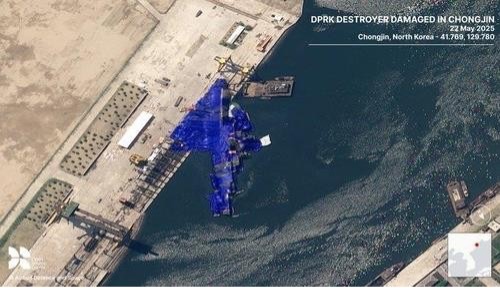
Maxar Technologies via New York Times
South Korea’s military said the North appears to have failed in using a side launching technique and the destroyer remains partially capsized in the sea. Today, the North said it has launched an investigation into the accident, while noting that the extent of the damage to the warship is “not serious.” (Chae Yun-hwan, “Satellite Photo Shows N. Korea’s New Warship Capsized at Shipyard,” Yonhap, May 23, 2025) Experts say a technique used to maneuver the ship into the water sideways was part of the problem. It was the first time that analysts had observed North Korea using the sideways launch for warships and pointed to a lack of experience, as well as political pressure from Kim for quick results, for the mishap. Three shipyard officials, including the chief shipyard engineer, and a senior munitions official have been arrested, the official Korean Central News Agency reported, after Kim called the capsizing a criminal act. Satellite imagery from three days before the accident showed the 470-foot-long vessel, the biggest class of warships Pyongyang has ever built, on top of a launch ramp. The ill-fated warship was assessed by analysts to be the same size and configuration as the Choe Hyon guided missile destroyer, the North’s first destroyer and the most powerful surface ship the country has ever built. That vessel is the pride of Kim’s ambitious plan to modernize and expand his Soviet-era naval fleet, and was the centerpiece of a grand christening ceremony last month in Nampo, a west coast port near Pyongyang. About 40 meters from the ship, a structure that appeared to be a viewing area and likely where Kim was stationed during the incident, was under construction. The destroyer was assembled in Chongjin, a port city on North Korea’s northeastern coast, which is known for producing smaller vessels, such as cargo ships and fishing boats. In a report published by the Center for Strategic and International Studies, a research institute in Washington, analysts said the shipyard “undoubtedly” lacked expertise in manufacturing and launching large warships. State media footage showed an elaborate event with confetti and fireworks that was attended by Kim and his daughter, Kim Ju-ae. A large viewing platform was set up near the Choe Hyun, which was already afloat in the water. That launch went smoothly, according to state media. Engineers used a technique common for large and heavy vessels. They appear to have built the Choe Hyun inside a roofed construction hall in Nampo, brought it out on a floating dry dock and then set it afloat by letting water into the dry dock, said Choi Il, a retired South Korean Navy captain. But the shipyard in Chongjin didn’t have a dry dock large enough to build a Choe Hyun-class destroyer nor an incline to slide the ship stern first into the water. Engineers built the ship on the quay under a netting. When it was completed, they had to launch it sideways off the platform. (Choe Sang-Hun and Jiawei Wang, “How North Korea Botched the Launch of a Warship,” New York Times, May 27, 2025)
5/22/25:
North Korea fired multiple cruise missiles toward the East Sea today, South Korea’s military said, a day after a “serious” accident occurred during Pyongyang’s launch of a new warship. The Joint Chiefs of Staff (JCS) said it detected the North’s missile launches at about 9 a.m. from the Sondok area in South Hamgyong Province, without providing further details, such as the number of missiles fired. It marked the North’s latest major missile launch this month after it fired multiple short-range ballistic missiles into the East Sea on May 8. (Chae Yun-hwan, “N. Korea Fires Multiple Cruise Missiles after Failed Warship Launch,” Yonhap, May 22, 2025)
The U.S. Air Force conducted a routine launch of an unarmed intercontinental ballistic missile (ICBM) that is capable of carrying a nuclear warhead this morning, the military said. The LGM-30G Minuteman III missile was launched from Vandenberg Space Force Base in California at 12:01 a.m. Pacific Time, the Air Force said. The unarmed missile, equipped with a single Mark-21 High Fidelity Re-Entry Vehicle, traveled 15,000 mph to a test range near the Kwajalein Atoll in the Marshall Islands, located about 4,200 miles from the launch site, the military said. The Air Force said the test was routine and “not a response to current world events,” adding that more than 300 similar tests have been conducted in the past. “This test launch is part of routine and periodic activities designed to demonstrate that the United States’ nuclear deterrent remains safe, secure, reliable and effective in deterring 21st-century threats and reassuring our allies,” the Air Force said. (Stephen Sorace, “U.S. Tests Launch of Nuclear Capable ICBM Minuteman III in Show of Force,” Fox News, May 22, 2025)
The United States’ reported consideration of a U.S. Forces Korea (USFK) troop drawdown is raising eyebrows in South Korea as the reduction, if realized, could affect deterrence against a muscle-flexing North Korea and be construed as a sign of a diminished security commitment to South Korea. President Donald Trump’s administration is weighing the idea of pulling out roughly 4,500 troops, part of the 28,500-strong USFK, and move them to other locations in the Indo-Pacific, including Guam, The Wall Street Journal reported Thursday, citing unnamed defense officials. The move comes as the Pentagon is looking to rebalance and reapportion its military assets in the region to optimize deterrence against its geopolitical rival, China, amid Trump’s belief that South Korea, a “wealthy” ally, is not “reimbursing” the United States sufficiently for America’s “big-time” military protection of it. The issue is expected to figure prominently as a key alliance topic for the next Seoul government that will be launched following the June 3 presidential election, an event triggered by the ouster of former conservative President Yoon Suk Yeol. The idea of withdrawing around 16 percent of the USFK troops dovetails with the Trump administration’s pursuit of a reported approach whereby it prioritizes defending its homeland and bolstering deterrence against China’s potential invasion of Taiwan, while tasking regional allies to handle North Korea, Russia and other potential adversaries. For some observers, the reduction option did not come as a big surprise as Trump’s earlier remarks on the USFK presence have raised that possibility, with his drive for the “America First” agenda fueling speculation over a potential scaling back of America’s costly overseas military involvement. In April last year, U.S. magazine Time reported that Trump had suggested that the U.S. could pull out its troops in South Korea if the Asian ally does not pay more to support U.S. troops to deter threats from the “increasingly belligerent” North Korean regime. He noted U.S. troops in Korea are in a “precarious” position. He has repeatedly revealed his perception that South Korea’s sharing of the cost for stationing the USFK is not enough. “We pay for military over in Europe. We don’t get reimbursed by much … South Korea too,” Trump told reporters at the White House in April, responding to a question about whether he has any plans to reduce the number of American troops in Europe. During a campaign period in October, Trump dubbed South Korea a “money machine” and said that if he had been in the White House, South Korea would be paying US$10 billion a year for the upkeep of USFK. Under a deal struck last year, Seoul is to pay 1.52 trillion won ($1.1 billion) next year, up from 1.4 trillion won this year. For policymakers and other observers in Seoul, the reduction idea struck a worrisome note as it could be a foretaste of a brewing shift in the alliance that is being driven by Washington’s growing emphasis on countering Chinese threats. In particular, the drawdown review called into question the prevailing idea that the U.S. government might not be able to unilaterally push for a troop cut due to the National Defense Authorization Act (NDAA) that calls for the maintenance of the current USFK troop strength. “There have been no discussions at all between South Korea and the U.S. about the USFK troop withdrawal,” Seoul’s defense ministry said. “The USFK, a core force of the South Korea-U.S. alliance, has contributed to peace and stability on the Korean Peninsula and in the region by working together with our military to maintain a robust combined defense posture and by deterring North Korea’s aggression and provocations,” it added. Secretary of Defense Pete Hegseth has recently tasked Under Secretary of Defense for Policy Elbridge Colby to craft the 2025 National Defense Strategy (NDS) under a directive to prioritize deterring Chinese threats and raising burden sharing with allies. He directed that a final NDS draft be provided to him no later than Aug. 31. The ongoing NDS work has raised the prospect of the U.S. seeking greater “strategic flexibility” of USFK forces to undertake expeditionary operations outside the Korean Peninsula in what could be a move signaling a shift in the USFK mission, role and force makeup. During an interview with Yonhap News Agency in May, Colby advocated for a USFK overhaul to have it focus more on handling Chinese threats rather than “being held hostage” to dealing with the North Korean security quandary. Bruce Bennett warned that the troop reduction, if realized, could send an undesirable signal to both South and North Korea. “I do think that this is not a great signal to be sending. It’s saying that we perceive that Korea is not all that important,” he said. “Where can you put forces other than Korea that are as close as you can get to China? Having forces in Korea is ideal not just for dealing with North Korea but for dealing with China. To pull them out of Korea is really a bad idea from an overall U.S. perspective,” he added. North Korea may view the potential reduction as a sign of “friction” in the alliance, Bennett pointed out. “I think North Korea is potentially going to feel after the (presidential) election that there are various ways that it could undermine the alliance and start to increase its provocations in order to move in that direction,” he said. The scholar also warned the U.S. government against considering pulling out key U.S. assets, such as Air Force assets, the air and missile defense element, and logistics, from Korea, as he highlighted their critical utility in the event of China-related contingencies. “These are three critical things that would really be unwise to reduce,” he said. During a Senate hearing last month, U.S. Indo-Pacific Command Commander Adm. Samuel Paparo Jr. and USFK Commander Gen. Xavier Brunson presented negative views about the idea of a USFK troop drawdown. Paparo warned the withdrawal or reduction of American troops from Korea would raise a “higher” likelihood of a North Korean invasion, while Brunson stressed that a troop reduction would be “problematic.” “With the loss of the force on the Korean Peninsula, there’s a higher probability that (North Korea) would invade,” Paparo said. Brunson affirmed the importance of maintaining USFK troops. “What we do provide there is the potential to impose costs in the East Sea to Russia, the potential to impose costs in the West Sea to China, and to continue to deter against North Korea, as it currently stands,” Brunson said. “I’m trying to focus right now on the capabilities necessary to do all those things that we might participate routinely in the campaign … which is to prepare, deter and then prevail in conflict should it come. But the forces in Korea play an important role. In over 75 years, they’ve done the same.” In 2004, Seoul and Washington agreed to curtail the USFK troop number from the then 35,000 down to 25,000 under a U.S. strategy for “strategic mobility,” a concept that took on greater importance as the U.S. was coping with threats from terrorists and non-state actors whose locations were difficult to identify. But during a summit in 2008, the allies agreed to keep the troop number at the current USFK level of 28,500. (Song-Sang-ho, “USFK Drawdown Idea Deepens Security Concerns in S. Korea over N.K. Threats,” Yonhap, May 23, 2025)
5/24/25:
This month, South Korea and the U.S. staged their latest joint naval drills. Destroyers and patrol aircraft rehearsed responses to potential incursions by North Korean drones and special forces across the maritime border. “With the overwhelming power of the South Korea-US combined fleet, we will strongly retaliate against any enemy provocation,” South Korean navy commander Ryu Yoon-sang declared. But behind the expressions of common resolve, experts describe a series of possible crises brewing in US-South Korea relations. Despite an alliance that goes back decades, the two countries are threatening to diverge on questions of trade, regional security and the growing North Korean nuclear threat. When President Donald Trump announced a 25 per cent “reciprocal” tariff on Korean imports, South Korean officials were shocked. They had believed a long-standing free trade agreement under which South Korea in effect does not levy tariffs on American goods would set them apart. Policymakers in Seoul also worry that America’s fixation on the rise of China will lead it to neglect deterrence efforts against Pyongyang, while also pressuring South Korea into a more confrontational stance towards Beijing. While many of these fears reflect long-standing tensions, they have been exacerbated by the return to power of Trump, whose repeated declarations of admiration for North Korean dictator Kim Jong Un stand in contrast with his often-contemptuous attitude towards the South. During his first term, Trump threatened to pull out of the Korea-US (Korus) free trade agreement that came into force in 2012, and to withdraw US troops from the Korean peninsula in a dispute over cost-sharing. The fact that South Korea has a record trade sur-plus with the U.S. has only added fuel to the fire. Since returning to office in January this year, Trump has declared his intention to reopen negotiations with Kim, fueling South Korean fears of a deal between Washington and Pyongyang over Seoul’s head that could leave it even more vulnerable to North Korean nuclear blackmail. And South Korean anxieties have been compounded by economic weakness and political instability at home. Even before then-president Yoon Suk Yeol’s ill-fated declaration of martial law in December, growth in Asia’s fourth-largest economy was slowing amid persistently weak domestic demand and intensifying competition from China. Seoul’s ability to respond has been undercut by the prolonged political crisis that followed the martial law debacle. Yoon was removed from office by South Korea’s constitutional court in April, and this month both acting president Han Duck-soo and finance minister Choi Sang-mok resigned within hours of each other. That has left the country in the hands of a weak caretaker administration led by the education minister until fresh presidential elections are held next week. The frontrunner, leftwing opposition leader Lee Jae Myung, has in the past described the U.S. as an “occupying force”, and more recently advocated for South Korea to take a more conciliatory line with China. Whether Lee or his conservative challenger Kim Moon-soo prevail, sensitive discussions that have been put on hold cannot be postponed for much longer. The results could have ramifications for economic and security relationships across east Asia. “The alliance is in a state of quiet crisis that few people have noticed,” says Victor Cha, Korea chair at the Center for Strategic International Studies (CSIS) think-tank in Washington and a former White House official. “But … the crisis is unlikely to remain ‘quiet’ for long.” At first, South Korean officials were confident they would be spared the worst of the US president’s aggressive trade policies, diplomats recall. In addition to their long-standing security relationship and the trade agreement, Korean companies including chipmaker Samsung and auto giant Hyundai are investing tens of billions of dollars in manufacturing facilities in the U.S. But that illusion was shattered in March, when Trump singled South Korea out for censure during his State of the Union address. Claiming falsely that the east Asian country imposes tariffs “four times higher” on the U.S. than vice versa — because of the free trade agreement, the correct number is in effect zero on both sides — the US president suggested that Seoul was benefiting unfairly. “We give so much help militarily and in so many other ways to South Korea,” Trump said. “This system is not fair to the United States and never was.” Since then, Korean exporters have been hit by Trump’s tariffs on steel and autos, and are bracing themselves for levies that target chips, smartphones and pharmaceuticals. Trump’s “reciprocal” tariff rate of 25 per cent is only suspended until July. “Korean officials were extremely disappointed and dismayed by the fact that they were assigned such a high tariff rate,” says Wendy Cutler, a former US trade official who helped negotiate the Korus pact and is now vice-president of the Asia Society Policy Institute thinktank. “That said, they’re pragmatic.” Korean efforts to resolve tensions have been hampered, however, by prolonged political turmoil at home. According to people familiar with the continuing talks between US and Korean officials, last month then acting president Han made a push for a quick deal that he could present to the South Korean electorate before standing in the election himself. Trump administration officials also wanted a speedy agreement, which they could present as evidence that their approach was yielding quick results. But those hopes were dashed after it became clear that Han did not have the political authority to deliver a deal that would have bound the hands of his elected successor. When he and Choi both resigned, the prospect seemed dead. Even if talks resume as expected soon after the election, observers note that they could yet prove contentious. Potential outcomes include South Korea securing some degree of tariff relief by demonstrating willingness to reduce its trade surplus, including by buying more US liquefied natural gas. The two countries also hope to secure an arrangement for Korean shipbuilders to build US Navy vessels, and Seoul has signaled willingness to address US concerns over Korean non-tariff barriers. But people with knowledge of the talks privately acknowledge the proposals under discussion are unlikely to make a significant short-term dent in South Korea’s trade surplus in goods with the US, which is now $55bn. “We have known for some time that economic over-dependence on China was a risk,” says a former senior Korean government official. “But now we know that over-dependence on the US is a risk for us too.” For many South Koreans, the potential for trade tensions to spill over into the defense alliance with the US is even more concerning. “Our economic relations are a matter of richer or poorer, but our security relations are a matter of life or death,” says Yeo Hankoo, a former South Korean trade minister now at the Peterson Institute for International Economics think-tank in Washington. Trump has publicly linked the two, writing in a social media post last month that he had discussed “payment for the big time Military Protection we provide to South Korea” in a call with Han. “We are bringing up other subjects that are not covered by Trade and Tariffs, and getting them negotiated also. ‘ONE STOP SHOPPING’ is a beautiful and efficient process!!!” Trump wrote. While Trump is expected to demand that Seoul make a larger financial contribution to the presence of the 28,500 US troops stationed on the peninsula — it will pay 1.52tn won ($1.19bn) in 2026, up 8.3 per cent from 1.4tn won in 2025 — more concerning for many analysts is what appears to be a growing divergence of views on the purpose of their defense relationship. Clint Work, a fellow at the US National Defense University, a research institution affiliated with the Pentagon, notes that whereas South Korea has historically insisted the alliance be focused on the threat from North Korea, the US increasingly views this as secondary to the risk of a Chinese invasion of Taiwan. Elbridge Colby, now a senior official in charge of overseeing policy development at the Pentagon, told South Korean media in May last year that “South Korea is going to have to take primary, essentially overwhelming responsibility for its own self-defense against North Korea.” That may result in Washington intensifying pressure on Seoul to consent to US troops being redeployed or rotated elsewhere in the region as Washington sees fit. “South Korea has two great fears: either that it will be abandoned by the US to face North Korea alone, or that the US will rope it into a war with China,” says Work. Speaking on condition of anonymity, a US official in Korea says that the policy now being pursued within the Pentagon is “100 per cent” in line with Colby’s previous remarks. They add that the outcome of talks, including those on cost sharing, would determine whether American troop numbers go up or down — noting that maintaining the status quo was the “least likely option.” While this will probably prove uncomfortable for whoever wins next week’s presidential election, analysts say tensions could be particularly acute in the event of a victory for leftwing frontrunner Lee, who insists that South Korea has no direct interest in the out-come of a conflict involving Taiwan. “We must keep our distance from a China-Taiwan contingency, if such a crisis should occur,” Lee said during a television debate this month. Work says a Lee administration could find common cause with the Trump administration if a modest reduction of US troops in South Korea were presented as Seoul assuming more responsibility for its own defense — something that has been a goal of successive leftwing governments. But that would probably provoke a backlash from Korean conservatives. And members of both the US and South Korean military establishments remain doubtful about South Korean armed forces’ readiness, says Work. “This has contributed to a sense that you can push back hard against the Americans, because they’ll never actually leave,” he says. “But if all of a sudden you realize that the Americans really are prepared to leave, that could have a very sobering effect.” If Trump showing less interest in deterring North Korea militarily creates a dilemma for the South, the prospect of him re-engaging with Pyongyang diplomatically could prove even more frightening. During his first term, Trump became the first sitting US president to meet a North Korean leader, although talks between the two sides eventually collapsed in 2019. Since then, North Korea’s nuclear weapons program has gone from strength to strength. Kim has also been emboldened by his blossoming relationship with Russian President Vladimir Putin since Moscow’s full-scale invasion of Ukraine in 2022 — North Korean troops were sent to fight Ukrainian forces — and by Russia and China’s waning commitment to enforcing UN sanctions against Pyongyang. “North Korea is significantly more capable, has more nuclear warheads and can threaten the US and its allies in more credible ways than it was positioned to do when Trump first took office in 2017,” says Ankit Panda, a nuclear weapons expert at the Carnegie Endowment for International Peace think-tank in Washington. South Korea does not possess nuclear weapons. Panda is among a number of defense experts who argue that rather than continuing to insist on the North’s denuclearization, Washington and Seoul should instead pursue a more realistic objective — agreeing arms control and other risk-reduction measures with Pyongyang. Such an approach is regarded as anathema by South Korean officials, who worry this would tacitly accept North Korea’s right to possess nuclear weapons. The Trump administration is reviewing its North Korea policy. But while official statements have so far restated the US commitment to denuclearization, Trump and officials including defense secretary Pete Hegseth have also referred to the North on several occasions as a “nuclear power” — a phrase that sounds alarm bells in Seoul. In March, Trump claimed that his administration was already in “communication” with Pyongyang, describing the North as a “big nuclear nation”, and Kim as a “very smart guy.” Jenny Town, a senior fellow at the Stimson Center think-tank in Washington, says that “one of South Korea’s nightmare scenarios” would be Trump cutting a deal with Kim that involves North Korea halting or scrapping its intercontinental ballistic missile pro-gram, but retaining its shorter-range missiles and the ability to produce nuclear warheads. Such an outcome would reduce or eliminate Pyongyang’s capacity to threaten the US, while allowing it to continue or intensify its nuclear threats against the South. “South Korea worries that Washington and Pyongyang will cut them out of the process altogether,” says Town. “They have good reason to be concerned, given that Trump and Kim both seem much less interested in consulting them than last time round,” says Town. Cha of CSIS adds that, if this were to happen, growing demands within South Korea for the country to acquire its own nuclear weapons may prove unstoppable — a scenario that would spark a wider security crisis through Asia and beyond. “It’s not even going to be a debate,” he says. (Christian Davies, “South Korea under Pressure,” Financial Times, May 27, 2025, p. 13)
KCNA: “The Institute for American Studies of the DPRK Foreign Ministry today released a memorandum to inform the international community that the U.S. establishment of a new missile defense system is a very dangerous “threatening initiative” aimed at threatening the strategic security of the nuclear weapons states regarded by the U.S. with hostility and facilitating the use of the offensive military muscle of the U.S. forces. According to the memorandum, the U.S. plan for the “Golden Dome” missile defense system setting it as a goal to closely defend the Continent of North America from the ballistic missile, cruise missile and supersonic missile attack by its strategic enemy states is a typical product of “America first”, the height of self-righteousness, arrogance, high-handed and arbitrary practice, and is an outer space nuclear war scenario supporting the U.S. strategy for unipolar domination with the preemptive establishment of the outer space-based military substructure, not a “defensive measure” to cope with the “threat” from someone. The memorandum disclosed the U.S. offensive weapon system aimed at the preemptive strike at sovereign states. The U.S., which defined outer space as a battlefield in future in its early years, has been hell-bent on the moves to militarize outer space, claiming that those who dominate outer space can win victory in the future war. The plan for “Golden Dome” being advocated by the present U.S. administration is also the expression of another attempt to militarize outer space coming from the past strategies for dominating outer space and the epitome revealing the criminal past of the U.S. which plunged the whole world into the nightmare of the outbreak of a nuclear war. Down through history, the U.S. has justified its moves for space militarization, claiming that the perfect interception of nuclear missiles by its enemy states flying toward its mainland can be realized only by the introduction of the space-based interception system. Under the pretext of defending its mainland, it has been hell-bent on building a missile defense system targeting the independent sovereign states including the DPRK. Clear is the reason why the U.S. is scheming to freeze the so-called “threat” from sovereign states as a pretext for modernizing its missile defense system, persistently spinning out the time-worn sophism just like a guilty party filing the suit first. It is to preemptively attain military superiority in an all-round way by justifying its hegemony-oriented moves for space arms buildup and accelerating outer space militarization behind the screen of “mainland defense” and to launch the military strike at its enemy states at its will by relying on it. This is the military strategic goal pursued by the U.S. and the main goal of the “Golden Dome” project being prioritized by the present U.S. administration. The memorandum pointed out the malignant factor that has heated the strategic arms race worldwide and accelerated the potential danger of outer space war. The U.S. plan for building a new missile defense system is the root cause of sparking off global nuclear and space arms race by stimulating the security concerns of nuclear weapons states and turning the outer space into a potential nuclear war field. Shortly ago, a U.S. space company announced that the U.S. Space Force is planning the design of a kind of orbit transporter called “space aircraft carrier” and will invest 60 million U.S. dollars in it. The reality in which the global concern about the fact that the advent of the “space aircraft carrier” will be a catalyst for aggravating military confrontation in outer space is growing is a typical example proving a catastrophic consequence to be entailed by the U.S. moves to militarize outer space. Another example of the U.S. moves to militarize outer space is the development of the “X-37B” unmanned spacecraft being accelerated by the U.S. Space Force. It is not fortuitous that many space experts appreciate that the threat posed by the “X-37B” to the world is no less than nuke as the advent of the “X-37B” is an unpleasant factor reminiscent of the realistic possibility of space warfare that has been considered by mankind as imagination. The memorandum disclosed the U.S. military hazardous attempt of betting the security of its satellites. Since 2016, the U.S. has staged all sorts of missile interception drills including missile warning drill, combined ballistic missile defense drill and naval missile defense drill by mobilizing Aegis destroyers and latest drones together with Japan and the ROK. The U.S. set up a space force unit in the ROK in December 2022. It inaugurated the U.S. space force in Japan at the Yokoda U.S. Air Force Base in December 2024, and formally operated the real-time tripartite missile information sharing system among the U.S., Japan and ROK targeting the DPRK’s missile launch in December 2023. Clear is the aim sought by the U.S. in its persistent attempt to build an integrated missile defense system with Japan and the ROK. Lurking behind it is an attempt to further intensify their military subjugation to the U.S. through the establishment of the integrated missile defense system with its satellite countries and to use the forces of its satellites for the military operations of the U.S. forces in case offensive actions against regional countries are launched. The above-said facts prove that the U.S. moves to build the integrated missile defense system are the dangerous military gambling prompted by the ignorant and selfish intention of the suzerain state to use its satellites as the cannon fodder and bullet shield for realizing its interests even by betting the security of its satellites. The memorandum pointed out the means of offering profits to ensure the constant boom of the U.S. munitions monopolies. Today, the U.S. armaments spent in the space field are three times the cost of civil space development, which corresponds to 95 percent of the space-related expenditure of all countries of the world. The present U.S. administration claims that the establishment of the “Golden Dome” missile defense system will cost only 175 billion U.S. dollars, but the recent announcement of the U.S. Congressional Budget Office that the cost of building the space-based interceptor missile system will amount to 542 billion U.S. dollars to maximum suggests that the plan for “Golden Dome” is the largest arms buildup plan in history. The global security environment, which is becoming uncertain due to the U.S. undisguised moves for space militarization, proves that the security of the state and the region can be reliably guaranteed only by the symmetry of the matchless power capable of firmly bringing not only the current challenges but also the coming challenges under its control, the memorandum stressed.” (KCNA, “Memorandum Issued by Institute for American Studies of DPRK Foreign Ministry,” May 27, 2025)
5/26/25:
Korea’s presidential candidates stooped to coarse language and mudslinging in the third and final televised debate today. Meanwhile, they failed to engage in a substantive discussion about the serious predicaments facing Korea in the areas of diplomatic and national security, which were the nominal topic of the debate. The one topic that was debated at any length was Korea’s putative nuclear armament. Democratic Party presidential candidate Lee Jae Myung and People Power Party (PPP) candidate Kim Moon-soo traded barbs about whether such a move is feasible under the ROK-US alliance. When Lee asked Kim the simple question of whether he holds that Korea ought to acquire nuclear weapons, Kim answered evasively. “Rather than nuclear armament, I think we need to achieve nuclear balance. We need to do that prudently, in a way that preserves the ROK-US alliance,” he said. When Lee asked for a more definitive response (“Shouldn’t you be clearer about whether you’re arguing for or against nuclear armament?”), Kim provided the following clarification: “The ROK-US alliance is our central pillar. If it were possible to acquire nuclear weapons within the bounds of that alliance, we ought to do that. Nuclear armament would be pointless if it meant the end of the ROK-US alliance.” Given those statements, would South Korea’s nuclear armament actually be compatible with the ROK-US alliance? The view shared by multiple experts is that Korea can’t have it both ways because the extended deterrence, or “nuclear umbrella,” that the U.S. provides Korea through the alliance is predicated on Korea renouncing nuclear weapons. “The U.S. regards South Korea’s nuclear armament to be an element of instability in Northeast Asian affairs and a method for gaining autonomy from American influence,” said Jun Bong-geun, professor emeritus at the Korea National Diplomatic Academy and president of the Korea Nuclear Policy Society, during an interview with the Hankyoreh on April 1. Along with being an American ally, Korea is an open trading nation that’s vulnerable to foreign sanctions — which Jun described as the “worst possible conditions for nuclear armament.” According to the explanation that Jun provided, the U.S. set up the international non-proliferation regime, which is encapsulated in the Treaty on the Non-Proliferation of Nuclear Weapons, to prevent nuclear weapons from spreading further after China’s successful nuclear test in 1964. After the treaty took effect in 1970, the US assumed it had limited the nuclear club to five countries — itself, the Soviet Union, the UK, France and China. But in 1974, India carried out a successful nuclear test using peaceful nuclear technology and facilities acquired from Canada. Following that shocking development, the U.S. began to strictly curtail the sharing of uranium enrichment and plutonium reprocessing technologies. Just about the only countries that have braved US sanctions to acquire such technologies in subsequent years are Pakistan, North Korea and Iran. Since then, not a single American friend or ally has acquired those technologies. Nuclear non-proliferation is a cornerstone of US foreign policy. The harsh reality is that nuclear armament is not a viable option unless South Korea is prepared to endure sanctions that would strangle its exports and make it an international pariah like North Korea. Some national security experts do say Korea may be forced to arm itself with nuclear weapons if the U.S. pulls troops out of Korea or reneges on its security commitments. But even in such a case, the louder Koreans demand the bomb, the less chance there is of actually getting it. Nonetheless, former President Yoon Suk-yeol and other politicians associated with the People Power Party exploited public anxiety sparked by North Korea’s rapid advancements of its nuclear capabilities to advocate for South Korea to go nuclear. Yoon first suggested that South Korea could build its own nuclear arsenal in January 2023, only to walk back his statement with the Washington Declaration, issued after the South Korea-US summit in Washington in April of that year. The declaration stated, “President Yoon reaffirmed the ROK’s longstanding commitment to its obligations under the Nuclear Nonproliferation Treaty as the cornerstone of the global nonproliferation regime as well as to the US-ROK agreement for Cooperation Concerning Peaceful Uses of Nuclear Energy.” The declaration served as a promise by Yoon to the US and the international community that South Korea would not go nuclear, but some figures within the PPP continued to float the possibility of pursuing nukes. PPP lawmakers held public seminars at the National Assembly regarding nuclear armament and nuclear latency, and at one point even circulated a petition to get 10 million signatures in support of pursuing nuclear weapons. Such behavior did nothing to improve South Korea’s national security — if anything, it endangered both security and South Korea’s development of scientific technology by triggering the US Department of Energy to classify South Korea as a “sensitive country,” subjecting to more stringent considerations when it comes to exchange cooperation on advanced technology. Kim, who has been a vocal advocate for nuclear armament, took a more ambivalent stance during this debate, saying, “If it were possible to acquire nuclear weapons within the bounds of that alliance, we ought to do that.” Because South Korea needs US approval or support to possess its own nuclear weapons, “nuclear latency” became the next best option. Kim maintains that Korea should have the technical capabilities and resources, such as nuclear enrichment and reprocessing, to rapidly arm itself in the event of an emergency. The first candidate to propose pursuing nuclear latency in this debate was Kim. While butting heads with Lee Jae Myung, Kim said, “As plutonium reprocessing and uranium enrichment are restricted by the US-ROK [123 Agreement], when it comes to nuclear latency, I will meet with US President Donald Trump to ensure that we acquire reprocessing capabilities on par with Japan.”
In response, Lee said, “If I may correct you, the process does not involve reprocessing plutonium. The nuclear fuel that has been spent becomes reprocessed to extract plutonium.” “Some argue that the US classified South Korea as a sensitive country due to suspicions regarding [intentions to pursue] nuclear arms, so loudly advocating for nuclear latency will only further fuel suspicions on the part of the US,” Lee went on. “Going back and forth on the issues of nuclear armament and nuclear latency is not a good use of time. We should focus on more practical issues.” If Korea wants to realize its nuclear potential, it will require amending the 123 Agreement with the US. Specifically, changes will need to be made to allow the free reprocessing of spent nuclear fuel and full enrichment of uranium to below and above 20 percent. If South Korea, unable to achieve its dream of nuclear arms, openly parades its intentions to pursue nuclear latency as the next best option, it is highly unlikely that the US will say yes to requests to amend the nuclear agreement between the two countries. Last but not least, the presidential candidates debated nuclear sharing and the redeployment of tactical nuclear weapons in Korea. Lee Jae Myung asked Kim, “Did your campaign pledges not include nuclear sharing with the US and the redeployment of tactical nuclear weapons? To my knowledge, the US stands by the principle of not sharing its nukes. How is this feasible?” Kim responded, “It is feasible. NATO has nuclear sharing arrangements, and we could negotiate to come up with our own nuclear sharing arrangement between South Korea and the US. After sufficient discussions through summits with the US, we will be able to pursue nuclear submarines, too.” The NATO nuclear sharing arrangements mentioned by Kim involve NATO allies providing nuclear weapons deployment facilities to the U.S. and being responsible for the delivery of a number of its weapons. The US currently deploys and operates tactical nuclear weapons in five NATO member states: Germany, Belgium, the Netherlands, Italy and Türkiye. The U.S. and NATO hold regular consultations regarding nuclear weapons through the Nuclear Planning Group and remain responsible for the safety, security and control of nuclear arms. However, even if NATO member states launch nuclear weapons from their own fighter jets, the decision to use those weapons is still made by the US president. NATO member states and the US do not share the right to own or use nuclear weapons through these arrangements but merely share the political burden and operational risks of using such weapons. The nuclear submarine mentioned by Kim may be an issue worth discussing for the next administration if the situation on the Korean Peninsula escalates. A nuclear submarine actually refers to a submarine that uses nuclear propulsion rather than a diesel engine, not necessarily a submarine that is capable of launching a nuclear weapon. This means it wouldn’t violate the Non-Proliferation Treaty if South Korea were to come into possession of a nuclear submarine. Korea pursued a project to build a nuclear submarine during the administration of Roh Moo-hyun, and the idea picked up momentum once more after Moon Jae-in spoke about the necessity of acquiring such a submarine in the lead-up to the 2017 presidential election. But the project ran aground after the Yoon administration cut all related funding. (Park Min-hee, “Can South Korea Have Nukes and the U.S. Alliance Too?” Hankyoreh, May 29, 2025)
5/28/25:
A South Korean soldier stationed at a front-line unit near the inter-Korean border accidentally fired a machine gun toward North Korea earlier this week, prompting the military to air broadcasts to notify the North of the incident, the military said. The soldier mistakenly fired a single round from the K6 heavy machine gun from a general outpost unit in Yangju, some 25 kilometers north of Seoul, at around 5 p.m. today, according to the military. “The respective unit immediately conducted a broadcast to the North to notify of the incident and no unusual movements by the North Korean military have been detected so far,” Yang Seung-kwan, spokesperson for the Joint Chiefs of Staff (JCS), told a regular press briefing May 29. Today’s incident occurred just about a month after a South Korean soldier accidentally fired a single round from the K6 from a guard post inside the Demilitarized Zone separating the two Koreas in Cheorwon County, about 70 kilometers north of the capital. Yang, the JCS official, said the military has launched an investigation into the case and will review measures to prevent similar accidents. (Lee Minji, “S. Korean Soldier Misfires Machine Gun toward Inter-Korean Border,” Yonhap, May 29, 2025)
KCNA: “Talks between Ri Song Chol, vice-minister of Public Security of the DPRK, and Vitaly Shulika, vice-minister of Interior of Russia, who is leading the visiting delegation of the ministry, were held here on May 28. Present at the talks from the DPRK side were officials of the Ministry of Public Security and from the opposite side members of the delegation and members of the Russian embassy here. The talks discussed the issues for expanding the exchange and cooperation between the security bodies of the two countries. The talks proceeded in a comradely and friendly atmosphere.” (KCNA, “Talks between Vice-Minister of Public Security of DPRK and Vice-Minister of Interior of Russian Federation Held,” May 29, 2025)
5/29/25:
KCNA: “A firing contest among artillery sub-units of large combined units of the Korean People’s Army was conducted on May 29 amid the intensive combat training for implementing the line of the Workers’ Party of Korea on building a powerful army in the new era, which is aimed at attaining the strongest military capability, being organized and enforced in the entire army. Kim Jong Un, general secretary of the Workers’ Party of Korea and president of the State Affairs of the Democratic People’s Republic of Korea, oversaw the artillery firing contest. The respected Comrade Kim Jong Un was accompanied by Pak Jong Chon, secretary of the Central Committee of the WPK and vice-chairman of the Central Military Commission of the WPK. He was greeted on the spot by No Kwang Chol, minister of National Defense of the DPRK, Ri Yong Gil, chief of the General Staff of the KPA, Jong Kyong Thaek, director of the General Political Bureau of the KPA, and other commanding officers of the Ministry of National Defense and military and political commanding officers of large combined units of the KPA. The commanders of the front-line large combined units commanded the firing. The artillery sub-units at all levels that participated in the contest fully demonstrated the skillful artillery firing techniques they have consolidated through intensive training true to the Party’s training-first policy. Kim Jong Un praised the artillery sub-units for demonstrating the perfect actual war capability of the artillery of the KPA, which is preparing itself in full combat readiness to be matchless combat ranks that can fight any time and surely win if they fight a war. He positively appreciated that a scientific combat training system has been thoroughly established in the entire army and qualitative changes are taking place in strengthening the war capability of the artillery in conformity with the developing aspects and changing trend of modern warfare. He said it is very important to frequently organize firing contests in a simulation of an actual warfare in training the artillerymen into all-round and a-match-for-a-hundred ones capable of directly hitting the target at any time and in any situation. He stressed once again that prioritizing and intensifying training are an expression of absolute loyalty to the Party, the revolution, the country and the people and making the highest degree of demand on training is the shortcut to building up a powerful army. He expressed expectation and belief that the units at all levels of the entire army would train all the service personnel into heroes in training and combat, possessed of strong spiritual strength, stubborn will, great ability and high qualifications for an actual war, by thoroughly applying the spirit of the seventh conference of the training officers in the military activities and thus firmly guarantee the comprehensive development of the DPRK by force of arms.” (KCNA, “Respected Comrade Kim Jong Un Oversees Firing Contest of Artillery Sub-units of Large Combined Units of KPA,” May 30, 2025)
Korean government’s foreign and security strategy, former foreign ministers said, should be adapting to a shifting, more inward-looking U.S — one demanding greater burden-sharing from its allies under President Trump’s “America First” doctrine — while keeping the alliance at the heart of its approach at this critical crossroads. Amid a wave of increasingly interconnected global crises, the former top diplomats also urged Seoul’s next leadership to move beyond the conventional US-centric approach and adopt a more holistic, big-picture foreign policy suited to the shifting global order. “What’s most important as Korea’s new government takes office is that we are facing not just one or two challenges, but a complex web of simultaneous crises. We all know that these issues are unfolding on multiple fronts at once,” former Foreign Minister Yun Byung-se, who served under the former conservative Park Geun-hye administration, said during Thursday’s session at the Jeju Forum held on the southern island of Jeju. “Therefore, the new administration should not approach strategy solely through the lens of relations with the US, but should instead adopt a broader, more comprehensive perspective,” Yun said during a session on South Korea’s diplomatic and security strategy ahead of the early presidential election on June 3. With no transition period before taking office, the new South Korean leadership will also need to quickly find its footing as it responds to growing US calls for greater responsibility in national and regional defense, as well as increased demands across the board within the bilateral alliance framework, Yun said. Yun also noted that, unlike in the past when North Korea’s provocations were the main concern for an incoming administration, this time will be different: “the new government will need to prioritize how quickly it can formulate its own position in response to US priorities.” “Ultimately, it comes down to two main points: the role of US Forces Korea and South Korea’s own regional role,” Yun explained. In Seoul, concerns are growing that the operational scope of US Forces Korea could extend beyond the Korean Peninsula and expand to regional defense, including being repurposed for a potential Taiwan contingency. “In 2003, some units from US Forces Korea were redeployed to Iraq. Now, if they are redeployed — not to Iraq, but to areas near Taiwan — that could present a whole new set of challenges, and it’s something we need to think about very carefully,” Yun said. “From what I see, neither (presidential election) camp is fully prepared to address this issue yet.” Both the classified “Interim National Defense Guidance,” as reported by The Washington Post, and Secretary of Defense Pete Hegseth’s statement on the development of the 2025 National Defense Strategy make clear that US forces will prioritize deterring China as the sole pacing threat. Another key point is that allies should shoulder more responsibility for defending against other regional threats — for South Korea, this means threats posed by North Korea. Former Foreign Minister Song Min-soon underscored that “Korea needs to transform its current alliance system — which is now overly dependent on the U.S. — into a more autonomous alliance, while still faithfully upholding the Korea-US alliance.” “This is something the US also wants,” Song said. “However, in Korea, there is a fear that moving toward a more self-reliant alliance could lead to isolation from the US, and how to overcome that fear is the challenge.” Song, who served in the former liberal Roh Moo-hyun administration, also called for the next South Korean government to “more actively explore ways to achieve a nuclear balance between the two Koreas,” instead of merely relying on US extended deterrence. Extended deterrence refers to Washington’s commitment to deter or respond to coercion and external attacks on its allies and partners with the full range of its military capabilities, including nuclear weapons. “However, it doesn’t necessarily mean that we need immediate nuclear armament,” Song continued. Former Foreign Minister Kim Sung-hwan, however, said the next government should pursue a policy toward the US to ensure that US extended deterrence is well maintained, opposing the idea of South Korea independently seeking a nuclear balance against North Korea. On The Diplomatic front, Kim emphasized that the key challenge is how to navigate between the Korea-US alliance and China amid the shifting global order. “From the perspective of our diplomatic and security interests, regardless of who becomes the next president, the most important point is what stance South Korea should take between the US, our ally, and China, given our geopolitical realities,” Kim said. “This remains our greatest diplomatic challenge.” But Kim also pointed out that the US is no longer willing to unilaterally provide public goods as it did in the past, as it needs to focus its limited capacity on addressing mounting domestic challenges. Kim, who served under former conservative President Lee Myung-bak, expressed his concerns over a potential return to what’s known as the “Kindleberger Trap,” highlighting this as a key factor for South Korea to consider in devising its foreign policy. The trap refers to the failure of the international system due to the under-provision of global public goods and the dangers inherent in a shifting balance of power. “Looking at the current global order, if the US stops providing public goods, who will take on that role? Is Europe economically strong enough to take on that responsibility?” Kim said. “These are the kinds of questions we need to seriously consider in the context of international affairs.” (Ja Da-gyum, “How Korea’s Next Leader Should Set Foreign Policy Compass,” Korea Herald, May 30, 2025)
Lee Jae Myung will take office as one of the most powerful leaders the country has chosen in recent decades. Besides the presidency, where most of the political power is concentrated, he will have the National Assembly on his side, as his Democratic Party has a large majority of the seats there.? Here is a glance at what Lee, who calls himself a “pragmatist,” has said on key issues: Lee represents a break from his impeached predecessor, Yoon Suk Yeol. Yoon was more confrontational toward North Korea and China, and he improved ties with Japan, a historic enemy, despite outcries in South Korea. He aligned Seoul more firmly with Washington as the strategic competition between the United States and China intensified. Lee said he would try to repair his country’s strained ties with China and North Korea while maintaining a strong military alliance with the United States, which he said should remain the bedrock of South Korean diplomacy. He has said Yoon was too “submissive” toward Japan and too “antagonistic” toward China. “Cooperation with the United States and Japan is essential,” Lee said. “But we should not put all our eggs in one basket.” Lee and his Democratic Party have long championed dialogue with Pyongyang as the best way to avoid conflict on the divided Korean Peninsula and defuse tensions over North Korea’s nuclear weapons capabilities. They have said they would recommend President Trump for a Nobel Peace Prize should he succeed in bringing peace in Korea through new negotiations with North Korea’s leader, Kim Jong-un. “It is important to win a war; it is even more important to win without a war. But the best of all is to make peace and make it unnecessary to fight,” Lee said. The Democratic Party does not want South Korea to be embroiled in the clash between the United States and China, including in a potential armed conflict over Taiwan. When his conservative rivals accused him of sitting on the fence, Lee said South Korea’s national interest was his guiding priority. “Why should it matter so much to us if China and Taiwan engage in conflict?” he said on the campaign trail. Lee said the second Trump administration was bringing “the law of the jungle” into the international order. Trump has demanded that South Korea pay more for keeping American troops on its soil. He has also placed steep tariffs on key South Korean exports like cars and steel. Lee said that fending off the relentless pressure from Trump was one of his most urgent diplomatic challenges. “I will crawl between his legs if necessary, and if that’s what I have to do for my people,” he said this week. “But I am not a pushover, either. South Korea also has quite a few cards to play in give-and-take negotiations.” The most urgent issue, “more urgent than domestic reform, is improving the economic condition of the people,” Lee said on the eve of the election. In the past, Lee’s critics had often called him “South Korea’s Bernie Sanders” because of his progressive proposals, such as a universal basic income for young people, when he was a provincial governor. During the presidential campaign, he said he would pass a parliamentary bill that would give subcontracted workers more rights to start collective bargaining and labor strikes. But Lee steered away from his party’s traditional election-time promises of wealth distribution and higher taxes on the rich. Instead, he tried to expand his appeal among voters in the middle by emphasizing economic growth. South Korea’s economic condition has become so dire that “we must give more priority to growth,” he said. “It doesn’t mean that I have given up on welfare and distribution.” During his campaign, Lee urged South Koreans to vote to “end the insurrection,” saying that Yoon’s short-lived imposition of martial law in December has placed South Korea at a “crossroads between a free republic and dictatorship.” While Lee has said that he would not seek revenge if elected, and that he would heal divisions, his opponents fear a sweeping purge. Lee has vowed to launch extensive investigations to “ferret out” and “punish” those in government, military and political circles who played key roles in conspiring to place South Korea under martial law for the first time in 45 years. Lee and his center-left Democratic Party are also widely expected to pass bills to tame the nation’s prosecution service. Yoon, a former prosecutor-general, had been accused of using his allies in the prosecution service to harass his enemies, including unfriendly journalists and politicians like Lee. Lee’s supporters want him to push special bills through the National Assembly to investigate wide-ranging allegations of corruption surrounding Yoon’s family. Young South Korean women played a prominent role in immense rallies that precipitated the parliamentary impeachment of Yoon and his removal from office, which made the election — and Lee’s expected presidency — possible. During the campaign, Lee said he would make South Korea safer and fairer for women by cracking down on sexual crimes and tackling the gender-income gap in his country, the widest among developed countries. But he shied away from addressing other urgent demands from women, such as anti-discrimination legislation. Lee was accused of avoiding those issues so as not to anger young male voters who regarded the women’s demands as “reverse discrimination” against men. Lee denied the accusation and said that he would create more job opportunities for all young South Koreans to reduce tensions between young men and women. (Choe Sang-hun, “Where the New President Stands on Trump and North Korea,” New York Times, June 4, 2025, p. A-10)
5/30/25:
North Korean leader Kim Jong-un has demoted the director of the military’s general political bureau in an apparent sweeping reshuffle of senior military officials following the recent warship accident. The decision came as North Korea held an enlarged meeting of the Central Military Commission of the ruling Workers’ Party of Korea (WPK) on Wednesday, presided over by the North’s leader, KCNA reported today. The commission “newly appointed six commanding officers of corps-level units, the director of the Artillery Bureau and the director of the Security Bureau and newly dispatched some political commissars,” KCNA said, without disclosing other details. Jong Kyong-thaek, director of the General Political Bureau of the Korean People’s Army (KPA), has been demoted to the rank of colonel general from general, Seoul’s unification ministry said, citing photos carried by the North’s state media. Photos related to a firing contest among military artillery units held yesterday showed Jong with the lower military rank’s insignia on his uniform, though he was referred to with the current title of the KPA’s director in state media reports. The director of the KPA’s general political bureau is in charge of ideological education and surveillance at the armed forces. The commission’s enlarged meeting, the first such gathering in August 2023, came after a new North Korean warship partly capsized during its launch on May 21, a serious accident that Kim witnessed and slammed as an intolerable “criminal act.” North Korea said the meeting discussed ways to more firmly establish the “steel-like discipline system” of the country’s armed forces organs and exercise “tight control and guidance” on the military. At the meeting, North Korea decided on “military measures to firmly maintain the strategic and tactical superiority” and approved a series of new projects in the defense science and industry sectors, without revealing other details. The North’s meeting appears to be intended to tighten the military’s discipline following the recent warship accident occurring during the launch in the northeastern port city of Chongjin. Kim ordered the restoration of the warship to be “completed unconditionally” before a plenary meeting of the WPK’s meeting set for June. As part of an investigation into the warship accident, North Korea has detained some officials, including the vice director of the party’s munitions industry department. (Kim Soo-yeon, “North Korea’s Kim Demotes Director of Military’s General Political Bureau,” Yonhap, May 30, 2025)
5/31/25:
If there was any doubt about Donald Trump’s top military priorities in the Indo-Pacific, his defense chief’s widely anticipated speech at this year’s Shangri-La Dialogue made things crystal clear: deterring China and having allies commit to higher spending and burden-sharing are at the top of his list. Warning on Saturday of an imminent and “real” threat by Beijing to alter the regional balance of power in Asia, particularly with an invasion of Taiwan, Defense Secretary Pete Hegseth called on Washington’s regional allies and partners to ramp up military budgets — possibly to as high as 5% of gross domestic product. “We cannot look away and we cannot ignore it. China’s behavior toward its neighbors and the world is a wake-up call and an urgent one,” Hegseth said before a packed house as defense chiefs, military brass and senior diplomats gathered in Singapore for Asia’s premier regional security conference. Pointing to “destabilizing actions” in areas such as the disputed South China Sea as well as Beijing’s potential to invade self-ruled Taiwan, Hegseth said in his first major public outline of the Pentagon’s Indo-Pacific policy that China’s People’s Liberation Army (PLA) is building the capabilities needed for an invasion. Beijing is “training for it every day and rehearsing for the real deal,” he warned, asserting that Chinese leader Xi Jinping “has ordered his military to be capable of invading Taiwan by 2027” — an intelligence-based assessment that is difficult to independently verify as there is no public record of Xi stating this. China, which did not send its defense minister, Adm. Dong Jun, to the conference, reacted swiftly, with the Foreign Ministry in Beijing accusing Washington of touting a “Cold War mentality for bloc confrontation.” Beijing also warned the Trump administration “not to play with fire,” referring to Taiwan, which it views as a breakaway province it aims to unite with the mainland, as “entirely China’s internal affair.” Today’s remarks by the U.S. defense secretary were closely scrutinized by regional defense chiefs, military leaders and senior diplomats skeptical of Washington’s commitment to the region. They came as Trump continues to run roughshod over long-held conventions between Washington and its allies and partners, threatening even close friends with onerous tariffs and labeling long-standing alliances as unfair. Meia Nouwens, an expert on Chinese defense policy at the International Institute for Strategic Studies, which is also the Shangri-La Dialogue’s co-organizer, called Hegseth’s speech “a clear statement of commitment to the region.” “This is the strongest speech we’ve heard so far from this administration that the Indo-Pacific remains the U.S.’s priority theater,” she told Japan Times. Still, she added, “Asian capitals will be looking to see if words match actions moving forward.” Meanwhile, Hegseth sought to link what he said was the threat China represents to U.S. demands that Asian allies and partners spend more on their own defense, calling on them to follow Europe’s example and commit to higher spending and burden-sharing. “NATO members are pledging to spend 5% of their GDP on defense, even Germany,” he said. “So it doesn’t make sense for countries in Europe to do that while key allies in Asia spend less on defense in the face of an even more formidable threat, not to mention North Korea.” The defense chief noted that while China envies what the U.S. and its allies can collectively bring to bear on defense, “it’s up to all of us to ensure that we live up to that potential by investing.” “U.S. allies in the Indo-Pacific can and should quickly upgrade their own defenses,” Hegseth said. “Deterrence does not come cheap. Time is of the essence. We must step up and move out with a sense of urgency.” In a written interview with Asahi Shimbun the next day, Hegseth reiterated this view, saying that Japan must, as a first step, secure more defense funding to better reflect the threat that China represents. But the U.S. defense chief’s calls for boosted defense budgets in Asia will be an uphill battle from the start. As of last year, South Korea topped the region by spending 2.6% of GDP, followed by Taiwan, Australia, Japan and the Philippines, according to the Stockholm International Peace Research Institute. The demand is likely to be a nonstarter with Tokyo, in particular. Ostensibly pacifist Japan has in recent years undertaken a dramatic transformation of its security policy, including a decision to ramp up defense spending to 2% of GDP by 2027. Pouring even more cash into defense coffers would come with significant political costs, something Defense Minister Gen Nakatani alluded to following a bilateral meeting with Hegseth later today. Asked whether the two had spoken about a specific number for Japan’s defense budget, or if the U.S. side had requested that Tokyo purchase more defense equipment, Nakatani demurred, saying only that he had reiterated Japan’s view that “what is important is the substance of strengthened defense capabilities,” not an arbitrary figure. Hegseth had sought to ease at least some of the growing skepticism and murkiness surrounding the Trump administration’s claimed focus on the Indo-Pacific by zeroing in on China as a malign regional actor. “We will not be pushed out of this critical region, and we will not let our allies and partners be subordinated and intimidated,” Hegseth said in his speech, claiming that Beijing “seeks to become a hegemonic power” in Asia. Later today, Hegseth met with the defense chiefs of Japan, Australia and the Philippines — the first gathering of a grouping known as “the Squad” under the second Trump White House — with the defense chief calling the grouping the most “strategically positioned to manifest deterrence, to bring about peace” amid “an unprecedented military buildup by China.” Dong, China’s defense chief, had used his speech at the 2024 iteration of the Shangri-La Dialogue to denounce the formation of “exclusive military alliances” and attempts to create “bloc confrontation” to rein in China. Dong, however, was conspicuously absent from this year’s conference, despite China sending its defense chief in recent years, with a delegation from the country’s National Defense University, attending instead. The reason for the apparent downgrade was unclear, but the decision was seen by some as a snub. Da Wei, director of the Center for International Security and Strategy at Tsinghua University, questioned Washington’s credibility with allies and partners, pointing to Trump’s unilateral sanctions and its treatment of Canada, Panama and European countries. Zhou Bo, a senior fellow at the same institute, raised doubts about whether groupings like the Squad will be truly viable in times of conflict if they become legitimate targets for the PLA. “In peacetime, these groupings might be there, but in wartime, they may not be there,” Bo told The Japan Times in an interview, while also raising doubts about Japan’s appetite for a major conflict with China. Hegseth’s speech stood in sharp contrast with remarks delivered the previous night by French President Emmanuel Macron who called on Asian and European nations to build “strategic autonomy,” avoid picking sides between the U.S. and China, stand up to “spheres of coercion” and forge “coalitions of action” in a number of areas including security, the environment and trade. But Macron also credited Trump for encouraging Europe to increase defense spending, widely seen as an important step to achieving this strategic autonomy. Kaja Kallas, the European Union’s top diplomat, shared a similar view, comparing Trump’s insistence on more military spending to “tough love.” “It’s love nonetheless, so it’s better than no love,” Kallas said when asked later about Hegseth’s speech. Nevertheless, this year’s Shangri-La Dialogue revealed a growing perception gap between the U.S. and Europe in terms of what the latter’s role in Asia should be. In recent years, European powers have been ramping up their presence in the region, engaging in a flurry of bilateral and multilateral military activities. Queried about this, Hegseth said that while this was “useful,” he would “much prefer that the overwhelming balance of European investment be on that continent.” This, he said, would allow Washington to use its “comparative advantage as an Indo-Pacific nation to support our partners here.” Kallas, however, disagreed, adding that she had made her views known to Hegseth following his speech. “Great powers maybe think that they don’t need anybody; everybody needs them instead,” she told The Straits Times newspaper. “But I think in these times, everybody needs everyone. We need to work together — the big powers too.” (Gabriel Dominguez and Jesse Johnson, “Hegseth to Prioritize China and More Allied Spending in Asia — But Questions Remain,” Japan Times, June 1, 2025)
Attack drones directed by artificial intelligence. Tanks with improved electronic warfare systems. A newly built naval destroyer fitted with supersonic cruise missiles. A new air-defense system. Air-to-air missiles. The list of new weapons being touted by North Korea grows almost by the week. Long-held conventional wisdom had it that North Korea — crippled by international sanctions, natural disasters and the coronavirus pandemic — was unable to upgrade its decrepit Soviet-era military because it lacked the money, fuel, spare parts and technology required. But its wily leader, Kim Jong-un, found a solution to his country’s decades-old problem. He courted Russia after it invaded Ukraine three years ago and ran into a dire shortage of both troops and conventional weapons, like artillery shells. North Korea had plenty of both to provide. In return, Moscow has revived a Cold War-era treaty of mutual defense and cooperation with Pyongyang, supplying North Korea not only with fuel and food, but also with materials and technologies to modernize its military, according to South Korean officials and analysts. They warn that the growing expansion of military cooperation between Russia and North Korea, if left unchecked, could threaten a delicate military balance around the Korean Peninsula. Russia’s war against Ukraine has brought Kim a military bonanza. It gave North Korea opportunities to test its weapons and troops, and to gain valuable insights into modern warfare. Its conventional weapons industry has entered a renaissance, thanks to Russia’s insatiable demand for its artillery shells and missiles and the military technology flowing the other way, South Korean analysts said. Kim now has greater ability to destabilize the East Asia region and more leverage should he sit down again with President Trump or China’s leader, Xi Jinping, they said. “North Korea appears to be entering a strategic golden age,” said Yang Uk, an expert on the North Korean military at the Asan Institute for Policy Studies in Seoul. The alliance has benefited President Vladimir V. Putin of Russia, too. For months, Russian officials concealed the fact that North Korean troops were taking part in efforts to push Ukrainians out of the Kursk region, in western Russia. It was only at the end of April, when most of the Ukrainian-occupied area had been liberated, that the head of the Russian General Staff said during a public meeting with Putin that North Korean troops “provided significant assistance” to the Russian army there. Perhaps more valuably, North Korea sent millions of artillery rounds, as well as many missiles, to Russia. South Korean officials said that North Korea was also cooperating with Russia to build drones for both nations. Russia’s resurgence in the war has given Putin a stronger hand in any potential peace negotiations with Ukraine, and with Trump. The courtship between Kim and Putin deepened when they met in Russia’s Far East in September 2023. Kim was shown around a Russian space-launch station, an aircraft manufacturing factory and air force and naval bases, compiling what South Korean analysts called a “bucket list” of Russian technologies he wanted to get his hands on. Last June, Kim invited Putin to Pyongyang, the North’s capital, to sign an alliance treaty. Soon, North Korean troops began streaming into Russia, numbering up to 15,000 in all, according to South Korean intelligence officials. North Korean troops took part in recapturing two villages in the Kursk region, said Dmitri Kuznets, an analyst with the news outlet Meduza, which was outlawed by the Kremlin and operates from Latvia. But the true extent of the troops’ contribution has been debated. Valery Shiryaev, an independent Russian military analyst, said in a post on Telegram, a popular messaging app, that the participation of Koreans in real battles was Kim’s idea, so that he could test his army. “All of them are getting an incredible experience now and will come back as real veterans,” Shiryaev said. “There are no such people in the South Korean Army, which undoubtedly fills Kim Jong-un with pride.” Analysts in South Korea and other Western powers have been tallying Kim’s hardware gains. They have monitored aircraft and ships carrying what appeared to be Russian military technologies to North Korea. Kim also began more frequently visiting munitions factories and watching weapons tests. He oversaw the test firing of an antiaircraft missile system in March amid indications that he was getting badly needed Russian help to modernize its decrepit air defense. He later inspected reconnaissance and the self-destructing attack drones that used artificial intelligence to hit targets. Kim’s prioritizing of drones alone would help significantly narrow the gap with South Korea in conventional weapons, analysts said. In April, Kim and his daughter, Kim Ju-ae, widely believed to be his heiress, attended the launching of the North’s first naval destroyer, the Choe Hyon. He later watched the ship test-fire various missiles. One of them was called a supersonic cruise missile by North Korea, and it resembled the nuclear-capable Russian cruise missile 3M22 Zircon, said Hong Min, a military expert at the Korea Institute for National Unification in Seoul. While launching the destroyer, Kim reconfirmed that he was also building a nuclear-powered submarine. Early in May, Kim visited a tank factory where he said that “the armored weapons of the last century” were being replaced, state media reported. He later inspected expanded and modernized munitions factories, praising a fourfold increase in artillery shells, a key North Korean export to Russia. Kim also visited an air force unit and watched what looked like a MiG-29 fighter jet hitting a midair target with an air-to-air missile. Such a scene was a far cry from the days when North Korea could rarely get its fighter jets off the ground for lack of fuel and spare parts. The weapons that North Korea has been brandishing suggest Russian help in developing them, said Lee Sung-joon, a South Korean military spokesman. South Korean officials usually take North Korea’s claims with a dose of skepticism, as it has often exaggerated its military achievements for propaganda purposes. And the pressure that Kim has been exerting on his engineers to complete new weapons quickly has led to mishaps. This past month, when North Korea launched its second destroyer, the ship capsized, prompting an angry Kim to order the arrests of several officials. But with Russia’s help, North Korea is moving faster to fulfill its ambitious plans for upgrading weaponry announced in 2021, said Choi Yong-hwan, an analyst at the Institute for National Security Strategy in Seoul. Building bigger ships would allow North Korea to start joint naval exercises with Russia around the Korean Peninsula, as South Korea has done with the United States for decades, he said. Multiple U.N. Security Council resolutions ban arms trading with North Korea. But military cooperation with Russia “has proved a perfect route for the North to evade sanctions and overcome its technological limits,” said a report from the institute. There remains doubt over how much sensitive technology Russia is willing to share with North Korea. North Korea has repeatedly failed to launch military spy satellites. And to build a nuclear-powered submarine, the country would need a small nuclear reactor. Such a submarine, which would vastly improve its ability to cross the Pacific and launch a nuclear attack on the United States mainland, was so politically risky that Moscow would be “very, very cautious,” said Doo Jin-ho, a senior analyst at the Korea Institute for Defense Analyses in Seoul. But the mere threat it could happen gives Kim more leverage, and North Korean state media has shown part of what it said was a nuclear-powered submarine under construction. “It’s the most dangerous weapon North Korea has unveiled so far,” said Hong, of the Korea Institute for National Unification. (Choe Sang-hun and Ivan Nechepurenko, “For Helping on Ukraine, Russia Gives North Korea a Military Bonanza,” New York Times, June 1, 2025, p. A-6)
6/1/25:
President Donald Trump has nominated a Korean American official as assistant secretary of defense for Indo-Pacific security affairs, a post that deals with defense cooperation with South Korea and other regional allies and partners, Congress’ website showed. John Noh, who was previously appointed as deputy assistant secretary of defense for East Asia, was tapped to undertake the assistant secretary role — a nomination that was submitted to Congress on Monday. He has already been performing the duties of the assistant secretary. Before joining the Pentagon, Noh served as deputy general counsel on the U.S. House Select Committee on the Chinese Communist Party. Prior to his stint on the committee, Noh was an attorney in private practice and worked on cross-border investigations. Noh is a graduate of Brown University and Stanford Law School. (Song Sang-ho and Kim Dong-hyun, “Korean-American Official Tapped as Assistant Secretary of Defense for Indo-Pacific Security,” Yonhap, June 3, 2025)
6/3/25:
Lee Jae Myung elected president of South Korea. At first glance, South Korea’s political landscape appears to have shifted to the left, with liberal candidate Lee Jae Myung elected president. But a closer look at the results reveals a nation that remains largely unchanged — still sharply divided along familiar regional and ideological lines, even in an election prompted by the ousting of a conservative administration. According to the National Election Commission, President Lee secured 49.42 percent of the vote, while conservative runner-up Kim Moon-soo received 41.15 percent. The third-place candidate, Lee Jun-seok — a conservative figure unaffiliated with the mainstream People Power Party — garnered 8.34 percent. Although a simple addition of vote shares does not account for how voter behavior might have shifted in the event of a campaign merger, the results nonetheless suggest an electorate that remains closely split along ideological lines: Lee’s 49.42 percent versus a combined 49.49 percent for Kim and Lee Jun-seok. Exit polls — including a joint survey by major broadcasters MBC, KBS and SBS — had projected a more decisive lead for Lee, estimating his support at between 50.6 and 51.7 percent, while placing Kim’s support at below 40 percent. By region, President Lee and Kim split the country almost exactly in half. Traditional liberal strongholds in the southwest and Jeju Island voted overwhelmingly for Lee, while Kim won the southeastern regions that have long been in conservatives’ pocket. The swing regions split demographically, the North and South Chungcheong provinces, Gyeonggi Province and the capital Seoul chose Lee and Gangwon Province went for Kim. The two main candidates were relatively close in the swing provinces. Lee had a lead of 4.3 to 4.4 percentage points in the Chungcheong provinces, while Kim was just 3.3 percentage points ahead of Lee in Gangwon Province. Lee took the most populous city of Seoul 47.1 to 41.6 percent. In Incheon and Gyeonggi Province, which surround the capital, however, Lee won over 50 percent of the voter. Both Lee and Kim had previously served as governor of Gyeonggi Province. Lee’s support in the region that includes North and South Jeolla provinces plus Gwangju surpassed the 80 percent mark — unsurprising, given its longstanding status as a vote pocket for liberals in past elections. But Kim’s lead in the southeast, which includes North and South Gyeongsang provinces and metropolitan cities there, was less prevalent than support for conservatives in the same region in the past. Kim got 67.6 percent of the vote in Daegu, 66.9 percent in North Gyeongsang Province, 52 percent in South Gyeongsang and 51.4 percent in Busan. Ulsan was the only southeastern region that recorded under 50 percent for the conservative candidate: Kim beat Lee 47.6 percent to 42.5 percent in the city. In the 2022 presidential election where Lee faced off against conservative rival and eventual winner Yoon Suk Yeol, Yoon garnered 75.1 percent of the vote in Daegu, 72.8 percent in North Gyeongsang Province, 58.3 percent in Busan, 58.2 percent in South Gyeongsang Province and 54.4 percent in Ulsan. Dominance in the more populous southeastern region, compared to the southwest, is one of the advantages the conservative bloc had enjoyed in elections. In turn, the southwestern region’s support for liberals is usually higher than southeastern region’s support for conservatives, which is why most elections tend to be neck-and-neck. The conservative bloc’s less-overwhelming lead in its traditional stronghold can be attributed to ex-President Yoon’s much-disputed martial law imposition, which led to his impeachment and ongoing criminal trial. Support for the conservative People Power Party — formerly affiliated with Yoon before he left the party last month — took a hit in the aftermath of the martial law and subsequent impeachment trial. Exit polls offer the only available data on generational voting patterns. Due to voter secrecy, it is impossible to determine the exact votes each candidate received by age and gender. According to these polls — which projected Lee to win with 50.6 to 51.5 percent of the vote, a wider margin than the final tally — Lee led Kim in all age groups under 60, while Kim held the advantage among voters aged 60 and older. Lee’s projected lead over Kim ranged from 50.5 percentage points among those in their 40s to 10.4 percentage points among the under-30 group, according to the joint exit polls. Kim was presumed to lead Lee slightly among voters in their 60s — 48.9 to 48 — but to take a commanding lead in the 70-and-above group by garnering 64 percent to Lee’s 34 percent. This was mostly consistent with past election results, where the conservative bloc had generally received more support from older voters. The joint polls for the 2022 election, South Korea’s closest presidential race, indicated that Lee received more votes than Yoon in the under-30, 40-something and 50-something groups, but Yoon edged out Lee slightly for those in their 30s and overwhelmed Lee among voters in their 60s and aged 70 and above, by respective margins of 32 percentage points and 41.4 percentage points. Compared to the previous election, the conservative bloc’s lead over liberals in 2025 shrank among those in their 60s and decreased somewhat among those aged at least 70. In terms of gender, Lee Jae Myung also was indicated as having gotten more votes than Kim from women of all age groups under 60. But while he got the most votes from men between the ages of 30 and 69, the president was outdone by not only Kim, but also minor New Reform Party candidate Lee Jun-seok among men under the age of 30. Lee Jun-seok was seen to be leading all candidates by winning 37.2 percent of votes from men under 30, who turned out to be the electoral outlier in this election. While the eventual winner of the race took the lead among men in their 30s with 37.9 percent, Kim and Lee Jun-seok garnered 34.5 percent and 25.8 percent, respectively. The prevalence of the minor candidate among young men was inconsistent with the general voting pattern, in terms of both age and gender. Eventually winning 8.34 percent of the overall vote total, the New Reform Party candidate was not projected to get more than 5.3 percent from any of the older male groups, or more than 10.3 percent from any female group — topping out with women under 30. Throughout his campaign, the youngest presidential candidate ever claimed to be an alternate option to the older generation of politics, which may have appealed to younger voters. He has also catered to young men throughout his career by saying they are subject to the adverse discrimination of society, often making comments that were deemed anti-feminist or discriminatory toward women. He even sparked a major controversy in the last TV presidential candidate debate before the election by his graphic description of a sexually violent act on the air. (Yoon Min-sik, “South Korea Chose New Leader But the Vote Shift Is Subtle,” Korea Herald June 4, 2025)
6/4/25:
President Lee Jae Myung today nominated one of his close confidants, Rep. Kim Min-seok of the Democratic Party (DP) who served as a top campaign aide, as his candidate for prime minister, marking his first personnel announcement since he took office earlier in the day. Kim, a former student activist turned four-term lawmaker, played a key role in Lee’s presidential campaign. He also named former Unification Minister Lee Jong-seok to head the National Intelligence Service, the nation’s spy agency. While both nominees must undergo confirmation hearings, the prime minister nominee requires parliamentary approval before being formally appointed by Lee. On his first day in office, Lee announced his picks for top aides. Kang Hoon-sik, a three-term DP lawmaker and a key campaign figure, was appointed as chief of staff. Kang has worked closely with Lee since the 2022 presidential election, in which Lee lost narrowly to his then conservative archrival Yoon Suk Yeol, and oversaw campaign strategy during the June 3 election. Wi Sung-lac, a seasoned diplomat turned lawmaker, was appointed as national security adviser. Wi formerly served as South Korea’s ambassador to Russia and as chief negotiator for the six-party talks on North Korea’s denuclearization. He became a DP lawmaker through the proportional representation system last year. Lee said Wi will play a key role in achieving his vision for “pragmatic diplomacy, defense based on cutting-edge technologies and the Korean Peninsula for peace and prosperity.” In addition, retired Army General Hwang In-kwon was tapped to lead the Presidential Security Service, while DP lawmaker Kang Yu-jung, who served as Lee’s campaign spokesperson, was named presidential spokesperson. (Kim Eun-jung, “Lee Nominates PM, Spy Chief on 1st Day in Office,” Yonhap, June 4, 2025)
KCNA: “Kim Jong Un, general secretary of the Workers’ Party of Korea and president of the State Affairs of the Democratic People’s Republic of Korea, met Sergei Shoigu on a visit to the DPRK leading a delegation of the Security Council of the Russian Federation upon authorization of Comrade Vladimir Vladimirovich Putin, president of the Russian Federation, at the headquarters building of the WPK Central Committee on June 4. The respected Comrade Kim Jong Un gladly received Comrade Sergei Shoigu visiting Pyongyang again in just 70-odd days and had a friendly and trustworthy talk with him. Sergei Shoigu courteously conveyed the friendly greetings from Comrade Vladimir Vladimirovich Putin to the respected Comrade Kim Jong Un. Kim Jong Un expressed his deep thanks for it, and sent his warm comradely greetings to the respected Comrade Vladimir Vladimirovich Putin. Shoigu conveyed the special thanks of the Russian leadership for the matchless heroism and self-sacrificing spirit displayed by the Korean people’s excellent sons who participated in the operations for liberating the Kursk area and defended the precious part of the Russian territory as they would do their own motherland, fighting shoulder to shoulder with the Russian soldiers in the same trench. Kim Jong Un expressed his thanks for it. Discussed in depth at the talk were a series of important matters for defending the common core interests by more solidly developing the special and firm comprehensive strategic partnership between the DPRK and Russia and items of mutual cooperation in different fields. Also exchanged in a broad way at the talk were views and opinions of the leaderships of the two countries on the development of situation over the Ukrainian crisis and on the international and regional situations. The talk confirmed the consensus of stand of the two sides. Kim Jong Un affirmed that the government of the Democratic People’s Republic of Korea would, in the future, too, unconditionally support the stand of Russia and its foreign policies in all the crucial international political issues including the Ukrainian issue and responsibly observe the articles of the treaty between the DPRK and Russia. He expressed expectation and conviction that Russia would, as ever, surely win victory in the just and sacred cause for defending its national sovereignty, territorial integrity and security interests. Expressed at the talk was the will of the leaderships of the two countries to continue to dynamically expand and develop the DPRK-Russia relations into powerful and comprehensive relations of strategic partnership that fully conform to the national interests of the two countries and wellbeing of their peoples and contribute to realizing genuine international justice. Kim Jong Un wished the Russian people eternal victory, prosperity and happiness and extended warm wishes to the respected President of the Russian Federation Vladimir Vladimirovich Putin, and the Russian government, army and people.” (KCNA, “Respected Comrade Kim Jong Un Meets Secretary of Russian Security Council Sergei Shoigu,” June 5, 2025)
KCNA: “The field restoration promotion team informed the Central Military Commission of the Workers’ Party of Korea of its work to restore the damaged destroyer on June 5. After restoring the balance of the destroyer early in June, the team moored it at the pier by safely conducting its end launching on Thursday afternoon. The team will start the next-stage restoration after the reexamination of a group of experts into the overall hull of the destroyer. The next-stage elaborate restoration is to be carried out at the dry dock of the Rajin Dockyard for the period of 7-10 days. Jo Chun Ryong, secretary of the WPK Central Committee, who is guiding the work of the field restoration promotion team, said that the perfect restoration of the destroyer will be completed without fail before the convening of the Twelfth Plenary Meeting of the Eighth Central Committee of the WPK.” (KCNA, “Damaged Destroyer Moored at Pier after Perfect Restoration of Its Balance,” June 6, 2025)
6/7/25:
Russia has struck a deal with North Korea to help Pyongyang produce Iranian-style kamikaze drones in return for North Korean troops to support Moscow’s war in Ukraine, according to Ukrainian military intelligence. In an interview with The War Zone published today, Kyrylo Budanov, head of Ukraine’s Defense Intelligence, said Russia plans to transfer drone production capabilities to North Korea, specifically referencing the Shahed series — a type the report called “the most prolific long-range aerial threat to Ukraine for years.” This marks the first time a Ukrainian official has publicly confirmed Russian support for North Korea’s drone manufacturing efforts. Based on Ukrainian intelligence, Russia aims to scale up its drone production from 2,000 to as many as 5,000 units per month, a plan that includes outsourcing some of that production to North Korea. The spy chief spoke of “agreements on the beginning of the creation of capabilities to produce UAVs [unmanned aerial vehicles] of the Garpiya and Geran types on the territory of North Korea,” denoting the Russian models that resemble Iran’s the Shahed-136 drones, adding, “It will for sure bring changes in the military balance in the region between North Korea and South Korea.” Military analysts in South Korea have speculated since last year that Pyongyang has accelerated its drone production with Russian backing. North Korean leader Kim Jong-un oversaw a test of what appeared to be a loitering munition in November of last year and ordered the rapid establishment of a mass production system. North Korean state media at the time released images of drones that closely resembled the Shahed-136, also known by its Russian designation Geran-2, further fueling suspicions of Russian technological assistance. The unveiling of North Korea’s new kamikaze drones came only a year after it revealed its reconnaissance and attack UAVs — the Saetbyol-4 and Saetbyol-9 — in July 2023, suggesting an unusually fast timeline for operational deployment. Budanov also addressed the KN-23, a North Korean short-range ballistic missile. “I told you before about the KN-23 ballistic missiles,” he said. “Initially, with the beginning of the transfer to Russia, they were flying with a deviation of a few kilometers, but now they are exactly hitting the target. This is the result of the common work of Russian and North Korean specialists.” His comments echo a recent report by the UN’s Panel of Experts on North Korea on sanctions monitoring, which said in late May that Russia provided North Korea with Pantsir air defense systems capable of intercepting drones. Budanov also claimed that Russia is helping North Korea overcome technical difficulties in launching missiles from the sea. “So let’s say they had huge problems with the carriers of these missiles and the firing from their sea component,” he said. “And Russians are helping them with this.” His comments are an indication that Moscow is playing a role in Pyongyang’s efforts to stabilize its submarine-launched ballistic missile program and advance the development of nuclear-powered submarines. (Lee Keun-Pyung and Lee Yu-jung, “Ukraine Says Russia Struck Deal to Help North Produce Kamikaze Drones,” JoongAng Ilbo, June 10, 2025)
6/9/25:
The unification ministry voiced regret today over a recent anti-North Korea leaflet campaign staged by a group of families of those abducted by North Korea, “strongly” calling on them to suspend the campaign. Families of abduction victims launched four large latex balloons carrying leaflets into North Korea from the western border city of Paju June 2, marking the group’s third such campaign this year. The leaflets contained messages demanding information on and the return of seven people believed to have been abducted by the North, along with warnings. “The unification ministry expresses regret over the third leaflet distribution by the group of families of abduction victims, despite our call for restraint,” ministry spokesperson Koo Byuong-sam said at a press briefing. “We strongly urge a halt to leaflet sending, as it can heighten tensions in the Korean Peninsula (security) situation and threaten the lives and safety of residents near the border,” he said. The ministry will work to ensure compliance with anti-leaflet regulations in cooperation with relevant government agencies, he noted. It marked the first time the ministry has called for a halt to leaflet campaigns since the Constitutional Court ruled the law banning them unconstitutional in September 2023, citing freedom of expression. (Park Boram, “Seoul Voices ‘Regret’ over Leaflet Campaign by Families of Abductees Held in N. Korea,” Yonhap, June 9, 2025)
South Korea’s military said today whether to suspend anti-Pyongyang loudspeaker broadcasts along the border would depend on North Korea’s actions, amid prospects that the new government will seek to mend ties and return to dialogue with the North. South Korea resumed loudspeaker broadcasts near the heavily fortified border a year ago, in response to the North’s repeated launch of trash-carrying balloons across the border. The North has also blared loudspeaker broadcasts toward the South, causing inconveniences to border residents. “Our military decided on the resumption of loudspeaker broadcasts in June last year … we are conducting it in a flexible manner in conjunction with the strategic and operational situation,” Col. Lee Sung-jun, spokesperson for the Joint Chiefs of Staff (JCS) told a regular press briefing, when asked about the possibility of halting such an operation. (Lee Minji, “Military Says Halting Loudspeaker Broadcasts Depends on N. Korea’s Actions,” Yonhap, June 9, 2025)
6/10/25:
North Korea appears to be building a new uranium-enrichment plant in its main nuclear complex, the United Nations’ nuclear watchdog warned this week, the strongest sign yet that the country’s leader, Kim Jong-un, plans to grow its nuclear weapons supply. Until now, experts and the International Atomic Energy Agency had identified two undeclared uranium-enrichment plants in North Korea. One is in Yongbyon, North Korea’s main nuclear complex, 62 miles north of its capital, Pyongyang. The other plant is in Kangson, just outside Pyongyang. But in his report to the I.A.E.A.’s board of governors in Vienna today, its director general, Rafael Grossi, said that his agency was “monitoring the construction of a new building at Yongbyon which has dimensions and features similar to the Kangson enrichment plant.” Grossi’s statement provided no further details about the new facility. But it marked the strongest indication to date that North Korea is building another uranium-enrichment plant at Kim’s repeated exhortation to his country to expand its nuclear arsenal. Western officials and analysts are closely monitoring North Korea’s facilities because its growing nuclear capabilities, as well as its newly forged alliance with Russia, could reinforce Kim’s leverage should he return to the negotiating table with the United States or South Korea. North Korea has been producing both types of atomic bomb fuel — plutonium and highly enriched uranium — for years. It has extracted plutonium from spent fuel from a small Soviet-designed nuclear reactor in Yongbyon. Today, Grossi said that North Korean engineers appeared to be reprocessing more spent nuclear fuel in a radiochemical laboratory in Yongbyon to produce more plutonium. North Korea is widely believed to be enriching uranium in Yongbyon and Kangson. Analysts suspect that the country may be operating centrifuges — devices used to enrich uranium — in additional secret locations. Although North Korea showed a centrifuge plant in Yongbyon to a visiting team of former U.S. officials and academics in 2010, it had kept its uranium-enrichment program under a shroud. That changed last September when the North’s state media revealed what it called a weapons-grade uranium-manufacturing site for the first time while reporting Kim’s visit there. Kim urged engineers there to expand their production of highly enriched uranium to build “exponentially” more nuclear weapons. The I.A.E.A. later said that the features of the site Kim visited looked consistent with “the structure of the main building at the Kangson Complex and its newly constructed annex.” In January, North Korea state media again reported Kim’s visit to a “nuclear-material production base” and released photos of him inspecting a plant packed with long rows of centrifuges. Kim called for “over-fulfilling the plan for producing weapons-grade nuclear materials.” After scrutinizing the photos, some analysts, like Hong Min at the Seoul-based Korea Institute for National Unification, said at the time that the plant looked different from the one Kim visited in September. (Choe Sang-Hun, “North Korea Is Suspected of Building Uranium Site,” New York Times, June 11, 2025, p. A-11)
6/11/25:
South Korea’s military today suspended its loudspeaker broadcasts along the border against North Korea amid prospects the new government will seek to mend strained ties with Pyongyang. The halt came a year after the military had resumed such propaganda broadcasts in June last year in response to North Korea’s repeated launch of trash-carrying balloons across the border. “The decision was made as part of efforts to carry out the promise of restoring inter-Korean trust and peace on the Korean Peninsula,” a Joint Chiefs of Staff (JCS) official said. President Lee Jae Myung, who took office last week, has vowed to suspend anti-Pyongyang leaflet campaigns and loudspeaker broadcasts against North Korea as he seeks to improve frayed inter-Korean relations. (Lee Minji, “Military Suspends Loudspeaker Broadcasts against N. Korea in Border Area,” Yonhap, June 11, 2025)
North Korea has refused to accept U.S. President Donald Trump’s letter to leader Kim Jong Un, NK News reported today, quoting an informed high-level source as saying that Trump drafted the letter to Kim with the aim of resuming bilateral talks, which have been suspended for more than five years. The United States attempted to deliver the letter multiple times through North Korean diplomats stationed at the U.N. headquarters in New York, but they “bluntly” refused, the source was also quoted as saying. The timing remains unclear. (Kyodo, “North Korea Refused to Accept Trump’s Letter to Kim: Report,” June 11, 2025)
6/12/25:
North Korea appears to have paused its broadcasts of loud noises toward South Korea today, the South’s military said, a day after Seoul suspended its yearlong anti-Pyongyang broadcasts along the border. “Currently, there are no areas where such broadcasts are being detected. They ceased late Wednesday and clearly did not take place in the early hours or in the morning,” Col. Lee Sung-jun, spokesperson for the Joint Chiefs of Staff (JCS), told a regular press briefing. “But we are closely monitoring, including (the possibility of) whether they will take place in the afternoon,” he said. The JCS official said there are no changes to scheduled plans to conduct training in border areas. Since defining inter-Korean ties as those between “two states hostile to each other” in 2023, the North has sought to erase traces of inter-Korean exchanges and carry out construction in the border area to reinforce roads and anti-tank barriers. When asked whether such activities will continue, Lee of the JCS said North Korean troops were conducting such moves in “very small numbers.” (Lee Minji, “N. Korea Appears to Pause Broadcasts of Loud Noises toward S. Korea,” Yonhap, June 12, 2025)
President Lee Jae Myung today vowed to pursue a swift restoration of dialogue channels with North Korea, a day after South Korea halted loudspeaker broadcasts against the North in his first concrete measure to ease tensions with Pyongyang. In a speech marking the 25th anniversary of the 2000 inter-Korean summit, Lee said he will “stop the exhausting hostilities” with North Korea and resume inter-Korean dialogue and cooperation. “We will swiftly restore a crisis management system that prevents accidental clashes and avoids escalating tensions,” Lee said. “To that end, we will make efforts to quickly restore the suspended inter-Korean communication channels.” Still, it remains to be seen how North Korea will react to Lee’s overture, as Pyongyang has appeared to have little appetite for engagement with either Seoul or Washington amid its deepening alignment with Russia. “I will make every effort to promote peace, coexistence and prosperity on the Korean Peninsula,” Lee said in the speech delivered on his behalf by Woo Sang-ho, presidential secretary for political affairs, during a commemorative event. Lee praised the June 15 Declaration signed by former South Korean President Kim Dae Jung and North Korean leader Kim Jong Il during a 2000 summit as a milestone that laid the groundwork for peace and pledged to uphold the spirit of the landmark agreement. “Let’s transform the Korean Peninsula risk into a Korean Peninsula premium. That is the path forward for both the South and the North,” he said. (Yonhap, “Lee Vows to Swiftly Restore Dialogue Channels with North,” Dong-A Ilbo, June 12, 2025)
South Korea will work toward the prompt and safe repatriation of four North Korean nationals who were rescued while adrift on the South Korean side of the East Sea last month, a government official said today. South Korea’s military and Coast Guard rescued the four North Koreans on May 27 while they were drifting about 100 kilometers south of the Northern Limit Line, the de facto inter-Korean maritime border, in the East Sea aboard a small wooden boat. A unification ministry official said all of them have expressed a wish to return to North Korea during a government investigation. “The ministry will work to have them return to North Korea promptly and safely in a humanitarian manner in cooperation with other relevant government agencies,” the official told reporters. It remains, however, unclear whether North Korea will respond to Seoul’s approach to discuss their repatriation. Two separate North Korean nationals were rescued in the Yellow Sea in a similar case in March, but they have remained in South Korea for more than three months amid North Korea’s continued silence on Seoul’s efforts to repatriate them. Sending North Koreans home across the land border requires approval from the United Nations Command, which oversees the ceasefire of the 1950-53 Korean War, but the North has remained unresponsive to the command’s attempted contacts regarding the repatriation. (Yonhap, “S. Korea To Repatriate 4 N. Korean Nationals Found Adrift in East Sea,” Korea Times, June 12, 2025)
6/14/25:
President Lee Jae Myung ordered official today to come up with measures to prevent the launch of anti-Pyongyang leaflets in areas bordering North Korea. The president’s order followed a report that a civic group had launched anti-Pyongyang leaflets from Ganghwa Island off Incheon, west of Seoul, earlier in the day, presidential spokeswoman Kang Yu-jung said in a written briefing. “The government has previously said the illegal distribution of anti-Pyongyang leaflets should be halted, as it could jeopardize the safety of border area residents and escalate military tensions on the Korean Peninsula,” she said, adding that the government “takes violators’ actions very seriously.” She warned of “stern measures” against those responsible. (Yonhap, “Lee Orders Measures to Prevent Anti-Pyongyang Leaflet Launches, Punish Violators,” Korea Times, June 14, 2025)
6/17/25:
North Korea will send 5,000 military construction workers and 1,000 sappers to Russia’s Kursk region, Russian media reports said today. The announcement came as Security Council Secretary Sergei Shoigu visited the North Korean capital on a special mission from Russian President Vladimir Putin and held talks with Kim Jong Un earlier in the day, as the two countries prepare to mark the first anniversary of their mutual defense treaty. “Chairman of the State Affairs of the DPRK Kim Jong-un has decided to send 1,000 sappers to Russia to clear mines on Russian territory, as well as 5,000 military construction workers to restore infrastructure destroyed by the occupiers,” Tass quoted Shoigu as saying. It marks Shoigu’s second visit to North Korea this month, following his previous trip in early June, during which he also met with Kim and discussed security issues involving the Korean Peninsula. Tass quoted the Russian Security Council as saying that Shoigu’s meeting with Kim is part of the agreements reached during his previous visit to North Korea on June 4, adding that it is a follow-up to the mutual defense agreement signed last year between North Korea and Russia. (Lee Minji, “N. Korea to Send 6,000 Builders, Sappers to Kursk Region,” Yonhap, June 17, 2025)
President Lee Jae Myung’s planned summit with President Donald Trump will not proceed as scheduled today, the presidential office said Monday, following reports that Trump would depart Canada earlier than expected. “Trump has suddenly decided to return home, and we will be unable to proceed with the bilateral talks (on Tuesday) as planned,” Wi Sung-lac, director of national security at the presidential office, told reporters Monday, local time. “These things happen often during multilateral summits,” Wi also said, adding that the Israel-Iran conflict is presumed to be the cause of the delay. Wi also said Lee’s office “was notified of the delay” by Washington before its public announcement. Lee’s in-person meeting with Trump was highly anticipated amid uncertainties about tariffs to be imposed on Seoul by Washington. Trump was seeking to impose a 25 percent tariff against most South Korean goods in a move to improve the US trade balance. South Korea is one of more than 150 countries on which US “reciprocal” tariffs were to be imposed. During his flight to Canada, Lee told reporters yesterday that he would work to “ensure at least that (South Korea) will not be placed in a more disadvantageous situation.” According to the presidential office, Lee told his aides to “do it that way” when they suggested rescheduling the meeting. (“Lee-Trump Talks Called off Due to U.S. Leader’s Early G7 Exit,” Korea Herald, June 17, 2025)
North Korea has long claimed that it defeated the Covid-19 pandemic without vaccines, losing only 74 lives in what it called “a miracle unprecedented in the world’s public health history.” But a report released today said the government lied and left many of its people to die without proper health care or access to outside help. As the pandemic raged, the already woeful economic and public health conditions of ordinary North Koreans rapidly worsened as a result of their government’s efforts, especially in the first two years, to deny that the virus was spreading, according to a report compiled by the Washington-based Center for Strategic and International Studies and the George W. Bush Institute. Pyongyang’s repeated rejections of international help and its draconian crackdown on the movement of people made their suffering worse, the report said. The authors said their report was based on rare interviews with 100 people inside isolated North Korea — conducted by an outside intermediary that engaged them in “casual, in-person conversations.” Their findings provide a rare glimpse into the scale of human distress inside the country during the pandemic. One woman interviewed for the report said that there were so many deaths in nursing homes in the winter of 2020 that “there weren’t enough coffins.” “Deaths and suffering due to suspected Covid-19 cases were widespread in North Korea starting in 2020,” well before it reported its first outbreak in May 2022, the report said. “The government’s negligence was nothing short of abominable,” it noted. Citizens had virtually no access to vaccines, no antiviral medications, and minimal supply of personal protective equipment, although they had been available globally for more than a year, the report said. Nearly 90 of the 100 interviewees said they had not been tested for Covid. Nearly 40 reported not having received a vaccine during the pandemic. And 92 said they suspected that they or people they knew had been infected, though there was no way to be sure. Local health officials misreported Covid deaths and diagnoses because of fear of punishment for not aligning with the government’s claim that there were no cases, it said. So did citizens, because reporting that they were sick did not bring help from the government but rather forced detention or even collective lockdowns, either of which would have worsened already-acute food shortages. “This resulted in a doubling of misinformation whereby the government and citizenry each lied to the other, creating further spread of the pandemic,” the report said. When the virus began spreading globally in early 2020, North Korea shut its borders and ordered troops to shoot to kill anyone trying to cross them. It reported “zero cases” of the virus until it admitted to an outbreak in May 2022. But three months after that, North Korean state media declared a “brilliant victory” in “exterminating” the virus, thanking its leader, Kim Jong Un, for “his death-defying will for the people’s happiness and well-being.” Some nations like China helped contain infections, at least initially, by closing borders and enforcing lockdowns, as North Korea tried to. But experts outside North Korea have long cast doubt on the North’s pandemic-beating claims, in part because it lacked testing kits and laboratories to accurately track a major outbreak. They have warned that the pandemic provided Kim with excuses to tighten surveillance and control on his people even as his pandemic-related crackdown was bound to worsen the scarcity of food and medicine. The report by the U.S. research groups said that the interviews took place in the second half of 2023 through “an organization that has a successful track record of managing discrete and careful questionnaires in North Korea.” Several nongovernmental groups, some of them run by defectors from the North, gather information through informants inside North Korea. The interviewees’ accounts could not be independently verified in the famously closed-off country, but the assessment that the North’s government shirked its responsibility echoed findings in a human rights report published by the South Korean government last year. That report, based on the accounts of recent North Korean defectors, said that when North Korea began vaccinating pockets of its population starting in June 2022, health officials told them to thank Kim’s generosity because they said the vaccine “cost as much as a cow.” Kim’s regime sought to use the pandemic as political propaganda, the report by the two U.S. research institutes also indicated. Interviewees reported that state media reports often emphasized how bad outbreaks were in other countries, while claiming that North Korea was safe thanks to Kim’s leadership. After finally admitting to an outbreak, North Korea accused South Korea of spreading the virus across the border. More than one-third of the 100 interviewees still believed that South Korea sent the virus to their country, the report said. (Choe Sang-hun, “Report Says North Korea Lied About Covid’s Toll,” New York Times, June 18, 2025, p. A-12)
6/19/25:
North Korea fired around 10 artillery shells from its multiple rocket launcher system today, South Korea’s military said, a day after the South conducted joint air drills with the United States and Japan. The North fired the shells toward the Yellow Sea at around 10 a.m. from the Sunan area near Pyongyang, the military said, adding that South Korean and U.S. intelligence authorities are conducting an analysis of the latest weapon test. The North’s 240mm multiple rocket launcher puts Seoul and its adjacent areas in target range. Last year, the North conducted a test-launch of what it claimed to be a multiple rocket launcher equipped with a new guidance system. The weapon test came a day after South Korea, the U.S., and Japan conducted a three-way aerial exercise as part of efforts to strengthen their trilateral security cooperation against North Korean military threats. The exercise, the first to take place under the Lee Jae Myung government, involved the South Korean F-15K, the U.S. F-16 and the Japanese F-2 fighter jets. (Lee Minji, “N. Korea Fires 10 Multiple Rocket Launcher Shells after Trilateral Air Drills,” Yonhap, June 19, 2025)
6/20/25:
Japan has canceled a high-level meeting with the U.S. set for July following a demand that Tokyo spend even more on defense, according to a media report. Tokyo abruptly scrapped annual “two-plus-two” security talks involving the allies’ top diplomats and defense chiefs less than two weeks before the meeting after the U.S. asked Japan to hike its defense budget to 3.5% of gross domestic product, the Financial Times reported today, citing unidentified sources. Defense Minister Nakatani Gen and Foreign Minister Iwaya Takeshi had been scheduled to meet Secretary of State Marco Rubio and Defense Secretary Pete Hegseth in Washington on July 1 for the talks. Asked about the report at a news conference Friday, U.S. State Department spokesperson Tammy Bruce said the U.S. had “no comment on that at this point.” The Pentagon did not immediately respond to requests for comment. The report said that the U.S. had initially asked Japan to spend 3% of GDP on defense, though Pentagon officials told The Japan Times earlier that it had set a “global standard” for Tokyo and other U.S. allies to spend 5% of GDP on defense, in the first official confirmation that Washington is asking Tokyo to pump up its defense budget even further. The reason for the discrepancy was not immediately clear, though the Pentagon has been gripped by upheaval, including high-level dismissals and scandals in recent months under Hegseth. The Financial Times said the new, higher demand was made in recent weeks by Elbridge Colby, the Defense Department’s No. 3 official, sparking anger in Tokyo. Colby said during his confirmation hearing in March that Japan “should be spending at least 3% of GDP on defense as soon as possible,” citing the growing military threat from China and North Korea. Ostensibly pacifist Japan has in recent years undertaken a dramatic transformation of its security policy, including a five-year plan to ramp up defense spending to 2% of GDP by 2027. But pouring even more cash into defense coffers would come with significant political costs as the government focuses on domestic economic priorities and amid growing uncertainty over how to secure funds. Japan is currently getting far less bang for its buck as inflation and the yen’s diminishing value erode its plans for the country’s largest military buildup since World War II. The Financial Times report, citing a senior Japanese official, said the decision to cancel the meeting was also related to the July 20 Upper House election in which the ruling Liberal Democratic Party is expected to lose seats. In a statement given to the Japan Times today, Chief Pentagon Spokesman Sean Parnell pointed to a majority of NATO nations that have signed on to U.S. requests to boost defense spending to the 5% level, saying that “European allies are now setting the global standard for our alliances, especially in Asia, which is 5% of GDP spending on defense.” Asked whether Parnell’s remarks apply specifically to Japan, a U.S. defense official said it “is inclusive for all of our allies across the Asia-Pacific region, including Japan.” Nakatani said in April that defense spending was within striking distance of the 2% target, at 1.8% of GDP. A Defense Ministry panel of experts, meanwhile, is reportedly set to recommend that the government consider hiking defense spending beyond 2%, and Prime Minister Ishiba Shigeru has said that future budgets “may top 2%, if needed,” depending on the security environment. Ishiba and senior Japanese officials, however, have said that Japan will not be told how much to spend, reiterating that what is most important is the substance of strengthened defense capabilities — not arbitrary figures. The issue of defense spending among U.S. allies and partners will be at the top of the agenda at next week’s NATO leaders’ summit in The Hague, which Ishiba is also set to attend. (Jesse Johnson, “Japan Scraps ‘Two-Plus-Two’ Meeting with U.S. over Defense Spending Demand, Report Says,” Japan Times, June 21, 2025)
6/23/25:
President Lee Jae Myung today named five-term lawmaker Ahn Gyu-back as defense minister, the first time in 64 years that a civilian defense chief has been nominated for the post, the presidential office said. Lee’s pick of Ahn is seen as carrying out his election pledge to reform the military, a key promise from his presidential campaign to rebuild a nation fractured by the brief imposition of martial law in December last year under his predecessor, the ousted former President Yoon Suk Yeol. The military has come under scrutiny since Yoon deployed troops to the National Assembly when he declared martial law on December 3, allegedly to block lawmakers attempting to stop his brief imposition of martial law decree. Yoon was removed from office in April over the martial law debacle. Ahn is a veteran politician with the Democratic Party who has mostly served on the defense subcommittee of the National Assembly. If confirmed, he will be the first civilian defense minister since 1961, when former President Park Chung-hee seized power through a military coup. “As the first civilian defense minister in 64 years, Ahn is expected to lead and oversee the transformation of the military that was mobilized during the martial law period,” presidential chief of staff Kang Hoon-sik said in a press briefing. Lee also tapped former Vice Foreign Minister Cho Hyun as South Korea’s top diplomat, as he announced his picks for 11 Cabinet positions, including ministers for the environment, science and labor, in the latest nominations since he assumed office June 4. Lee chose Cho for his first foreign minister as he is considered the right candidate to deal with key pending diplomatic issues, including tariff negotiations with the United States and Middle East affairs, Kang said. Cho, a retired veteran diplomat, served as both the first and second vice ministers under the Moon Jae-in government before serving as the South Korean ambassador to the United Nations from 2019-22. He is known for his extensive experience in multilateral diplomacy and trade issues. Lee also nominated Chung Dong-young, a journalist-turned-veteran DP lawmaker, for unification minister, responsible for inter-Korean affairs. Chung previously served as the unification minister under the Roh Moo-hyun government from 2004-05. “Chung has unmatched experience and a firm commitment to peace on the Korean Peninsula. He’s the right person to help create conditions for dialogue with North Korea and to find a breakthrough in easing tensions on the Korean Peninsula,” Kang said. (Kim Seung-yeon, “Lee Nominates Veteran Lawmaker as 1st Civilian Defense Chief in 64 Yrs,” Yonhap, June 23, 2025)
6/25/25:
For the first time under the Lee Jae Myung administration, the South Korean military conducted live-fire drills near the Northern Limit Line (NLL) in the Yellow Sea today, off the coasts of Baengnyeong and Yeonpyeong Islands. According to the Northwest Islands Defense Command of the Marine Corps, the 6th Marine Brigade and the Yeonpyeong unit fired some 200 rounds using K9 self-propelled howitzers and other standard weapons. The Marine Corps emphasized that the live-fire drills took place in “our waters, south of the NLL” and characterized the exercise as a routine and scheduled drill aimed at mastering combat procedures. The exercise comes after the full suspension of the inter-Korean military agreement, signed on September 19, 2018, last June and the subsequent resumption and institutionalization of live-fire drills in the northwestern islands. Lee had pledged during his campaign to restore the agreement. However, the military says that unless it receives separate orders, it will carry out the drills as scheduled. This was the first live-fire drill in the northwestern islands since Lee was inaugurated earlier this month following the June 3 presidential election. Despite having consistently promoted the message that military action in border areas should be minimized to reduce tensions with North Korea, The September 19 agreement, signed in 2018, carried legal effect after being ratified by the Cabinet and published in the official gazette. A similar process is expected if the agreement is to be reinstated. Nonetheless, the military maintains that absent instructions from the presidential office or a Cabinet decision, it will continue to execute scheduled drills. The latest drill, it explained, was part of a training schedule set after the former Yoon Suk Yeol administration voted to fully suspend the agreement in a Cabinet meeting last June. The military resumed live-fire drills on June 26 of that year on Yeonpyeong and Baengnyeong Islands, firing more than 290 rounds using K9 howitzers, the Chunmoo rocket artillery system and Spike missiles. Since then, such exercises have taken place quarterly. Training plans are typically drawn up on an annual basis, with the number of shells to be fired in live-fire drills determined in advance — meaning that drills are already scheduled through at least the second half of this year. The most recent drill before Wednesday’s was in February, when the military conducted maritime live-fire training with K9 howitzers. That marked the first such exercise in the northwestern islands since Yoon declared martial law on Dec. 3, 2024. (“Military Holds First NLL Live-Fire Drills under President Lee Jae Myung,” JoongAng Ilbo, June 25, 2025)
6/27/25:
The military has restored all of the 11 guard posts inside the Demilitarized Zone (DMZ) separating the two Koreas that had been dismantled under a 2018 inter-Korean military tension reduction pact, an opposition lawmaker said today. The 19.6 billion-won (US$14.4 million) project to restore the guard posts concluded last month, according to a report submitted to Rep. Kang Dae-sik by the Army. (Lee Minji, “Military Restores Dismantled Guard Posts inside DMZ,” Yonhap, June 27, 2025)
6/30/25:
It was a sight unlike any most North Koreans had probably ever seen: their nation’s leader, Kim Jong-un, looking somber and leaning over a coffin draped in their flag. The moment, as shown on state television, showed the remembrance of troops killed in Russia’s war against Ukraine, a conflict in which Kim tried to parlay their sacrifices into expanding military ties with Moscow. The event, which Kim and his teenage daughter and potential successor, Kim Ju-ae, attended yesterday with a Russian delegation, featured Russian and North Korean art performances in Pyongyang. Both governments organized events to celebrate the first anniversary of a treaty of mutual defense and cooperation that Kim signed with President Vladimir V. Putin of Russia. It was also an occasion for Kim to highlight the contributions North Korea has made to Russia’s war against Ukraine by showing his people, for the first time, images of North Korean soldiers fighting alongside Russian forces. North Korea has sent an estimated 14,000 to 15,000 North Korean troops, as well as large shipments of artillery shells, missiles and other weapons, to aid Russia’s war efforts, according to South Korean, Ukrainian and U.S. officials. North Korean troops were believed to have suffered 4,700 casualties, including 600 deaths, South Korean intelligence officials told Parliament in April. North Korea formally confirmed its troops’ deployment and casualties in April when it promised a monument in their honor in Pyongyang, and flowers adorning “the tombstones of the fallen soldiers.” But it was not until today that the North’s state television aired footage to the wider public of its soldiers fighting in Russia’s war and the arrival of caskets containing those who were killed. The images flashed in the backdrop of the stage as a female singer sang “the heroes will live on in our hearts forever. In the images, Kim was shown caressing a casket draped with a North Korean flag while North Korean and Russian officials stood nearby. It was unclear from the footage when the caskets arrived from Russia. Kim and the officials wore jackets, suggesting that the handover of the remains took place months ago, when the weather was still cool. The backdrop images also showed victorious North Korean and Russian troops posing for photos, as well as a North Korean soldier in full combat gear rubbing his face in a North Korean flag. They also contained a bloodstained page from a notebook that apparently belonged to a slain North Korean soldier. “The decisive moment has finally come,” read the handwritten message there, whose authenticity could not be verified independently. “Let us bravely fight this sacred battle with the boundless love and trust bestowed upon us by our beloved Supreme Commander,” it read. North Koreans in the audience wept, and Russian delegates wiped teary eyes. Kim stared ahead stoically. By airing such footage and photos on state TV in a rare tribute to the soldiers, Kim’s government was trying to boost the morale of his military and galvanize popular support for his decision to send troops to Russia, South Korean officials said in a background briefing. Showing such scenes in the presence of the Russian delegation allowed Kim to highlight the sacrifices his troops have made for Russia and the rewards he sought from Moscow, the officials said. After Sergei K. Shoigu, a close aide to Putin, met with Kim in Pyongyang last month, the Kremlin said North Korea planned to send an additional 6,000 troops — including 5,000 military construction workers and 1,000 combat engineers — to the Kursk region that North Korean troops had helped Russia retake from Ukraine. South Korean officials said the additional deployment could take place in the next couple of months. In return, the impoverished and heavily sanctioned North is believed to have received oil, food, and weapons technologies that South Korea and American officials feared would help modernize its military. Some analysts say that the expanding ties between Pyongyang and Moscow could peter out once Russia’s war against Ukraine ends. But others say that Kim seeks a lasting partnership with Moscow to lessen North Korea’s overreliance on China and to strengthen its leverage with the United States and South Korea. (Choe Sang-hun, “Kim Puts On Rare Display Of Tribute to Troops Slain While Fighting for Russia,” New York Times, July 3, 2025, p. A-6)
The North Korean government, struggling under the weight of international sanctions, has for years seeded companies in the United States and elsewhere with remote tech workers camouflaged by false and stolen identities to generate desperately needed revenue, federal prosecutors say. Taking advantage of the global demand for skilled tech employees and the rise in remote employment, the North Korean regime has found a way to work around United Nations and United States sanctions imposed on it for its nuclear weapons program, the prosecutors said in two indictments unsealed in federal district courts in Massachusetts and Georgia. It has also used the access to steal both money and information, they said. “Thousands of North Korean cyber-operatives have been trained and deployed by the regime to blend into the global digital work force,” Leah Foley, the chief federal prosecutor in Massachusetts, said in announcing the charges on Monday. She called the threat “both real and immediate.” Today, federal law enforcement authorities took a series of actions across 16 states aimed at shutting down the scheme. Investigators seized dozens of financial accounts and fraudulent websites and searched “laptop farms” that allowed North Korean operatives to gain access to the computers that companies provide their off-site employees, prosecutors said. In recent years, North Korean attempts to evade sanctions using false identities have increasingly been raising alarm. There is evidence that the operation has expanded geographically, targeting Europe in particular, according to a report from the Google Threat Intelligence Group in April. Last year, the Justice Department and the F.B.I. launched an initiative to identify people in the United States believed to be helping North Koreans advance the plots, some of them without their knowledge. In one of the cases brought by federal prosecutors this week, American, Chinese and Taiwanese citizens were accused of involvement in a plot that compromised about 80 American identities. The falsified identities were used to help North Koreans get remote tech jobs with over 100 companies across dozens of states in a range of industries between 2021 and 2024. Prosecutors say the scheme generated about $5 million for North Korea, and cost American business some $3 million in damages and expenses. It also exposed sensitive information, including some related to military technology, they said. The defendants are said to have used online background check services to cull personal information and create personas for the North Koreans so that they appeared authorized to work in the United States. They conducted records checks of hundreds of individuals, including dozens whose identities were stolen, prosecutors said. To bolster the falsified identities, participants in the scheme created fake companies, websites and bank accounts and arranged to receive the company laptops delivered to the remote workers in the United States, prosecutors said. Then, the authorities said, they granted remote access to the laptops to North Korean operatives working abroad. The second case unsealed this week, in the Northern District of Georgia, charges four North Koreans with theft and money laundering involving about $900,000 in cryptocurrency. The remote workers used false identities from Malaysia to perpetrate the scheme and worked out of the United Arab Emirates, prosecutors say. The defendants sought jobs in the crypto industry, according to the indictment. One was hired as a developer at an Atlanta-based company, and another worked for a Serbian firm. Together they diverted nearly $1 million in crypto from their employers, and their accused co-conspirators laundered the funds, according to the indictment. The American authorities have been raising alarms about the problem since at least 2022, when the F.B.I., along with the State and Treasury Departments, issued an advisory warning to the international community about infiltration. Operatives working mostly in North Korea, China and Russia were relying on an expansive network abroad to get jobs, targeting Europe and East Asia, the advisory said. After the American warning, North Korean workers increasingly began seeking contracts elsewhere, according to an April report from a lead adviser to the Google Threat Intelligence Group in Europe, James Collier. One North Korean worker ran at least 12 personas across Europe and the United States in late 2024, seeking jobs at defense companies and in governments, using fabricated references , the report says. There is also evidence of operatives and assistants working in Portugal, Germany and Britain. “In response to heightened awareness of the threat within the United States, they’ve established a global ecosystem of fraudulent personas to enhance operational agility,” Collier said. That evolution, he said, suggests they will remain able to run the financing schemes. (Ephrat Livni, “North Korean Tech Workers Infiltrating Companies in the U.S. and Around World, Prosecutors Say,” New York Times, July 4, 2025, p. B-4)
7/1/25:
Van Diepen: “On May 13, the US Defense Intelligence Agency (DIA), as part of the unveiling of the Administration’s “Golden Dome” anti-missile system, estimated the current and 2035 sizes of potential adversaries’ strategic missile forces. While much commentary focused on DIA’s projection that North Korea would deploy 50 intercontinental ballistic missiles (ICBMs) in 2035, little notice was given to the assessment that the North currently only deploys “10 or fewer” ICBMs. Such a low estimate of current ICBM deployments is surprising given how long North Korea has been flight-testing ICBMs, its suggestions that three different ICBM systems have already been deployed over that period, the apparent existence of some 17-21 potentially complete road-mobile ICBM launchers, and the apparent ongoing production of at least 27 others. The basis for DIA’s estimate is unknown, but may have included factors such as classified intelligence, assumptions about the status of launchers and missiles observed, false North Korean claims about deployment status, limited missile or warhead availability, or even different standards of what is deemed operational. US and regional security would certainly be better off if the North’s ICBM force was currently so small, not to mention US homeland missile defenses. Regardless of the current situation, open-source information points even more strongly to North Korea’s potential to have an ICBM force well in excess of 50 in 2035 if it so chooses—for example, to cope with expanding US missile defenses. There are a number of open-source factors that make DIA’s relatively small estimate of the size of North Korea’s ICBM force surprising. They include: ICBM development timeline. North Korea has been flight-testing ICBMs for eight years, and indicating since 2018 that it has deployed ICBMs—allowing plenty of time for building up the ICBM force. By 2024, Pyongyang had suggested that three different ICBM systems had been deployed over those years. The liquid-propellant Hwasong-15 (HS-15), first flight-tested in 2017, is almost certainly the missile Kim Jong Un had in mind when declaring in April 2018 that ICBM tests were no longer necessary for the DPRK, “given that the work for mounting nuclear warheads on ballistic rockets was finished … and the development of delivery and strike means was also made scientifically.” Kim announced a few days later that “the whole of its [the US’s] mainland is within the range of our nuclear strike and the nuclear button is on my office desk all the time; the United States needs to be clearly aware that this is not merely a threat but a reality.” DIA apparently assessed in October 2021 that the North had deployed ICBMs, which at that time basically had to be HS-15s, although an October 2024 DIA report listed North Korea as not having deployed ICBMs. The North’s Ministry of Foreign Affairs specifically cited the Hwasong-15 in February and April 2022 in saying that its missiles were “putting the US mainland in the firing range.” A November 2022 press statement noted that in 2017 Kim “let the armed forces of the country be equipped with” the system. An HS-15 launch in February 2023 reportedly was a short-notice unit training drill, indicating that the missile was still operational. The large, liquid Hwasong-17 (HS-17), first flight-tested in March 2022, reportedly completed its “final test-fire” before deployment in November 2022. Various aspects of the parading of Hwasong-17s in February 2023 suggested the North considered the system deployed, including indications that an HS-17 unit had been created in November 2022 (as well as another possible ICBM unit). A March 2023 HS-17 launch, which reportedly “confirmed the war readiness” of the “ICBM unit” conducting the launch, further indicated that the North considered the system to be operational. The solid-propellant Hwasong-18 (HS-18), first launched in April 2023, apparently was considered operational by the North Koreans after the successful conduct of its third launch in December 2023. This reportedly was the “launching drill of an ICBM unit” that demonstrated the unit’s “combat capability.” The apparent presence of at least four HS-18 road-mobile launchers (transporter-erector-launchers, or TELs) with missile canisters at what North Korean media in October 2024 termed during a visit by Kim Jong Un a “strategic missile base” kept on “combat duty,” further indicates the North considers the system operational. All of this makes it surprising that only as many as 10 ICBMs are currently deployed. Mobile launcher (TEL) production. North Korea has released photos and videos over the past several years indicating more than 10 ICBM TELs exist, and that indigenous production of such TELs has been underway — suggesting that even more launchers exist and would be available for deployment by now. Four HS-15 TELs with apparent missiles have been seen at one time during North Korean military parades in February 2018, October 2020, and April 2022. The North has not released images of the HS-15 since showing a single TEL at the February 2023 launch noted above. Twelve HS-17 TELs with apparent missiles have been seen at one time during the February 2023 military parade, underscoring the fact that Pyongyang has more ICBM-sized TEL chassis available to it than the six Chinese-made WS-51200s reported to have been transferred to the North in 2010. Eight presumably additional TELs without missiles were shown under construction in August 2023 at the March 16 Factory in Phyongsong, an ICBM TEL production facility reportedly visited by Kim Jong Un; it is unclear whether these are the same eight TELs seen there in January and May. Five HS-18 TELs with apparent missile canisters were seen during that same parade (for a total of 16 ICBM-sized TELs at one time), with four seen at the July 2023 parade and during Kim’s October 2024 visit to a “strategic missile base.” Nineteen presumably additional HS-18 TELs without canisters were seen under construction at the Phyongsong facility during another visit by Kim Jong Un, reported by the North Korean press in May 2024—up from 10 seen in January of that year. DIA did not disclose what type(s) of ICBM(s) were included in the “10 or fewer” deployed missiles, or the basis for its assessment. The possibility cannot be ruled out that the US has explicit intelligence on the size of North Korea’s ICBM force. In the absence of such data, DIA probably performed an all-source assessment drawing inferences from various indirect indicators. The following could be among the possible reasons that such an assessment might have resulted in a deployed ICBM number of “10 or fewer” despite the open-source ICBM development and TEL production factors noted above: Some of the TELs (and/or the missiles or canisters they were carrying) seen in the various instances noted above could have been parade mock-ups or training items without launch capability. Media reporting of purported US intelligence documents claimed the North probably paraded “nonoperational systems” in February 2023 to exaggerate the size of its missile force. That said, the North has had over two years since then to build more operational TELs and missiles; it has not released photos of ICBM TEL production since May 2024. That same media reporting also claimed US intelligence assessed North Korea would probably be unable to produce enough operational ICBMs during the next year to equip all the launchers seen in February 2023. If this is the case, Pyongyang’s ICBM production is extremely slow, as it has had eight years from first flight-test to series-produce HS-15s, three years for HS-17s, and two years for HS-18s. There is no open-source information on North Korean ICBM production capacities or rates, but Pyongyang appears to be expanding its capability to produce rocket engines suitable for liquid-propellant ICBMs. North Korea has not directly announced the initial deployment of any of its ICBM types, and its media suggestions that deployment has commenced may be incorrect or misleading. If initial deployment of a given ICBM system took longer than the North suggested or has not yet occurred, then series production of the associated missiles has also lagged. Open-source estimates generally credit North Korea with about 50 deployable nuclear warheads right now, with enough additional fissile material currently on hand to build some 40 more. There is no open-source information on its rate of warhead (as opposed to fissile material) production, and outside assessments of the amount of fissile material per warhead range substantially. Ten to twenty of those warheads are estimated to have been produced by 2017; these presumably were for other types of delivery systems because North Korea had not flight-tested ICBMs until then. Since 2017, Pyongyang has only expanded the numbers and types of non-ICBM systems it claims are associated with nuclear weapons, increasing the competition with ICBMs for the North’s relatively scarce nuclear warheads. The increasing profile since 2021 of “tactical nukes” was a clear motivation for Kim Jong Un’s December 2022 call for “an exponential increase of the country’s nuclear arsenal,” and since then North Korea has expanded its weapons-grade plutonium and uranium production capabilities, and currently appears to be expanding its uranium enrichment capacity even further. During the Cold War, the US Intelligence Community (IC) used very strict criteria to determine when it considered Soviet ICBM systems had reached “initial operational capability” (IOC). But the US had deep insight into a USSR that generally followed set and systematic missile development and deployment practices. North Korea historically has pursued a much less extensive and regularized development approach. Although the US IC certainly understands this, it is possible that the IC might take a stricter view than North Korea of what is necessary to regard missile systems as “deployed” or what adds to the deployed ICBM count. US intelligence assessments generally should be regarded as the most authoritative on matters relating to Pyongyang’s missile and nuclear activities, although substantial intelligence gaps must almost certainly exist for the IC about the secretive “hard target” that is North Korea. Nonetheless, the available open-source information—the eight years North Korea has been flight-testing ICBMs, its suggestions over that time that three different ICBM systems have already been deployed, the apparent existence of some 17-21 potentially complete ICBM TELs through February 2023, and the apparent ongoing production of at least 27 others through May 2024—makes it surprising that only “10 or fewer” North Korean ICBMs are estimated currently to be deployed. Several factors could explain DIA’s lower estimate, including the possibility it has pretty clear classified intelligence. Certainly, US and regional security would be better off if the North’s ICBM force was currently so small, not to mention US homeland missile defenses Regardless of the current situation, open-source information on ICBM development, TEL production, and fissile material production point even more strongly to North Korea’s potential to have an ICBM force well in excess of 50 by 2035 if it so chooses—for example, to cope with expanding US missile defenses.” (Vann H. Van Diepen, “Does North Korea Really Have So Few ICBMs?” 38 North, July 1, 2025)
7/3/25:
A group under sanctions linked to North Korea allegedly stole about $620mn in a 2022 cryptocurrency hack, US prosecutors intend to show in an upcoming trial, illustrating its reach in digital currency. The US Treasury department recently said it would blacklist a Cambodian financial conglomerate for allegedly laundering stolen digital currency for the shadowy group. The efforts are the latest to focus on the activities of the Lazarus Group, which US authorities suspect of pilfering billions of dollars over nearly two decades to fund the North Korean regime’s nuclear program. Prosecutors and defense lawyers are clashing over how much of the evidence in the money laundering case, involving a crypto service called Tornado Cash, can be shown to jurors, court filings show. Defense lawyers are seeking to block references to the Lazarus Group from the trial, saying it would be unfair to the defendant. Prosecutors allege the crypto wallet that the stolen funds went into was linked to the group. Lazarus Group has been associated with some of the most infamous digital heists in recent history, including the theft of $81mn from Bangladesh’s account at the Federal Reserve Bank of New York to the global “WannaCry” ransomware attack and the cyberattack on Sony Pictures in retaliation for its production of the movie The Interview. The US placed the group under sanctions in 2019. An enforcement unit of the Treasury department has also recently taken aim at Lazarus, noting it has used the Cambodia-based Huione Group, a bank-ing conglomerate, to launder $4bn in stolen digital funds. “Huione Group serves as a critical node for laundering proceeds of cyber heists carried out by the Democratic People’s Republic of Korea,” FinCEN said, adding it would sever Huione’s access to the US financial system. In 2023, the justice department charged Roman Storm, a co-founder of Tornado Cash, which obscured the his-tory of blockchain transactions, with knowingly facilitating the laundering of more than $1bn in criminal proceeds via his platform. Storm and other Tornado Cash cofounders, prosecutors alleged, believed the Lazarus Group was responsible for hacking the Ronin Network underpinning Axie Infinity, a blockchain-based video game. The co-founders also allegedly thought the funds might be used for North Korea’s program for weapons of mass destruction, the DoJ added. Lawyers for Storm, who has pleaded not guilty and will face trial this month, said Lazarus Group references should be blocked for lack of evidence and relevance, according to court filings. They said Storm was not charged with hacking, “nor is he alleged to have conspired with or have any ties to the Lazarus Group”, according to a court filing. The justice department also charged Tornado Cash co-founder Roman Semenov, who remains at large. A lawyer for Storm declined to comment. North Korea has become a leading force in international cybercrime, with US law enforcement treating it as one of the main global cyber threats alongside Russia, China and Iran. The regime is believed to misappropriate digital assets to support its illicit programs for ballistic missiles and weapons of mass destruction, the US Treasury says. “Lazarus Group has repeatedly victimized both the users and developers of digital assets technologies for purposes of funding the DPRK regime’s malign activities,” the justice department said in a statement. Victor Cha, president of the geopolitics and foreign policy department and Korea chair at the Center for Strategic and Inter-national Studies, said North Korea’s estimated haul of $1.34bn in stolen cryptocurrency last year was a “record”, leading to “concerns about proceeds being used for weapons proliferation financing.” (Stefania Palma and George Steer, “U.S. Steps up Pursuit of Crypto Hackers Connected to North Korea’s Nuclear Program,” Financial Times, July 3, 2025, p. 4)
7/9/25:
Six North Korean fishermen, who had been stranded in South Korea for months after drifting into its waters, were allowed to return home with one of their boats today, in what appeared to be a good-will gesture to the North from the government of South Korea’s new president, Lee Jae Myung. The repatriation took place at the countries’ maritime border off the east coast of the Korean Peninsula. Since taking office last month, Lee — whose predecessor, Yoon Suk Yeol, took a hard line toward the North — has called for dialogue and political reconciliation. Two of the fishermen were found in a boat off South Korea’s west coast in March, and the four others were in a boat discovered in May off the east coast. In both cases, the fishing crews, all men in their 30s and 40s with families in the North, had drifted into the South’s waters after their engines failed, South Korean officials said. Generally, when South Korea finds North Korean fishermen adrift in its waters — usually because of engine failure or a lack of navigational equipment — its navy tows them ashore. After extensive debriefing, they are given the choice of returning home or, if they want to defect, staying in the South. These debriefings take time as the South Korean authorities try to establish the fishermen’s motives for defecting, and ensure that they are not spies. But sending North Koreans back can be a delicate matter. During the Cold War, both Koreas used such repatriations for propaganda purposes. The South would give North Koreans new clothes and other gifts before handing them over across Panmunjom, the sole contact point on the land border. Once they crossed the border, the North Koreans would strip down to their underwear, hurling away the gifts from the capitalist South, as officials from both sides watched. Repatriating North Koreans can also raise legal issues in South Korea, whose Constitution claims the entire Korean Peninsula as its territory and treats North Koreans as its citizens. The six fishermen who were found earlier this year were asked repeatedly whether they really wanted to go back to the North, South Korean officials said. But there was another problem: North Korea did not respond to the South’s recent statements that it was willing to send the men home, in keeping with its policy of refusing to engage the South in dialogue. That left the fishermen stranded in the South for months. Eventually, Lee’s government decided to act unilaterally. “If they crossed the border while they were adrift and wanted to return to their hometowns, where they have families and livelihoods, we should let them, out of a humanitarian perspective,” Kang Yu-jung, Lee’s spokeswoman, told reporters on Monday, conveying the president’s position on the matter. The South fixed one of the North Koreans’ boats — the other was beyond repair — and let all six men take it to the North on Wednesday morning. It was not the first gesture Lee aimed at improving ties with the North. Last month, his government switched off propaganda loudspeakers that had been broadcasting K-pop songs, news and other content across the border for the past year. The North made no public comment about that, but it reciprocated by turning off its own loudspeakers along the border. That pattern apparently repeated itself this morning, when the North Koreans were returning home. The South had notified North Korea that it would release the men on Wednesday, communicating through the United Nations Command, which runs a hotline with the North at Panmunjom. The North did not respond. But when the fishermen crossed the maritime border, a North Korean patrol boat was waiting there to escort the boat, the South’s Unification Ministry said in a statement. “In the end, they returned home smoothly and safely,” it said. (Choe Sang-hun, “In a Good-Will Gesture, South Korea Returns Stranded Fishermen to North,” New York Times, July 9, 2025)
7/11/25:
South Korea, Japan and the United States conducted a joint air drill today involving a U.S. B-52 strategic bomber and fighter jets of the three allies over international waters, the South’s defense ministry said. It was the first time this year that a U.S. B-52H strategic bomber was deployed to the Korean Peninsula for a drill, conducted to improve deterrence against North Korea’s increasing nuclear and missile threats, it said. The three countries’ defense chiefs also held an annual meeting in Seoul today, where they recognized the importance of close trilateral cooperation in addressing security challenges posed by North Korea, in the Indo-Pacific and beyond, the defense ministry said in a statement. Russian Foreign Minister Sergei Lavrov’s scheduled visit to North Korea starting today is the latest high-level meeting between the two countries amid a dramatic upgrading of their strategic cooperation that now includes a mutual defense pact. Russian news agency RIA reported that the Russian foreign ministry is looking into when North Korea’s leader Kim Jong Un might visit Russia although Kremlin spokesman Dmitry Peskov had said there were no immediate plans for a visit by either of the leaders from the two countries. (Reuters, “South Korea, Japan and U.S. Conduct Joint Air Drills as Defense Chiefs Meet,” Yomiuri Shimbun, July 11, 2025)
7/12/25:
KCNA: “Kim Jong Un, general secretary of the Workers’ Party of Korea and president of the State Affairs of the Democratic People’s Republic of Korea, met on July 12 Sergei Lavrov, foreign minister of the Russian Federation, who visited the DPRK to take part in the second strategic dialogue between the foreign ministers of the DPRK and Russia. Present there were Andrei Rudenko, vice-minister of Foreign Affairs of the Russian Federation, and Aleksandr Matsegora, Russian ambassador to the DPRK. The respected Comrade Kim Jong Un gladly received Lavrov and had a talk with him in an atmosphere full of warm and comradely trust. At the talk, Russian Foreign Minister Sergei Lavrov courteously conveyed the warm greetings of Russian President Vladimir Vladimirovich Putin to Comrade Kim Jong Un. Comrade Kim Jong Un expressed deep thanks for it and asked the Russian foreign minister to convey his friendly greetings to the esteemed Comrade Vladimir Vladimirovich Putin. The talk widely exchanged the opinions of the leaderships of the two countries on a series of important matters for defending the common core interests by faithfully implementing the agreements made at the historic DPRK-Russia summit talks in June 2024, demonstrating the invincibility and vitality of the future-oriented DPRK-Russia relations in the new era and further developing the comprehensive strategic partnership between the DPRK and Russia, on the items of mutual cooperation in different fields and on the international and regional situations. And it confirmed the consensus of stand. Kim Jong Un said that the two countries share the views on all strategic issues in conformity with the level of alliance, adding that it shows the high strategic level reached by the two countries. He listened to the satisfactory result of the second strategic dialogue between the foreign ministers of the DPRK and Russia and expressed conviction that the coordinated and harmonious diplomatic stands of the two countries to take initiative and proactive attitude towards the radically changing international geopolitical situation would make a positive contribution to ensuring peace and security in the region and the rest of the world. Russian Foreign Minister Sergei Lavrov explained his impressions of the strategic communication held between The Diplomatic fields of the DPRK and Russia, and expressed the stand to further intensify the strategic and tactical cooperation and concerted action between the Russian Federation and the DPRK in the international arena. Kim Jong Un reaffirmed that the DPRK is ready to unconditionally support all the measures taken by the Russian leadership as regards the eradicating of the root cause of the Ukrainian crisis, in keeping with the spirit of the inter-state treaty between the DPRK and Russia in the future, too. Clearly expressed at the talk was the will of the leaderships of the two countries to closely support and cooperate with each other in the journey for thoroughly safeguarding the core interests of the two countries, powerfully promoting the comprehensive expansion and development of bilateral ties and guaranteeing endless wellbeing of the peoples and their bright future irrespective of any change in situation in conformity with the spirit of the treaty on comprehensive strategic partnership. Expressing firm belief that the Russian army and people would surely win victory in accomplishing the sacred cause of defending the dignity and fundamental interests of their country and achieving the prosperity of the Russian Federation under the outstanding leadership of President Putin, Kim Jong Un sincerely hoped that only victory and glory are always in store for the great Russia.” (KCNA, “Respected Comrade Kim Jong Un Meets Russian Foreign Minister,” July 13, 2025)
7/13/25:
DPRK MoD Policy Office chief’s press statement titled “The U.S.-Japan-ROK military nexus threatening regional peace should be closely watched and deterred”: “Recently, the U.S.-Japan-ROK’s military cooperation and joint military actions have been conducted periodically with more threatening nature. They are the main danger factors heightening the level of the military tension on the Korean peninsula and in its vicinity. On July 11, the U.S., Japan and the ROK waged a provocative tripartite joint air drill by mobilizing various kinds of combat bombers including the strategic bomber “B-52H” in the sky over the Korean peninsula and its vicinity. On the same day, they held a meeting of the chairpersons of the U.S.-Japan-ROK joint chiefs of staff to openly reveal their attempt to further accelerate the tripartite military cooperation targeting the DPRK and other regional countries. We express serious concern over their hostile acts of persistently conducting provocative and threatening military actions while deliberately ignoring the security concern of the Democratic People’s Republic of Korea and strongly warn of the grave consequences to be entailed by them on the regional situation. This year the U.S. is continuously posing a danger to the security environment of our state while renewing the records in the number of deploying strategic strike means on the Korean peninsula and drastically increasing the frequency and scale of joint military drills with its satellite countries. The U.S. strategic bombers, stealth fighters and various air reconnaissance assets are being massively deployed at U.S. military bases in Japan and the ROK and the U.S. secretary of Defense, the secretary of Navy, the transportation commander and other military officials appeared in the vicinity of the Korean peninsula to fan up confrontation hysteria. The U.S.-Japan-ROK tripartite military cooperation is getting more offensive. The serious development in which the military alliances between the U.S. and Japan and between the U.S. and the ROK have completely changed into a nuclear-based triangular military alliance and the tripartite military cooperation is being promoted in all spheres heralds the fact that the long-running instability and tension on the Korean peninsula can lead to an unpredictable phase of military confrontation at any moment. Irresponsible acts of the U.S., Japan and the ROK steadily heightening the level of tension and danger on the Korean peninsula should be closely watched and deterred. We clearly recognize that the attainment of the reliable and overwhelming military capability is the most realistic way to deter the practical application of the doctrine of “peace through strength” pursued by the U.S. and neutralize the joint military action plan of the U.S., Japan and the ROK. It is our just sovereign right to take countermeasures against provocative military actions such as the moves to strengthen the multilateral military alliance threatening the security of the region and the joint military drills with clear aggressive character. Our armed forces are in constant military preparedness to check the collective provocations by the U.S. and its vassal forces, deter their aggressive attempt and effectively cope with war acts. The Democratic People’s Republic of Korea will more clearly express its invariable stand that it will never tolerate any slightest act which exerts a negative influence on the security environment of the state with its practical military counteraction and continue to take responsible measures to defend the sovereignty and security interests of the state.” (KCNA, “Press Statement by Chief of Policy Office of DPRK Ministry of National Defense,” July 13, 2025)
7/14/25:
Unification Minister nominee Chung Dong-young hinted today that scaling back the intensity of annual South Korea-U.S. joint military drills could be a viable option for resuming halted dialogue with North Korea. He made the remarks during his confirmation hearing at the National Assembly, as the Lee Jae Myung administration seeks to reengage with Pyongyang to end a years-long deadlock in inter-Korean relations. “What opened the door for a thaw on the Korean Peninsula in 2018 was then-President Moon Jae-in’s proposal in late 2017 to the United States, ahead of the PyeongChang Olympics, to postpone the joint military exercises scheduled for March. That carried important implications,” Chung said in response to a question from Rep. Kim Joon-hyung of the minor progressive Rebuilding Korea Party about his position on the joint drills. “I believe it’s something that should be discussed within the government and the National Security Council,” Chung added. The nominee’s comments are widely interpreted as a signal that adjusting or scaling down the joint military exercises could once again serve as a diplomatic tool of the liberal Lee administration to reopen talks with North Korea. (Lee Hyo-jin, “Unification Minister- Designate Suggests Scaling Back Military Drills to Restart N. Korea Talks,” Korea Times, July 14, 2025)
7/16/25:
Wit: “U.S. President Donald Trump’s attack on Iran’s nuclear facilities has once again raised the prospect of Washington destroying North Korea’s stockpile of weapons of mass destruction (WMD). That’s only natural given Trump’s first term in office, when he appeared on the brink of launching such an attack on North Korea. But as analysts have pointed out, Pyongyang’s WMD programs have grown to alarming proportions over the past decade. As a result, such a strike has virtually no chance of succeeding. What analysts haven’t pointed out is that serious planning for a first strike against North Korea’s arsenal was initiated by then-President Barack Obama almost five years before Trump’s “fire and fury” threats, and those plans came up short. Obama and Trump met for the first — and only — time days after the Republican candidate had won the presidential election. Obama had decided to personally take on the task of making sure an uninformed Trump, who didn’t even know there were two Koreas, understood that Pyongyang’s nuclear weapons would soon be able to devastate American cities. Obama warned Trump that Kim Jong Un was about to cross a technological Rubicon. Obama often told his advisors that a future president might have to attack North Korea before it launched its weapons. While Obama informed Trump that he had ordered the Pentagon to figure out how to do that, their plan still fell short of achieving the objective. Obama’s warning may have been too successful. It certainly left an impression on the president-to-be. An astounded Trump repeatedly asked his advisers how past presidents could have left him with this mess. He would also ask everyone, including the musician Kid Rock, what to do. Trump would later claim in public that Obama was about to start a war with North Korea, but all Obama was trying to do was to arm future presidents with a plan to prevent the destruction of American cities. Trump also claimed that Obama has been “begging for a meeting” with Kim Jong Un. Susan Rice, Obama’s national security adviser, called Trump’s accusation “horseshit,” but like many of Donald Trump’s pronouncements, there was a grain of truth in what he said. The North Korean arsenal grew to alarming proportions during Obama’s two terms in office. In 2009, intelligence estimates predicted the threat of a North Korean intercontinental ballistic missile (ICBM) was still a decade off. But in January 2011, Secretary of Defense Robert Gates made headlines when he announced that North Korea could attack U.S. cities in five to ten years. It turned out Pyongyang’s long-range missile program had been hiding in plain sight. Suspicious purchases of “large off-road vehicles,” perfect for transporting a new mobile ICBM, were announced on a Chinese company’s website starting in October 2010. Deliveries started 8 months later. In April 2012, those transporters appeared carrying a new missile dubbed the KN-08 in a massive Pyongyang parade celebrating Kim Il Sung’s birth. The missile was a potential game-changer for the Pentagon, since a stationary missile could be destroyed before launch. Mobile missiles were likely to survive an attack. Some experts argued the paraded missiles were only mockups and a hoax. The Pentagon, however, believed they were intended to help build a new weapon. The KN-08 confirmed the worst fears of a handful of Defense Department officials. James “Jim” Miller, the third ranking civilian official at the Pentagon, had initially supported the majority view that the real North Korea threat was short-range missiles aimed at U.S. troops and allies — South Korea and Japan — in Northeast Asia. However, the more Miller and an aide, Tom Ehrhard, a former Air Force officer who didn’t engage in wishful thinking, talked to intelligence analysts, the more they realized the ICBM danger was real. The two were joined by four-star Admiral James “Sandy” Winnefeld, Jr., then the newly appointed vice chairman of the Joint Chiefs of Staff. Tasked to protect the continental United States from attack in his last job, Winnefeld’s wife had complained that Pyongyang ruined their holidays by launching rockets. He assured her he would take care of the problem. The admiral feared that North Korea would eventually be able to obliterate cities on the United States’ West Coast. The April 2012 parade also set off alarm bells in the White House. Obama had been concerned about the North Korean threat. His daily brief, featuring the KN-08’s appearance, concluded that the missile wouldn’t be operational until it was successfully tested. But Obama sent an unequivocal message to the Pentagon. “I have to defend this country. I want you to take this seriously,” a senior military officer recalled the president as saying. A successful North Korean satellite launch in December using a large rocket was a “big wake up call,” according to a Pentagon official. Then, Pyongyang’s nuclear detonation in February 2013, which it claimed helped develop nuclear warheads small enough to place on top of a rocket, proved to be the last straw. Miller and Winnefeld won their fight. In March, Secretary of Defense Chuck Hagel announced a $1 billion initiative to buy 14 more Ground Based Interceptors, or GBIs, to add to the existing stockpile. They would protect the United States from Pyongyang’s “irresponsible and reckless provocations.” However, complacency soon set in again. The Pentagon’s attitude was, “We’ve got it,” according to one Defense Department official, even though it became clear that a modest upgrade in U.S. missile defenses wouldn’t be able to cope with more than a handful of KN-08s. Officials reasoned, “If they launch a nuclear weapon at San Francisco, we will nuke them.” That view wasn’t shared by everyone. A policy review ordered by Obama confirmed that Hagel’s GBI upgrade could easily be overwhelmed by a growing missile arsenal. The president ordered the Pentagon to consider the new North Korean ICBM operational even if it hadn’t been tested and to develop a plan to take “those missiles out” before they could be launched, according to a senior U.S. military officer. Obama didn’t want the military to “bring him another rock.” The fight to find a solution to the growing North Korean threat was joined by a new important ally. Robert “Bob” Work, a Marine veteran who was appointed deputy secretary of defense, quickly focused on the danger, with the aid of Ehrhard, who had remained behind when Miller left the Pentagon. History had proved that destroying mobile missiles is hard. The Allies only managed to stop one German V-1 rocket during World War II. None was destroyed during the 1991 “Great SCUD hunt” for Saddam Hussein’s mobile rockets. However, technology had advanced. Missiles could be tracked more precisely, data could be transmitted more quickly, and more accurate weapons could destroy the missiles before they moved. Moreover, exotic “left of launch” technologies, such as cyber-strikes against computers that controlled the weapons, might destroy or disable missiles before they left the ground. Both Work and Winnefeld had their own expert groups examining this new toolkit. While much of the Pentagon was fixated on the exotic to the exclusion of the pragmatic, those technologies were only “1 percent of the answer,” according to a senior Pentagon official. There was no substitute for old-fashioned detective work, tracking and blowing up North Korea’s missiles. Ehrhard had experienced that drudgery as a young Air Force captain assigned the job of figuring out how to destroy mobile Russian missiles. The U.S. intelligence community had been monitoring Pyongyang’s weapons. but there was still much more work that remained to be done, tracking their daily movements and operations. The Pentagon missed White House deadlines twice to come up with an ICBM-busting plan. When it did deliver, the proposals were bounced back. “It’s not good enough, I want another version,” Rice commented after seeing the first report. “Is that enough? What else can you do?” White House officials asked during briefings. In May 2015, the Joint Chiefs of Staff organized a half-day long secret war game to review how much progress had been made. The answers fell far short of what Obama wanted. According to one White House aide, the Pentagon’s bottom line — “We are just not sure we can catch everything” — was disappointing. Moreover, North Korea’s response to a strike could devastate South Korea and Japan. Past presidents going back to Richard Nixon, who considered attacking the North after it shot down an American spy plane in 1969, had faced the same dilemma. Seoul, a city with millions of inhabitants, is only 22 kilometers from the Demilitarized Zone (DMZ). Still, Obama reminded his advisers that the United States had found Osama Bin Laden. Why couldn’t it find North Korea’s mobile missiles? “You’ve got to be working harder,” an aide heard him argue. After Pyongyang’s hydrogen bomb test in September 2016, Obama asked again if it was possible to launch a preemptive strike supported by cyber operations. It’s unlikely that the Obama administration ever succeeded in formulating a plan for an attack on North Korea. One administration official recalled that on a scale of one to ten, it rated a five on the priority list. By the end of Obama’s administration, North Korea was well on the way to building a nuclear arsenal that could withstand a U.S. first strike. Eight years later, Trump’s options for such a strike would be even more constrained.” (Joel S. Wit, “How Barack Obama Planned to Destroy North Korea’s Weapons of Mass Destruction,” The Diplomat, July 16, 2025)
7/18/25:
Japan’s government said today it lodged a strong protest with South Korea over military drills conducted in waters near remote islets in the Sea of Japan that are controlled by Seoul but claimed by Tokyo. Kanai Masaaki, head of the Japanese Foreign Ministry’s Asian and Oceanian Affairs Bureau, told the South Korean Embassy in Tokyo that the exercises were “totally unacceptable and extremely regrettable,” the government said. The islets, called Takeshima in Japan and Dokdo in South Korea, are “clearly an integral part of Japanese territory in light of historical facts and international law,” the Foreign Ministry said. Earlier in the day, the South Korean navy said it had carried out the drills, the first since President Lee Jae Myung took office last month, succeeding Yoon Suk Yeol. Yonhap reported that troops did not land on the islets and that the biannual regular training, similar in scale to previous years, was closed to the public, as was the case under the Yoon administration. (Kyodo, “Japan Protests South Korean Military Drills near Dispute Isles,” July 18, 2025)
7/20/25:
Japanese Prime Minister Ishiba Shigeru today said he will remain in office to avert a “political stalemate,” even as the ruling coalition lost its majority control in both chambers in parliament following a crushing House of Councilors election defeat. Ishiba, who heads the ruling Liberal Democratic Party, also underscored the need for leadership continuity at a time of “national crisis,” as households reel from high prices and as Japan continues negotiations with the United States ahead of steep tariffs set to be imposed by President Donald Trump on August 1. The LDP and Komeito failed to clear the majority threshold in the 248-member upper house, a hurdle seen as relatively low. After Sunday’s election, the total number of seats the ruling camp holds fell to 122 from 141. Voter turnout stood at 58.51 percent, higher than the 52.05 percent recorded in the previous upper house election in 2022. A record 26 million people cast early ballots in the election, which took place in the middle of a three-day weekend. (Suzuki Noriyuki, “Japan PM Ishiba Vows to Stay on to Avoid Stalemate after Poll Defeat,” Kyodo, July 21, 2025) The ruling coalition headed by Prime Minister Ishiba lost its majority in the Upper House election on July 20, putting it on further shaky political ground. It marked the second major setback for the Liberal Democratic Party and its junior partner Komeito in less than a year. The coalition suffered a stunning defeat in the Lower House election held in October. According to the tally finalized on July 21, the LDP and Komeito won 47 seats between them, short of the minimum 50 required for the coalition to maintain its majority in the 248-seat Diet chamber. Ishiba had said the coalition’s “must-achieve goal” in the Upper House election was securing a majority, or 125 seats. The goal was set low because the two allies, which together had 75 uncontested seats, were able to meet it by only winning 50 seats, 16 less than the total of their seats up for re-election. The coalition took a drubbing due to voter distrust over the LDP’s money-in-politics scandal, the soaring cost of living and other issues. The LDP gained 39 seats, down 13 from the number of its seats up for grabs this year. It was the third-lowest number of seats the party has won in an Upper House election. Specifically, the LDP struggled in the 32 electoral districts where only one seat was contested — rural areas where the party had dominated since its return to power in 2012 — and won only in 14 of them. Komeito won eight seats, down six from the number of its seats up for re-election this year. It was the lowest number of seats the party has won in an Upper House election. Komeito candidates lost seats in the Saitama, Kanagawa and Aichi constituencies, although the party had prioritized those prefectures. Voter turnout was 58.51 percent for electoral districts, up from 52.05 percent in the previous Upper House election in 2022, the internal affairs ministry announced July 21. It was the first turnout of more than 55 percent in an Upper House election since 57.92 percent in 2010. A record 42 women won, up from 35 in 2022. Despite the rout of the ruling coalition, many opposition parties failed to increase their strengths, except for the Democratic Party for the People and Sanseito. The DPP captured 17 seats, one more than its goal. With a total of 22 seats, including uncontested ones, the party can now submit a bill that requires a budget to the Diet by itself. Sanseito, which advocates “Japanese First” policies, garnered 14 seats, more than the 11 seats required for the submission of a bill without a budget. The main opposition Constitutional Democratic Party of Japan managed to secure 22 seats, the same number as its seats contested this year. The party lost in the multi-seat Fukuoka and Ibaraki constituencies, where candidates from the rising opposition party Sanseito grabbed seats. Nippon Ishin (Japan Innovation Party) gained seven seats, one more than its goal. The party maintained its two seats in the Osaka constituency, and a new face won in the Kyoto constituency. But Nippon Ishin failed to widen its influence beyond its traditional stronghold in the Kansai region. The Japanese Communist Party only secured three seats, down from seven up for re-election. The Social Democratic Party won one seat in the proportional representation portion, garnering at least 2 percent of valid votes, which is required to maintain the status of a political party under the Public Offices Election Law. The Conservative Party of Japan won two seats, its first in the Upper House. (“LDP-Komeito Coalition More Precarious after Drubbing at Polls,” Asahi Shimbun, July 21, 2025)
7/21/25:
South Korea’s intelligence agency has reportedly stopped all radio and television broadcasts aimed at North Korea this month, according to multiple private broadcasters, marking a significant shift in Seoul’s approach toward Pyongyang under President Lee Jae Myung. The National Intelligence Service (NIS) has long operated cross-border broadcasts as part of its psychological operations strategy; however, reports on Monday stated that those channels have now gone silent. The NIS declined to confirm or comment on the matter. At a year-end Workers’ Party meeting in 2023, Kim rejected the idea of reunification with the South, declaring, “There can never be reunification with South Korea, which has adopted policies like ‘absorption reunification’ and ‘system unification’ — completely at odds with our vision of one people, one nation and two systems.” “The puppet regime’s vicious ambition to destroy our system and government remains the same, whether it hides behind the banner of ‘democracy’ or wears the mask of ‘conservatism,'” he said, signaling a shift in the North’s position toward the South. In response, the South Korean government announced plans to expand public access to non-propaganda North Korean materials, including films, literature and science texts. The Ministry of Unification defines North Korean documents as either general or special. The current system places special materials under NIS control, with each holding institution deciding on public release — though most remain classified due to unclear criteria. To improve transparency, the ministry intends to gain parliamentary approval to transfer authority over classification of special materials from the NIS to the Unification Ministry. Democratic Party lawmaker Lee Yong-sun plans to introduce a bill to establish a North Korean Materials Review Committee in the Unification Ministry and define clearer disclosure standards. (JoongAng Ilbo, “South Korean Spy Agency Halts Broadcasts Targeting North Korea as Seoul Ramps up Peace Efforts,” July 21, 2025) While South Korea’s National Intelligence Service (NIS) recently stopped sending propaganda broadcasts into North Korea, it turns out that North Korea had already halted its own broadcasts to South Korea early last year. A source in the intelligence community said that the spy agency’s suspension of the broadcasts was intended to reciprocate North Korea’s earlier move. A well-positioned source familiar with North Korea policy under President Lee Jae Myung told the Hankyoreh on July 22 that “the government has halted broadcasts to North Korea in response to the North ending its own broadcasts, based on the judgment that it’s time to end the era of extreme conflict between our separate systems.” NIS Director Lee Jong-seok, who assumed the position on June 25, gave the order to halt all propaganda broadcasts into North Korea. The NIS implemented that order between July 5-15, following a working-level review of the measures. South Korea suspended six broadcasts altogether: five radio broadcasts (The People’s Voice, Echo of Hope, Freedom FM, K-News and Free Korea Broadcast) and one television broadcast. The move ends a practice that had lasted for 52 years since being launched under the Korea Central Intelligence Agency (the former name of the NIS) in the 1970s. North Korea discontinued all radio broadcasts to South Korea on 14 frequencies in January 2024 after North Korean leader Kim Jong-un declared that inter-Korean relations should be seen as relations between two separate states. That closure covered Echo of Unification on six frequencies (three FM, three short-wave), Pyongyang Broadcasting Station on seven frequencies (three FM, two AM and two short-wave) and Pyongyang FM on just one frequency. North Korea also took down nine websites of propaganda media operated as psychological warfare against South Korea, including Uriminzokkiri (meaning “among our race”) and Ryomyong (meaning “daybreak”), and closed all their overseas social media accounts. Despite North Korea’s measures, former President Yoon Suk-yeol only intensified South Korea’s psychological warfare measures, demanding the “end of the North Korean regime.” The intelligence source said that the suspension of these propaganda broadcasts into North Korea by the NIS amounted to “a belated reciprocal measure aimed at ending the era of confrontation.” “Whereas [the NIS] used to be an organization that organized broadcasts to wage psychological warfare against North Korea, in the future, it will continue refocusing its efforts on detecting security threats, providing early warnings and helping to promulgate a global consensus on matters critical to the national interest,” the source said. (Lee Je-hun, “South and North Korea End Propaganda Broadcasts Aimed at One Another,” Hankyoreh, July 23, 2025)
The South Korean government is considering allowing individual tourism to North Korea as part of the Lee Jae Myung administration’s broader push to rebuild fractured inter-Korean relations. “The government is reviewing and implementing its North Korea policy with the aim of easing tensions on the Korean Peninsula and improving inter-Korean relations. Various measures are under review as part of this process,” Koo Byung-sam, spokesperson for the Ministry of Unification, said during a briefing Monday. Koo was responding to a local media report suggesting that the tourism idea had been discussed during a recent National Security Council meeting presided over by the president. While he did not deny the report, the spokesperson declined to comment on any specific measures under consideration. The presidential office said that “various plans are under review to improve inter-Korean relations,” but offered no further details. South Koreans’ tours to North Korea have been suspended since 2008, after a South Korean tourist was shot and killed by a North Korean soldier in the Mount Kumgang resort area. Despite multiple efforts over the years, the tour program has not resumed. Under the previous liberal Moon Jae-in administration, Seoul proposed a plan allowing South Korean citizens to visit the North via third countries using tourist visas. But that initiative ultimately stalled due to a lack of response from Pyongyang and opposition from Washington, which urged Seoul to coordinate closely on any economic or tourism-related initiatives involving the North. Tourism remains one of the few sectors in North Korea not currently restricted by United Nations Security Council sanctions. South Korean officials view that individual travel would not violate international sanctions, as it avoids direct cash transfers or large-scale payments. While officials in Seoul maintain that individual tourism is technically permissible under the current international sanctions framework, observers note that the Lee administration may be wary of how Washington might respond, particularly as speculation continues over a potential U.S.-North Korea dialogue. Seoul’s renewed interest in tourism comes as North Korea’s ambitious Wonsan-Kalma coastal tourist zone faces early setbacks in attracting foreign visitors, despite efforts to appeal to Russian and Chinese tourists. The resort complex, unveiled on July 1 as part of the Kim regime’s push to revive the tourism industry, suspended access to foreign tourists abruptly just weeks after opening. Yesterday, state-run Korean Central Television aired an interview with a site manager who said, “We are currently not accepting foreign tourists temporarily,” citing efforts to improve services focused on domestic visitors. A similar notice was posted on July 18 on the DPR Korea Tour website, a state-run tourism portal. No official explanation was given for the suspension, but experts cite limited infrastructure and the site’s remote location as key factors behind low foreign demand. (Lee Hyo-jin, “South Korea Mulls Allowing Individual Tourism to North,” Korea Times, July 21, 2025)
7/28/25:
WPK Central Committee Vice Department Director Kim Yo Jong’s press statement “The DPRK-ROK relations have gone completely beyond the time zone of the concept of homogenous”: “The suspension of loudspeaker broadcasting against the DPRK, a halt to leaflet scattering and the allowance of individual ROK people for tour of the DPRK — these are details of the “sincere efforts” the Lee Jae Myung government of the ROK made since the moment of coming into office with hope for improved relations with the DPRK. In addition to that, Jong Tong Yong, newly-appointed minister of Unification, proposed putting an end to the time of power for power and opening up the time of addressing the good will in kind, the time of reconciliation and cooperation, talking about the revival of the disappeared peace and the restoration of the collapsed south-north relations. Recently, he is spinning a daydream, guessing the possibility of inviting someone to the Asia-Pacific Economic Cooperation summit to be held in Kyongju a few months later. We did not care who is elected president or what policy is being pursued in the ROK and, therefore, have not made any assessment of it so far. But this time I’m going to make our stand clear. As for the suspension of the anti-DPRK psychological propaganda broadcasting which the ROK authorities described as the first signal for the restoration of confidence between the south and the north, all this is the scourge they have voluntarily invited and thus it is the issue of themselves no matter how they settle it and is nothing but a reversible turning back of what they should not have done in the first place. In other words, it is not the work worthy of appreciation. If the ROK, which had stoked the atmosphere of extreme confrontation in the past after unilaterally declaring the DPRK as its principal enemy, expected that it could reverse all the results it had made with a few sentimental words, nothing is more serious miscalculation than it. The past few years that the Lee Jae Myung government described as the worst and foolish period were not only the meaningless time for the DPRK. The DPRK could reach a very important historical conclusion that the ROK, whether it advocates the “democracy” or assumes the mask of “conservativeness”, can never be the partner of reconciliation and cooperation and throw away the preconceived idea contradictory to the reality after breaking away with a very tired and uncomfortable history fettered by the rhetorical expression of fellow countrymen. We can confirm once again that the true nature of the ROK politician who is surely enslaved to the departed spirit of unification by absorption cannot be changed as the fact shows that he has set as a task of the times the normal operation of the Ministry of Unification that must be dissolved along with the reality in which the state-to-state relations are permanently fixed on the Korean peninsula. When only the 50-odd days since Lee Jae Myung’s assumption to power are brought to light, leaving aside the past history of the successive regimes of the ROK, the ROK authorities made such sweet remarks as defusing tension on the Korean peninsula and improving the DPRK-ROK relations, but their blind trust to the ROK-U.S. alliance and their attempt to stand in confrontation with the DPRK are little short of their predecessor’s. The land of the ROK adjacent to our southern border will be stained by powder fumes through the successive large-scale joint military drills of aggressive nature, and the U.S. and the ROK will try to shift the blame for the deteriorating situation on the Korean peninsula caused by them onto us as they did in the past. The world will soon witness it. No matter how desperately the Lee Jae Myung government may try to imitate the fellow countrymen and pretend they do all sorts of righteous things to attract our attention and receive international attention, there can be no change in our state’s understanding of the enemy and they cannot turn back the hands of the clock of the history which has radically changed the character of the DPRK-ROK relations. We clarify once again the official stand that no matter what policy is adopted and whatever proposal is made in Seoul, we have no interest in it and there is neither the reason to meet nor the issue to be discussed with the ROK. The DPRK-ROK relations have irreversibly gone beyond the time zone of the concept of homogeneous.” (KCNA, “Press Statement of Kim Yo Jong, Vice Department Director of C.C., WPK,” July 28, 2025)
President Lee Jae Myung today stressed the importance of restoring trust with North Korea by fostering a peaceful atmosphere, hours after Pyongyang flatly rejected his offer for dialogue with the North. Lee made the remark while presenting a letter of appointment to the new Unification Minister Chung Dong-young, according to presidential spokesperson Kang Yu-jung. The ceremony was held hours after Kim Yo Jong, the influential sister of North Korean leader Kim Jong-un, issued the North’s first official statement on the Lee administration, declaring that Pyongyang has no interest in any policy or proposal from South Korea. “It is important to restore trust between South and North Korea while making efforts to build peace,” Lee was quoted as saying by Kang. In response, Chung pledged to work toward establishing peace, noting “a high wall of distrust has formed between the two Koreas due to years of hostile policies,” according to Kang. (Kim Eun-jung, “Lee Stresses Importance of Restoring Trust with N. Korea after Pyongyang Snubs Dialogue Overture,” Yonhap, July 28, 2025)
New Unification Minister Chung Dong-young said today he will propose adjusting South Korea-U.S. military exercises to President Lee Jae Myung, hours after Pyongyang denounced such joint drills and accused Seoul of “blindly adhering” to its alliance with Washington. Chung revealed the plan to reporters, saying, “Yes, I have such an intent,” in response to a question about whether he plans to propose adjusting South Korea-U.S. military exercises to Lee. The response came hours after Kim Yo Jong, the powerful sister of North Korean leader Kim Jong-un, accused the Lee administration of “blindly adhering” to the South Korea-U.S. alliance, declaring that Pyongyang will never engage in talks with Seoul. Citing continuing military drills with the United States, Kim argued that Lee is no different from his predecessor, referring to former President Yoon Suk Yeol, who pursued hardline policies toward North Korea. “It is clear that the policy line of the Lee Jae Myung administration is different from that of Yoon. The policy approach to South Korea-U.S. military exercises under Yoon will not be continued,” Chung noted. In mid-August, South Korea and the U.S. are set to kick off their annual large-scale Ulchi Freedom Shield exercise. (Park Boram, “Unification Minister Says to Propose Adjusting Joint Military Drills with U.S. to President Lee,” Yonhap, July 28, 2025)
7/29/25:
WPK Central Committee Vice Department Director Kim Yo Jong’s press statement “The contact between the DPRK and the U.S. is only a ‘hope’ of the U.S.”: “Shortly ago, a person in authority of the White House said that the president stabilized the situation on the Korean peninsula and reached the first top-level agreement on denuclearization through the three DPRK-U.S. summit meetings during his first term of office and that he is still open to dialogue with the DPRK leader for achieving the complete denuclearization of the DPRK. We do not want to give any meaning to the U.S. side’s unilateral assessment of the past DPRK-U.S. dialogue. It is worth taking into account the fact that the year 2025 is neither 2018 nor 2019. The recognition of the irreversible position of the DPRK as a nuclear weapons state and the hard fact that its capabilities and geopolitical environment have radically changed should be a prerequisite for predicting and thinking everything in the future. No one can deny the reality and should not misunderstand. Any attempt to deny the position of the DPRK as a nuclear weapons state which was established along with the existence of a powerful nuclear deterrent and fixed by the supreme law reflecting the unanimous will of all the DPRK people will be thoroughly rejected. The DPRK is open to any option in defending its present national position. There should be a minimum judgment to admit that it is by no means beneficial to each other for the two countries possessed of nuclear weapons to go in a confrontational direction, and if so, it would be advisable to seek another way of contact on the basis of such new thinking. I do not want to deny the fact that the personal relationship between the head of our state and the present U.S. president is not bad. However, if the personal relations between the top leaders of the DPRK and the U.S. are to serve the purpose of denuclearization, it can be interpreted as nothing but a mockery of the other party. If the U.S. fails to accept the changed reality and persists in the failed past, the DPRK-U.S. meeting will remain as a “hope” of the U.S. side.” (KCNA, “Press Statement of Kim Yo Jong, Vice Department Director of C.C., WPK,” July 29, 2025)
Daniel Sneider: “The three-day visit earlier this month of Russian Foreign Minister Sergei Lavrov to the North Korean coastal city of Wonsan marked a noticeable intensification of a strategic relationship between the two neighbors. The sheer trappings of the visit—from lavish treatment at newly opened resort to a tête-à-tête aboard North Korean leader Kim Jong Un’s yacht—sent that message. And it was accompanied by other symbols of tightening ties, from renewed rail and air flight links to ballyhooed visits of Russian tourists to the resort and the dispatch of North Korean artificial intelligence (AI) researchers to Russia. As a result of signing a treaty in June 2024, Lavrov told Russian reporters, “we became allies.” But now there is a “deepening of ties … rooted not only in our geographic proximity but also in our alignment on key issues,” not least on the Ukraine war and on countering American presence in the Indo-Pacific. Lavrov spoke about a “brotherhood of arms,” about Russian readiness to defend North Korea and “jointly resist the hegemonic aspirations of extra-regional players.” While the war with Ukraine served as the catalyst for this “brotherhood,” as the North Koreans stepped up to provide Russia with crucial supplies of men and material at a moment last year when their campaign was faltering, it is by no means the only driver of their growing bilateral cooperation. Their shared mission to resist Western dominance and the mutual economic and political benefits that are forming between these two countries may serve as a cornerstone for a new world order. The massive transfer of North Korean weapons and the deployment of more than 11,000 troops to the Ukraine frontlines is the most visible sign of their alignment. North Korea provided a crucial influx of millions of artillery rounds as well as more than 100 ballistic missiles which have been raining down on Ukrainian cities. It is a two-way street, with sharing of Russian military technology, particularly drones, in return. Russian oil and food flows freely, effectively nullifying the United Nations (UN) sanctions regime. This is documented in a recent detailed report on “Unlawful Military Cooperation including Arms Transfers between North Korea and Russia,” issued in late May by the 11-nation Multilateral Sanctions Monitoring Team. Less strategic, but increasingly important, is the flow of North Korean workers to Russia, also in violation of UN sanctions. According to an investigative report by the émigré Russian journal “The Insider,” some “thousands of North Koreans are entering Russia, posing as students on ‘practical training,’ but instead coming to labor under slave-like conditions.” In the Russian Far East, “North Koreans are very much back,” at levels not seen since before COVID-19, according to a Russian scholar based in Vladivostok, in an email exchange. The illicit transfers are significant but there are other shifts in Russian policy that may be even more consequential. Russia, once a stalwart protector the nuclear non-proliferation regime, has now nakedly endorsed the legitimacy of North Korea’s nuclear weapons program, something even China has balked at doing. Asked by Russian reporters to comment on what conclusions Pyongyang may have drawn from the US attack on Iran’s nuclear facilities, the veteran Russian diplomat gave the nuclear status of the Democratic People’s Republic of Korea (DPRK) a blanket approval: “The DPRK leadership drew its conclusions regarding national defense long before the recent US-Israeli strikes on the Islamic Republic of Iran. It is precisely because those conclusions were made in a timely manner that no serious actor contemplates a military strike against the DPRK today. Nevertheless, we are witnessing ongoing military buildup around the Korean Peninsula, driven by the United States in coordination with South Korea and Japan. We caution against the misuse of alliances and partnerships as tools of confrontation, including any efforts to direct them against the DPRK or the Russian Federation. The technologies applied by the Democratic People’s Republic of Korea are a result of efforts by North Korean scientists. We respect the DPRK’s actions and understand the reasons why they carry out their nuclear program.” While the Russians have avoided direct aid to the North Korean nuclear program, they have cleared the way to assistance and technology transfer to assist nominally civilian satellite development and launch efforts. “The provision of technologies and know-how related to the satellite program is not completely prohibited in the eyes of Russia, since the exploration of outer space, from the point of view of Russia, is the legal right of the DPRK,” wrote leading Russia Korea expert Georgy Toloraya following the Lavrov visit. Perhaps equally important, the Russians have embraced Kim Jong Un’s policy shift toward abandonment of unification as a goal and opposition to any sustained engagement with South Korea. “Russia has de facto recognized the legitimacy of Kim Jong-un’s concept of the existence of two separate, unfriendly states on the Korean Peninsula and the rejection of the idea of the unification of Korea, under the slogan of which South Korea has been planning to absorb the North for decades,” wrote Toloraya. The relationship with Pyongyang “lays the foundation for building a new Eurasian security system.” For Russian strategists, North Korea has now acquired a status that is similar to Belarus, its military and political ally in the West. “This is precisely how the Kremlin sees North Korea these days: as an easternmost strategic bulwark of the Russia-led anti-Western security bloc,” says Igor Torbakov, a Senior Fellow at the Institute for Russian and Eurasian Studies at Uppsala University in Sweden. Moscow’s backing only serves to reinforce the hardline coming out of Pyongyang toward the US, particularly their fierce rebuff of new overtures from the progressive Lee Jae Myung administration that has come to power in Seoul. “No matter how desperately the Lee Jae Myung government may … pretend they do all sorts of righteous things to attract our attention and receive international attention, there can be no change in our state’s understanding of the enemy and they cannot turn back the hands of the clock of the history which has radically changed the character of the DPRK-ROK relations,” Kim Yo Jong, the sister of Kim Jong Un, said this week. On the surface, the Russian alliance with North Korea exists in parallel, and even reinforces, the long-standing alliance with China. It may even be seen as a tripartite axis in which all three countries share a goal of reducing the American presence and in countering the security cooperation structure of South Korea, Japan and the US. But analysts have pointed to signs that Beijing is less than happy with the burgeoning Moscow-Pyongyang ties, avoiding direct comment on them and signaling indirectly their less than enthusiastic response. “Beijing does not want North Korea to start a war or trigger increased US military deployments to the region, even though it may see North Korea as a useful way to distract the US-South Korea-Japan alliance from its focus on the PRC,” a recent report from the Institute for the Study of War concluded. “Moscow has less interest than Beijing in maintaining stability on the Korean Peninsula and may embolden North Korea to increase its bellicosity.” Russian analysts counter that their alliance is a force for stability, not a spur to North Korean adventurism. Russian assistance to North Korea’s conventional warfare capability strengthens the balance of power on the Korean Peninsula and in the Northeast Asian region, they argue. But Russian experts also provide support to the idea that there is a rivalry with Beijing at work. Compared to the security ties with Russia, the long-standing alliance with China, formalized in a 1961 treaty, offers little in terms of security and is a faux alliance, argued Russian scholar Artyom Lukin from the Far Eastern Federal University in Vladivostok. “China will likely remain Pyongyang’s main economic partner and benefactor, but there is little reason for Beijing to empower Pyongyang with large-scale military assistance,” Lukin wrote in a paper presented on July 17th to a conference at Seoul National University. “For one, Beijing does not want to antagonize Washington, Seoul, and Tokyo by transferring weapons and military-related technology to Pyongyang.” Lukin suggests that Chinese interest in North Korea as an ally is waning and that they may even abandon it in favor of South Korea. It’s not inconceivable that Beijing might eventually conclude a Korea unified under Seoul—provided it remains friendly or at least neutral toward China—is preferable to a divided peninsula with its constant risk of major conflict. Pyongyang cannot but suspect that, sooner or later, Beijing will throw the Kims under the bus. Regardless of what is going to happen in the future, the 1961 alliance of China and North Korea has long been hollow. The Russian scholar, a widely cited expert on geopolitics and the region, as well as US foreign policy, also points to another advantage held by Moscow—the close personal relationship between Kim Jong Un and Russian leader Vladimir Putin. “Kim feels at ease with Putin, even though he shows due respect to the Russian czar,” he told the South Korean conference. “He will never be comfortable with the Chinese emperor.” North Korean confidence in their Russian ally may have taken a hit from Moscow’s failure to come to the defense of Iran. But North Koreans may also feel this pact is much more substantial and, in any case, their nuclear capability gives them protection that Iran lacked. What are the implications of the alliance for the future of the Korean peninsula? Does it make North Korea more adventurous, or more confident in its power? Does it create better conditions for Pyongyang to engage in diplomacy with the United States and Seoul? Or the opposite? Some analysts have argued that the alliance with Russia is essentially transactional, fueled by Moscow’s need for Korean weapons and soldiers to prosecute the war in Ukraine. “Most immediately, North Korea’s current level of trade with Russia is unlikely to last after hostilities in Ukraine end,” Andrei Lankov, a respected Russian analyst long based in South Korea, wrote in a recent essay in Foreign Affairs. “Indeed, Moscow’s financial flows to Pyongyang could wind down almost overnight. Aside from munitions, there isn’t much of a trade opportunity between the two countries; the two economies are fundamentally incompatible.” In this view, North Korea, worried about its dependence on China, could then seek ties with the US, even South Korea, responding to overtures from both the Trump administration and the new administration in Seoul. The deepening of ties and the Russian embrace of Kim Jong Un’s concept of a permanent division of the Peninsula, along with a dramatic reversal of their support for denuclearization, suggest otherwise. For the foreseeable future, Russia has become a backer of a status quo marked by hard lines of division globally, and in Korea. And in its most visionary terms, Russians see this as a cornerstone of their bid to create a viable alternative to the US-led international system. As Toloraya concluded, “the Russian-North Korean alliance could become a factor in the creation of a new system of security and cooperation in Northeast Asia.” (Daniel Sneider “For Moscow, the North Korean Alliance with Russia Takes a Turn,”38 North, July 29, 2025)
7/31/25:
President Donald Trump said today that his administration has agreed to lower “reciprocal” tariffs on South Korea to 15 percent from the proposed 25 percent in return for massive investments and market opening, and hold a summit with President Lee Jae Myung at the White House in two weeks. Trump announced the deal with South Korea in a social media post, shortly after Seoul’s Finance Minister Koo Yun-cheol and other top negotiators met him in an effort to finalize an agreement before Friday, when the steep blanket tariffs are set to take effect unless a deal is reached. Under the deal, South Korea’s autos are to face 15 percent tariffs, lower than the current 25 percent levies that the Trump administration imposed in April, according to Commerce Secretary Howard Lutnick. “We have agreed to a Tariff for South Korea of 15%. America will not be charged a Tariff,” Trump wrote on Truth Social. Under what he called a “full and complete” trade deal, Trump said South Korea will give the United States US$350 billion for investments “owned and controlled by the United States, and selected by myself.” He claimed South Korea has agreed that it will be “completely” open to trade with the U.S., and that it will accept American products, including cars, trucks and agricultural goods. The deal also includes South Korea’s agreement to purchase $100 billion of U.S. liquefied natural gas or other energy products, and invest a large sum of money for Seoul’s investment purposes, Trump said. “This sum will be announced within the next two weeks when the President of South Korea, Lee Jae Myung, comes to the White House for a Bilateral Meeting,” he said. Later in the day, Lutnick wrote on X, formerly Twitter, that the auto tariff rate for South Korea will be set at 15 percent, while noting that Korea will not be treated “any worse than any other country” in terms of the envisioned tariffs on semiconductors and pharmaceuticals. Steel, aluminum and copper tariffs are not included in the deal with Korea and remain “unchanged,” he said. Touching on South Korea’s $350 billion investment plan, the secretary said 90 percent of the profits will go to the American people. In addition, Lutnick said that Trump and Lee will announce the “enormous investment” South Korean companies will make in America when Lee visits the White House in the coming weeks. The deal capped grueling months-long negotiations between the two sides, which started after Trump announced 25 percent reciprocal tariffs on South Korea in April. For Seoul, a focal point was on securing exemptions or relief from the 25 percent auto tariffs, given that automobiles are South Korea’s top export to the U.S. Last year, South Korea’s auto shipments to the U.S. reached $34.7 billion, or 49.1 percent of the total car exports. Hyundai Motor Group and GM Korea exported around 970,000 and 410,000 units to the U.S., respectively, last year. South Korea has been seen in Trump’s crosshairs as the Office of the U.S. Trade Representative put last year’s goods trade deficit with Korea at $66 billion. (Song Sang-ho, “Trump Says U.S. Agrees to 15 Pct Tariffs on S. Korea, Summit with Lee Will Occur in 2 Weeks,” Yonhap, July 31, 2025) President Trump calls them “signing bonuses,” and they have emerged as the most effective way for wealthy trade partners to complete deals with the world’s largest economy. It started when Japan declared it would establish a $550 billion fund for investments in the United States. Following suit, the European Union indicated its companies were poised to invest at least $600 billion. On Wednesday, South Korea pledged to create a $350 billion investment fund. But now, a little over a week after the Japan deal was announced, significant discrepancies have emerged between how the United States and its trade partners are interpreting the spending commitments, underscoring the tenuousness of these flashy pledges. For Japan, its commitment to establish a fund for U.S. investment proved a pivotal factor in securing a more favorable, lower-than-threatened tariff rate of 15 percent. Nevertheless, from the deal’s announcement last week, Japanese and American officials appeared to hold diverging views on the specifics of the investment plan. In revealing the U.S.-Japanese agreement in a social media post, Trump said that in exchange for the reduced tariff, Japan would funnel $550 billion, at his direction, into the United States, with America expected to receive 90 percent of the profits. Ryosei Akazawa, Japan’s chief trade negotiator, conveyed a different message back to Tokyo: Japan would offer a blend of investment, loans and loan guarantees, totaling up to $550 billion, with profits to be allocated based on each side’s committed risk and financial contribution. The scarcity of detail, and the absence of a publicly disclosed written joint agreement, prompted trade experts to question the substance of the investment proclamation. Brad Setser, a senior fellow at the Council on Foreign Relations who was a trade adviser under the Biden administration, likened it to “vaporware.” Given the investments that Japan most likely already had in its sights, “there is a lot less here than meets the eye,” he said. The deal with South Korea appeared to place it in a predicament similar to Japan’s. South Korean officials had looked to the Japanese agreement as a blueprint for its own trade negotiations. In return for a 15 percent across-the-board tariff, South Korea offered to invest $350 billion in the United States. U.S. officials, echoing what they had said about Japan, claimed that 90 percent of the profits from South Korea’s investment would “go to the American people.” Kim Yong-beom, South Korea’s presidential chief of staff for policy, said in a briefing in Seoul on Thursday that its investment fund would facilitate partnerships between South Korean companies and the United States in industries including semiconductors and shipbuilding. A large majority of the $350 billion would take the form of loans and loan guarantees, Kim said, adding that there was confusion over what U.S. officials meant when they said 90 percent of the profits from the investments would go to the American people. South Korea interpreted it as indicating that the profits would be “reinvested” in the United States, he said. Kim pointedly questioned how the United States could keep 90 percent of the profits when the money came from South Korea, calling the idea “hard to understand in a civilized country.” In Japan, the trade deal was initially met with relief, largely because of Trump’s concession to lower tariffs, particularly on its key auto industry. But since then, reactions have soured to an extent over the Trump administration’s statements about Japan’s investment commitments. Shortly after the deal’s announcement, the U.S. commerce secretary, Howard Lutnick, said in a Bloomberg TV interview that Japan would be “the banker” of various investments. He said Japan’s investments would not exclusively fund projects involving Japanese companies. Instead, Japan would provide resources when the United States wanted to fund projects it deemed strategically important. Hosokawa Masahiko, a former senior official at Japan’s trade ministry, deemed the investment scheme, as outlined by the commerce secretary, “humiliating.” Kiuchi Takahide, the executive economist at the Nomura Research Institute, characterized it as “completely unacceptable for Japan.” (River Akira Davis and Choe Sang-hun, “Murky Pledges Throw Shadow On Trade Deals,” New York Times, August 1, 2025, p. A-1)
8/4/25:
The South Korean military today started removing loudspeakers for propaganda broadcasts toward North Korea installed along the heavily fortified border, the defense ministry said, in Seoul’s latest efforts to reduce inter-Korean tensions. The move comes less than two months after President Lee Jae Myung ordered the suspension of loudspeaker broadcasts in front-line areas as part of efforts to mend strained ties with the North. Pyongyang has also since turned off its own noise-blaring campaign against the South.(Lee Minji, “S. Korea Begins Dismantling Anti-N. Korea Loudspeakers along Border,” Yonhap, August 4, 2025)
8/7/25:
A U.S. diplomat said today that the United States notes “with interest” a recent statement by the influential sister of North Korean leader Kim Jong-un that apparently signaled Pyongyang’s openness to diplomacy with Washington while rejecting any dialogue on its denuclearization. Seth Bailey, acting deputy assistant secretary in the State Department’s Bureau of East Asian and Pacific Affairs, made the remarks during a public event. “We have also seen high-level statements from the DPRK leadership, including recent statements from Kim Yo Jong, which we note with interest,” he said at the event that the Defense POW/MIA Accounting Agency (DPAA) hosted for the family members of the troops who went missing, mostly during the 1950-53 Korean War. DPRK is short for the North’s official name, the Democratic People’s Republic of Korea. “Both President Trump and Republic of Korea President Lee have shown their commitment to diplomacy and engagement with North Korea,” he added. At the DPAA event, more than 400 family members of the missing troops participated to get informed about the agency’s worldwide mission to identify and recover the unaccounted-for. Bailey stressed that repatriation of U.S. service members’ remains is not just a diplomatic priority, but a “moral obligation.” “The United States has made clear to the North Koreans that we believe recovery of remains of U.S. service members is one of our highest priorities and bilateral goals,” The Diplomat said. “This is why remains recovery features so prominently as an important pillar of President Trump’s joint statement with the DPRK at the Singapore summit in June of 2018.” He was referring to the 2018 summit statement, which included Pyongyang’s commitment to working toward the “complete denuclearization” of the Korean Peninsula and an agreement by both sides to work together to build new bilateral relations. The official said that the Trump administration remains committed to the principles outlined in the statement. “Since the beginning of President Trump’s second term, he has made clear his willingness to engage in negotiations with North Korea to achieve these policy goals,” he said. “The president has offered to engage Chairman Kim Jong-un on multiple occasions, including during his press conference with Japanese Prime Minister Ishiba back in February, during a White House press conference in June, and then several other media appearances when asked about his relationship with North Korea.” (Song Sang-ho, “U.S. Notes ‘with Interest’ N. Korea’s Recent Statement Hinting at Openness to Dialogue: Official,” Yonhap, August 8, 2025)
8/8/25:
The unification ministry said today it is discussing joint cooperation measures between Seoul and Washington aimed at ensuring peace on the Korean Peninsula, which will be presented during a scheduled summit between the South Korean and the U.S. presidents. “In preparation for the South Korea-U.S. summit, the ministry is closely consulting with relevant bodies (on bilateral cooperation) for peace on the Korean Peninsula and the resumption of inter-Korean ties,” Chang Yoon-jeong, deputy spokesperson at the ministry, said during a regular press briefing. Her remarks came shortly after Unification Minister Chung Dong-young told a media outlet that his ministry will draft a proposal on North Korea to be presented during a summit between President Lee Jae Myung and U.S. President Donald Trump, scheduled for later this month. Chang also reaffirmed that Seoul remains open to dialogue with North Korea aimed at peacefully resolving North Korean nuclear issues and that it supports the resumption of talks between Washington and Pyongyang. “Both South Korea and the U.S. share the position that they are open to dialogue with North Korea to promote peace on the Korean Peninsula and peacefully resolve North Korean nuclear issues,” she noted. “The government has repeatedly said that it proactively supports the resumption of North Korea-U.S. talks,” she added, in response to remarks by U.S. State Department acting deputy assistant secretary Seth Bailey, who said Washington takes “with interest” a recent statement by Kim Yo Jong, the powerful sister of the North Korean leader. (Park Boram, “Government Discussing Joint Seoul-Washington Measures to Build Peace with N. Korea,” Yonhap, August 8, 2025)
8/9/25:
North Korea today began dismantling some loudspeakers installed along the border for noise campaigns against South Korea, the Joint Chiefs of Staff (JCS) said, just five days after the South completed removing border loudspeakers to reduce inter-Korean tension. “Activities by the North Korean military removing loudspeakers against South Korea have been detected in parts of the front-line area since Saturday morning,” the JCS said in a notice to reporters. The military said further verification is needed as to whether it will take place in all border areas, vowing to continue to monitor relevant movements by the North Korean military. Since taking office in June, Lee has taken measures to revive inter-Korean ties that remain severed since the North declared in late 2023 that the two Koreas are two separate “hostile” countries and moved to dismantle symbols of inter-Korean relations and unification. In addition to halting the military’s loudspeaker broadcasts, Lee has called on civic groups to suspend their distribution of anti-Pyongyang leaflets, expressing hope that the reconciliatory gestures could pave the way for engagement with the North. Most recently, Seoul pushed back around half of some 40 field training exercises planned as part of the annual South Korea-U.S. combined Ulchi Freedom Shield exercise set to take place later this month to September, citing “multiple factors.” The decision came after North Korea denounced joint drills between the allies and accused the South of “blindly adhering” to its alliance with Washington. In response, Unification Minister Chung Dong-young, South Korea’s top point man on North Korea, said he will propose adjusting the combined military exercise to Lee. (Lee Minji, “N. Korea Begins Dismantling Loudspeakers after S. Korea’s Move,” Yonhap, August 9, 2025)
8/10/25:
South Korea’s military shrank by 20% in the past six years to 450,000 troops, largely due to a sharp drop in the population of males of enlistment age for mandatory service in the country with the world’s lowest birthrate, a report said today. The dramatic decline in the pool of available males for military service is also causing a shortfall in the number of officers and could result in operational difficulty if it continues, the defense ministry said in the report. The report was made to the ruling Democratic Party member of parliament Choo Mi-ae, whose office released it. South Korea’s military has steadily declined since the early 2000s when it had about 690,000 soldiers. The pace accelerated during the late 2010s and there were about 563,000 active-duty soldiers and officers in 2019. North Korea is believed to have an active-duty military of about 1.2 million, according to the latest estimate by the defense ministry in 2022. In the period between 2019 and 2025, the population of 20-year-old males declined by 30% to 230,000, according to government data, the age when most men who pass a physical exam enlist for military service, which is now 18 months long. Able-bodied men served 36 months in 1953 when the Korean War ended in an armistice. South Korea’s defense budget, at more than 61 trillion won ($43.9 billion) in 2025, is larger than the estimated size of North Korea’s economy. Still, the military is 50,000 troops short of the number of troops adequate for maintaining defense readiness, the ministry said. About 21,000 of the shortfall is in the non-commissioned officer ranks, it said. South Korea is one of the world’s fastest ageing societies and has the lowest fertility rate in the world at 0.75 in 2024, which signifies the average number of babies a woman is expected to have during her reproductive life. Its population, which hit a peak of 51.8 million in 2020, is expected to shrink to 36.2 million by 2072, according to a government projection. (Jack Kim, “South Korea’s Military Has Shrunk by 20% in Six Years as Male Population Drops,” Reuters, August 10, 2025)
DPRK Minister of National Defense No Kwang Chol’s press statement titled “It is the absolute mission of the armed forces of the Republic to defend its security interests from hostile threats of the U.S. and the ROK,” which said: “The U.S. and the ROK military warmongers officially announced that the large-scale joint military exercises Ulji Freedom Shield will start from August 18. The enemies do not conceal the fact that a new manual and methods of modern warfare targeting regional countries as well as the DPRK will be applied to the joint military exercises to be staged throughout the whole realms with the mobilization of the U.S. overseas troops, including the expedition of the U.S. Marine Corps, and even the troops from member states of the “UN Command.” We strongly denounce the U.S. and the ROK for their provocative moves of clearly showing the stand of military confrontation with the DPRK and making another serious challenge to the security environment on the Korean peninsula and in the region and solemnly warn them of the negative consequences to be entailed by them. The Ulji Freedom Shield to be staged under the simulated conditions of a real nuclear war is not only a direct military provocation against the DPRK but also a real threat to amplify the unpredictability of the situation on the Korean peninsula in the state of armistice and freeze the instability of the regional situation. The unilateral military threat and confrontation attempt perpetrated by the U.S. and the ROK under the pretext of containing “threat” from someone are the main reason why the situation on the Korean peninsula and in its surrounding region is changing negatively day by day. The military demonstration against the DPRK will certainly have a boomerang effect of plunging the security of the U.S. and the ROK into a less safe situation. From the point of view of power, it is the absolute mission of the armed forces of the DPRK to contain offensive movements of the enemy states, counter their military provocations and defend the security of the state and the peace of the region. The armed forces of the DPRK will cope with the war drills of the U.S. and the ROK with thoroughgoing and resolute counteraction posture and strictly exercise the sovereign right of the DPRK at the level of the right to self-defense in a case of any provocation going beyond the boundary line.” (KCNA, “Press Statement by Minister of National Defense of DPRK,” August 11, 2025)
8/12/25:
KCNA: “The respected Comrade Kim Jong Un, president of the State Affairs of the Democratic People’s Republic of Korea, held a phone conversation with Comrade Vladimir Vladimirovich Putin, president of the Russian Federation, on August 12. They exchanged greetings with each other and had a conversation in a warm comradely atmosphere. Kim Jong Un expressed heartfelt thanks to his most esteemed Vladimir Putin for warmly congratulating all the people of the DPRK on the occasion of the 80th anniversary of Korea’s liberation. He said that all the Korean people greeting the 80th anniversary of their country’s liberation will recollect with reverence the heroic feats performed by the officers and men of the Red Army 80 years ago as a genuine example of true internationalism and pay a high tribute to the fallen fighters of the Soviet army who sacrificed themselves for Korea’s liberation. The heads of state of the two countries highly appreciated the further development of relations of cooperation in all fields in accordance with the treaty on comprehensive strategic partnership concluded between the Democratic People’s Republic of Korea and the Russian Federation, confirming their will to strengthen cooperation in the future. The Russian president spoke highly once again of the support provided by the DPRK and the bravery, heroism and self-sacrificing spirit displayed by the service personnel of the Korean People’s Army in liberating Kursk, part of the Russian territory. Expressing his heartfelt thanks to Putin for his high appreciation of the DPRK and its soldiers, Kim Jong Un expressed firm conviction that the DPRK will always remain faithful to the spirit of the DPRK-Russia treaty and fully support in the future, too, all the measures to be taken by the Russian leadership. The heads of state of the two countries exchanged their views on the issues of mutual concern. Kim Jong Un and Putin agreed to keep closer contact in the future.” (KCNA, “Respected Comrade Kim Jong Un Holds Phone Conversation with Russian President Vladimir Vladimirovich Putin,” August 13, 2025)
The State Department accused the North Korean government of using “brutality” and “coercion” to keep its grips on the reclusive country in an annual report released today, but more than halved the amount of reporting on the regime and omitted criticism of Pyongyang’s political system. The department released the 2024 Country Reports on Human Rights Practices, which documents the status of respect for human rights and workers’ rights in countries around the world. It marks the first such report under the second Trump administration. The report came amid speculation that U.S. President Donald Trump’s administration might pay relatively less attention to human rights issues as Trump is pushing for his signature policy agenda, including reducing America’s trade deficits and bolstering foreign investments and domestic manufacturing. “The government, through brutality and coercion including executions, physical abuse, enforced disappearances, and collective punishment, maintained control of the country,” the report said. “There were no significant changes in the human rights situation in the Democratic People’s Republic of Korea during the year,” it added, referring to the North by its official name. The report cited “credible reports of “significant” human rights issues in the North, including arbitrary or unlawful killings; disappearances; torture or cruel, inhuman, or degrading treatment or punishment; involuntary or coercive medical or psychological practices; and arbitrary arrest or detention. While such issues have been commonly cited in past reports, the sharp reduction of pages dedicated to North Korea this year was notable. In last year’s report issued under the administration of former President Joe Biden, the North Korea section had 53 pages, while this year’s report has only 25. This year’s edition does not mention the election or political system in the North, while last year’s version explained the inability of North Korean citizens to change their government through “free and fair” elections as well as “serious and unreasonable” restrictions on political participation. (Song Sang-ho, “U.S. Report Halves Pages on N.K. Human Rights, Eschews Criticism of Political System,” Yonhap, August 12, 2025)
8/13/25:
As part of a five-year plan unveiled today, Korea’s Presidential Commission on Policy Planning has announced the goal of completing the transfer of wartime operational control (OPCON) of the Korean military during the presidency of Lee Jae Myung. Recovering OPCON while keeping the US-ROK alliance strong was among Lee’s campaign pledges, but the timeframe had not been specified until now. During today’s briefing, Hong Hyun-ik, the chair of the commission’s subcommittee on foreign policy and national security, included completing the OPCON transfer during Lee’s presidency on a list of foreign policy and national security tasks focused on the national interest. “We will quickly develop and execute an action plan for the [OPCON] transfer based on our robust alliance with the US, and we will establish a posture of deterrence against North Korea by improving our military’s capabilities for planning and directing operations,” the commission said. If the Lee administration is to achieve its goal of ensuring that the OPCON handover happens before it leaves office, it must reach an agreement with the U.S. Speaking to reporters at Camp Humphreys in Pyeongtaek last week, Gen. Xavier Brunson, the commander of US Forces Korea, warned that taking shortcuts on the transfer could “endanger the readiness of the force here on the peninsula,” emphasizing the importance of certain conditions being met before a possible handover. During Wednesday’s briefing, Hong also announced plans to abolish the Defense Counterintelligence Command and divvy up its roles to relevant agencies, citing a purpose of “preventing the military’s involvement in politics, as demonstrated by the unconstitutional martial law declaration of Dec. 3, 2024.” Additionally, Hong said that South and North Korea would lay down principles for a peaceful coexistence through the establishment of a treaty on basic relations, referring to the example of East and West Germany maintaining dialogue through a basic treaty. (Kwon Hyuk-chul, “Korea Formalizes Goal of Regaining Wartime OPCON during Lee’s Term,” Hankyoreh, August 14, 2025)
8/14/25:
WPK CC Vice Department Director Kim Yo Jong’s press statement titled “Hope of Seoul Is Nothing but a Foolish Dream”: “The ROK is dreaming of spring at an unseasonable time. Media of the ROK made a conjecture on August 12 that the DPRK’s inmost thoughts may be conveyed to the U.S. side at the Russia-U.S. summit meeting to be held soon. This is a typical proof that the ROK is having a false dream. If a dream is repeated very often, it will be an empty one, and oft-repeated conjectures will lead to self-contradiction that will never be solved. Why should we send a message to the U.S. side? I would like to remind again the world, which is listening to false conjectures spread by the ROK media, that we have nothing to do with the U.S. I have already said clearly that the special personal relations between the top leaders of the DPRK and the U.S. will not be reflected in the policy and that if the U.S. persists with the outdated way of thinking, the meeting between the top leaders will remain only the “hope” of the U.S. side. We are not at all interested in talks that are obsessed with the irreversible past, and there is no more need to explain the reason. I take this opportunity to comment on the fact that the ROK is misleading the public opinion by saying that we have removed the loudspeakers installed on the southern border area. Recently, the ROK has tried to mislead public opinion by saying that its “goodwill measures” and “appeasement policy” are meeting a response, as well as to create public opinion as if the DPRK-ROK relations are being “restored.” The ROK president said that after they first had removed the loudspeakers facing towards the DPRK, we, too, seemed to be removing some loudspeakers, hoping that such measures taken by each other as removing “unnecessary and costly loudspeakers” would help improve the “inter-Korean relations.” Days ago, the Joint Chiefs of Staff of the ROK, too, announced that the movement of removing loudspeaker by the DPRK has been detected. The irony is that after hearing the announcement by the military, the authorities and experts of the ROK are making such comments as a “response measure” and “change detected” and a “positive response.” Stating the fact first, it is unfounded unilateral supposition and a red herring. We have never removed loudspeakers installed on the border area and are not willing to remove them. I think that the present government of the ROK looks forward to being appraised for doing a good job by nullifying the measures taken unilaterally by the Yoon Suk Yeol regime, trying to incite someone’s response. As to the joint military drills, it is pretending hard to make proactive efforts for detente, talking about adjustment and postponement. But it does not deserve praise and will prove futile. The rulers of Seoul have some purpose in building up the public opinion while embellishing their new policy towards the DPRK. It is their foolish calculation that if they manage to make us respond to their actions, it would be good, and if not, their actions will at least reflect their “efforts for detente” and they will be able to shift the responsibility for the escalation of tensions onto the DPRK and win the support of the world. However, such a trick is nothing but a “pipedream” and it does not draw our attention at all. Whether or not the ROK withdraws its loudspeakers, stops broadcasting, postpones its military exercises and downscales them, we do not care about them and are not interested in them. The shabby deceptive farce is no longer attractive. I am confident that Seoul’s policy towards the DPRK remains unchanged and can never change. Although a filthy thing is wrapped with a wedding veil, it will still emit a stench. And no matter how hard they pretend to be righteous and they beautify and justify their actions, they can never cover up the hostile intention. The U.S.-ROK joint military drills to be started on August 18 will undoubtedly make the hostile nature of the ROK brought to light again. We have clarified on several occasions that we have no will to improve relations with the ROK, the U.S. faithful servant and ally, and this conclusive stand and viewpoint will be fixed in our constitution in the future. It will be a very just measure. The ROK stipulated its wild ambition for unification by absorption in its constitution, organized the “U.S.-ROK nuclear consultative group” focusing on preemptive nuclear strike at the DPRK, and regularly holds a confab. And it is engrossed in different war drills of aggressive nature, while repeating such a silly talk as “denuclearization” and totally denying our constitution. This is the stark reality of the DPRK-ROK relations witnessed by the world today. Our stand towards a dangerous and base state which is imposing a constant security threat on the DPRK should be clearer, and the ROK should be permanently described as the forces most hostile to the DPRK in its true colors, which should be stipulated in our national law. It is little short of wishing for a flower in bloom in the desert to expect or divine the change in our cognition towards the most hostile state in the world.” (KCNA, “Press Statement by Kim Yo Jong, Vice Department Director of C.C., WPK,” August 14, 2025)
8/18/25:
South Korea and the United States kicked off an annual combined exercise today to bolster their joint defense readiness against North Korea’s threats while rescheduling about half of the field training exercises to next month. The Ulchi Freedom Shield (UFS) exercise, which runs for 11 days through August 28, involves drills incorporating “realistic” threats aimed at enhancing the allies’ capabilities across all domains. Some 18,000 South Korean troops will be mobilized for this year’s drills. While the Joint Chiefs of Staff (JCS) said this year’s exercise will be held at a similar scale compared with last year, around half of some 40 planned field training exercises will be pushed back to September as part of apparent efforts by South Korea to mend frayed ties with North Korea. The North has long denounced the allies’ joint exercises as a rehearsal for an invasion against it and has a track record of staging weapons tests in response. In an Aug. 10 statement, Pyongyang’s defense chief denounced the large-scale exercise and warned of exercising his country’s “self-defense” right in the event of a provocation. (Lee Minji, “S. Korea, U.S. Begin Key Summertime Joint Military Exercise,” Yonhap, August 18, 2025)
South Korea’s new liberal president, Lee Jae Myung, said today he will seek to restore a 2018 military agreement with North Korea aimed at reducing border tensions and urged Pyongyang to respond to Seoul’s efforts to rebuild trust and revive dialogue. Speaking on the 80th anniversary of Korea’s liberation from Japanese colonial rule, Lee’s overture came amid soaring tensions fueled by North Korean leader Kim Jong Un’s nuclear ambitions and deepening ties with Russia over the war in Ukraine. The 2018 military agreement, reached during a brief period of diplomacy between Kim and South Korea’s former liberal President Moon Jae-in, created buffer zones on land and sea and no-fly zones above the border to prevent clashes. South Korea’s previous conservative government suspended the deal in 2024, citing tensions over North Korea’s launches of trash-laden balloons toward the South, and moved to resume frontline military activities and propaganda campaigns. The step came after North Korea had already declared it would no longer abide by the agreement. “To prevent accidental clashes between South and North Korea and to build military trust, we will take proactive, gradual steps to restore the (2018) September 19 military agreement,” Lee said in a televised speech. Lee said his government affirms “our respect for the North’s current system” and that the wealthier South “will not pursue any form of unification by absorption and has no intention of engaging in hostile acts.” Lee said South Korea remains committed to an international push to denuclearize North Korea and urged Pyongyang to resume dialogue with Washington and Seoul. Amid a prolonged diplomatic stalemate with its rivals, Kim’s government has made clear it has no intention of giving up the weapons it sees as its strongest guarantee of survival and would reject any future talks on denuclearization. “Denuclearization is a complex and difficult task that cannot be resolved quickly,” Lee said. “However, inter-Korean and U.S.-North Korea dialogue as well as international cooperation will help us approach a peaceful resolution.” (Kim Tong-hyung, “South Korea’s President Vows to Restore 2018 Military Agreement to Ease Tensions, Yonhap, August 18, 2025)
Foreign Minister Cho Hyun said today that South Korea will craft a “phased denuclearization” strategy for North Korea, moving in sequence from “freeze to reduction to dismantlement,” and seek inter-Korean dialogue in parallel with nuclear talks between Pyongyang and Washington. Cho made the remarks at the start of a parliamentary session on foreign affairs and unification issues, stressing that these plans will be carried out in close coordination with the United States. “Based on close coordination between the two countries, we will create conditions for dialogue on North Korean nuclear issues and seek to resume inter-Korean and North Korea-U.S. talks,” Cho said in the opening remarks. “Based on this, we will develop a phased denuclearization strategy and implementation plans, moving from freeze to reduction to dismantlement. … Should dialogue advance, we will pursue inter-Korean talks and North Korea-U.S. (nuclear) negotiations in parallel,” he said. Cho said in that way, the government hopes to create conditions in which the denuclearization process and establishing peace on the Korean Peninsula can “propel each other forward.” The government will also seek “constructive” roles from neighboring countries, including China and Russia, in the denuclearization process, he said. (Kim Seung-yeon, “S. Korea to Devise ‘Phased Denuclearization’ Strategy for N. Korea: FM Cho,” Yonhap, August 18, 2025)
8/19/25:
KCNA: “Kim Jong Un, general secretary of the Workers’ Party of Korea and president of the State Affairs of the Democratic People’s Republic of Korea, visited the destroyer Choe Hyon on August 18 and acquainted himself with the course of the integrated operation test of the weapon system of the destroyer and the training and life of the sailors of the destroyer. Admiral Pak Kwang Sop, commander of the Navy of the Korean People’s Army, greeted the respected Comrade Kim Jong Un on the spot. Kim Jong Un met the sailors of the destroyer Choe Hyon and acquainted himself in detail with the training and living conditions of them. And he set the goal of military and technical qualifications to be attained by the sailors for the operation of the new-type destroyer and expressed his view on the training mode for its realization. After receiving a report on the course of the sectional tests of the various weapon systems of the warship and the composition of the integrated operation system, he expressed satisfaction over the fact that the major tasks for making the navy high-tech and nuclear-armed are progressing on a stage-by-stage basis as planned. He underlined the need to complete the tasks slated for August and September and move on to the next stage, the process of assessing the performance and capability for conducting operations of the ship, in October as planned. That day, he received a report on the third Choe Hyon-class new-type multi-mission destroyer being built at the Nampho Shipyard and its long-term plan. And he had an important conversation with technicians and experts in the field of the shipbuilding industry. He said that it is the most important state affairs that not drops without delay from the viewpoint of the development of the DPRK armed forces and in view of the military theory based on the geopolitical peculiarities of the DPRK to extremely rapidly develop the capability for operations of our Navy which is performing its duty in the major space of national defense. He said that, as he had stressed before, the security environment around the DPRK is getting more serious day by day and the prevailing situation requires us to make a radical and swift change in the existing military theory and practice and rapid expansion of nuclearization. Labeling the U.S.-ROK joint military exercises being staged again from now as a clear expression of stand of openly revealing their intention to remain most hostile and confrontational to the DPRK, Kim Jong Un said that the U.S.-ROK intensified military nexus and the muscle-flexing are the most obvious manifestation of their will to ignite a war and the source of destroying the peace and security environment in the region. He said that the U.S.-ROK military exercises which had become habitual practice from long ago have always been provocative and dangerous in their nature but the gravity is increasing from the characteristics that they are recently plotting military nexus with the nuclear element involved. And such changing situation requires us to take counteraction with proactive and overwhelming changes, he stressed. He said that the DPRK will continue to bring about important and eventful changes in the position and activities of the DPRK Navy defending the core of the national sovereignty with unstoppable struggle and strenuous efforts and that the Navy will become a reliable force firmly performing a part in the composition of the state nuclear forces and the realm of nuclear use in the near future. It means that the combat strength of the DPRK Navy is growing more adaptable to the fulfillment of the national defense strategy and the use of war deterrent, he added. The most reliable and steadfast way and guarantee for controlling and keeping the security environment of the region and firmly defending the sovereignty and security of the DPRK are only to make enemies afraid of the DPRK, he said, adding that such view of the DPRK on controlling the situation and the national defense strategy will remain unchanged. He affirmed that important measures for the accelerated growth of the national defense capabilities will surely be taken continuously and the firm will and capabilities of the DPRK to defend the sovereignty and security of the country will be expressed through practical actions. (KCNA, “Respected Comrade Kim Jong Un Visits Destroyer Choe Hyon and Learns about Training and Life of Sailors,” August 19, 2025)
KPA General Staff Vice-Chief Lieutenant General Ko Jong Chol’s press statement August 22, “Dangerous provocation inciting military conflict in the southern border area should be stopped immediately”: “On August 19, the ROK military warmongers committed such a serious provocation as firing more than 10 warning shots with 12.7 mm large-caliber machine gun at the DPRK soldiers who were conducting a permanent barrier project near the southern border line. This is a very serious prelude that would inevitably drive the situation in the southern border area where a huge number of forces are stationing in confrontation with each other to the uncontrollable phase and the DPRK army is keeping tabs on the present situation. At present, the DPRK army is conducting a barrier project to permanently block the southern border with the ROK as part of the regular work to reinforce the border. Completely separating the territory, where the DPRK exercises its sovereignty, from the one of the ROK is the undertaking to eliminate the factor of escalated tension in the militarily acute southern border area and secure the stable environment and therefore, it poses no threat to anyone. As regards the barrier project in the southern border area, the DPRK army had already informed the U.S. forces side which is exercising control over the ROK army of the relevant contents on June 25 and July 18 out of the intention to prevent misunderstanding and accidental conflict. Even the U.S. forces side accepted this as a sincere measure for détente and confirmed that the project by our personnel is obviously underway within the sovereign territory of the DPRK. Nonetheless, the provocative acts rattling the nerves of our personnel still persist and worse still turn into more vicious ones and explosively increase in their scale. The loudspeaker broadcasting provocation which was confined to one or two observation posts in the past has been expanded to several units of the ROK army including the 3rd, 6th, 15th and 28th divisions and they are making such threatening remarks as “We’ll shoot” as a daily routine. Shortly ago, a high-ranking official concerned of the ROK army made public to the media that he would continue the warning broadcasting that irritates the DPRK in the southern border area under the pretext of “maintenance of security and defense posture”. This clearly reveals the standpoint of the U.S. forces side in dealing with our advanced notice. In particular, the recent incident, timed to coincide with the large-scale joint military drills being staged in the region of the ROK, cannot but be construed as a premeditated and deliberate provocation aimed at military conflict from A to Z. All facts go to clearly prove that the sinister intention of the U.S. and the ROK warmongers to pursue military confrontation with the DPRK remains unchanged. As the commanding officer responsible for the southern border management and security, I strongly demand to immediately stop the dangerous provocation aimed to make the fortification project in the southern border necessary for defending our sovereignty an excuse for escalation of tension. If the act of restraining or obstructing the project unrelated to the military character persists, our army will regard it as deliberate military provocation and take corresponding countermeasure. Until now, our side has not questioned the frequent approach to the border line by the airplanes as well as the forces and equipment of the ROK army notified by the U.S. forces side. Therefore, I clarify that if a dangerous situation in which an advanced notice of the other party is ignored in the southern border area where a huge number of forces are stationing in sharp confrontation with each other, we will take no responsibility for the grave consequences to be entailed by it. The General Staff of the KPA will closely watch the further development of situation.” (KCNA, “Vice-Chief of KPA General Staff Issues Press Statement,” August 23, 2025)
South Korea’s Joint Chiefs of Staff (JCS) said the military fired warning shots earlier this week after North Korean troops crossed the Military Demarcation Line (MDL) separating the two Koreas. “Measures, such as warning shots, were taken after North Korean soldiers violated the MDL in a central front-line area at around 3 p.m. Tuesday, and they retreated,” a JCS official said, adding the military continues to closely monitor the North’s military activities in the border area. Since April last year, North Korean troops have been seen installing barbed wire fences and anti-tank barriers near the MDL — a move seen as aimed at fortifying the border with the South. The South Korean military had broadcast a warning message when North Korean troops conducting the barrier project moved close to the MDL. It then fired warning shots when they violated the boundary. (Yonhap, “N. Korea Berates S. Korea for Firing Warning Shots at Its Troops in Border Area This Week,” Korea Herald, August 23, 2025) Around 30 North Korean troops recently crossed the inter-Korean border despite warning broadcasts, triggering warning shots from the South Korean military, a spokesperson of the U.S.-led U.N. Command (UNC) said August 24, citing its investigation into the incident. The spokesperson made the remarks in response to a question from Yonhap News Agency, a day after North Korea berated the South Korean military for having fired more than 10 warning shots at North Korean troops who were conducting a border reinforcement project last week. “The UNCMAC investigation team confirmed that the around 30 members of the Korean People’s Army (KPA) crossed the Military Demarcation Line (MDL) in an area where they have been conducting construction and maintenance activities,” the spokesperson said via email. UNCMAC is short for the UNC Military Armistice Commission. “ROK forces issued several warning broadcasts in an attempt to notify the soldiers that they had crossed the MDL, but they did not respond to the broadcasts. ROK forces then fired warning shots in a designated warning shot area to compel the KPA soldiers to return to the north side of the MDL,” the official added. The spokesperson said that following the incident, UNCMAC members initiated an investigation into the case, which South Korea’s Joint Chiefs of Staff said took place August 18. The UNC pointed out that North Korean military counterparts delivered prior notification about their intended construction activities in certain areas of the Demilitarized Zone separating the two Koreas. “UNC recognizes the value of prior notifications and dialogue in mitigating the risk of misinterpretation and accidental incidents,” the spokesperson said. “We remain ready to engage KPA counterparts on this and other potential issue areas related to our standing agreements.” Since April last year, North Korean troops have been seen installing barbed wire fences and anti-tank barriers near the MDL — a move seen as aimed at fortifying the border with the South. (Song Sang-ho, “UNC Says Around 30 N. Korean Troops Crossed Inter-Korean Border Recently, Triggering S. Korean Shots,” Yonhap, August 24, 2025)
8/20/25:
CSIS Beyond Parallel: “Located approximately 27 kilometers from the China-North Korean border, the Sinpung-dong Missile Operating Base is an undeclared ballistic missile operating base in North Pyongan Province. The base is one of North Korea’s approximately 15-20 ballistic missile bases, maintenance, support, missile storage, and warhead storage facilities which North Korea has never declared. This is the first in-depth open-source study confirming the base. Preliminary analysis suggests that the base likely houses a brigade-sized unit equipped with a total of 6-9 nuclear capable Hwasong-15 or -18 intercontinental ballistic missiles (ICBM), or an as yet unknown ICBM, and their transporter-erector-launchers (TEL) or mobile-erector-launchers (MEL). These missiles pose a potential nuclear threat to East Asia and the continental United States. Current assessments are that during times of crisis or war, these launchers and missiles will exit the base, meet special warhead storage/transportation units, and conduct launch operations from dispersed pre-surveyed sites. The Sinpung-dong Missile Operating Base and the other missile bases within North Korea’s strategic ballistic missile belt (including other undeclared bases like the Hoejung-ni, Sangnam-ni and Yongnim Missile Operating Bases) represent the primary components of what is presumed to be North Korea’s evolving ballistic missile strategy, and its expanding strategic-level nuclear deterrence and strike capabilities. The Sinpung-dong Missile Operating Base is not known to have been the subject of any denuclearization negotiations previously conducted between the United States and North Korea. The Sinpung-dong Ballistic Missile Operating Base is located (40.316252 125.276505) in Taegwan-gun, Taegwan County), Pyongan-bukto, North Pyongan Province), approximately 12 kilometers northeast of the city of Taegwan. The base is 27 kilometers from the border with China, approximately 146 kilometers north-northwest of Pyongyang, and 340 kilometers northwest of Seoul. All satellite imagery from 2003 onwards indicates that the base is active and being well-maintained by North Korean standards. Significantly, this imagery also shows that the base has continued to be developed. Sinpung-dong is part of North Korea’s strategic (or rear) missile belt, along with the missile operating bases at Hoejung-ni, Sangnam-ni, Yongjo-ri, and Yongnim. This missile belt is one component of a widely-dispersed nationwide hardened ballistic missile network subordinate to the approximately 10,000-person strong Strategic Force Strategic Force—the Korean People’s Army (KPA) organization responsible for all North Korea’s 15-20 undeclared ballistic missile bases, maintenance, support, missile storage, and warhead storage facilities. The Sinpung-dong base and the other missile bases within the strategic ballistic missile belt represent the primary components of what is presumed to be North Korea’s evolving ballistic missile strategy, and its expanding strategic-level nuclear deterrence and strike capabilities. Taken together, the ballistic missiles deployed within the strategic belt pose a potential nuclear threat to East Asia and the continental United States. Construction of the base began sometime around 2004 and was generally complete and operational by 2014. As with the other missile operating bases within the strategic ballistic missile belt, it is believed to have been built using specialized engineering troops from the KPA’s Military Construction Bureau.1 This ten-year construction timeline, when taken in context with the construction of the other strategic ballistic missile belt’s missile bases, suggests a considerable level of North Korean developmental planning that is rarely appreciated outside the Korean Peninsula. There is an even chance that ongoing improvements since 2014 are related to a combination of ongoing IRBM and ICBM developments, basing requirements, and organizational developments. North Korea is not known to have made any specific public references to the existence of the Sinpung-dong base or the KPA unit based here. Additionally, neither of their national designators is known.2 As such, the provisional title of Sinpung-dong Missile Operating Base is derived from its location adjacent to the village of Sinpung-dong. Media reports over the years referring to a missile base at Changsong-gun, Paegun-dong, Paegun-tong, Paekun-dong, Sakju-gun (the county adjacent to Taegwan-gub), Sakju-up, Taegwan-gun, or Taegwan-up are most likely referring to the Sinpung-dong base. Although the details concerning the precise model of ballistic missile deployed at the Sinpung-dong base have not been confirmed, it is believed that the unit based here is equipped with nuclear capable Hwasong-15, -18, or an as yet unknown intercontinental ballistic missiles (ICBM), their transporter-erector-launchers (TEL) or mobile-erector-launchers (MEL), and various support vehicles at the base. During times of crisis or war, these launchers and missiles will exit the base, meet special warhead storage/transportation units, and conduct launch operations from dispersed pre-surveyed sites. 4 If the two unique large earth-bermed support structures identified within the base serve as emergency launch sites, then warhead storage and maintenance units of necessity would deliver warheads to the launchers at the base before returning to their own base.” (Joseph S. Bermudez Jr., Victor Cha and Jennifer Jun, “Secret North Korean Missile Base: Sinpung-dong,” CSIS, Beyond Parallel, August 20, 2025)
8/21/25:
South Korea’s new president outlined a three-step process for achieving the denuclearization of the Korean peninsula that would start with a freeze on North Korea’s nuclear weapons program, but Pyongyang does not appear interested in engaging with Seoul. In an interview with Japanese newspaper Yomiuri Shimbun published August 21, President Lee Jae Myung said that “simply clamoring” about denuclearization will not achieve that objective and that it is time to “actively engage” North Korea in dialogue. To achieve denuclearization, Lee outlined a three-step process. He described a freeze in the North Korean nuclear and missile programs as the first step toward denuclearization. The second step would be to “scale” down North Korea’s current arsenal, he said, followed by the third step, which would be “complete denuclearization.” He also said that North and South Korea could mutually prosper if the two countries “recognize and respect” each other. He suggested that South Korea, Japan, and the United States should all be involved in diplomacy with North Korea. (Kelsey Davenport, “South Korea Outlines Denuclearization Steps,” Arms Control Today, LV, 7 (September 2025)
8/22/25:
North Korea appears to have installed additional loudspeakers against South Korea along the inter-Korean border, military officials said today. North Korea installed two loudspeakers in border regions, presumably the previous day, military officials said, adding that they are closely monitoring related movements. (Kim Hyun-soo, “N. Korea Installs Two Additional Loudspeakers along Border,” Yonhap, August 22, 2025)
8/23/25:
President Lee Jae Myung today urged Japanese Prime Minister Ishiba Shigeru to forge closer cooperation to cope with a vortex of changes in global trade and the security order, in their first full summit before Lee is set to hold a high-stakes summit with U.S. President Donald Trump. Calling Japan a “neighbor that shares a front yard,” Lee expressed hope for the two countries to work together to expand cooperation in a wide range of areas, while working to minimize unnecessary conflicts. “As the international order in trade and security is fluctuating, I believe the Republic of Korea and Japan, which share similar positions in terms of values, order and ideology, must strengthen their cooperation more than ever,” Lee said in his opening remarks, referring to South Korea by its official name. Ishiba echoed the sentiment, underlining the importance of the closer bilateral ties and trilateral cooperation with the U.S. “Strengthening cooperation among Japan, South Korea and the United States is very important,” Ishiba said. “Peace and stability will not come unless we make active efforts, and this is all the more true in such a turbulent era.” Ishiba also thanked Lee for choosing Japan as his first bilateral destination before visiting the U.S. The Saturday summit with Ishiba comes before Lee will head for Washington for summit talks with Trump, in a rare diplomatic decision for South Korean presidents, who typically choose Washington, a key defense ally, as their first diplomatic destination after taking office. It was Lee’s second in-person meeting with Ishiba, following their encounter on the sidelines of the Group of Seven summit in Canada in June, which Lee described as marking the resumption of “shuttle diplomacy” between the two nations’ leaders. On security, Lee and Ishiba reaffirmed their goal for the complete denuclearization of North Korea and strengthening trilateral cooperation with the U.S. “We reaffirmed our commitment to the complete denuclearization of the Korean Peninsula and the establishment of permanent peace and agreed to close coordination on North Korea policy,” Lee said at a joint press briefing. Following their talks, the two leaders issued a joint statement — the first from a bilateral summit between Seoul and Tokyo in 17 years. According to the statement, they agreed on the need to jointly respond to North Korea’s illegal cyber activities and its growing military ties with Russia, while underscoring the importance of addressing the North’s nuclear and missile programs through dialogue and diplomacy. The statement also said South Korea and Japan will establish a joint consultative body to tackle common challenges, such as low birthrates and aging populations, and enhance economic cooperation in advanced technologies, including artificial intelligence and hydrogen energy. Lee called his visit to Tokyo an opportunity to solidify the foundation for “future-oriented” ties as this year marks the 60th anniversary of the normalization of the countries’ diplomatic relations. “Korea-Japan relations simultaneously contain aspects of confrontation, cooperation and mutual tolerance. What’s important is to identify as many mutually beneficial elements as possible,” he said in the interview. “There is no need to abandon the beneficial aspects because of certain negative ones.” The two leaders also agreed to cooperate on South Korea’s hosting of the Asia-Pacific Economic Cooperation summit in Gyeongju in late October and on Japan’s hosting of the next South Korea-Japan-China summit. The talks came weeks after both countries separately struck trade deals with the U.S., which lowered proposed tariffs from 25 percent to 15 percent in exchange for large-scale investment pledges and greater market access. (Kim Eun-jung, “Lee Calls for Closer Relations with Japan amid Changes in Global Trade, Security Order,” Yonhap, August 23, 2025) Japan and South Korea agreed today to develop bilateral relations steadily and in a “future-oriented” manner based on the “foundation” laid since their ties were normalized six decades ago, as they face common security and economic challenges. At their summit in Tokyo, Prime Minister Ishiba Shigeru and South Korean President Lee Jae Myung agreed that the two nations, as “partners,” should step up cooperation and summit-level communication. They also agreed to expand a working holiday program for young people. Lee’s choice of Japan over the United States for his first overseas trip for bilateral talks signals the importance he places on the relationship despite strains over wartime history and territory. After nearly two hours of talks at the prime minister’s office, they issued their first joint statement in 17 years. In it, Ishiba affirmed the views on history expressed by his predecessors, including the 1998 partnership document. In the decades-old statement, Japan acknowledged the suffering of South Korean people through Japan’s 1910-1945 colonial rule and offered “deep remorse and heartfelt apology.” “Developing stable relations brings benefits not only to Japan and South Korea but also to the broader region,” Ishiba told Lee at the outset of the meeting at the prime minister’s office, which was open to the media. The second face-to-face meeting for Ishiba and Lee, who became president in June, comes as Japan and South Korea face similar issues, ranging from North Korea’s nuclear and missile development and China’s rise to declining birthrates at home. Tokyo and Seoul, both key U.S. allies in Asia, also share the challenge of trying to deepen cooperation with Washington over security while addressing the economic threats of higher import tariffs imposed by U.S. President Donald Trump. “Just as in personal relationships, relations between countries also require elements that can help manage conflicts and supplement each other,” Lee said, calling Ishiba a “close friend.” At a time when the global order has been shaken by trade and security issues, now is the time for South Korea and Japan to work together, Lee said. The Japanese and South Korean leaders underlined the need for the two countries to work together bilaterally, as well as trilaterally with their common ally the United States, toward the “complete denuclearization” of North Korea. Ishiba also won Lee’s backing for Japan’s efforts to resolve the issue of its nationals abducted by the North in the 1970s and 1980s. (Kyodo, “Japan, S. Korea Leaders Pledge ‘Future-Oriented ‘ Ties Based on History,” August 23, 2025)
KCNA: “The Missile Administration of the Democratic People’s Republic of Korea on August 23 conducted the firing of two types of new air defense missiles of improved version at different targets to test their combat capability. Kim Jong Un, general secretary of the Workers’ Party of Korea and president of the State Affairs of the Democratic People’s Republic of Korea, oversaw the firing. He was accompanied by Jo Chun Ryong, secretary of the Central Committee of the WPK, Kim Jong Sik, first deputy department director of the Central Committee of the WPK, Air Chief Marshal Kim Kwang Hyok, commander of the Air Force of the Korean People’s Army, and Kim Yong Hwan, president of the DPRK Academy of Defense Sciences. Through the firing, it has been assessed that the new air defense missile weapon systems have superior combat capability of fast response to various aerial targets such as attack drones and cruise missiles and their operation and reaction mode is based on unique and special technology. The firing particularly proved that the technological features of two types of projectiles are very suitable for destroying various aerial targets. That day, the respected Comrade Kim Jong Un indicated an important task to be carried out by the sector of national defense science of the DPRK ahead of the Party Congress.” (KCNA, “DPRK Missile Administration Conducts Firing of New Air Defense Missiles,” August 24, 2025)
8/25/25:
Today’s summit between Presidents Lee Jae Myung and Donald Trump set a “positive” tone for the South Korea-U.S. alliance, but areas of contention still remain, including Washington’s move to readjust the role of American troops in South Korea, analysts said. Despite Trump’s morning critique of South Korea in a social media post, their first in-person summit at the White House proceeded in a cordial manner, with Lee and Trump smiling together, and using the televised segment of their talks to discuss mostly areas of common interest — diplomacy with North Korea, shipbuilding cooperation and trilateral partnership with Japan, to name a few. But sources of tension remain as the alliance faces challenging issues, ranging from the Trump administration’s apparent move to increase the operational scope of the 28,500-strong U.S. Forces Korea (USFK) under the concept of “strategic flexibility” to help counter an increasingly assertive China. “Despite the scare from Trump’s early morning Truth Social text, the Oval Office meeting between the two leaders went well. The exchange and body language were positive and amicable,” Rob Rapson, former U.S. ambassador to South Korea, told Yonhap News Agency via email. He added, “As the Korean proverb goes, it was a first step well done, perhaps exceeding expectations. But many more steps to go.” On the social media platform Truth Social, Trump said there seems to be something like “a purge or revolution” in South Korea — a statement apparently critical of the Lee administration at a time when former President Yoon Suk Yeol has been detained over his botched martial law bid in December. Trump later said, “I am sure it’s a misunderstanding.” Analysts noted that Lee appeared to have made sufficient preparations to face Trump as seen in his applauding of Trump’s leadership on various fronts, including his efforts for world peace. “The Trump-Lee summit meeting went as well as expected. Lee seemed prepared for the meeting, effectively making the case for a strong, dynamic alliance, while praising Trump at every opportunity,” Wendy Cutler, vice president at the Asia Society Policy Institute, said in her commentary. “Both leaders agreed on the importance of engagement with North Korea, even if North Korea seems to be disinterested in resuming consultations. Importantly, Trump welcomed Korea’s cooperation on revitalizing the U.S. shipbuilding industry, a priority for the administration.” Despite the leaders’ show of alignment on North Korea and other issues, a series of tough tasks await the alliance, including joint efforts to “modernize” the alliance at a time of intensifying Sino-U.S. rivalry. The “strategic flexibility” issue was part of the alliance modernization efforts. Prior to the summit, Lee told reporters that a U.S. demand on the concept is something that Seoul “cannot easily” agree on, hinting at difficulties in finding consensus over the issue. “The leaders appear to have tasked senior officials with working through the nuts and bolts of modernization,” Patrick Cronin, the chair for Asia-Pacific security at the Hudson Institute, told Yonhap News Agency. “Yet absent clear joint pronouncements, it is premature to assume that disputes over posture, command and control, roles and missions, contingency planning, and burden-sharing will not resurface in the months ahead.” Cronin pointed out the need for the Trump administration’s commitment to “robust, expert-driven mechanisms on trade and defense, thereby ensuring strategic, well-informed decisions rather than ad hoc alliance management.” Cutler underlined potential strains in the alliance regarding both trade and security matters. “On trade, both sides have differing interpretations of the structure and operation of the US$350 billion investment fund announced last month,” she said, referring to the framework trade deal reached in July between Seoul and Washington. “As a U.S. FTA (free trade agreement) partner, Korea is disappointed about not receiving preferential treatment, particularly on autos and steel tariffs. Meanwhile, the U.S. continues to urge Korea to reduce digital trade barriers and provide expanded agriculture market access.” On the security front, she called attention to the Trump administration’s pressure on Seoul to spend more for its own defense as well as Trump’s expression of his hope to see if the U.S. can get “ownership” of land that South Korea has lent to host American troops on its soil — a suggestion that she called a “political non-starter” for Lee. The ownership suggestion spawned worries that what was seen as Trump’s “expansionism” could extend to Korea. Earlier, Trump showed his hope to acquire or take control of Greenland, the Panama Canal, Canada and Gaza. “This is international relations, not real estate,” Cronin said, referring to the ownership suggestion. Commenting on the bilateral trade deal, Tom Ramage, an economic policy analyst at the Korea Economic Institute of America, said the summit still has not provided greater clarification as to the exact confines of it. Under the deal, the Trump administration agreed to lower “reciprocal” tariffs on South Korea to 15 percent from the proposed 25 percent in return for Seoul’s commitment to invest $350 billion in the U.S. and other pledges. Specific details of the deal have not been released in a fact sheet. “I believe the summit means that, at least for now, the leaders will continue to remain focused on executing the current parameters of their preliminary deal, but it appears that certain aspects, such as agreements on agriculture, will still need to be hammered out through clearly delineated terms,” Ramage said. Analysts saw Trump’s social media critique of South Korea as a move intended apparently for the domestic audience. “Using social media to question South Korea’s domestic politics looked more like a gesture to President Trump’s base than a serious trade threat,” Cronin said. The social media post raised fears that in the worst case, the Lee-Trump summit could meet an embarrassing moment akin to that seen during Ukrainian President Volodymyr Zelensky’s White House visit earlier this year. “Lee did his best to ensure that his first in-person meeting with Trump wouldn’t devolve into a public spectacle that has happened with some world leaders,” Yeo said. “Trump and Lee were smiling as they managed to find common ground on issues like shipbuilding and North Korea diplomacy.” (Song Sang-ho, “Lee-Trump Summit Sets ‘Positive’ Tone for Alliance But Key Security, Trade Issues Remain,” Yonhap, August 26, 2025)
President Trump, appearing beside President Lee Jae Myung of South Korea today heaped praise on the North Korean dictator Kim Jong-un and stressed their positive relationship. Appearing eager to insert himself into one of the thorniest issues in Korean politics, Trump repeatedly mentioned having a good rapport with Kim, said the North had “great potential” as a country, and at one point offered to arrange a meeting between Kim and Lee. The remarks in the Oval Office were no surprise from a president who has often spoken admiringly of the world’s authoritarians, and who made a historic visit to meet with Kim in 2019. But the context in which Trump made the comments — with Lee, the new president of South Korea, sitting next to him and saying nothing to object — was striking. Only weeks ago, Kim Yo Jong, who speaks for her brother, Kim Jong-un, said in a statement carried in North Korean state media at the time that “no matter what policy is adopted and whatever proposal is made in Seoul, we have no interest in it.” In an hour-long session in front of reporters, Trump talked up the alliance between the United States and South Korea. He said the U.S. was thinking about contracting ships from South Korea, and that in World War II, “we built a ship a day.” He predicted that era of industry would come back, he said, with South Korean investment in the United States as well. But Trump repeatedly lingered on his relationship with Kim. Over and over, Trump described them as getting along well and reminisced about his visit to see Kim, when the U.S. president took a symbolic walk across the demarcation line of the Demilitarized Zone into North Korea. Trump was the first sitting American president to do so. Before that meeting, he and Kim had taunted one another with insults and threats of attacks. “I’d like to have a meeting,” Trump said of the chance for them to get together again. “I look forward to meeting with Kim Jong-un in the appropriate future.” (Maggie Haberman, “Trump Repeatedly Praises North Korean Dictator in Meeting with South’s President,” New York Times, August 25, 2025)
President Donald Trump repeated a series of perceivably misleading claims during the Korea-U.S. summit in Washington today, including remarks about Korea’s domestic politics, history and U.S. Forces Korea. Two hours before the summit, Trump wrote on his Truth Social account: “WHAT IS GOING ON IN SOUTH KOREA? Seems like a Purge or Revolution. We can’t have that and do business there.” He also said ahead of a signing ceremony that he “did hear that from intel that there was a raid on churches.” “I am sure it’s a misunderstanding, but you know, there is a rumor going around about churches,” he said to Lee during the summit. When his Korean counterpart referred to the special counsel investigating ex-President Yoon Suk Yeol’s declaration of martial law, Trump interjected, “Is his name ‘deranged’ Jack Smith, by any chance?” — referring to the prosecutor who investigated him. Trump also cited Chinese President Xi Jinping when discussing Korea’s history. “Well, I know it as two Koreas. And [ … ] you know, there was one Korea,” Trump said. “It was a powerful country and went to war with China. President Xi explained it, went to war with China many times over the last 2000 years. You had many … I think he told me 51 times.” In April 2017, Trump told the Wall Street Journal that Xi had said Korea “used to be a part of China,” a remark that sparked controversy at the time. Trump also addressed historical disputes between Seoul and Tokyo today, raising the issue of wartime sexual slavery. “I had a little bit of a hard time getting you two together because you’re still thinking about comfort women,” he said. “It was a very big problem for Korea, not for Japan. Japan was wanting to go. They want to get on, but Korea was very stuck on that [ … ] But Japan wants to do it, I can say. Korea is a little bit more tenuous.” Trump also spoke about former Japanese Prime Minister Abe Shinzo. “If you look at Prime Minister Abe, who was a great man,” Trump said. “He was a great friend of mine, and he was assassinated, but he felt very warmly toward your country.” During the 50-minute summit, which was broadcast live, Trump made additional inaccurate claims. “We have the greatest amount of energy in the world and we’re dealing with South Korea, as you know, in Alaska,” Trump said. “We’re going to be making a deal, a joint venture with South Korea. Japan is involved also, very strongly involved.” But Korea has not announced participation in the Alaska LNG project, though it recently signaled interest in purchasing U.S. LNG during tariff negotiations.
Trump also mischaracterized his meetings with North Korean leader Kim Jong-un. “We even had a press conference. He had his first press conference,” Trump said. “And you know what, he did great. It was a great press conference.” Trump and Kim, however, did not hold a joint press conference, although the two held three summits between 2018 and 2019. Kim has stood alongside other leaders, though, including at the 2018 inter-Korea summit with South Korean President Moon Jae-in and the 2023 North Korea-Russia summit with Russian President Vladimir Putin. Trump also repeated an inflated figure for U.S. troop levels in Korea, saying “over 40,000” soldiers instead of the actual 28,500. (Park Hyun-ju, “From Abe’s Korea “Warmth’ to ‘40,000’ USFK Troops, Trump Shoots from the Hip in Summit,” JoongAng Ilbo, August 26, 2025)
8/28/25:
KCNA: “Kim Jong Un, general secretary of the Workers’ Party of Korea and president of the State Affairs of the Democratic People’s Republic of Korea, will soon visit the People’s Republic of China at the invitation of Xi Jinping, general secretary of the Central Committee of the Communist Party of China and president of the People’s Republic of China, to participate in celebrations of the 80th anniversary of the victory of the Chinese People’s War of Resistance against Japanese Aggression and the World Anti-Fascist War.” (KCNA, “Respected Comrade Kim Jong Un Will Visit PRC to Participate in Celebrations of Victory of Chinese People’s War of Resistance against Japanese Aggression and World Anti-Fascist War,” August 28, 2025)
North Korean leader Kim Jong Un, Chinese President Xi Jinping, and Russian President Vladimir Putin will gather in Beijing’s Tiananmen Square for a parade marking China’s victory over Japan on September 3. This will be the first time that all three leaders will be in the same place at the same time since Kim first took power in 2012. The announcement was made on today, right after South Korean President Lee Jae Myung wrapped up consecutive visits to Japan and the US. Irrespective of the strategic intentions behind the three leaders gathering, the development is fanning concerns about the resurrection of Cold War-era blocs, with the US, South Korea, and Japan pitted against China, North Korea, and Russia. Kim’s unexpected decision to attend the parade indicates his resolve jump headfirst into diplomacy with the superpowers of the US, China and Russia. This will be his first time attending a summit event involving multiple national leaders. While this could be a move to strengthen North Korea’s ties with the China-Russia camp, it may also be Kim’s way of preparing for a sit-down with US President Donald Trump with China and Russia’s backing. Lee’s visits to Japan and the US seemed to have been the start of a flurry of strategic diplomacy that will have major ramifications for the state of affairs on the Korean Peninsula and in Northeast Asia. The decision by the leaders of North Korea, China, and Russia to gather in one place undoubtedly gives the impression of a coalition aimed at countering the US-led hegemony and unipolar world order. However, it remains to be seen just how durable this cooperation will be. The geopolitical approach and strategic objectives of North Korea and Russia have significantly diverged from those of China. China has made efforts to avoid appearing as a direct partner of Russia and North Korea. While Kim and Putin have brazenly defied UN and international sanctions as they openly declaring their intention to form a “just and multipolar new world order” in direct opposition to a US-led world order, Xi has announced his intentions to “resolutely safeguard the UN-centered international system and the international order underpinned by international law.” Will Xi stand next to Kim in Tiananmen Square? Or will he place Putin between himself and Kim? This simple decision may reflect Beijing’s intentions regarding its international foreign policy strategy. Historically, North Korea, China and Russia have never maintained trilateral cooperation for very long, even during the Cold War. This will be Kim’s first visit to Beijing in six years and eight months, since his visit to the Chinese capital in January 2019. It will also be the first North Korea-China summit in six years and two months, the last one being Xi’s visit to Pyongyang in June 2019. Since Russia’s invasion of Ukraine in February 2022, Kim’s foreign policy has been overtly pro-Russia. He has called Putin his “closest comrade.” Kim’s decision to join Xi for the Victory Day parade appears to be an adjustment in this foreign policy. From Xi’s perspective, there is a need to bring Kim back to his side, as China’s relations with North Korea have frosted over since the restoration of the Pyongyang-Moscow alliance. Since China’s increased enforcement of UN sanctions against North Korea have caused intense friction between Beijing and Pyongyang, it’s likely that China will relax its enforcement of sanctions after the parade. Kim’s decision to attend the parade should not be viewed exclusively within the context of China and Russia. Historically, North Korea has always reached out to China first before attempting to diplomatically engage with South Korea, the US or Japan — particularly Washington. In 2000, North Korea’s then-leader Kim Jong Il emerged from a long period of seclusion to visit Beijing before pursuing summits with South Korea and the US. In 2018 and 2019, Kim Jong-un went to China four times in visits that preceded and succeeded summits with South Korea and the US. Several former senior officials in South Korea’s government suggested that Kim Jong-un’s decision to attend the Victory Day parade is a strategic choice, made with his negotiations with Trump in mind. (Lee Je-hun, “By Heading to Beijing, Kim Jong Un Lays Groundwork for Meeting Trump,” Hankyoreh, August 29, 2025)
Just three days after President Donald Trump sketched out an idea to meet with North Korea’s Kim Jong Un again, Kim responded by accepting a different kind of invitation — to Beijing, where he will join Russia’s Vladimir Putin and China’s Xi Jinping in a show of defiance against the Western-led global order. With his January deadline fast approaching, analysts say, Kim has made surprising progress: He now has a credibly upgraded arsenal, even if many of the technologies are not quite ready to use. Kim, it turns out, had impeccable timing. One year after announcing his goals, Russia launched a war against Ukraine — paving the way for a new era of friendship between Pyongyang and Moscow. “I think most of the people who listened to his presentation [in 2021] said, ‘Maybe one or two of those things, but a whole bunch of them? Not likely,'” said Bruce Bennett, a North Korea military expert at Rand, a national security think tank. “Kim came a lot further than many people expected. I think the Russian help has been important.” Wednesday’s parade will be Kim’s third time meeting with Putin since the Russian invasion of Ukraine in 2022, as the two leaders, both under heavy Western sanctions, unite in solidarity. North Korea doesn’t have much the world wants, but it had plenty of the artillery that ammunition-hungry Russia needed and was willing to send thousands of troops into battle to help Putin’s war effort. Moscow is believed to be reciprocating with weapons technology and economic support. Together, this means Kim doesn’t need the United States as it did in the decades it used its nuclear ambitions as a bargaining chip in negotiations with Washington. That will make it much more difficult for Trump to reprise the relationship he tried to forge with Kim in his first term in pursuit of a denuclearization deal — despite the U.S. president’s praise for the North Korean this week. Instead, a new concern is arising: As Kim grows increasingly confident in his growing nuclear arsenal and support from Putin, he may be willing to take more risks and provocations to get what he wants politically, particularly toward South Korea. “In the future, if the North Koreans detect the right timing, they can really cause a huge amount of instability in the region,” said Go Myong-hyun, senior research fellow at Seoul’s Institute for National Security Strategy, a think-tank affiliated with South Korea’s spy agency. With Russia by its side, North Korea can now make rapid progress in areas that previously seemed out of reach. This makes North Korea — and its threats to the United States and its allies — more formidable than ever, Go said. There’s still a lot that remains unknown about the North’s capabilities. Pyongyang has not tested a nuclear device since 2017 and, Vann H. Van Diepen, a former senior nonproliferation official at the State Department, said the results of weapons tests since 2021 have been a mixed bag or impossible to verify. But experts warn that each failed launch gives Pyongyang a chance to learn from its mistakes and fix them. “They clearly want to show that they’ve got a diversified, and therefore survivable, force,” Van Diepen said, referring to North Korea’s ability to not only survive an attack, but to seriously retaliate with nuclear weapons. What is even more certain, experts say, is Moscow’s assistance. Since 2023, when Kim and Putin met at a cosmodrome in Russia’s Far East in a public display of transactional affection, North Korea already appears to have received air defense systems and antiaircraft missiles from Russia — much-needed upgrades to North Korea’s antiquated air force. “What we need to be extremely wary of is whether North Korea’s technology advances explosively with Russia’s help,” said Yang Uk, North Korean military expert at the Asan Institute for Policy Studies in Seoul. “That would lead to a proliferation of technology that we can’t roll back.” Here are some of the developments North Korea has made since Kim laid out his ambitious plans in 2021. For more than a decade, North Korea has been working to make nuclear warheads small enough to fit on top of a missile. In March 2023, Pyongyang unveiled the Hwasan-31, a tactical nuclear warhead. It was only 18 inches in diameter, suggesting the North was making progress on miniaturization, according to the Open Nuclear Network, an NGO that analyzes nuclear risks. It hasn’t tested this small warhead by detonating it. Nor has it proven that it has mastered the difficult reentry technology that would enable the warhead-tipped missile to withstand the extreme heat and vibrations involved with coming back into the Earth’s atmosphere and delivering the warhead to a target. Kim also wants to complete the development of a “superlarge” hydrogen bomb, which is far more destructive than atomic bombs, but the status of this project is unknown. His regime last carried out a nuclear test in 2017, detonating what it said was a hydrogen bomb. The explosion was recorded as a 6.3 magnitude earthquake, lending credibility to North Korea’s claims. But Pyongyang has not pressed ahead with nuclear tests, perhaps because of warnings from China, the North’s main trading partner, experts say. The regime does, however, appear to have continued producing weapons-grade uranium. North Korea last year released photos of Kim visiting a uranium-enrichment facility, underscoring his growing nuclear ambitions. One area where North Korea has made clear and demonstrable progress is in missiles. Over the past four years, it has fired intercontinental ballistic missiles that can reach the mainland U.S. as well as “tactical” ones that fly shorter distances and could be used to strike nearby South Korea and Japan. In 2023, it successfully launched a military reconnaissance satellite into orbit after two failed tests — a capability it has long sought, and which Putin publicly said he’d help it develop. Now, Kim wants to develop multiple independently targetable reentry vehicles (MIRV), which would allow a single missile to direct several nuclear warheads to different targets. This is challenging technology, but it could overwhelm the missile defense systems of the United States and its allies because they have to deal with missiles being launched at multiple locations at the same time, experts say. A test in June last year showed North Korea is serious about developing multiple-warhead missiles: The regime fired an intermediate-range ballistic missile with what it claimed were three independently targeted warheads and a decoy. The South Korean military found the booster most likely failed after launch, exploding midair and scattering into pieces, but Van Diepen wrote that Kim clearly thought he was making enough progress to warrant a flight test. North Korea is likely to continue testing this technology, and help from Russia could significantly speed up its progress, experts say. In March, Pyongyang revealed images of the hull of what it claimed was its first nuclear-powered submarine underway, one of Kim’s priorities under his five-year plan. A nuclear-powered submarine, which can stay underwater far longer than a diesel-powered one, would be an impressive feat. But such a submarine is expensive and requires highly sophisticated technology, including a nuclear reactor inside the vessel. North Korea is likely years away from being operational, experts say. In fact, only six countries have mastered it. One of them is Russia — and many experts said Moscow may be willing to lend a hand. Lami Kim, international security expert at the Daniel K. Inouye Asia-Pacific Center for Security Studies in Honolulu, said the Putin-Kim friendship could be a game changer: “Now, with Russia’s support, I think it is actually possible that North Korea will be able to build them.” There’s precedent: In the 1980s, the former Soviet Union helped India, which launched its first nuclear-powered ballistic missile submarine in 2009. North Korea has been developing hypersonic weapons, which travel at least five times the speed of sound and at low altitudes, and are difficult to track and intercept. They are also much easier to maneuver than traditional ballistic missiles. This cutting-edge technology is being developed by major military powers — including China, Russia and the United States — and since 2021, North Korea has tested several of what it claimed were hypersonic missiles. The next step is for North Korea to successfully launch a hypersonic glide vehicle (HGV), which even the world’s best militaries are competing to master. They are highly maneuverable after they are released from their rocket boosters — and therefore harder to shoot down. Kim appears to be making some headway. In January, North Korea tested the Hwasong-16B, a new type of intermediate-range ballistic missile, which could reach Guam and the Philippines. Pyongyang said it successfully test-fired the missile, which flew more than 930 miles at 12 times the speed of sound. Seoul called the distance estimate a “deception,” though its former defense minister said the North is making progress and “will succeed one day” given how much it has prioritized the project. Kim has already demonstrated a variety of reconnaissance drones under his plan, which allow North Korea to surveil and collect sensitive information on South Korean forces and facilities. North Korea’s drone capabilities are developing rapidly, while Seoul’s drone strategy has been woefully lagging, said Lami Kim, the international security expert — leaving South Korea potentially vulnerable to a threat responsible for extensive carnage in Ukraine and elsewhere. Meanwhile, North Korea has gained experience in confronting Ukrainian drones. It’s not only using drones to spy, but is now producing ones that can strike, including by carrying GPS-guided bombs. Russia and North Korea are even cooperating on the production of the Geran drone, a Russian version of the Iranian-made suicide drone, Shahed, according to the Ukrainian intelligence agency. Russian instructors are working in North Korea and training North Korean drone pilots, according to a July Telegram post by Andriy Kovalenko, head of the Ukrainian National Security and Defense Council’s Center for Countering Disinformation. (Michelle Ye Hee Lee, “With Russia’s Help, North Korea Expands Its Nuclear Weapons Capability,” Washington Post, August 28, 2025)
8/29/25:
For the first time Japan plans to deploy longer-range missiles to a military base in Kumamoto Prefecture starting next March and to another base in Shizuoka Prefecture in fiscal 2027 as part of its “counterstrike capability” to deter enemies and strike targets. The Defense Ministry said today it would send the country’s domestically made Type-12 surface-to-ship extended-range missiles to the Ground Self-Defense Force’s Camp Kengun in the city of Kumamoto and later to its Camp Fuji in Oyama, Shizuoka Prefecture. The deployments come as the Chinese military ramps up its training around Japan’s far-flung islands near Taiwan and continues to exercise even further from China’s periphery and well into the Pacific Ocean. The moves are also seen as a response to nuclear-armed North Korea’s increasingly sophisticated missile program. Defense Minister Nakatani Gen told a news conference today ahead of the announcement that the deployments were necessary to defend against threats targeting Japanese territory, “including those targeting our islands, from outside our territory.” “This means possessing the necessary and sufficient capabilities to intercept and neutralize such threats from multiple locations nationwide, regardless of where an incursion occurs,” he added. Nakatani said the deployments would “instill in any adversary targeting any part of Japan the understanding that an attack using naval vessels or landing forces will be reliably thwarted.” The ground-launched, upgraded versions of the Type-12 missiles will have a range of about 1,000 kilometers, putting China’s coastline and much of the East China Sea — including the waters northeast of Taiwan — within striking distance from the Kumamoto base. Nearly all of North Korea would also fall within range. The ministry also announced that the ship-launched and aircraft-launched variants of the missiles will enter service in fiscal 2027, a year earlier than planned. The ship-launched version will be deployed aboard the recently refitted Teruyuki destroyer based in Yokosuka, Kanagawa Prefecture, while the air-fired variant will be sent to the Air Self-Defense Force’s Hyakuri Air Base in Omitama, Ibaraki Prefecture. Japan will also be moving up the deployment of its cutting-edge Hyper Velocity Gliding Projectile, intended for island defense, to Camp Fuji this fiscal year. In fiscal 2026, the weapon will be deployed with new operational units at Camp Kamifurano in the town of Kamifurano, Hokkaido, and Camp Ebino in the city of Ebino, Miyazaki Prefecture. Japan’s 2022 National Security Strategy paved the way for the ostensibly pacifist country to acquire the controversial counterstrike capabilities. The government has long viewed the capability as constitutional so long as three conditions for the use of force are met: that an armed attack has occurred or is imminent; that there is no other way to halt an attack; and that the use of force is limited to the minimum necessary. One option for this capability is to employ standoff missiles, as the weapons are known, that allow it to attack from outside an enemy’s range. However, critics say their deployment would effectively turn the bases where they are located into retaliatory targets for enemies. (Jesse Johnson, “With Eye on China, Japan Plans to Deploy Long-Range Missiles for First Time,” Japan Times, August 29, 2025)
North Korea saw its economy grow at the fastest pace in eight years in 2024, driven by improvements in the manufacturing and construction sectors and increased trade with Russia, South Korea’s central bank said today. The North Korean economy is estimated to have expanded 3.7 percent from a year earlier in 2024, following 3.1 percent on-year growth in 2023, according to a report from the Bank of Korea (BOK). Last year’s figure marked the highest growth since 2016, when the economy expanded 3.9 percent on-year. “North Korea has actively implemented national policy projects aimed at boosting its economy, including the five-year economic development plan, and has expanded economic cooperation with Russia,” BOK official Park Chang-hyun told a press briefing. The mining and manufacturing sector surged 7.6 percent on-year in 2024 on the back of an increase in the production of coal, metals and non-metallic minerals, as well as an increase in heavy and chemical industry production. The construction field expanded 12.3 percent on-year due mainly to growth in residential building construction, the BOK said. The service sector also grew 1.3 percent last year, while the agriculture industry shrank 1.9 percent due mainly to decreases in livestock and forestry products. Mining and manufacturing accounted for 30.5 percent of the country’s total gross domestic product (GDP), with the service sector accounting for 29.8 percent and the agriculture sector 20.9 percent, according to the South Korean central bank. The North’s external trade totaled US$2.7 billion in 2024, down 2.6 percent from $2.77 billion the previous year. Exports rose 10.8 percent on-year to $360 million, while imports declined 4.4 percent to $2.34 billion, the data showed. No inter-Korean trade took place in 2024 amid strained relations between the two Koreas. No goods were exchanged between them in 2023 either. “Since the shutdown of the Kaesong Industrial Complex in 2016, there has been virtually no trade between South and North Korea,” the BOK official said. Inter-Korean trade amounted to $332 million in 2016 before the closure of the joint industrial complex. North Korea’s nominal gross national income (GNI) was estimated at 44.4 trillion won (US$32.01 billion) in 2024, equivalent to just 1.7 percent of South Korea’s GNI. The North’s GNI per capita stood at 1.72 million won, or about 3.4 percent of South Korea’s per capita GNI, the data showed. (Oh Seok-min, “N. Korea Economy Logs Fastest Growth in 8 Years: BOK,” Yonhap, August 29, 2025)
8/31/25:
KCNA: “Kim Jong Un, general secretary of the Workers’ Party of Korea and president of the State Affairs of the Democratic People’s Republic of Korea, went round the newly-inaugurated combined missile production line of a major munitions enterprise to learn about the overall condition of the state missile production capacity and its prospect on August 31. The respected Comrade Kim Jong Un was accompanied by Jo Chun Ryong, secretary of the Central Committee of the WPK, Kim Jong Sik, first vice department director of the Central Committee of the WPK, Jang Chang Ha, general director of the Missile Administration of the DPRK, managers of major missile production enterprises and members of the non-permanent committee for modernizing the defense industry. Kim Jong Un appreciated that the plan for expanding the missile production capacity ordered by the Eighth Congress of the WPK to meet the long-term demands for the operation of the state missile forces has been successfully fulfilled by this year, the last year of the Five-Year Plan, and various kinds of missiles were put into serial production, saying that this result would be the most important core and strategic success achieved by the munitions industry field in carrying out the plan for developing the defense capability during the period under review. Kim Jong Un learned in detail about the newly designed automated assembly-line missile production system. He was greatly satisfied to hear the report that the automated assembly-line production system was established with the process of preparing materials, the process of manufacturing all components of the airframe and the equipment specialized in precision processing, measuring and assembling different parts, thus increasing the productivity and ensuring qualitative character of the products in a scientific and technical way. He noted that the state missile production capacity has rapidly been increased and a sure guarantee has been provided for raising the fixed quantity for major missile units according to plan as a result of the establishment of the modern production line capable of meeting the long-term demand of the development-oriented missile forces of our army. He said that the eye-opening change has been made in the struggle for implementing the Party’s core defense building policy on strengthening the missile forces, adding that this is a clear fruition of the remarkably increased spiritual strength, wisdom and enthusiasm of our research group and workers in the field of defense science. He stressed that the missile production sector should be fully prepared to unconditionally accept and fully implement the new long-term production goals set forth by the Ninth Congress of the Party. That day, he ratified three new long-term plans related to missile production capacity and the draft for defense expenditure on the plans. The senior officials of the Missile Administration and major missile production enterprises pledged to uphold our Party’s cause of building a powerful army by producing many more powerful war deterrents.” (KCNA, “Respected Comrade Kim Jong Un Inspects Newly-inaugurated Combined Missile Production Line of Major Munitions Enterprise,” September 1, 2025)
9/1/25:
DPRK Foreign Ministry Department of Press and Information Director Kim Chon Il’s press statement “Attempt of the U.S., Japan and the ROK to turn cyber space into a theatre of geopolitical confrontation should not be allowed”: “The U.S., Japan and the ROK are expanding their provocative acts to a new domain with an aim to systematize and institutionalize the collective collaboration to put pressure on a sovereign state and aggravate geopolitical confrontation. A typical example is that they recently made public a “joint statement” full of fabrication under the pretext of coping with the “cyber threat” from the DPRK and held a meeting of the cyber diplomatic working group. The tripartite confab of the hostile forces is a political farce to tarnish the image of the DPRK and embellish the moves for collaboration to put pressure on the DPRK by building up world public opinion about the groundless “cyber threat theory.” The DPRK Foreign Ministry strongly denounces and rejects the U.S., Japan and the ROK for their moves to use cyber space, the domain of development common to humankind, as a theatre of geopolitical confrontation and hostile propaganda against sovereign states. The U.S., which formed the tripartite diplomatic working group for the first time under the pretext of “cyber threat” from the DPRK in December 2023, has held regular confabs with Japan and the ROK to use cyber space as a major means for sanctions and pressure. This year alone, the U.S. set the “cyber threat” from the DPRK as the core agenda and incited the atmosphere of confrontation at the tripartite U.S.-Japan-ROK confabs on the sidelines of the Munich Security Conference and the NATO foreign ministers’ meeting. It is also adding our citizens and organizations to the list of sanctions. Meanwhile, the U.S., Japan and the ROK have staged the annual “Freedom Edge”, the first tripartite multi-domain joint military exercises covering the cyber space, in the Korean peninsula since June last year to steadily improve the mode of joint cyberattack targeting our state between the three parties. This proves that the motive and purpose of cyber confabs between the U.S., Japan and the ROK are to further intensify political and military pressure on our state from A to Z and to pave the way for the fabrication of the triangular military alliance. We warn the U.S., Japan and the ROK for their hostile attempt to turn cyber space into a theatre of geopolitical confrontation aimed to threaten the security of our state and infringe upon its sovereign rights. The more the U.S. persists in its anachronistic and malicious hostile acts against the DPRK through the intensified collaboration with its satellite countries, the more distrust and hostility will be piled up between the DPRK and the U.S. The DPRK will take practical measures to defend its rights and interests against the undisguised acts of the hostile states in cyber space and other domains and neutralize their malicious influence.” (KCNA, “Press Statement of Department Director of Press and Information of DPRK Foreign Ministry,” September 1, 2025)
9/3/25:
North Korea’s leader, Kim Jong Un, traveled to Beijing this week to hobnob with the presidents of China and Russia, two of his nation’s key allies. But he seems to have had another purpose for the trip: introducing his daughter as his potential successor. The daughter, Kim Ju-ae, accompanied Kim to Beijing, where he joined leaders from more than 20 countries at a military parade on Wednesday. After the special train carrying Kim’s entourage pulled into Beijing Railway Station on Tuesday, Ju-ae stood close to Kim as he was greeted by senior Chinese officials, according to photographs released by North Korean state media. It is the first overseas trip that Ju-ae is known to have taken with Kim. Ju-ae, who is believed to be 12 years old, is the only child of Kim to have appeared in the North’s state media, which refers to her as “dear daughter.” Since late 2022, she has accompanied her father to military parades, weapons tests and other politically significant domestic events. South Korean analysts have said that Kim appears to be grooming her as an heir, though they have also been careful not to jump to conclusions. The fact that he brought Ju-ae on his first trip to China in six years, and to a major gathering of international leaders, is a significant new sign of her rising status, some said. Yang Moo-jin, a former president of the Seoul-based University of North Korean Studies, said the girl was going through the ritual of “introducing herself” to the leadership of China, North Korea’s most important ally. The scene at the Beijing station “showed that she was being treated as No. 2 of North Korea not only at home but also abroad,” said Cheong Seong-chang, a North Korea expert at the Seoul-based Sejong Institute. “By taking her to China, Kim Jong-un is sending a strong signal to the world that she is going to be his successor.” Although Kim was designated as the successor of his father, Kim Jong Il, at an early age, that status was kept secret until his father suffered a stroke in 2008. The gathering in Beijing highlighted Kim’s transformation from a nuclear-armed international pariah into a global player. He has built up diplomatic leverage by growing closer with China amid the rivalry between Beijing and Washington, and by intervening in Russia’s war against Ukraine. After the parade today, Putin and Kim traveled in the Russian leader’s car to the Diaoyutai State Guesthouse in Beijing, where they held talks for two and a half hours, according to Russian news media. Putin thanked Kim for helping his war effort in Ukraine by sending North Korean troops and weapons. Kim said he cherished the new alliance treaty that the two leaders signed last year in Pyongyang, North Korea’s capital. North Korea considered helping Moscow “a fraternal duty, “Kim was quoted as saying by Tass. “If there is anything we can do to help Russia, we will definitely do it,” he added. (Choe Sang-hun, “Kim’s Guest in Beijing May Become His Heir,” New York Times, September 4, 2025, p. A-7)
KCNA: “Kim Jong Un, general secretary of the Workers’ Party of Korea and president of the State Affairs of the Democratic People’s Republic of Korea, participated in the commemorations marking the 80th anniversary of the victory in the Chinese People’s War of Resistance against Japanese Aggression and the World Anti-Fascist War held in Beijing, the capital city of the People’s Republic of China, on September 3. The great victory in the anti-Japanese war and the world anti-fascist war marked a world historic event that brought about a fundamental turn in carving out the destiny of the peoples of the DPRK and China and the progressive mankind and powerfully encouraged the national liberation struggle in the colonial countries and the human cause of independence. The respected Comrade Kim Jong Un arrived at the venue for the event through the Upright Gate of the Forbidden City in Beijing. He met Comrade Xi Jinping with delight and exchanged greetings and had a picture taken with heads of state and government of different countries and leaders of international organizations invited to the event. Kim Jong Un mounted the Rostrum of the Tian’anmen Square, chatting with Xi Jinping. … ” (KCNA, “Respected Comrade Kim Jong Un Participates in Commemorations Marking 80th Anniversary of Victory in Chinese People’s War of Resistance against Japanese Aggression and World Anti-Fascist War,” September 4, 2025)
KCNA: “Kim Jong Un, general secretary of the Workers’ Party of Korea and president of the State Affairs of the Democratic People’s Republic of Korea, met and held talks with Vladimir Vladimirovich Putin, president of the Russian Federation who participated in the commemorations marking the 80th anniversary of the victory in the Chinese People’s War of Resistance against Japanese Aggression and the World Anti-Fascist War, at the Diaoyutai State Guesthouse in Beijing in the afternoon on September 3. The respected Comrade Kim Jong Un had a photo taken with Comrade Putin in commemoration of their meeting in Beijing. Present there were Russian Foreign Minister Sergey Lavrov, Minister of Defense Andrei Beloussov, Minister of Natural Resources and Ecology Alexandr Kozlov and Aide to the President of Russia for Foreign Policy Yuri Ushakov. Expressing his pleasure to meet Putin again, Kim Jong Un made an affirmative appreciation of the bilateral relations expanding and developing vigorously into all fields after the conclusion of the DPRK-Russia inter-state treaty. Putin highly appreciated the matchless bravery and heroism of the DPRK soldiers displayed in the operations for liberating Kursk, saying that the relations between the two countries are special ones of trust, friendship and alliance. He noted that Russia would always remember sacrifices made by the DPRK army and asked Kim Jong Un to convey the warmest greetings to all the DPRK people on behalf of the Russian people. Kim Jong Un expressed deep thanks for this. He said that the DPRK would fully support the struggle of the Russian government, army and people for defending the national sovereignty, territorial integrity and security interests and remain faithful to the implementation of the inter-state treaty between the DPRK and Russia, regarding it as a fraternal duty in the future, too. The heads of state of the DPRK and Russia discussed in detail the long-term plans for cooperation between the two countries and reaffirmed their steadfast will to continue to lead the bilateral relations to a high level. Kim Jong Un had an open-minded exchange of views with Putin on important international and regional issues. The meeting proceeded in a comradely and friendly atmosphere. Conveying warm greetings to the fraternal Russian people, Kim Jong Un exchanged warm farewells with Putin.” (KCNA, “Respected Comrade Kim Jong Un Meets Russian President Vladimir Vladimirovich Putin,” September 4, 2025)
9/4/25:
KCNA: “Kim Jong Un, general secretary of the Workers’ Party of Korea and president of the State Affairs of the Democratic People’s Republic of Korea, had talks with Xi Jinping, general secretary of the Central Committee of the Communist Party of China and president of the People’s Republic of China, at the Great Hall of the People in the afternoon on Sept. 4. The respected Comrade Kim Jong Un was warmly welcomed by Comrade Xi Jinping. Kim Jong Un exchanged greetings with delight with Xi Jinping and had a photo taken with him against the background of the national flags of the two countries. He expressed thanks to the Chinese party, government and people for having given special hospitality to the DPRK delegation with sincerity and congratulated them on their holding of excellent and splendid commemorations marking the 80th anniversary of the victory in the Chinese People’s War of Resistance against Japanese Aggression and the World Anti-Fascist War as a grand political festival. He said that China showed its firm determination to defend world peace and clearly demonstrated its important international position and influence on this occasion. On behalf of the Chinese party, government and people, Xi Jinping warmly welcomed once again Kim Jong Un’s visit to the People’s Republic of China and said that his participation in the commemorations marking the 80th anniversary of the victory in the Chinese People’s War of Resistance against Japanese Aggression and the World Anti-Fascist War served as an important occasion of showing the firm will of the DPRK side to resolutely defend the outcome of the victory in the Second World War and of further developing the friendly and cooperative relations between the two parties and between the two countries. Xi Jinping said that China and the DPRK are good neighbors, good friends and good comrades who share the destiny and help each other. Noting that the Chinese party and government are attaching great importance to the traditional China-DPRK friendship, he expressed his willingness to successfully defend, consolidate and develop the China-DPRK relations. Noting that no matter how the international situation may change, this stand will not change, he said that as in the past, the Chinese side in the future, too, supports the DPRK in its struggle to steadily open up a new phase of the Korean-style socialist cause while taking the road of development suited to its actual conditions. Affirming that the friendly feelings between the DPRK and China cannot change no matter how the international situation may change and it is the steadfast will of the WPK and the government of the DPRK to steadily develop the DPRK-China relations, Kim Jong Un said that the DPRK will as ever invariably support and encourage the stand and efforts of the Communist Party of China and the government of the People’s Republic of China to defend the sovereignty, territorial integrity and development interests of the state. At the talks, the top leaders of the two countries had an open-minded exchange of views on the issues of intensifying the high-level visits and strategic communication between the DPRK and the PRC and informed each other of the independent policy stands maintained by the parties and governments of the two countries in the field of external relations. They also referred to the issue of strengthening strategic cooperation and defending common interests in international and regional affairs. The talks proceeded in a warm and friendly atmosphere. That evening Xi Jinping hosted a reception for Kim Jong Un.” (KCNA, “Respected Comrade Kim Jong Un Has Talks with Comrade Xi Jinping,” September 5, 2025)
Feng Zhang: “On September 3, China gave North Korean leader Kim Jong Un a high-profile reception at its military parade commemorating the 80th anniversary of the end of World War II. This marked the first time in 66 years that a North Korean leader had attended a Chinese military parade at Tiananmen Square. Beijing accorded Kim protocol rank just below Russian leader Vladimir Putin, who was also attending. Kim enjoyed both a private meal and one-on-one discussions with President Xi Jinping, in addition to a formal bilateral summit. China clearly wants to strengthen ties with North Korea after multiple disruptions in recent years. The COVID-19 pandemic brought bilateral interactions to a standstill. More significantly, the relationship suffered when North Korea signed a new alliance treaty with Russia in June 2024 and deployed troops to support Russia’s war in Ukraine. China’s concern about losing leverage over North Korea as Russia’s influence grows is evident. The prominent reception for Kim Jong Un signals Beijing’s intent to reset bilateral relations and reassert its influence over Pyongyang. Nevertheless, cracks in the relationship remain visible, even in the official readouts of the visit. The North Korean readout was brief and formulaic, containing only one sentence about the visit’s significance: “it further consolidates the political trust between the two parties and two countries, strengthens strategic coordination, and powerfully demonstrates that the friendly relations forged and tempered through the common struggle of the DPRK and China for the victory of the socialist cause will remain eternal and unbreakable despite all trials and challenges.” This boilerplate language fails to address the relationship’s substance given recent developments. The Chinese readout was more substantive and pointed. It included the usual emphasis on “traditional friendship” between the countries and pledged to maintain peace and stability on the Korean Peninsula. Notably, however, it introduced a new reference to “common interests.” President Xi stated that “China and North Korea should strengthen strategic coordination in international and regional affairs, in order to safeguard their common interests.” According to the Chinese readout, Kim also pledged to “properly safeguard the common and fundamental interests of both sides” a commitment absent from the North Korean readout. The appearance of “common interests” is particularly significant when compared to previous summit readouts between the two leaders. During Xi’s last visit to North Korea in June 2019, the Chinese readout emphasized “traditional friendship” and focused almost entirely on Korean Peninsula denuclearization. It made no mention of “common interests” because Beijing did not then consider this an issue. The addition of this phrase in the 2025 readout suggests China seeks to redefine the relationship in more pragmatic, interest-based terms rather than relying solely on ideological affinity and historical ties. China’s emphasis on “common interests” signals perhaps a warning that Beijing expects Pyongyang to align its policies more closely with China’s strategic objectives, especially given North Korea’s growing ties with Russia or in advance of prospective future talks with the US. Judging from the North Korean readout, Pyongyang may not have received this message or simply chose to ignore it.”(Feng Zhang, “China’s Grand Reception for Kim Jong Un: Strategic Reset or Warning Shot?” 38 North, September 5, 2025)
North Korean leader Kim Jong-un and Chinese President Xi Jinping revealed their willingness to restore traditional friendly relations between the two countries through their first summit in six years, but analysis suggests they failed to reach a consensus on issues related to the Korean Peninsula, including denuclearization and North Korea’s stance on the “hostile two states.” Rodong Sinmun, on the 5th, did not mention Kim Jong-un’s gratitude for China’s long-standing aid to North Korea or his hope to expand economic cooperation between the two countries. Rodong Sinmun reported the results of the summit between Kim Jong-un and Xi Jinping, held at the Great Hall of the People on the 4th, stating that the leaders “exchanged frank opinions on strengthening high-level exchanges and strategic communication” and “mutually informed each other about the independent policy positions maintained by the two countries’ parties and governments in foreign relations.” The phrase “mutually informed” implies that each side shared its stance with the other, differing from reaching an agreement. While Xinhua News Agency reported that Kim Jong-un “highly evaluated China’s fair stance on the Korean Peninsula issue,” Rodong Sinmun did not include this statement. The newspaper mentioned only that “the two sides discussed strengthening strategic cooperation and protecting common interests on international and regional issues” without referencing the Korean Peninsula. Hong Min, a senior research fellow at the Korea Institute for National Unification, said, “There appears to have been a disagreement between the two leaders on their positions regarding the Korean Peninsula, preventing them from reaching a unified view.” He added, “North Korea has requested China’s support for its push to define inter-Korean relations as a ‘state-to-state’ relationship, including constitutional amendments, under its ‘hostile two states’ stance. However, it is possible that China took a reserved or opposing position.” Hong further noted, “As a signatory to the Armistice Agreement, China likely feared that a ‘state-to-state’ relationship between the two Koreas would render the agreement ineffective and lead to a loss of influence over the Korean Peninsula.” Unlike the previous four summits between the two leaders, the recent joint statements omitted any mention of denuclearization of the Korean Peninsula. During Kim Jong-un’s first visit to China in March 2018—a three-day, four-night trip—he stated in his first summit with Xi Jinping that “denuclearization of the Korean Peninsula would be realized according to the bequest” and that “the issue of denuclearization would be resolved through phased measures.” He also exchanged opinions with China on denuclearization. Subsequent summits in May and June 2018, and January 2019, also included discussions on denuclearization and the situation on the Korean Peninsula. China has traditionally maintained three principles regarding the Korean Peninsula: denuclearization, peace and stability, and resolving issues through dialogue and negotiation. However, this time, China only mentioned “peace and stability on the Korean Peninsula” without referencing denuclearization. Hong Min stated, “It is difficult to rule out the possibility that China has tentatively shifted its stance to support the legitimacy of North Korea’s nuclear possession.” He explained that while China’s principle of denuclearization aimed to deter not only North Korea but also South Korea’s nuclear armament, recent discussions between South Korea and the U.S. on the Nuclear Consultative Group (NCG) and modernization of the alliance might have led China to indirectly support North Korea’s nuclear possession as a means to pressure the U.S. and South Korea. Yang Mu-jin, a chair professor at the North Korea University Graduate School, commented on the omission of denuclearization from China’s three principles, saying, “It gives the impression that China is suspending its stance on North Korea’s denuclearization,” adding, “China seems concerned that recognizing North Korea’s nuclear status could lead to the deployment of U.S. tactical nuclear weapons on the Korean Peninsula.” Rodong Sinmun did not report Kim Jong-un’s expressions of gratitude for China’s long-standing aid to North Korea or his hope to expand economic cooperation. Xinhua reported that Kim “expressed gratitude for China’s steadfast support and valuable aid to North Korea’s socialist cause over the years,” but Rodong Sinmun omitted this. Additionally, Kim’s remarks about “sharing experiences in party building and economic development to promote the development of North Korea’s party and state-building projects” and “deepening mutually beneficial economic and trade cooperation to achieve more fruitful results” were also absent from Rodong Sinmun. The newspaper also did not cover Kim’s statement that “North Korea firmly supports China’s position on issues related to its core interests, such as Taiwan, Xinjiang, and Tibet.” During the previous four summits between 2018 and 2019, North Korea publicly disclosed that Kim Jong-un invited Xi Jinping to visit Pyongyang during the first and fourth summits. This time, no such invitation was mentioned, but analysts suggest a high possibility of Xi Jinping visiting North Korea next month for the 80th anniversary of the Workers’ Party of Korea, a major political event. Yang Gab-yong, a senior research fellow at the National Security Strategy Institute, said, “Given the atmosphere of this summit, I think Xi Jinping will visit North Korea next month.” He added, “Although the exact date of China’s Fourth Plenary Session has not been announced yet, considering the anticipated U.S.-China summit at the APEC leaders’ meeting in Gyeongju, a sudden visit by Xi Jinping to North Korea seems highly likely.” (Kim Min-seo, “Kim Jong Un, Xi Jiping Diverge on Korean Peninsula Issues,” Chosun Ilbo, September 5, 2025)
9/5/25:
A group of Navy SEALs emerged from the ink-black ocean on a winter night in early 2019 and crept to a rocky shore in North Korea. They were on a top-secret mission so complex and consequential that everything had to go exactly right. The objective was to plant an electronic device that would let the United States intercept the communications of North Korea’s reclusive leader, Kim Jong-un, amid high-level nuclear talks with President Trump. The mission had the potential to provide the United States with a stream of valuable intelligence. But it meant putting American commandos on North Korean soil — a move that, if detected, not only could sink negotiations but also could lead to a hostage crisis or an escalating conflict with a nuclear-armed foe. It was so risky that it required the president’s direct approval. For the operation, the military chose SEAL Team 6’s Red Squadron — the same unit that killed Osama bin Laden. The SEALs rehearsed for months, aware that every move needed to be perfect. But when they reached what they thought was a deserted shore that night, wearing black wet suits and night-vision goggles, the mission swiftly unraveled. A North Korean boat appeared out of the dark. Flashlights from the bow swept over the water. Fearing that they had been spotted, the SEALs opened fire. Within seconds, everyone on the North Korean boat was dead. The SEALs retreated into the sea without planting the listening device. The 2019 operation has never been publicly acknowledged, or even hinted at, by the United States or North Korea. The details remain classified and are being reported here for the first time. The Trump administration did not notify key members of Congress who oversee intelligence operations, before or after the mission. The lack of notification may have violated the law. The White House declined to comment. This account is based on interviews with two dozen people, including civilian government officials, members of the first Trump administration and current and former military personnel with knowledge of the mission. All of them spoke on the condition of anonymity because of the mission’s classified status. Several of those people said they were discussing details about the mission because they were concerned that Special Operations failures are often hidden by government secrecy. If the public and policymakers become aware only of high-profile successes, such as the raid that killed bin Laden in Pakistan, they may underestimate the extreme risks that American forces undertake. The military operation on North Korean soil, close to American military bases in South Korea and the Pacific region, also risked setting off a broader conflict with a hostile, nuclear-armed and highly militarized adversary. The New York Times proceeds cautiously when reporting on classified military operations. The Times has withheld some sensitive information on the North Korea mission that could affect future Special Operations and intelligence-gathering missions. It is unclear how much North Korea was able to discover about the mission. But the SEAL operation is one chapter in a decades-long effort by U.S. administrations to engage North Korea and constrain its nuclear weapons programs. Almost nothing the United States has tried — neither promises of closer relations nor the pressure of sanctions — has worked. In 2019, Trump was making a personalized overture to Kim, in search of a breakthrough that had eluded prior presidents. But those talks collapsed, and North Korea’s nuclear program accelerated. The U.S. government estimates that North Korea now has roughly 50 nuclear weapons and missiles that can reach the West Coast. Kim has pledged to keep expanding his nuclear program “exponentially” to deter what he calls U.S. provocations. The SEAL mission was intended to fix a strategic blind spot. For years, U.S. intelligence agencies had found it nearly impossible to recruit human sources and tap communications in North Korea’s insular authoritarian state. Gaining insight into Kim’s thinking became a high priority when Trump first took office. The North Korean leader seemed increasingly unpredictable and dangerous, and his relationship with Trump had lurched erratically between letters of friendship and public threats of nuclear war. In 2018, relations seemed to be moving toward peace. North Korea suspended nuclear and missile tests, and the two countries opened negotiations, but the United States still had little insight into Kim’s intentions. Amid the uncertainty, U.S. intelligence agencies revealed to the White House that they had a fix for the intelligence problem: a newly developed electronic device that could intercept Kim’s communications. The catch was that someone had to sneak in and plant it. The job was given to SEAL Team 6 in 2018, military officials said. Even for Team 6, the mission would be extraordinarily difficult. SEALs who were more used to quick raids in places like Afghanistan and Iraq would have to survive for hours in frigid seas, slip past security forces on land, perform a precise technical installation and then get out undetected. Getting out undetected was vital. In Trump’s first term, top leaders in the Pentagon believed that even a small military action against North Korea could provoke catastrophic retaliation from an adversary with roughly 8,000 artillery pieces and rocket launchers aimed at the approximately 28,000 American troops in South Korea, and nuclear-capable missiles that could reach the United States. But the SEALs believed they could pull off the mission because they had done something like it before. In 2005, SEALs used a mini-sub to go ashore in North Korea and leave unnoticed, according to people familiar with the mission. The 2005 operation, carried out during the presidency of George W. Bush, has never before been reported publicly. The SEALs were proposing to do it again. In the fall of 2018, while high-level talks with North Korea were underway, Joint Special Operations Command, which oversees Team 6, received approval from Trump to start preparing, military officials said. It is unclear whether Trump’s intent was to gain an immediate advantage during negotiations or if the focus was broader. Joint Special Operations Command declined to comment. The plan called for the Navy to sneak a nuclear-powered submarine, nearly two football fields long, into the waters off North Korea and then deploy a small team of SEALs in two mini-subs, each about the size of a killer whale, that would motor silently to the shore. The mini-subs were wet subs, which meant the SEALs would ride immersed in 40-degree ocean water for about two hours to reach the shore, using scuba gear and heated suits to survive. Near the beach, the mini-subs would release a group of about eight SEALs who would swim to the target, install the device and then slip back into the sea. But the team faced a serious limitation: It would be going in almost blind. Typically, Special Operations forces have drones overhead during a mission, streaming high-definition video of the target, which SEALs on the ground and senior leaders in far-off command centers can use to direct the strike in real time. Often, they can even listen in on enemy communications. But in North Korea, any drone would be spotted. The mission would have to rely on satellites in orbit and high-altitude spy planes in international airspace miles away that could provide only relatively low-definition still images, officials said. Those images would arrive not in real time, but after a delay of several minutes at best. Even then, they could not be relayed to the mini-subs because a single encrypted transmission might give the mission away. Everything had to be done under a near blackout of communications. If anything awaited the SEALs on shore, they might not know until it was too late. SEAL Team 6 practiced for months in U.S. waters and continued preparations into the first weeks of 2019. That February, Trump announced that he would meet Kim for a nuclear summit in Vietnam at the end of the month. For the mission, SEAL Team 6 partnered with the Navy’s premier underwater team, SEAL Delivery Vehicle Team 1, which had been doing mini-sub espionage for years. The SEALs boarded the nuclear-powered submarine and headed for North Korea. When the submarine was in the open ocean, and about to enter a communications blackout, Trump gave the final go-ahead. It is unclear what factors Trump weighed when approving the SEAL mission. Two of his top national security officials at that time — his national security adviser, John Bolton, and the acting defense secretary, Patrick M. Shanahan — declined to comment for this article. The submarine neared the North Korean coast and launched two mini-subs, which motored to a spot about 100 yards from shore, in clear shallow water. Mission planners had tried to compensate for having no live overhead video by spending months watching how people came and went in the area. They studied fishing patterns and chose a time when boat traffic would be scant. The intelligence suggested that if SEALs arrived silently in the right location in the dead of night in winter, they would be unlikely to encounter anyone. The night was still and the sea was calm. As the mini-subs glided toward the target, their sensors suggested that the intelligence was correct. The shore appeared to be empty. The mini-subs reached the spot where they were supposed to park on the sea floor. There, the team made what may have been the first of three small mistakes that seemed inconsequential at the time but may have doomed the mission. In the darkness, the first mini-sub settled on the sea floor as planned, but the second overshot the mark and had to do a U-turn, officials said. The plan called for the mini-subs to park facing the same way, but after the second sub doubled back, they were pointing in opposite directions. Time was limited, so the group decided to release the shore team and correct the parking issue later. Sliding doors on the subs opened, and the SEALs — all gripping untraceable weapons loaded with untraceable ammunition — swam silently underwater to shore with the listening device. Every few yards, the SEALs peeked above the black water to scan their surroundings. Everything seemed clear. That might have been a second mistake. Bobbing in the darkness was a small boat. On board was a crew of North Koreans who were easy to miss because the sensors in the SEALs’ night-vision goggles were designed in part to detect heat, and the wet suits the Koreans wore were chilled by the cold seawater. The SEALs reached shore thinking they were alone, and started to remove their diving gear. The target was only a few hundred yards away. Back at the mini-subs, the pilots repositioned the sub that was facing the wrong way. With the sliding cockpit doors open for visibility and communication, a pilot revved the electric motor and brought the sub around. That was probably a third mistake. Some SEALs speculated afterward in briefings that the motor’s wake might have caught the attention of the North Korean boat. And if the boat crew heard a splash and turned to look, they might have seen light from the subs’ open cockpits glowing in the dark water. The boat started moving toward the mini-subs. The North Koreans were shining flashlights and talking as if they had noticed something. Some of the mini-sub pilots told officials in debriefings afterward that from their vantage point, looking up through the clear water, the boat still seemed to be a safe distance away and they had doubted that the mini-subs had been spotted. But the SEALs at the shore saw it differently. In the dark, featureless sea, the boat to them seemed to be practically on top of the mini-subs. With communications blacked out, there was no way for the shore team to confer with the mini-subs. Lights from the boat swept over the water. The SEALs didn’t know if they were seeing a security patrol on the hunt for them or a simple fishing crew oblivious to the high-stakes mission unfolding around them. A man from the North Korean boat splashed into the sea. If the shore team got into trouble, the nuclear-powered sub had a group of SEAL reinforcements standing by with inflatable speedboats. Farther offshore, stealth rotary aircraft were positioned on U.S. Navy ships with even more Special Operations troops, ready to sweep in if needed. The SEALs faced a critical decision, but there was no way to discuss the next move. The mission commander was miles away on the big submarine. With no drones and a communications blackout, many of the technological advantages that the SEALs normally relied on had been stripped away, leaving a handful of men in wet neoprene, unsure of what to do. As the shore team watched the North Korean in the water, the senior enlisted SEAL at the shore chose a course of action. He wordlessly centered his rifle and fired. The other SEALs instinctively did the same. If the SEALs were unsure whether the mission had been compromised before they fired, they had no doubt afterward. The plan required the SEALs to abort immediately if they encountered anyone. North Korean security forces could be coming. There was no time to plant the device. The shore team swam to the boat to make sure that all of the North Koreans were dead. They found no guns or uniforms. Evidence suggested that the crew, which people briefed on the mission said numbered two or three people, had been civilians diving for shellfish. All were dead, including the man in the water. Officials familiar with the mission said the SEALs pulled the bodies into the water to hide them from the North Korean authorities. One added that the SEALs punctured the boat crew’s lungs with knives to make sure their bodies would sink. The SEALs swam back to the mini-subs and sent a distress signal. Believing the SEALs were in imminent danger of capture, the big nuclear submarine maneuvered into shallow water close to the shore, taking a significant risk to pick them up. It then sped toward the open ocean. All the U.S. military personnel escaped unharmed. Immediately afterward, U.S. spy satellites detected a surge of North Korean military activity in the area, U.S. officials said. North Korea did not make any public statements about the deaths, and U.S. officials said it was unclear whether the North Koreans ever pieced together what had happened and who was responsible. The nuclear summit in Vietnam went ahead as planned at the end of February 2019, but the talks quickly ended with no deal. By May, North Korea had resumed missile tests. Trump and Kim met once more that June in the Demilitarized Zone between North and South Korea. It made for dramatic television, with Trump even stepping across into North Korea. But the brief meeting yielded little more than a handshake. In the months that followed, North Korea fired more missiles than in any previous year, including some capable of reaching the United States. Since then, the United States estimates, North Korea has amassed 50 nuclear warheads and material to produce about 40 more. The aborted SEAL mission prompted a series of military reviews during Trump’s first term. They found that the killing of civilians was justified under the rules of engagement, and that the mission was undone by a collision of unfortunate occurrences that could not have been foreseen or avoided. The findings were classified. The Trump administration never told leaders of key committees in Congress that oversee military and intelligence activities about the operation or the findings, government officials said. In doing so, the Trump administration may have violated federal law, said Matthew Waxman, a law professor at Columbia University who served in national security positions under former President George W. Bush. Waxman said the law has gray areas that give presidents some leeway on what they tell Congress. But on more consequential missions, the burden leans more toward notification. “The point is to ensure that Congress isn’t kept in the dark when major stuff is going on,” Waxman said. “This is exactly the kind of thing that would normally be briefed to the committees and something the committees would expect to be told about.” Many of the people involved in the mission were later promoted. But the episode worried some experienced military officials with knowledge of the mission, because the SEALs have an uneven track record that for decades has largely been concealed by secrecy. Elite Special Operations units are regularly assigned some of the most difficult and dangerous tasks. Over the years, the SEALs have had a number of major successes, including hits on terrorist leaders, high-profile rescues of hostages and the takedown of bin Laden, that have built an almost superhuman public image. But among some in the military who have worked with them, the SEALs have a reputation for devising overly bold and complex missions that go badly. Team 6’s debut mission, which was part of the U.S. invasion of Grenada in 1983, is a case in point. The plan was to parachute into the sea, race to the coast in speedboats and plant beacons to guide assault forces to the island’s airport. But the SEALs’ plane took off late; they jumped at night and landed in stormy conditions, weighed down by heavy gear. Four SEALs drowned, and the rest swamped their speedboats. The airfield was later seized by Army Rangers who parachuted directly onto the airfield. Since then, SEALs have mounted other complex and daring missions that unraveled, in Panama, Afghanistan, Yemen and Somalia. During a rescue mission in Afghanistan in 2010, Team 6 SEALs accidentally killed a hostage they were trying to rescue with a grenade and then misled superiors about how she had died. In part because of this track record, President Barack Obama curtailed Special Operations missions late in his second term and increased oversight, reserving complex commando raids for extraordinary situations like hostage rescues. The first Trump administration reversed many of those restrictions and cut the amount of high-level deliberation for sensitive missions. A few days after taking office in 2017, Trump skipped over much of the established deliberative process to greenlight a Team 6 raid on a village in Yemen. That mission left 30 villagers and a SEAL dead and destroyed a $75 million stealth aircraft. When President Joseph R. Biden Jr. succeeded Trump, the gravity of the North Korea mission attracted renewed scrutiny. Biden’s defense secretary, Lloyd J. Austin III, ordered an independent investigation, conducted by the lieutenant general in charge of the Army inspector general’s office. In 2021, the Biden administration briefed key members of Congress on the findings, a former government official said. Those findings remain classified. (Dave Philipps and Matthew Cole, “How a Top-Secret Seal Team 6 Mission into North Korea Failed,” New York Times, September 5, 2025) “After the US’ failed infiltration and the lack of a deal in the Hanoi summit in 2019, North Korea launched a major operation to catch American spies that led to many people being arrested and punished for espionage,” a high-ranking intelligence source knowledgeable about the incident told the Hankyoreh on Tuesday. “I’m told there have been many incidents that were much worse than the SEALs’ attempted wiretapping mentioned in the report. The HUMINT [human intelligence] network that the US had built inside North Korea was gravely weakened by North Korea’s counterespionage operation,” the source added. Some analysts think that any potential dialogue between North Korea and the US could be further complicated by the explosive report from The New York Times, published six years after the fact. (Park Min-hee, “North Korea Said to Have Exposed Numerous U.S. Spies after Botched 2019 SEAL Mission,” Hankyoreh, September 12, 2025)
Fontaine and Kendall-Taylor: “When President Xi Jinping presided over an enormous exhibit of China’s military might in Beijing on Wednesday, there were more than fighter jets and missiles on display. Xi, flanked by the leaders of Russia, Iran and North Korea, was signaling to the world that a viable alternative to U.S. leadership exists. That China, in alignment with these other states, could upend the existing international order and resist the current system’s chief architect, the United States. The show of unity may have seemed remarkable to some, given that just over two months ago some observers dismissed the understanding between the four — what we have called the “axis of upheaval” — as either dead or overblown from the beginning. In June Russia, China and North Korea had more or less stood by as Iran endured 12 days of punishing war at the hands of Israel and the United States, issuing statements condemning the attacks but little else. But to dismiss the axis on these terms is to misunderstand what it truly is: an alignment of four countries that, despite vast differences, see a common adversary in the United States. Though they may occasionally come to one another’s aid — like the North Korean soldiers who joined their Russian allies in battle against Ukrainian forces — that is not the point. The group has a much more ambitious objective. It seeks, like the World War II era Axis Powers of Germany, Italy and Japan, “a new order of things,” in which each country can claim “its own proper place.” Discontented with an international system they believe denies them the status and freedom of action they deserve by virtue of their power and civilizations, they are united in the desire to change it. Already, cooperation among the four has strengthened the military capabilities of America’s adversaries while weakening the foreign policy tools that Washington can wield to confront them. Nowhere has their impact been more apparent than in Ukraine, where China, Iran and North Korea have enabled the Kremlin to sustain its war and better withstand international pressure. The axis countries are likely to continue to cultivate their economic and technological ties to improve their ability to bypass U.S. and allied sanctions and export controls while offering third countries alternatives to dependence on America’s market, banks and currency. It is the military impact of the ties between them that is bound to be most consequential. These countries are sharing military technology and know-how in ways that allow them to narrow America’s military edge. Their cooperation could shorten the time it would take Russia to reconstitute its conventional forces in any pause in the war in Ukraine, by supplying ammunition or the component parts Moscow needs to manufacture more weapons faster. This could create a window of vulnerability for NATO if Russia can rebuild faster than Europe can ramp up its capabilities. Axis cooperation also complicates the picture for U.S. and allied defense planners who can no longer assume that any one of these countries would fight alone, either because one or more of these countries provides military aid and weapons or, less likely, fighters. And there is also a risk that they could initiate concurrent crises in an explicitly coordinated or opportunistic manner, overstretching U.S. bandwidth and capabilities. Indeed, the gathering in Beijing suggests that the axis, rather than withering following the war in Iran in June, has momentum. Its members sense an opportunity. The Trump administration is riling America’s longtime allies and partners, closing off access to its market, withdrawing humanitarian aid and development assistance, ceasing international broadcasting and democracy support, and explicitly declining to play its longtime global leadership role. For Xi, Vladimir Putin of Russia and others, there may never be a better moment to challenge the U.S.-led global system and hasten American retrenchment. That President Masoud Pezeshkian of Iran was included in the gathering certainly suggests it is too soon to assume Iran is sidelined. Although it was weakened by the U.S. and Israeli strikes, China, Russia and North Korea are likely to see value in helping Iran to reconstitute its capacity to antagonize the United States. The Trump administration is well aware of the challenge the axis poses. Its solution, so far, has been one that aims to improve relations with Russia under the assumption that by doing so, it can draw Moscow away from its other backers. Ending the war in Ukraine in a way that allows for a better relationship with Russia would seem to be their first step. But another attempt to reset relations with Russia is not only bound to fail — as it has before — but also exacerbate the problem. The Kremlin will not abandon its view of Washington as the key impediment to Moscow’s aims, and Putin is unlikely to believe that a single U.S. president can undo, in any long-term way, decades of U.S. foreign policy toward Russia. Efforts to lure China are likely to be similarly futile. Certainly, the administration’s attempt to get to a trade deal with Beijing by handing out geopolitical concessions — for example, allowing advanced A.I. chips to go to China — is unlikely to succeed in pulling the axis’ most powerful member away from its partners. Russia and China are likely to simply pocket the concessions this administration is willing to make and use them to strengthen their ability to challenge the United States. The good news is that Washington does have the necessary tools at its disposal to overcome the axis. The American economy is the world’s largest and most attractive. Its alliance system is still unparalleled, its network of overseas bases unmatched and its military might enormous. American values — of democracy, basic rights and dignity, and of opportunity and equality — are a supreme strength, more so when we embrace them at home. America, if it chooses to, can sustain a global order that is far superior to anything the axis has to offer. The question is whether the Trump administration will choose to do so.” (Richard Fontaine and Andrea Kendall-Taylor, “A Project for a New World Order,” New York Times, September 6, 2025, p. A-19)
9/8/25:
KCNA: “The Missile Administration of the DPRK, together with the Academy of Chemical Materials, conducted another ground jet test of high-thrust solid-fuel engine using the composite carbon fiber material on September 8. A spokesman for the DPRK Missile Administration made public such following contents: The respected Comrade Kim Jong Un oversaw the important test. The ninth ground jet test of the engine is the last one in the development process. The maximum thrust of the engine is 1 971 kN. On the sam e day, a decree on awarding the state commendations to the president of the Academy of Chemical Materials and the director of the Institute of Solid-fuel Engine under the Missile Administration was ratified. Kim Jong Un appreciated that the eye-opening fruition of the development of high-thrust carbon fiber solid-fuel engine is the success assuming the most strategic nature in the recent modernization of defense technology and heralds a significant change in expanding and strengthening the nuclear strategic forces of the DPRK. Present there were Kim Jong Sik, first vice department director of the Munitions Industry of the Central Committee of the Workers’ Party of Korea, the general director of the Missile Administration, the president of the Academy of Missile Science, the president of the Academy of Chemical Materials, managers and chief engineers of the Institute of Solid-fuel Engine and the Missile Engine Production Factory and other scientists, technicians and officials in the relevant sector.” (KCNA, “DPRK Missile Administration Conducts Ground Jet Test of Carbon Fiber Solid-fuel Engine,” September 9, 2025)
The South Korean and Japanese defense ministers agreed today to maintain close cooperation with Washington against North Korea’s nuclear threat and Pyongyang’s growing military ties with Russia, Seoul’s defense ministry said. It was the first official trip to Seoul by a Japanese defense minister since 2015. South Korean Defense Minister Ahn Gyu-Back and his Japanese counterpart Nakatani Gen agreed to hold more defense talks and reaffirmed their commitment to the complete denuclearization of the Korean Peninsula, the ministry said in a statement. The two nations would also pursue cooperation in high-end military technologies such as artificial intelligence, unmanned defense systems and aerospace, it said. (Kim Heejin, “South Korea, Japan Defense Ministers Pledge to Work with U.S. to Deter North Korea Threats,” Reuters, September 8, 2025)
9/9/25:
Sang Yong Lee: “North Korea’s once-thriving markets are experiencing a transformation as the government intensifies control measures. Notably, over the past four years, there have been declining merchant activity and market closures stemming from deliberate enforcement actions involving plainclothes inspectors, permit checks, and seizure of unlicensed goods and foreign materials. The crackdown represents a multifaceted strategy to restrict external information flow, eliminate unofficial merchants in favor of state-registered operators, and reassert comprehensive surveillance over people’s daily lives. Rather than isolated administrative measures, these market controls signal the regime’s broader effort to reclaim political authority over spaces that had evolved into relatively autonomous social and economic hubs. This choice of restrictive control reveals the regime’s prioritization of political control over economic efficiency, marking a shift away from the pragmatic tolerance that had previously allowed markets to flourish as survival mechanisms for ordinary citizens. According to a 2022 analysis of North Korea’s official market conditions published by the Korea Institute for National Unification, North Korea operated 414 official markets at that time. Compared to 2016, there were 7 new markets, 8 closures, 45 relocations, 38 expansions, and 18 contractions, showing that the overall market size remained relatively stable. However, recent developments tell a more nuanced story. Merchants have been abandoning street vending operations in large numbers and selling off their shops, including at Chongjin’s Sugam Market, once a major commercial hub. Satellite imagery analysis revealed market closures across multiple regions between 2019 and 2024, including in Wonsan (Kangwon Province), Deokryong Workers’ District (Uiju County, North Pyongan Province), and Haksan District (Unsan County, South Pyongan Province). This shift suggests a departure from the previous trend of expansion, revealing that while markets appear to maintain their formal structure, government oversight and control have become increasingly stringent. Authorities are particularly focused on bringing informal commerce under official control through street vendor crackdowns, restrictions on what can be sold, and new taxes and fees. The result is that while markets may look similar in size on paper, merchants are finding their business freedom and independence steadily eroded. While reporting limitations prevent comprehensive analysis of enforcement differences between urban and rural areas, unpublished information obtained by Daily NK from sources inside North Korea indicates that major markets in Pyongyang and provincial capitals are experiencing sustained crackdowns. Reports suggest that the regime plans to continue crackdowns until the Ninth Party Congress and then carry out a comprehensive review and assessment of these measures. The systematic nature of these enforcement campaigns suggests they stem from deliberate policy decisions rather than economic factors alone. In May, for example, officials conducted a broad inspection in Pyongyang, with plainclothes inspectors from district commerce departments and security forces monitoring markets, according to unpublished information obtained by Daily NK. Business permits were checked and the origins of goods reviewed, leading to the removal of dozens of unlicensed merchants and the seizure of certain items. North Korea’s market crackdowns extend far beyond simple commercial regulation. Foreign pharmaceuticals, USB drives, movies, and other items containing outside information or culture are permanently banned, while merchants and shop owners face constant surprise inspections from market management offices and security agencies. Enforcement tactics include undercover purchases, searches of bags and cell phones, and CCTV surveillance. Violations lead to goods confiscation, fines, business suspensions (or bans from entering markets), and mandatory “ideological education” sessions. Repeat offenders reportedly risk criminal charges. This pressure forces merchants to focus on safer daily necessities, and many street vendors simply shut down. Some try workarounds like private warehouse storage or mobile sales, but as the costs of avoiding detection get built into prices, customer demand drops too. The result is that while markets may look intact from the outside, merchants have far less freedom and customers have fewer choices. Recent efforts by North Korean authorities to increase market control reflect multiple interconnected motivations, representing an escalation from previous periodic enforcement campaigns. The current crackdown’s significance lies in its systematic nature and connection to broader political objectives emphasized since the Eighth Party Congress in 2021, where strengthened party guidance was highlighted. Informal economic activities that had previously operated in gray areas are now being actively brought under formal party control. Given how these measures have been reportedly carried out, there appear to be three major driving motivations. First, limiting external information flow. Historically, markets were permitted following the food shortages of the 1990s as a means for people to access necessities, and their presence has grown nationwide. As markets have facilitated the introduction of foreign goods and information, authorities have expressed concerns about potential impacts on state stability. The recent enforcement campaign includes efforts to confiscate items like USB drives and foreign media that may influence public attitudes, thus limiting the spread of such information inside the country. Second, bringing merchant activities under state control and eliminating unofficial operators. Permit checks and origin investigations by inspectors go beyond maintaining order; they are part of a strategy to ensure only state-registered businesspeople operate. By removing unregistered individuals, authorities seek to secure tax revenue and bring market activities under state control, absorbing the informal economy. This transforms private survival mechanisms into sources of state power. Third, pursuing regime stability through enhanced surveillance. The North Korean government has consistently linked regime preservation with comprehensive oversight. Recent market crackdowns are not simply administrative actions; rather, they signal the reactivation of extensive surveillance mechanisms that affect people’s everyday activities. The presence of plainclothes inspectors and security personnel within market areas serves as a reminder to citizens that monitoring can occur at any moment, thereby creating a psychological effect potentially greater than the crackdown itself. These interconnected strategies—market crackdowns for regime consolidation, establishing state-directed economic control, and intensifying public surveillance—represent a comprehensive effort by North Korea’s government to reassert political authority over markets that had become relatively independent social spaces. The regime aims to suppress capitalist influences and eliminate potential threats from autonomous economic networks and non-governmental relationships that emerge from market activity. This represents a preemptive move to prevent any challenge to centralized control that could arise from independent economic activity. Although authorities are once again pushing for a restoration of the planned economy, North Koreans keep turning to markets. The reason is straightforward: state-run stores and grain distribution centers simply can’t deliver. State stores carry limited stock or sell poor-quality goods, while grain distribution centers offer stale, moisture-laden grain. Markets, by contrast, provide real choices—Chinese rice, Russian flour, and rice from private farms. Goods purchased in the markets may be pricier than from state stores, but consumers tend to consider the higher quality and more ample supply worth the higher price. North Koreans have found creative ways to keep their market activities going despite common institutional roadblocks like business permit requirements, market fees, restrictions on what can be sold, and controls over operating hours and locations. Young merchants, who struggle to get business permits because of age restrictions and other requirements, register under other people’s names or set up shop at unofficial stalls. Delivery services using bicycles and motorcycles have expanded recently, and “grasshopper trading”—hushed transactions in market outskirts and back alleys—is booming. Rather than confronting the system head-on, people have responded with flexibility—adapting to the changing conditions and moving fluidly between official and unofficial channels. The success and sustainability of markets is not just about making ends meet—they have spaces where North Koreans collectively learn self-reliance, adaptability, and survival skills. North Korean authorities keep trying to replace markets by expanding state stores, but North Koreans continued to trust the markets, which out compete on quality, price, variety, and convenience, and enable a certain level of autonomy within an oppressive system. The international community must shift their approach to North Korea by recognizing that markets represent the true economic foundation of North Korean society. Current policy frameworks that focus primarily on high-level diplomatic engagement and sanctions miss the critical reality that ordinary North Koreans have created resilient economic networks that operate independently of state control. Market trading stability and independence must be guaranteed so that North Korean citizens can become self-reliant rather than dependent on state rations. To achieve this, the international community should develop concrete programs that support market autonomy recovery, including expanded access to foreign currency and the flow of practical technology and information. We must not forget that markets are the foundation for the livelihoods of North Koreans. While maintaining the sanctions regime against North Korea, we should consider expanding exceptions in areas directly linked to survival rights, such as food, healthcare, and finance. This should go beyond short-term aid to provide structural support that enables North Koreans to develop long-term self-sufficiency. It is time for policies that balance humanitarian concerns with sanctions. North Korean markets are not simply trading posts—they are social lifelines that sustain North Koreans’ survival. The international community must urge North Korean authorities to transform markets into engines of development rather than targets of oppression. For the “socialist market economy” to be more than empty rhetoric, market autonomy and economic choices must be protected, which would also enhance the sustainability of the North Korean system. There is an imperative to persuade the North Korean regime with this logic. Meanwhile, future reunification planning must account for the fact that North Korea’s real economy is already largely market-based, building on existing market structures and merchant networks rather than attempting to replace them with imported systems. The survival strategies and community bonds forged through market activities represent valuable social capital that should be preserved and strengthened. Understanding North Korean markets isn’t just about economic policy—it’s about recognizing the agency and resilience of ordinary people who have created sustainable alternatives to failed state-led systems. Effective policy must respect these achievements while working to expand the freedoms and opportunities that markets have already begun to provide.” (Sang Yong Lee, “Beyond State Control: The Struggle over North Korea’s Markets,” 38 North, September 9, 2025)
9/11–12/25:
KCNA: “Kim Jong Un, general secretary of the Workers’ Party of Korea and president of the State Affairs of the Democratic People’s Republic of Korea, gave field guidance at the Armored Defensive Weapons Institute and the Electronic Weapons Institute under the Academy of Defense Sciences on September 11 and 12. The respected Comrade Kim Jong Un listened to the report on the development of major core technologies completed through the joint research of the Armored Defensive Weapons Institute and the Tank Designing Bureau. He learned in detail about the research in the field of armored defense including the development of special composite armor, the reaction test of the intelligent active protection system in the process of its final test before introduction and various designs of the effective defense structure against upper attack. He appreciated that the combat capability of the armored forces of the DPRK has been remarkably bolstered up as the directional infrared and jamming equipment, active protection system and passive protection means were successfully developed and introduced. On the same day there was a comprehensive operation test of the new-type active protection system against the frontal, lateral and upper attack by live firing of anti-tank missiles of various kinds. The test proved in practice the very high reactivity of the detection system and revolving intercepting projectile launchers and the great advantage of the newly developed active protection system. Kim Jong Un visited the Electronic Weapons Institute and learned about and guided important work. Saying that the Ninth Congress of the WPK would put forward the policy of simultaneously pushing forward the building of nuclear forces and conventional armed forces in the field of building up national defense, he expressed the belief that the Academy of Defense Sciences would continue to stand in the vanguard in the work for modernizing the conventional armed forces true to the Party’s line of building a powerful army.” (KCNA, “Respected Comrade Kim Jong Un Gives Field Guidance at Armored Defensive Weapons Institute and Electronic Weapons Institute under Academy of Defense Sciences,” September 13, 2025)
9/13/25:
WPK Central Committee Vice Department Director Kim Yo Jong’s press statement “I remind them that the show of strength in the wrong place will inevitably bring bad results to themselves”: “A few days later, nuclear operation drill dubbed Iron Mace and multi-domain joint military exercises Freedom Edge will be staged simultaneously on the Korean peninsula and in the surrounding region with the participation of the U.S. and its allies. We have already cautioned that the “Guidelines for Nuclear Deterrence and Nuclear Operations on the Korean Peninsula” fabricated by the U.S. and the ROK are, indeed, a dangerous “idea.” If the present rulers have sympathized with the dangerous “idea” cooked up by the former rulers and put it into practice with full consideration given to it, we will regard it as an unfiltered “demonstration” of their anti-DPRK confrontational stand and “succession” of confrontational policy. I remind the U.S., Japan and the ROK that the reckless show of strength made by them in real action in the vicinity of the DPRK, which is the wrong place, will inevitably bring bad results to themselves.” (KCNA, “Press Statement of Kim Yo Jong, Vice Department Director of C.C., WPK,” September 14, 2025)
WPK Central Military Commission Vice-Chairman Pak Jong Chon’s press statement titled “The DPRK will continue to exercise sovereignty in a responsible manner to make the enemy states realize that their war drills are a meaningless waste of strength”: “I received a report from the General Reconnaissance Information Bureau that nuclear operation drill Iron Mace and multi-domain joint military exercises Freedom Edge will be staged simultaneously on the Korean peninsula and in its vicinity in the near future with the participation of the U.S. and its allies. Iron Mace, aimed to improve the joint operation of the nuclear forces of the U.S. and the conventional forces of the ROK according to the “Guidelines for Nuclear Deterrence and Nuclear Operations on the Korean Peninsula” cooked up by the U.S. and the ROK, is an undisguised nuclear war rehearsal aimed at using nuclear weapons against the DPRK from A to Z. And the multi-domain joint military exercises Freedom Edge to be staged by the U.S., Japan and the ROK are the most comprehensive and offensive war drill for aggression in its scale, content and nature as it is a series of the large-scale joint military drill Ulji Freedom Shield staged in August. The reckless military moves of the U.S., Japan and the ROK on the Korean peninsula, the world’s biggest hotspot, pose a grave challenge to the security interests of our state and a major danger of undermining regional stability and escalating military tension. The U.S. and its allies are gradually undermining the security environment on the Korean peninsula through the expansion of exclusive military blocs and consecutive war drills. Their uneasy movements are calling for reinforcement of war deterrent and maintenance of thoroughgoing war posture. The prevailing situation proves that the most appropriate option of the DPRK to ensure its security and defend the stability of the region is to constantly reinforce the strategic power to frustrate the hostile forces’ attempt of aggression and remove the military danger. The enemy states’ attempt to cover up the aggressive nature of the war drills with a sheer sophism that their war drills are “annual” and “defensive” ones can never work on anyone and we have no reason to overlook the U.S.-Japan-ROK military adventure which adds an additional serious variable to the dangerous regional situation. The U.S. and its followers should not try the patience of the DPRK and give up dangerous moves to further aggravate the tension and security environment of the region. I stress that if the hostile forces persist in their muscle-flexing, the DPRK will respond to them with counteraction in a very clear and intensified way. The DPRK’s armed forces assume the important mission to deter war and defend its sovereignty. The DPRK will make a very responsible choice under the present situation where all unreasonable actions of the enemy states against it are being systematically escalated.” (KCNA, “Press Statement Issued by Vice-Chairman of WPK Central Military Commission<" September 14, 2025)
9/14/25:
DPRK Permanent Mission of the UN Office and International Organizations in Vienna press statement: “With a recent session of the Board of Governors of the International Atomic Energy Agency as an opportunity, the U.S. again committed a grave political provocation, terming the DPRK’s access to nuclear weapons “illegal” and talking about “denuclearization.” We strongly denounce and reject the U.S. provocative act of revealing once again its invariable hostile intention against the Democratic People’s Republic of Korea while openly interfering in its internal affairs and infringing upon its sovereignty and express serious concern over the negative consequences to be entailed by it. The U.S. repeated its anachronistic “denuclearization” assertion at the international meeting, clearly proving that the final goal of its policy towards the DPRK is to make the latter abandon its constitution and system and the U.S. has no intention to coexist with it. The DPRK’s access to nuclear weapons plays a key and important role in guaranteeing global peace and stability as an inevitable option for reliably defending the sovereignty and security of the state from the U.S. persistent nuclear threat and ensuring the balance of strength. In contrast with this, the U.S. endangers global peace and security and undermines the foundation of the international nuclear non-proliferation system through radical nuclear arms buildup and reckless nuclear proliferation. Such hegemony-seeking act of the U.S. is the most serious threat that the international community faces. As for the world’s biggest nuclear weapons state, the U.S. should honestly fulfill its obligation for nuclear disarmament more than anybody else and immediately stop such worrying nuclear proliferation acts as “offering extended deterrence”, realizing nuclear sharing with non-nuclear states and transferring nuclear submarine technology. We warn the IAEA for its attempt to call into question and deter the just exercise of the sovereign rights of the Democratic People’s Republic of Korea, losing its independence and impartiality and disregarding the realistic and practical U.S. nuclear threat. The position of the Democratic People’s Republic of Korea as a nuclear weapons state which has been permanently specified in the supreme and basic law of the state has become irreversible. The IAEA, which has not formally established relations with the DPRK for more than 30 years, has no legal right and moral justification to interfere in the internal affairs of a nuclear weapons state which exists outside the NPT. If the IAEA is sincerely concerned about the international nuclear threat and the ever-worsening international security environment caused by it, it would be logical to call into question the malicious act of the U.S. which wantonly violates the obligation it has assumed before the international community to prevent nuclear proliferation while concentrating more than anyone else on nuclear power buildup. The U.S. has gone to extremes in its nuclear threat as days go by and the U.S.-led nuclear alliance is getting desperate in its confrontational moves. To steadily bolster up the nuclear deterrent for self-defense to cope with this reality is the best option for preventing the danger of a nuclear war on the Korean peninsula and in the region and reliably guaranteeing the right to existence and development of our state. ” (KCNA, “Press Statement of DPRK Permanent Mission to UN Office and International Organizations in Vienna,” September 15, 2025)
9/17/25:
South Korea’s military has obtained intelligence suggesting that Russia supplied North Korea with a nuclear reactor for use in nuclear-powered submarines, and is currently working to verify the report. If confirmed, the action will have major repercussions for Seoul-Moscow relations as well as the global security order. Russia is believed to have handed over two to three nuclear submarine modules to North Korea in the first half of this year, according to multiple government officials on Tuesday. These modules include the reactor, turbine and cooling system — the core components of a nuclear propulsion unit. This raises the possibility that North Korea received an entire propulsion system, including a functioning reactor. The modules were reportedly not newly manufactured but taken from decommissioned Russian submarines. “Since last year, North Korea has been persistently requesting nuclear submarine technology and advanced fighter jets from Russia,” said one government source, speaking on condition of anonymity. “Russia was initially reluctant but appears to have agreed to provide them this year.” By obtaining them, North Korea would gain access to reactor technology it has never been able to develop on its own. Pyongyang had pressed Moscow for such technology in return for sending personnel to support Russia’s war effort in Ukraine. “North Korea could reverse-engineer the Russian reactor, running it on land to gain practical knowledge,” said Lee Chun-geun, an emeritus research fellow at the Science and Technology Policy Institute. If Russia did transfer these modules, it would mean Moscow has crossed a “red line,” fundamentally undermining the Nuclear Nonproliferation Treaty (NPT). Such a move would almost certainly trigger additional international sanctions against both North Korea and Russia. The intelligence obtained by South Korea has reportedly been shared with the United States and allied nations. Still, some officials urged caution. “We are considering several possibilities and assessing the credibility of the intelligence,” one government source said. (Lee Chul-jae, “Russia May Have Supplied North with Nuclear Reactor, South’s Military Says,” JoongAng Ilbo, September 17, 2025)
9/18/25:
KCNA: “Kim Jong Un, general secretary of the Workers’ Party of Korea and president of the State Affairs of the Democratic People’s Republic of Korea, Thursday guided the performance test of the unmanned weapons and equipment being developed and produced by an institute and enterprises under the Unmanned Aeronautical Technology Complex. The respected Comrade Kim Jong Un was accompanied by Ri Pyong Chol, general advisor for the munitions policy of the WPK Central Committee, and other senior officials of the WPK Central Committee and officials in the defense science research field. He learnt in detail about the performance and combat application of various types of unmanned weapons and equipment including strategic and tactical unmanned surveillance vehicles and multipurpose drones being developed and produced by the institute and enterprises under the UATC. Clearly proved in the test held on the same day were the military strategic value and innovative performance of the strategic unmanned surveillance vehicle and the excellent combat effectiveness of Kumsong-series tactical attack drones. Kim Jong Un expressed great satisfaction over the result of the test. He said that as he already stressed, the reality, in which the utility range of unmanned equipment is being further expanded in modern warfare and unmanned equipment emerges as a major military activity asset, raises it as a top-priority and important task in modernizing the armed forces of the DPRK to put on a highly-developed basis the core technology of unmanned equipment and the artificial intelligence and operational ability of the unmanned weapons and equipment systems. He referred to the issues arising in directing primary efforts to rapidly developing the newly-introduced artificial intelligence technology and expanding and strengthening the serial production capacity of drones. That day he approved and signed a document related to an important plan reflecting an organizational and structural measure for further expanding and strengthening the technological potentialities of the UATC.” (KCNA, “Respected Comrade Kim Jong Un Guides Work of Unmanned Aeronautical Technology Complex,” September 19, 2025)
9/21/25:
KCNA: “The respected Comrade Kim Jong Un made a speech at the 13th Session of the 14th Supreme People’s Assembly of the Democratic People’s Republic of Korea on September 21. The full text is as follows: … Our Republic is an independent socialist state that never tolerates any kind of subjugation or domination. So, the most important of its state affairs is to strengthen its self-defensive capabilities, and this is something which we must bolster without a moment’s halt and make no compromise over. By relying on the powerful war deterrent we have already built up, we should work responsibly to defend our state’s sovereignty and security, and make constant efforts to increase our capabilities with which to counter all kinds of military threats. We should make proactive efforts to ensure that our paramilitary forces maintain full readiness as required by the features of modern warfare, thus further consolidating the might of the nationwide, all-people defense system. We should also see to it that the national trait of everyone regarding national defense as the highest expression of patriotism and rendering wholehearted support to the People’s Army is brought into fuller play. Today, availing myself of this opportunity, I would like to tell you particularly about our people’s admirable deeds. Recently, after we went public with the heroic exploits the combatants of our overseas military operations units had performed in liberating the Kursk region of the Russian Federation, a climate of mass heroism is prevailing across our society and our young and middle-aged people’s enthusiasm for volunteering to join the army is growing more than ever before. These are part of an increasing, positive tendency to turn out in the patriotic struggle staking the dignity of Koreans and the reputation of Korea. There have been so many instances of giving sincere assistance to the participants in the recent overseas operations and the bereaved families of the martyrs and donating money to help them meet their needs in living. For less than a month from August 22 to this day, tens of thousands of people–officials, employees and residents–have donated a large sum for the construction of a combat feats memorial museum and a monument to combat feats to honor the memory of the heroes, for the construction of Saeppyol Street and for the bereaved families of the martyrs. Among these people are honored disabled ex-soldiers, farmers, scientists and housewives. Regarding the continuing of this laudable trend, there arose the problem of using the money donated for the participants in the overseas operations and the bereaved families of the martyrs. As the Party and the state should take full responsibility for taking care of them, I have instructed officials to return the money to the donors without fail, thank them sincerely on behalf of the government of the Republic and give wide publicity to their deeds. These deeds are clear testimony to the virtues and ennobling moral character unique to our people, the stability of our society and its true unity and might. Availing myself of this opportunity, I would like to express thanks on behalf of the government of the Republic to all the admirable people who, with a noble mind, offered assistance to and donated money for our heroic combatants and the bereaved families of the martyrs. Comrades, The key, crucial variable in continuing the historic course for the comprehensive development of our country is how we defend the security of our state amid the volatile political trends of the world and the changing conditions of the times. Today, at this meeting, I am going to make clear the status quo of the relations with the United States and the Republic of Korea and their compatibility, which have a decisive impact on the security of our state and the situation in the region, as well as the principled stand which we should maintain in the external activities. At present, as global unrest and universal crisis are mounting due to the unreasonable ambitions of, and excessive use of force by, the camp led by the United States that is attempting to maintain its rapidly declining hegemony, the security structure surrounding the DPRK is still facing serious challenges. In particular, the objective security situation around the Korean peninsula is literally renewing one worst record after another. The United States and its vassal states, in disregard of the DPRK’s security concern, have regularly committed provocative actions to exacerbate the tension, the danger of which has now increased to a noticeable level, quite unlike several years previously. According to the United States’ hegemony-oriented Indo-Pacific strategy and the scenario for its implementation, the US-ROK and US-Japan military alliances and the US-Japan-ROK tripartite military cooperation system are mutating into increasingly offensive and aggressive entities, and the direct victim of this is none other than the security environment of our state. The reality facing us today is that various kinds of bilateral and multilateral war games against the DPRK take place simultaneously and continue without any gap in time and space, involving more and more nuclear elements. Formerly, the tensity of the situation around the Korean peninsula used to peak every March and every August, like a seasonal wind, with the frantic, large-scale joint war exercises by the United States and the ROK. Presently, however, chronic tension persists all the year round, caused by a series of bilateral and multinational joint war exercises and frequent deployment of strategic assets. This is clearly evidenced by the fact that last month, by launching the large-scale joint war exercise Ulji Freedom Shield, the United States and the ROK drove the situation to the extreme, and in September, the enemy continues to bring increasing military pressure to bear upon our state. Even more serious is the fact that the nuclear operations guidelines presupposing the use of nukes against our state, which were formulated by the previous regimes of the United States and the ROK, have been inherited in their entirety by their current replacements and, accordingly, their nuclear war plan has entered the stage of more practical and concrete implementation. Some days ago, the United States and the ROK launched Iron Mace, another undisguised nuclear war rehearsal aimed at getting familiar with the procedures and mode for attacking our state with nukes according to the above-mentioned guidelines, while at the same time conducting a multi-realm joint military exercise with the involvement of Japan. This is an extension of and succession to the anti-DPRK policy the enemy states have handed down through generations irrespective of their regime change, and also a stark revelation of the intrinsic confrontational nature of their present ruling circles. At the same time, the Japanese mainland witnessed a blitz deployment of the US forces’ ground-based medium-range missile system for the first time in its history. As a result, the territorial depths of the regional nuclear powers including our state have become the constant, direct targets of the US military, which means they are exposed to an unprecedented security risk as well. Owing to the adventurous military actions of the enemy states for demonstration, unpredictable and dangerous circumstances have been created in all realms of the ground, sea and air, and the confrontation between nuclear states has become unprecedentedly severe. This is the prevailing military and political situation we are in. Like this, the present situation is more severe than ever before. Although the present security situation has turned unprecedentedly bad, the level of security of our state, or the security coefficient, stands higher than ever before. The security index for prevention of war has risen higher than it was in the past though the tension is getting worse with the passage of time and the fuse is burning–this fact hints at a very important thing. It is that our nuclear forces are fully and perfectly performing their deterrent function for coping with and overwhelming all security challenges from outside. In other words, the ever-increasing physical deterrent of our state, which is in direct proportion to the increasing use of military force by the United States and its allies, has completely sapped the will of its enemy states to unleash a war and ensured the balance of strength in the region. I am sure of this fact, and I think it will be difficult for the enemy to deny it. No matter how harsh the objective situation may be, war will be fully deterred if the subjective factor, that is, the internal force, grows strong enough to keep it under its control and manage it. Through its uninterrupted, rapid development and threatening demonstration, our nuclear deterrent has proved its capability for, and reliability in, defending the national sovereignty, territorial integrity and the lives and safety of the people from foreign military threats, aggression and attack, steadily increased the security coefficient on the Korean peninsula and in the region, and made the enemy states dread the possible fatal consequences of an emergency. Today’s reality testifies that our painstaking efforts to speed up the accumulation of physical strength without interruption are entirely justifiable. As I have already stated, maintaining security and defending peace by overwhelming strength is our unchangeable choice. I say our enemy states have no means or way to stop the growth of our absolute strength, nor will they get them even in the distant future. We are ready to cope with anything. There may be different ways and principles for counteraction, and we are prepared to cope with anything. Four years ago I stressed the need to get prepared for both dialogue and confrontation, especially to get fully prepared for the latter, in order to protect the dignity of our state and its interests for independent development and to reliably guarantee the peaceful environment and the security of our state. The administrations of the United States and the ROK that were formed this year are talking about their willingness to have dialogue and improve relations with us. But, their aim to sap our strength and bring down our social system in the long run can never change. Recently they came up with the idea of “phased denuclearization,” which has led to the destroying with their own hands of the justification and foundations for negotiation with us. I do not think the United States and the ROK have any good logic to reason with the international community to acknowledge their need for negotiation with us. The concept of “denuclearization” has already lost its meaning. We have become a nuclear state, and this was an inevitable choice we made at the crossroads of rise and fall of our state. That is why we enshrined our nuclear possession in the supreme law of our Republic as something sacred and absolute, which cannot be affected or amended in any case. Asking us to accept “denuclearization” now is as good as asking us to go against our Constitution. There still exist a lot of people who join the United States in clamoring for “denuclearization.” They should know that they are committing acts of openly disregarding and grossly violating the sovereignty of the DPRK. Could we go against our Constitution? For what should we turn to “denuclearization”? To avoid sanctions? Never. Never ever. I say “denuclearization” is the last, last thing to expect from us. The fact that the DPRK is possessed of nuclear weapons will remain permanently as it is, whether the United States and its allies like it or not and however ardently they call in chorus for “denuclearization” for 10, 20 or 50, nay, 100 years. Our retaining of nuclear weapons is enshrined in a national law, and we have a legal duty to defend the national law without fail. Our enemy states’ crafty sermon that we can be well off only when we give up our nukes has already lost its power of persuasion as we see the tragedies of bloodshed all around the world, which are of their own making. The world knows well what the United States does after having others give up their nuclear weapons and disarming them. We will never lay down our nukes. The sanctions imposed by the hostile forces on us have taught us a lesson on how to get stronger, and developed tolerance and resistance in us so that we will not yield to any pressure. There will be no negotiations, and never at that, with our enemy states to exchange something with them, obsessed with trying to get free from their sanctions. If the hegemony-seeking Western forces led by the United States think they can pressurize and bring us to our knees through sanctions or saber-rattling, still overcome with the delusion that they can win by inflicting a strategic defeat on the DPRK, a nuclear state, they are sadly mistaken. The options are on their table. If they want to continue with their foolish acts like imposing sanctions and pressure still clamoring for “denuclearization” without facing up to the changed reality, let them go ahead with the acts. To be frank, that will provide us with a greater advantage. Because we will have more time to do what we intend to do. Time is on our side. As befitting a great political power, we will shore up our economy as we have planned, and ceaselessly update our position of being a world-class military power by stepping up the strengthening of our military capabilities, which constitutes our unmistakable strategic aim. Our Party and government will invariably, firmly and without a slightest deviation defend the Constitution of the DPRK and the basic law on the nuclear force policy, which has permanently codified our possession of nukes, and thoroughly safeguard the supreme interests of our state. Unless the nuclear threat to us coming from outside is terminated, and as long as there exist the imperialist forces that use the nukes for the means of existence of their tyranny, we will never allow an interruption on our road of bolstering up our military capabilities to safeguard the security of our state and the wellbeing of our people both at present and in the future, but continue to move forward to maintain the edge of our overwhelming strength. The hostile forces are well advised to be well aware of the fact that if they keep boasting of their strength recklessly and without limit in our neighborhood, they might provoke us to impatience. We are now exercising our war deterrent, and I do not want the primary mission of this deterrent to become invalid. If invalid, its secondary mission will be put into operation. I have already mentioned it. If the secondary mission of the deterrent is put into operation, the military organizations and infrastructures of the ROK and its allies in the vicinity will collapse in a moment, and this just means annihilation. I never seek the development of such a dangerous situation. If the United States, freeing itself from its absurd pursuit of other’s denuclearization and recognizing the reality, wants genuine peaceful coexistence with us, there is no reason for us not to come face to face with it. Personally, I still have a good memory of the current US President Trump. Availing myself of this opportunity, I am going to make our stand towards the relations with the ROK clearer. We have no reason to sit together with it and will do nothing together with it. I make clear that we will not deal with it at all. In fact, we and the ROK have existed in the international community as two states over the last scores of years. It is a stark reality that the two most hostile states on earth, two belligerent states, have been in acute confrontation on the Korean peninsula. It was Syngman Rhee, the first president of the ROK, and his clique that rigged up a separate government on one half of the Korean peninsula in stubborn opposition to the aspirations of all the fellow countrymen to get rid of the tragedy of division imposed by foreign forces and live and develop independently on one territory. In the first Constitution of the ROK fabricated and promulgated in July 1948, Syngman Rhee stipulated that “the territory of the ROK covers the Korean peninsula and its attached islands,” thus codifying its inborn nature which is the most hostile to our state. The Korean Armistice Agreement, concluded in 1953 after the three-year war, officially confirmed in front of the international community that the two belligerent states undeniably exist on the Korean peninsula without the complete end of the war. And in 1991 the Democratic People’s Republic of Korea and the Republic of Korea joined the United Nations separately, and thereby they came to be internationally recognized as completely two different states. We defined the ROK as a foreign country and the most hostile state, not based on the judgment formed abruptly in recent years. This is nothing new. We simply accepted the hard fact. We call the ROK the most hostile state, because they have kept writing a history of the most hostile acts against the DPRK. Starting with Focus Lens after the war, they frenziedly staged anti-DPRK war games almost every day, ceaselessly changing their codenames, including Freedom Bolt, Ulji Focus Lens, Team Spirit, Key Resolve and Ulji Freedom Guardian. At present, the drills developed more viciously into such all-round nuclear war rehearsals as Ulji Freedom Shield and Freedom Edge. The ROK turned its whole territory into a nuclear outpost and depot, the largest of their kinds in the Far East, by introducing more than 1 000 nuclear weapons of all kinds into the Korean peninsula for the first time in history. It is now in a frenzy with war games by introducing into the peninsula at any time a huge amount of advanced military hardware including the three strategic assets of the United States and even the NATO-led Western forces. The reckless anti-DPRK military moves, made by the ROK in collusion with foreign forces, have turned the Korean peninsula into a constant war danger zone where it would not be regarded as abnormal if a war breaks out right now. Though government has changed more than ten times and the Constitution undergone revision nine times in the ROK so far, nothing has changed in the territory-related article of the Constitution, which is aimed at invading and annexing the DPRK. And although the National Security Law has been revised several times, the article concentratedly reflecting hostility towards the DPRK has not undergone even the slightest revision. We have detestably witnessed what the successive rulers of the ROK have pursued. The history of fierce confrontation between the DPRK and the ROK spanning nearly eight decades and the present reality clearly show that the inborn wild ambition of the ROK, whether they advocate “democracy” or put on the mask of “conservatism,” to make our system and government collapse has never changed and will never change, and that the enemy is the enemy. Furthermore, in view of national interests, we have no intention to get reunited with the country which has entrusted its politics and defense to foreign forces. The ROK is a deformed entity with hemiplegia and a colonial tributary whose all fields have been Americanized, a foreign country that has thoroughly become heterogeneous. It is a matter of course that as water and fire can never fuse into one, the independent politics and the sycophantic and treacherous politics cannot concur, the independent defense and the subordinate defense cannot merge with each other, the self-reliant economy and the colonial contract economy cannot combine, and the socialist culture and the Yankee culture cannot go together. The reunification of the two entities, which have become completely heterogeneous and mutually exclusive, can never be achieved unless one of them ceases to exist. Reunification is never needed. The recently formed Lee Jae Myung government of the ROK is advocating a “line of compromise” with us, talking about “improvement of relations” and “peace,” in a bid to make a distinction between it and its preceding governments. But nothing has changed substantially. In view of its wild ambition for “unification by absorption,” it puts in the shade its preceding vicious “conservative” regimes, which set the anti-DPRK policy as a state policy. In public they say they will “assiduously build a tower of confidence with patience” for “restoring the south-north relations without fail,” but behind the scenes they are building higher the wall of confrontation by expanding and strengthening the war rehearsals for aggression such as nuclear operation drill and multi-realm joint military exercise aimed at a preemptive nuclear strike on the other party. Actually, in the draft budget bill for next year, which the Lee Jae Myung government passed for the first time after they came to power, the military expenditure is expected to increase by 8.2 percent, far surpassing that of the Yoon Suk Yeol regime that earned notoriety for its confrontational fanaticism against the DPRK. These days, they say that they will recognize our system and will not pursue “unification by absorption” but coexist with us peacefully. But the chief of his state security office explained quite exactly the true intention of the ruler some days ago. At a round-table meeting on September 17, he made a remark of totally denying our system and Constitution by saying, “The denuclearization of the Korean peninsula is the ultimate goal traditionally pursued by the ROK and the United States, and it remains unchanged, whether anyone likes it or not.” Now the enemy is openly clamoring for an early resumption of dialogue, saying that the longer the suspension of dialogue gets, “the more boosted the nuclear and missile capabilities of the north will be.” The “three-stage denuclearization theory” of the current ruler, so-called “suspension-reduction-denuclearization,” is nothing other than a copy from the “workbook” of his predecessors who dreamed of disarming us. It will be only an expression of deep attachment and obsession to discuss reunification with such an enemy state, and such persistence cannot change anything in realty. How can we and the ROK be reunified? Has the world history ever recorded a case of unification between such two sworn enemy states? Why should we pursue a reunification which cannot be achieved unless one of them ceases to exist? We will enshrine in a national law that we and the ROK are two states sharing the border, which are heterogeneous from each other and which can by no means become one. The government of the DPRK will, in the future, too, reliably defend the sovereignty, security and fundamental interests of the state and strongly promote peace and security in the Korean peninsula and the region surrounding it in a most responsible manner. … ” (KCNA, “Respected Comrade Kim Jong Un’s Speech at 13th Session of 14th Supreme People’s Assembly of DPRK,” September 22, 2025)
North Korea’s leader, Kim Jong-un, said he had “good memories” of President Trump and saw no reason not to meet him again — as long as the United States stops insisting on dismantling his country’s nuclear arsenal. Kim’s remarks — contained in his speech before the North Korean Parliament today and reported by state media the next day — came days after Trump said he would travel to South Korea in late October for a regional summit meeting. Trump, who met Kim three times in 2018 and 2019, has repeatedly since his return to the White House expressed a willingness to meet Kim again, boasting of his “good relationship” with the North Korean dictator. North Korea too has reported that Kim’s relations with Trump were “not bad.” But the speech on Sunday marked the first time since the American leader began his second term that Kim personally commented on their relationship. “Personally, I still have good memories of U.S. President Trump,” Kim said during his speech on Sunday. “If the U.S. drops its hollow obsession with denuclearization and wants to pursue peaceful coexistence with North Korea based on the recognition of reality, there is no reason for us not to sit down with the U.S.” Kim saved some of his harshest words for South Korea, snubbing calls from the South’s leader, Lee Jae Myung, for inter-Korean dialogue. He said the North would never sit down with the South for talks or discuss the reunification of the divided Korean Peninsula. “We will never unify with a country that entrusts its politics and defense to a foreign power,” he said, referring to South Korea’s military alliance with the United States. Since the collapse of the negotiations, Kim has doubled down on producing fuel for nuclear weapons and developing more nuclear-capable missiles. He has dismissed South Korea as a dialogue partner. He has vowed never to put his country’s nuclear arsenal on the negotiating table — a stance he reiterated more emphatically on Sunday than before. “I affirm that there will never, never be denuclearization for us,” he said, calling his country’s status as a nuclear weapons power “irreversible” and not tradable for sanctions relief. Some analysts in South Korea noted the timing of Kim’s comments. Trump said on social media on September 19 that he would travel to South Korea for the Asia-Pacific Economic Cooperation summit and meet with President Xi Jinping of China there. South Korean officials said that Kim was not expected to join the APEC meeting in the city of Gyeongju. But Kim and Trump met on short notice in 2019 in Panmunjom, a village straddling the border between North and South Korea. It would be difficult for the two leaders to pull off such a meeting this time, given the tense relationship between the two Koreas, said Lee Byong-chul, an analyst at the Institute for Far Eastern Studies in Seoul. But the friendly exchange between Trump and Kim increased the chances of resuming diplomacy. If the two were to meet again, Kim would likely insist that Washington ease sanctions on North Korea in return for a freeze on its nuclear weapons program, analysts said. Such a deal would essentially recognize North Korea as a nuclear weapons power. “It would be a huge trophy for Kim,” Lee said. Kim has more leverage than he had during his first round of negotiations. Washington’s growing tensions with Beijing and Moscow have helped him, as both China and Russia have vetoed U.S.-led attempts to place new sanctions on the North. Earlier this month, Kim stood side by side with Xi and Putin watching a military parade in Beijing. Today, Kim said that in his country’s confrontation with the United States, “time is on our side.” (By Choe Sang-hun, “Kim Open to Talks if U.S. Drops Nuclear Demands,” New York Times, September 23, 2025 p. A-10)
9/22/25:
South Korea’s president has said he would agree to a deal between Donald Trump and Kim Jong Un in which North Korea agreed to freeze production of its nuclear weapons, rather than get rid of them. Lee Jae Myung told the BBC North Korea was producing an additional 15-20 nuclear weapons a year and that a freeze — as “an interim emergency measure” — would be “a feasible, realistic alternative” to denuclearization for now. North Korea declared itself a nuclear power in 2022 and vowed to never relinquish its weapons. “So long as we do not give up on the long-term goal of denuclearization, I believe there are clear benefits to having North Korea stop its nuclear and missile development,” Lee Jae Myung said. “The question is whether we persist with fruitless attempts towards the ultimate goal [of denuclearization] or we set more realistic goals and achieve some of them,” Lee added. President Lee, who entered office in June, wants to establish peaceful relations with North Korea and reduce tensions, which flared under his predecessor Yoon Suk Yeol, who was impeached for trying to impose martial law last year. The South Korean leader has been vocal about wanting President Trump to resume nuclear talks with Kim, which broke down in 2019 during Trump’s first term, after the US asked the North to dismantle its nuclear facilities. In a speech to parliament on Sunday, the North Korean leader suggested he would be willing to negotiate with Trump — but only if the US dropped its demand for the North to denuclearize. Lee told the BBC that he thought it possible that Trump and Kim could come back together, given they “seem to have a degree of mutual trust”. This could benefit South Korea and contribute to global peace and security, he added. The BBC sat down with the South Korean president at his office in Seoul, ahead of his trip to the United Nations General Assembly in New York today. South Korea currently holds the presidency of the UN Security Council, but Lee would not be drawn on whether the body was failing South Korea, because for years both China and Russia have blocked attempts to impose further sanction the North over its nuclear program. “While it’s clear the UN is falling short when it comes to creating a truly peaceful world, I still believe it is performing many important functions,” Lee said, adding that reforming the Security Council was “not very realistic.” Asked whether China was now enabling North Korea’s nuclear weapons program. Lee said it was “impossible to know”, but based on his current knowledge this was not his understanding. Earlier this month Chinese President Xi Jinping welcomed Kim at a military parade in Beijing alongside Russia’s Vladimir Putin and, unlike in past meetings, China did not publicly mention the North’s nuclear weapons or denuclearization. The burgeoning ties between Beijing, Moscow and Pyongyang, on show at China’s parade, put South Korea in “a very difficult situation”, Lee said. “Seeing China, Russia and North Korea become so close is clearly not desirable for us,” he said, adding that he would likely respond by continuing to work closely with the U.S. and Japan. Historically, South Korea has balanced its relationships between the U.S. — its military ally — and China — which it relies on for much of its trade — but this tightrope is becoming trickier to walk. Recently Lee said he would stand with the U.S. in the new world order that is emerging, but speaking to him, it is clear he wants to avoid making enemies in the process. This once left-leaning, hardline opposition leader now presents himself as a centrist. He chooses his words and positions carefully, as he tries to deftly navigate South Korea’s place in a shifting world. “The world is dividing into two camps, and South Korea is positioned right on the border,” he said, noting his country’s “truly precarious location” next to China and Russia. “This situation is become increasingly difficult. But these camps cannot completely shut their doors, so we can position ourselves somewhere in the middle.” Lee was even careful not to discard a future relationship with Russia, which has forged a military partnership with North Korea during the Ukraine war — sending it food, oil and vast sums of money in return for weapons and troops. “It is clear that Russia’s invasion of Ukraine should be condemned, and that the war must end as soon as possible,” he said. “But relations between countries are not straightforward, and we find ways to co-operate wherever possible and strive to co-exist peacefully.” (Jean Mackenzie, “South Korea Would Accept a Trump-Kim Deal to Freeze Nuclear Program, President Tells BBC,” BBC, September 22, 2025)
9/25/25:
North Korea is in the last stage of developing an intercontinental ballistic missile that could hit the United States with a nuclear weapon, though it has yet to master re-entry technology, South Korea’s president said today. President Lee Jae Myung, who is visiting New York for the United Nations General Assembly, hosted an investor relations session on Thursday at the New York Stock Exchange. He pledged to reduce security risks linked to North Korea in order to draw more investments and spur the economy. “Whether for negotiations with the U.S. or for their own regime, they are continuing to develop intercontinental ballistic missiles capable of reaching the United States, carrying a nuclear bomb and bombing the United States,” Lee said. “It appears they haven’t achieved success yet, but they are in the final stage, only with the so-called atmospheric re-entry technology left. That, too, is likely to be resolved soon,” the South Korean leader said. (Park Ju-min, “North Korea Close to Developing ICBM That Can Hit U.S. with a Nuclear Weapon, South Korea’s Lee Says,” Reuters, September 25, 2025)
A new air defense system designed to counter cruise missiles and drones has been deployed to the U.S. Forces Korea (USFK), photos showed today, in the latest arrival of advanced weapons systems to the Korean Peninsula. Photos uploaded on the Pentagon’s Defense Visual Information Distribution Service (DVIDS) earlier this week showed U.S. Chief of Staff of the Army Gen. Randy George and officials posing for a photo in front of an Indirect Fire Protection Capability (IFPC) system during his visit to South Korea. “Chief of Staff of the Army Gen. Randy George meets with leaders from the 35th Air Defense Artillery Brigade and Soldiers from 6th Battalion, 52nd Air Defense Artillery Regiment, in front of a launcher indirect fire protection capability system at a Patriot tactical site,” according to one of the photo captions. The IFPC system is a “mobile, ground-based weapon system designed to defeat cruise missiles, unmanned aircraft systems and rocket, artillery, and mortars,” according to the U.S. Army. The system is called the U.S. version of the Iron Dome, an Israeli air defense architecture intended to intercept hostile short-range rockets and artillery shells. The advanced system works to “bridge the gap between short-range air defense (SHORAD) systems, the Patriot air and missile defense system, and the Terminal High Altitude Area Defense (THAAD) system.” (Lee Minji, “U.S. Version of Iron Dome Air Defense System Deployed to USFK,” Yonhap, September 25, 2025)
The United States today sanctioned five people and one entity for their role in generating revenue for North Korea’s weapons of mass destruction and ballistic missile programs, despite growing expectations for the resumption of dialogue between Washington and Pyongyang. The Treasury Department’s Office of Foreign Assets Control (OFAC) added two North Koreans, three Myanmarese nationals and one Myanmarese company to the sanctions list, after U.S. President Donald Trump voiced his hope to meet North Korean leader Kim Jong-un this year, with Kim having expressed openness to conditional dialogue with the U.S. “North Korea’s unlawful weapons programs are a direct threat to America and our allies,” Under Secretary of the Treasury for Terrorism and Financial Intelligence John Hurley was quoted as saying as the department announced the sanctions. “At Treasury, we will continue to dismantle the financial networks that sustain them.” The latest action involved a key network facilitating weapons deals between North Korea and Myanmar’s military regime. Those sanctioned included Kim Yong-ju, the Beijing-based deputy representative of the Korea Mining Development Trading Corporation (KOMID). Also known as “221 General Bureau,” KOMID serves as the North’s primary arms dealer and exporter, according to the department. Also added to the sanctions list was Royal Shune Lei Company Ltd., a Myanmarese arms procurement company accused of having brokered weapons sales with KOMID for the Burmese military, according to the department. Its CEO Tin Myo Aung and employees Kyaw Thu Myo Myint and Aung Ko Ko Oo were also put on the list. “Since the Burmese military’s Feb. 1, 2021 coup … the military regime has relied on indiscriminate aerial and artillery attacks during its military operations against resistance groups. Consequently, military airstrikes affecting infrastructure — including schools, religious sites, and hospitals — have led to many civilian deaths,” the department said. “Today’s action disrupts these weapons sales to Burma, cutting off an important funding stream for the DPRK regime.” DPRK is short for the North’s official name, the Democratic People’s Republic of Korea. Another North Korean national on the sanctions list was Nam Chol-ung, a representative of the Reconnaissance General Bureau, the North’s key military intelligence agency involved in overseas revenue generation schemes. Nam has built a sprawling network of multiple companies and restaurants in Laos and Thailand, which he uses to launder foreign currency earnings for the regime, according to the department. (Song Sang-ho, “U.S. Sanctions 5 Persons, 1 Entity for Role in Funding N. Korean WMD, Missile Programs,” Yonhap, September 25, 2025)
9/26/25:
KCNA: “Kim Jong Un, general secretary of the Workers’ Party of Korea and president of the State Affairs of the Democratic People’s Republic of Korea, met scientists and technicians in the nuclear field including the Nuclear Weapons Institute and guided an important consultative meeting related to the production of nuclear materials and weapons on September 26. Present at the meeting was Hong Sung Mu, first deputy department director of the WPK Central Committee. The respected Comrade Kim Jong Un listened to a report on the implementation of the plan for 2025 to increase the capacity of the nuclear-material production field and learned about the recent work and major production activities of the Nuclear Weapons Institute. Saying that the nuclear-material production field and the Nuclear Weapons Institute thoroughly carried out two tasks according to the new important strategy set forth by our Party, he noted with great satisfaction that as a result, major problems in highly developing the country’s nuclear capability were perfectly solved. After acquainting himself with the scale of the next year plan and development prospect of the nuclear-material production field and the Nuclear Weapons Institute, he said that he highly appreciates with pleasure the ever-growing nuclear technology forces of the DPRK and their increased capabilities. He added that having such strategic nuclear technological potentials is a great encouragement to our Party and a reliable guarantee for the struggle of our people, the victorious advance of our cause and the security of the future. As he clarified at the 13th Session of the 14th Supreme People’s Assembly a few days ago, the logic of keeping peace and security by force with a powerful deterrent, namely nuclear forces, as its backbone is the invariable stand of the DPRK, he said. He declared that steadily evolving the state’s nuclear response posture is an essential top priority task in view of the security environment of the Republic, the most right choice for the present and future of the state and an unchangeable duty that we must carry out. Saying that we should constantly strengthen and upgrade the nuclear shield and sword capable of reliably defending the security of the sovereignty, interests and right to development of the state, he noted that to this end, the WPK and the DPRK government will give top priority to providing and supporting every possibility and condition to the nuclear technology field for its sustained development. Underlining the need for all the experts in the nuclear technology field to be well aware of the essence of our Party’s line on increasing the nuclear forces and greet the Ninth Congress of the WPK with outstanding research successes and proud results of increased production, he indicated important tasks for steadily and highly developing the self-defensive nuclear capabilities of the country.” (KCNA, “Respected Comrade Kim Jong Un meets scientists and technicians in nuclear field and guides important consultative meeting,” September 27, 2025)
9/28/25:
KCNA: “Choe Son Hui, member of the Political Bureau of the Central Committee of the Workers’ Party of Korea and foreign minister of the Democratic People’s Republic of Korea, had talks with Wang Yi, member of the Political Bureau of the Central Committee of the Communist Party of China and foreign minister of the People’s Republic of China, at the Diaoyutai State Guesthouse in Beijing on Sept. 28. Choe Son Hui said that the historic exploits of the PRC and its present international position and overall national power were fully demonstrated through the commemorations of the 80th anniversary of the victory in the Chinese People’s War of Resistance against Japanese Aggression and the World Anti-Fascist War. She said that the meeting and talks between the top leaders held at a crucial time, when great changes are taking place in the internal and external circumstances of the two countries and the international situation, provided the main orientation and important guidelines for developing the DPRK-China relations in conformity with the changing situation and the requirements of the times. The respected Comrade Kim Jong Un said that the friendly feelings between the DPRK and China cannot change no matter how the international situation may change and that it is the steadfast stand of the Workers’ Party of Korea and the government of the Democratic People’s Republic of Korea to further strengthen and develop the traditional DPRK-China relations of friendship and cooperation as required by the times, she noted. She expressed the stand to make positive efforts for developing in depth the DPRK-China friendly and cooperative relations in the spirit of the DPRK-China summit meeting and talks. She hoped that the Fourth Plenary Meeting of the 20th Central Committee of the CPC would be successfully held and that the Chinese people would achieve great successes in the struggle to push ahead with the cause of building a powerful nation and achieving national prosperity in an all-round way under the leadership of the CPC with General Secretary Xi Jinping as its core. Wang Yi said that Choe Son Hui’s visit is the first visit to China by the DPRK high-level delegation after the meeting of the top leaders of the two countries held on the occasion of the commemorations of the 80th anniversary of the victory in the Chinese People’s War of Resistance against Japanese Aggression and the World Anti-Fascist War, adding that General Secretary Xi Jinping and General Secretary Kim Jong Un met after six years and set forth the orientation and blueprint for developing the relations between the two countries on a new high stage. It is necessary to strengthen strategic communication between the two sides, promote mutual visits and cooperation and jointly defend regional peace and stability, regarding the common understanding of the top leaders of the two countries as the basic guidelines, he said. Noting that the China-DPRK friendship provided and developed by the leaders of the elder generations of the two countries is a precious common wealth of the two countries, he stressed that it is the consistent and steadfast stand of the Chinese party and government to successfully defend, consolidate and develop the traditional China-DPRK friendship. He expressed expectation that the current visit would mark an occasion in defending the common interests of the two countries and further strengthening the bilateral relations in conformity with the important common understanding achieved by the top leaders of the two countries. At the talks there exchanged in-depth opinions related to international and regional issues and reached a full consensus of views on them. Present at the talks from the DPRK side were the party of the foreign minister and DPRK Ambassador to China Ri Ryong Nam, and from the Chinese side officials of the Chinese Foreign Ministry including Vice-Minister Sun Weidong.” (KCNA, “DPRK FM Choe Son Hui Holds Talks with Chinese FM Wang Yi,” September 29, 2025)
10/1/25:
President Lee Jae Myung said in a speech today marking South Korea’s Armed Forces Day that the annual defense budget would rise 8.2 per cent next year, the largest increase since 2008, in response to “an era of increased conflict, where it’s every man for himself.” “To ensure peace and prosperity for the Republic of Korea, we must not depend on anyone else, but strengthen our own power,” said Lee. He added that his government would invest in new defense technologies, including robotics and drones. President Donald Trump’s administration has been pushing its Asian allies to match the commitment by NATO members in June to increase defense spending as a share of GDP to 5 per cent over the course of the next decade. “With NATO stepping up, we now have a new standard for allied defense spending that all of our allies around the world, including in Asia, should move to,” Trump’s defense secretary Pete Hegseth told the Senate’s armed forces committee in June. South Korea, which hosts more than 28,000 US troops and relies on US extended deterrence to warn off a growing nuclear threat from Pyongyang, spends about 2.3 per cent of its GDP on defense, according to the country’s defense ministry. That means it would have to more than double its annual defense spending to about Won132tn ($94bn) to meet what Trump’s administration has called the “global standard” of 5 per cent. (Christian Davies, “South Korea Raises Military Spending by Most in 17 Years,” Financial Times, October 2, 2025, p. 4)
10/4/25:
Takaichi Sanae won the Liberal Democratic Party presidential poll today with the backing of a party membership that saw its moderate groups split their support among two candidates in the first round of voting and amid worries about the rise of smaller right-wing opposition forces like Sanseito. Takaichi, who became the LDP’s first-ever female president and is likely to become Japan’s first female prime minister, was also the choice of former Prime Minister Aso Taro, whose support was critical for her victory in the runoff and whose role as a behind-the-scenes kingmaker could greatly influence her party leadership and Cabinet choices, as well as her policies. Saturday’s voting patterns suggest that, while the conservative and hawkish Takaichi, a protege of former Prime Minister Shinzo Abe, was the favorite among local LDP chapters, her fellow members of parliament were more divided. In the initial round, two candidates who were running as moderate conservatives — agriculture minister Koizumi Shinjiro and Chief Cabinet Secretary Hayashi Yoshimasa — finished in second and third place behind Takaichi. She won 183 of the 589 votes available from lawmakers and rank-and-file party members, while Koizumi and Hayashi had a combined 298 votes. Of the first-round total split among five candidates, Takaichi won 64 of the 294 parliamentary votes. Koizumi and Hayashi won a combined 152, with Koizumi taking 80 and Hayashi pulling in 72. For the separate 295 rank-and-file party member votes, Takaichi finished with 119. Koizumi and Hayashi won a combined total of 146 votes, with Koizumi taking 84 and Hayashi grabbing 62. Thus, although Takaichi prevailed, the result might have been different if the party’s centrists had been able to channel their votes to just one preferred candidate in the first round. “The fact that Koizumi and Hayashi, who represented the LDP’s moderate, centrist faction, split the party member vote created an image of a landslide victory for Takaichi,” said Ritsumeikan University political scientist Kamikubo Masato. In the key runoff election between Takaichi and Koizumi, the final vote flow showed a split in preference between local party members and parliamentarians. Takaichi won 36 of the 47 local chapter votes, one for each prefecture. But the final tally among LDP parliamentarians was close: 149 for Takaichi and 145 for Koizumi. What may have given her the edge was the support of Aso, who continues to head the party’s last remaining faction of 43 members. The other factions were dissolved last year in the wake of a political funds scandal that was centered on the former Abe faction. The 85-year-old Aso backed Takaichi in last year’s presidential election and she lobbied hard for his support in this year’s contest — a move that appears to have paid off. Prior to today’s vote, Aso told his faction members to vote in the runoff for whichever candidate received the largest number of party member votes in the first round. As some media polls indicated before the election, Takaichi was the clear leader in that category, so that was seen as a call by Aso on his faction members to vote for her. It remains unclear how many of the 43 Aso faction members backed Takaichi. A few, especially former digital minister Kono Taro, supported Koizumi. But Kamikubo said many individual LDP parliamentarians, regardless of whether they are Aso faction members, cast their ballots in the runoff for Takaichi out of self-interest rather than loyalty to the former prime minister. Takaichi will need to reassure moderate-centrist coalition partner Komeito, which reacted cautiously to her win. She must also find an as-yet unknown opposition party to join the ruling coalition or support the LDP’s policies in order to secure a parliamentary majority — all before the expected autumn session begins in a few weeks. These challenges mean Takaichi will likely be forced to alter or abandon long-cherished personal ideological beliefs in order to gain the needed consent to govern a divided party running a minority government. These include visits to the controversial Yasukuni Shrine in Tokyo, which is dedicated to 2.5 million war dead who have perished in conflicts since the late 19th century, but includes senior military and political figures convicted of war crimes after World War II. Abe, who visited the shrine in 2013, was the last sitting prime minister to do so. That visit stoked tensions with China and South Korea and was even opposed by the U.S. Takaichi has enthusiastically supported such visits by Japanese leaders, but has avoided questions on whether she would make a visit herself. While Takaichi may be willing to avoid Yasukuni and compromise other beliefs, she could find that doing so alters the flow of support — and not in her favor. “Being flexible on her ideological beliefs risks provoking a backlash from the LDP’s conservative faction in parliament and in local chapters that have fervently supported her, and this loss of support means a potentially swift decline in her approval ratings,” Kamikubo said. (Eric Johnston, “How Takaichi Won the LDP’s Leadership Race,” Japan Times, October 5, 2025)
10/5/25:
KCNA: The respected Comrade Kim Jong Un made a speech at the opening ceremony of the military hardware exhibition Defense Development-2025. The full text is as follows: “Comrades, I think it is very significant that in the run-up to the 80th founding anniversary of the Workers’ Party of Korea, the military hardware exhibition Defense Development-2025 is being held, which once again gives us a visual display of the general level attained by our defense capabilities. This exhibition features the recent results of the important projects that we have pressed on with in order to put the structure of the DPRK’s military capabilities, with its nuclear deterrent as the backbone, on an increasingly modern, advanced footing. Availing myself of this opportunity, I express my thanks to all the groups of defense scientists and technicians and all the workers in the munitions industry for having added significance to the revolutionary October holiday by achieving proud results of upgraded defense industry. Comrades, This exhibition brings into bold relief the historic meaning of the 80th founding anniversary of our Party. Since the initial days of its founding our Party has consistently prioritized the Juche-oriented defense industry, laying the groundwork for its independent development and setting one ambitious goal after another for its steady growth. Recently, in less than one year, this industry has achieved notable successes again, and I am sure that making public those successes for our people to see constitutes the highest praise for our Party’s 80-year-long history. It is because this exhibition eloquently shows that in building up the defense capabilities we have attained a much higher level than the founder generation of the Juche-oriented defense industry hoped to reach. Our Party was born with the absolute mission of taking full responsibility for the destiny of the people, so it is a natural duty of the Party and its unique mode of activity to direct its main efforts to building the most powerful defense industry in the world and developing it without let-up so that it can protect the dignity and security of the nation, defend the rights and interests of the people and secure their future. The history of our munitions industry, which provides a material and technical guarantee for our state’s overall military strength, started with the founding of the Party, and this industry, led by the Party, has followed a steady upward trajectory to become as it is today. These latest achievements of defense development, which fill up this venue, can proudly represent and symbolize our Party’s achievements for the state, revolution and people. The destiny of a state and its people cannot be secured apart from the munitions industry which surely guarantees their security environment, as well as the vanguard organization which guides them politically. As they had foreseen this undeniable truth and fully realized its realistic necessity, the first-generation revolutionaries of Korea, after national liberation, spared nothing for creating an armaments industry which would be the primary cornerstone in building a new country, while working to achieve the cause of founding the Party as their foremost concern. The generations of our grandfathers and fathers, who had created the armaments industry of Korea, manufactured submachine guns which could be called their own things, both in name and in reality, from scratch after liberation. During the period of the hard-fought war, they even sacrificed their precious lives to produce weapons with which to destroy the imperialist invaders; in doing so, they created the tradition of the revolutionary spirit of Kunja-ri — the spirit of defending the country and displaying self-reliance. As we have faithfully carried forward the spirit and tradition, the gunshots that rang out in Phyongchon-ri nearly eight decades ago led to a succession of explosions demonstrating the strength with which to reliably defend the independent dignity of our state and people and overpower the imperialist tyranny. And as we can see today, this has resulted in the steady production of Juche-based weapons, the like of which cannot be found in any ordnance encyclopedia, thus decorating the venue for this splendid exhibition. This exhibition can be said to be the epitome of epochal leaps forward made by our defense science and technology, and of the comprehensive development of our munitions industry. At the recent session of the Supreme People’s Assembly, we reiterated that maintaining security and defending peace by dint of overwhelming strength is our unchangeable principle, and officially declared that we are prepared to cope with anything. This exhibition will prove this guarantee. Our latest achievements of defense development, which are on display here, have been proved to be sufficiently powerful on the highest level. In recent years, military hardware capable of actively and effectively coping with the changing aspects of modern warfare has been newly developed or upgraded, and AI technology and other latest sci-tech findings have been widely introduced, with the result that the feasibility of their application not only to the present battlefield but also to the future one has been confirmed in view of the capability of fighting a war. This is an important feature of the development of our style of defense technology that can be seen in this exhibition. I think that everyone present here can clearly see that our defense industry is now focusing on continuous upgrading and making a leap forward in order to protect the security environment of our state; it is doing so by relying on its self-supporting foundations, through a unique course of development and by highly ingenious methods of development. This shows that we can review the work of the eighth-term Party Central Committee with pride in having attained its goals by fulfilling its ennobling mission and responsibility for the state and the people. I, on behalf of the Party Central Committee, extend the warmest militant respect once again to all our groups of defense scientists and technicians and all our comrades working in the munitions industry for having prepared the most valuable presents for the celebration of the 80th founding anniversary of the Party. Comrades, I would like to stress once again that we must never allow ourselves to be complacent about the supremacy of our state’s defense capabilities, nor must we slow down on account of it. The moment we feel complacency leads to the beginning of our advance getting sluggish. Our military capabilities should be improved steadily. As I have mentioned recently, the security environment and instability we are in at present never allow us to feel relieved or complacent even for a moment. The US-ROK nuclear alliance is making rapid progress, and they are conducting various kinds of exercises to execute dangerous scenarios according to the so-called nuclear operations guidelines and to get adept at them. Recently, the United States is taking measures for expanding the stockpile of its military assets in and around the ROK, posing a real and serious threat to the security of our country and others in the region. It is upgrading the whole structure of its military capabilities including strategic means of reconnaissance and offensive and defensive means. What does this mean? No one can deny or conceal the fact that the United States’ arms buildup schemes are mainly geared to making it easier to launch preemptive strikes against the other side in times of emergency. This is the very situation. Then, what should we do in such an environment? We are closely watching the United States’ deployment of its means of strategic strike and reconnaissance in and around the Korean peninsula and their mobilization for hostile military acts in connection with a new possible threat to our state’s security. And we have adopted clear measures. In direct proportion to the US military’s arms buildup in the ROK region, our strategic concern about this region has also grown, and accordingly we have assigned our special assets to the major targets of our concern. The enemy, I think, will have to worry about which direction their security environment is moving in. I will not make a detailed comment about it. They themselves should have to judge whether the territory of the ROK would be a safe place in any case. We will surely adopt additional military measures corresponding to their maneuverings. If the United States persists in the dangerous moves of reinforcing its military strength in blatant disregard of the security concerns of the states in the region, the developments will spur us more powerfully to implement the relevant military and technological measures aimed at removing the new threats and maintaining the balance of power. Comrades, Everyone will soon know the new goals to be set forth for the defense technology sector and the aspect of its development at the next stage. The Party’s strategic program for defense development specifies the development-oriented core goals for all the realms of the project. Our powerful assets for national defense capability will develop more rapidly without a moment of delay, and the cause of the WPK for strengthening the war deterrent for self-defense without let-up will continue to follow the glorious road of victory. I hope that all the comrades present at the opening ceremony of the military hardware exhibition, which has opened with splendor in celebration of the 80th founding anniversary of our Party, will have a good time, looking round in real earnest the exhibits with a high sense of dignity and pride in our tremendous strength.” (KCNA, “Speech Made by Respected Comrade Kim Jong Un at Opening Ceremony of Military Hardware Exhibition Defense Development-2025,” October 5, 2025)
10/10/25:
North Korea showed off its newly developed Hwasong-20 intercontinental ballistic missile (ICBM) for the first time, among other new weapons, at a military parade to mark the 80th anniversary of the founding of its ruling Workers’ Party of Korea, according to state media Saturday. The military parade at Kim Il Sung Square in Pyongyang tonight, overseen by North Korean leader Kim Jong-un and attended by high-ranking leaders from China, Russia, Vietnam and others, was seen as Kim’s willingness to solidify his diplomacy with nations against the West and display the North’s nuclear arsenal. KCNA described the new ICBM as “the most powerful nuclear strategic weapon system” as it reported its disclosure at the military parade. The display of the Hwasong-20 ICBM, capable of striking the U.S. mainland, appears aimed at showcasing the country’s nuclear force and demonstrating its de facto possession of nuclear weapons in the presence of foreign state leaders and high-level guests. In his speech to the parade, Kim called for the armed forces to continue to develop into an “invincible” entity. “Our army should continue to grow into an invincible entity that destroys all threats approaching our range of self-defense by dint of its political, ideological, military and technical superiority overwhelming the enemy, and it should steadily strengthen itself into elite armed forces which win victory after victory on the strength of morality and discipline,” he said. “The heroic fighting spirit displayed, and the victory achieved, by our revolutionary armed forces on the foreign battlefields for international justice and genuine peace, demonstrated the ideological and spiritual perfection of our army,” he said. No direct mention of either the U.S. or South Korea was made. North Korea has invited foreign guests to events marking the party anniversary, including Chinese Premier Li Qiang; Dmitry Medvedev, deputy chairman of the Russian Security Council; and Vietnam’s leader To Lam. Chinese Premier Li and Vietnamese leader Lam stood on either side of Kim during the military parade, with Medvedev standing next to Lam. Last month, KCNA unveiled the test of a new high-thrust solid-fuel missile engine, saying it will be used for the new-generation Hwasong-20 ICBM under development. The engine test marked the ninth of its kind and “the last one” in the development process, the KCNA said at that time, describing its maximum thrust was 1,971 kilonewtons. It is predicted that the new model may be developed to carry multiple warheads, representing an increased missile threat to the U.S. Today’s military parade also featured hypersonic missiles, a weapon capable of bypassing enemy missile defense systems. “Strategic weapon systems, the core of absolute power and the essence of our party’s continuously strengthened self-defense capabilities to safeguard the rights to survival, development and peace, entered the square,” the KCNA said. The KCNA listed hypersonic glide and medium- and long-range strategic missiles, Chonma-20 main battle tanks, 155-millimeter howitzers and 600 mm multiple rocket launchers as featured in the parade. Files of strategic cruise missiles, drone launch vehicles, and surface-to-air and surface-to-surface missiles also took part in the parade, according to the state media. (Kim Soo-yeon and Park Boram, “N. Korea Unveils New Hwasong-20 ICBM at Military Parade,” Yonhap, October 11, 2025)
10/17/25:
North Korea displayed a new intercontinental ballistic missile (ICBM), the Hwasong-20, during its October 10 parade commemorating the 80th anniversary of the Workers’ Party. Following the event, South Korea said it will deploy a powerful conventionally armed ballistic missile, the Hyunmoo-5, which is designed to penetrate buried targets to deter North Korea, by the end of the year. North Korea has tested ICBMs capable of reaching the continental United States, but the Hwasong-20 is more powerful, according to KCNA. The three-stage, solid-fueled Hwasong-20 appears similar to the Hwasong-19, a solid-fueled ICBM that North Korea tested in 2024. But the tip of the Hwasong-20 is shaped differently, suggesting that it is designed to carry a different payload, possibly multiple warheads. North Korea has not flight-tested the Hwasong-20, but it has tested the missile engine, which KCNA described in September as a “new-type solid-fuel engine using the composite carbon fiber material.” The Hwasong-20 was transported on an 11-axle transport erector launcher, or TEL, that is similar to the Hwasong-19. North Korea has designed a larger 12-axle TEL that its leader, Kim Jong Un, was pictured with in 2024. The use of the smaller TEL for the Hwasong-20 raises questions about whether North Korea is developing an even larger ICBM that would require the 12-axle TEL. North Korea also paraded the short-range Hwasong-11E, a nuclear-capable ballistic missile with a hypersonic glide vehicle, for the first time. North Korea has fielded other short-range strategic missiles, but the addition of the hypersonic glide vehicle makes the Hwasong-11E more difficult to intercept using missile defenses. Prior to the event, Russian President Vladimir Putin’s United Russia Party signed a joint statement with North Korea’s Workers’ Party condemning the “aggressive politics of the West.” In the October 9 statement, the United Russia Party expressed “firm support” for the steps North Korea is taking to “bolster up” defense capabilities. The Workers’ Party reiterated its “full support” for Russia’s “special military operations” in Ukraine. After the parade, South Korea’s defense minister, Ahn Gyu-back, said that his country is preparing to deploy the Hyunmoo-5, a more powerful conventionally armed short-range ballistic missile. South Korea first displayed the system in 2024. South Korea has been expanding the range and power of its conventional missile capabilities for more than a decade. In an interview today with Yonhap, Ahn described the Hyunmoo-5 as a “bunker buster” that will maintain a “balance of terror” to deter North Korea. The “bunker buster” description refers to the Hyunmoo-5’s penetrating ability, which will allow South Korea to target hardened facilities below ground. Ahn suggested that South Korea intends to mass-produce the missiles. A salvo of 15-20 Hyunmoo-5 missiles would have a destructive effect similar to a nuclear warhead, he said. Ahn also said that South Korea is planning a new “next-generation missile system” that will have a “significantly enhanced warhead power and range.” South Korea needs to “significantly increase our arsenal of diverse missiles” to counter North Korea, he said. During a parliamentary defense committee hearing October 13, Ahn reiterated that South Korea’s focus is deterring the threat posed by North Korea. He pushed back against comments from U.S. officials that U.S. Forces Korea should expand its mission to include deterring China. Currently, USFK focuses on supporting and training joint U.S.-South Korean forces and the United Nations Command, the multilateral force deployed in South Korea to enforce the 1953 armistice agreement that ended the Korean War. But U.S. Army Secretary Dan Driscoll told reporters October 1 that USFK should be ready to respond to threats from both North Korea and China, according to JoongAhn Ilbo. The commander of USFK, U.S. Army General Xavier Brunson, said during an August 10 press briefing that USFK must demonstrate “strategic flexibility” in response to the complex regional security environment. He suggested that South Korea and the United States may need to “modernize” the alliance to “go after other things.” But in his October 13 testimony to the National Assembly Defense Committee, Ahn said he disagreed with Driscoll and insisted that under the status of forces agreement between South Korea and the United States, South Korea will not be involved in a regional conflict “against the will of the Korean people.” South Korea’s “foremost objective must be to counter threats from and around the peninsula,” particularly North Korea, he said. (Kelsey Davenport, “North and South Kore Invest in New Missiles,” Arms Control Today, (November 2025), pp. 28-29)
10/19/25:
Around 20 North Korean soldiers briefly crossed the Military Demarcation Line (MDL) in the border city of Paju, just northwest of Seoul, on October 19 and retreated after South Korean soldiers fired warning shots, the Joint Chiefs of Staff (JCS) said October 23. South Korean troops monitoring their movement issued several warning broadcasts and fired warning shots when the soldiers continued to move southward, it said. The North Korean soldiers then retreated without showing any particular response. The JCS said the soldiers, believed to be working near the border, such as clearing land or laying mines in the buffer zone, likely crossed the border temporarily while working. Some of them were armed. The incident took place on the same day a North Korean soldier defected across the border in Cheorwon, Gangwon Province, the first such case since the Lee Jae Myung government took office. Military officials, however, said the two incidents appear to be unrelated given the difference in their time and location. (Yonhap, “Around 20 North Korean Soldiers Briefly Cross MDL, Retreat after Warning Shots,” October 23, 2025) Two North Korean soldiers briefly crossed the heavily fortified inter-Korean border after a North Korean soldier crossed into South Korea to defect October 19, military sources said October 24. The armed soldiers crossed the Military Demarcation Line and advanced about 200 meters toward a South Korean guard post. They are presumed to have been chasing the North Korean soldier who crossed into the South earlier on the same day through the central section of the border. In response to the two North Korean soldiers, the South Korean military issued warning broadcasts and fired warning shots, prompting them to retreat, the sources said. The Joint Chiefs of Staff said at that time there had been no unusual movements detected from the North Korean military following the defection. A JCS official said the military decided not to disclose the border intrusion, judging that it was not clear whether they were chasing the soldier as there was a gap of more than five hours between the two incidents. Some observers speculate the decision not to reveal the incident may have been aimed at avoiding unnecessary tension with the North. (Yonhap, “2 NK Soldiers Briefly Cross MDL to Apparently Chase Defecting Soldier: JCS,” Korea Herald, October 24, 2025)
10/20/25:
Public support for Korean unification has dropped to a record low of 49 percent, falling below a majority for the first time since the survey began in 2014, suggesting growing indifference toward North Korea. The government-funded Korea Institute for National Unification today released the results of its annual public opinion survey on unification and North Korea, which it has conducted each year since 2014. The survey was conducted through face-to-face interviews with 1,000 adults aged 18 and older nationwide from July 10 to August 13 this year. When asked, “To what extent do you think unification is necessary?” 49 percent of respondents said it was necessary — the lowest level since the survey began, down 3.8 percentage points from last year’s 52.8 percent. In the survey, 63.2 percent of respondents also agreed with the statement, “Unification is unnecessary as long as the two Koreas can peacefully coexist.” This is the highest level since KINU first introduced the question in its 2016 survey. Meanwhile, 19.6 percent gave a neutral response, while 17.2 percent disagreed. Along with decreasing interest in unification, public indifference toward North Korea itself has grown. Asked, “How interested are you in North Korea?” 68.1 percent of respondents said they were “not interested,” the highest level since 2015. KINU explained that public apathy has steadily increased over the past decade, rising from 50.8 percent in 2015. In the poll, opposition to providing humanitarian aid to North Korea rose sharply compared with previous years. When asked whether “humanitarian assistance to North Korea should continue,” 39.5 percent of respondents said they disagreed — up from 27.6 percent in 2021, 34 percent in 2022, 33.7 percent in 2023 and 33.3 percent in 2024. The survey showed that negative views have now outnumbered positive ones, with support for humanitarian aid standing at 36.8 percent this year. It is also the first time that opposition has exceeded support since 2017, when inter-Korean tensions reached their peak in the aftermath of Pyongyang’s two nuclear tests in 2016. Public opposition to reopening the shuttered inter-Korean Kaesong industrial park — a flagship economic cooperation project between the two Koreas — has also reached its highest level since 2016. In response to the question, “Should the Kaesong industrial park be reopened?” 44.6 percent said they opposed the idea, while 36.2 percent expressed support. Opposition continued to grow compared to surveys from 2021 and 2022, when 24.6 percent and 30.4 percent of respondents opposed reopening the complex, respectively. Among respondents who identified with the ruling Democratic Party of Korea, 49.1 percent supported the complex’s reopening, while only 26.1 percent of the opposition People Power Party supporters were in favor. The poll has a margin of error of plus or minus 3.1 percentage points at a 95 percent confidence level. (Ji Da-gyum, “Public Support for Unification Dips below 50% for 1st Time: Poll,” Korea Herald, October 20, 2025)
The Liberal Democratic Party’s new coalition government with Nippon Ishin (Japan Innovation Party) has taken on a distinctly stronger conservative stance following the departure of Komeito, which had long served as a brake on the LDP’s hawkish policies. In the coalition agreement signed on October 20 by LDP President Takaichi Sanae and Yoshimura Hirofumi, her Nippon Ishin counterpart, the LDP largely swallowed the new partner’s po d deadlines for their implementation. On foreign and security policy, the agreement spells out plans to revise three key national security documents ahead of schedule that call for increasing defense spending to 2 percent of the nation’s gross domestic product by fiscal 2027. Takaichi, who was elected as the nation’s first female prime minister today, is expected to refer to the accelerated revision in the policy speech she is set to deliver before the Diet on October 24. With a Japan-U.S. summit set for October 28, the government aims to clearly signal Japan’s commitment to raising its defense budget to 2 percent and beyond, which would be music to the ears of U.S. President Donald Trump who has griped that America’s allies are not paying their way. On arms exports, the agreement goes so far as to pledge the abolition of the current five-category restriction during the ordinary Diet session in 2026. The government and the LDP have long sought to scrap the restriction, which limits the purposes for which exported defense equipment can be used to “rescue, transportation, vigilance, surveillance and minesweeping.” But Komeito, which brands itself as the “party of peace,” was always leery, leading the LDP to repeatedly shelve the matter in consultations with its coalition partner. Additionally, the agreement calls for promoting the introduction of submarines powered by “next-generation propulsion systems,” such as nuclear technology. The issue refers to submarines equipped with vertical launching systems for missiles that would provide counterstrike capabilities, which are currently under research by the Maritime Self-Defense Force. This aligns with recommendations in a report compiled in September by a Defense Ministry expert panel on ways for Japan to fundamentally reinforce its defense capabilities. All these foreign and security policies were sought by Nippon Ishin during coalition negotiations, and they also resonate with Takaichi’s hawkish views. The two parties even considered explicitly stating “nuclear-powered submarines” at Nippon Ishin’s request at one point during the negotiations, according to a government source. “This is practically a wholesale acceptance of Nippon Ishin’s demands,” the source said. On intelligence policy, the coalition agreement stipulates that consideration on anti-espionage legislation, a goal pursued by both Takaichi and Nippon Ishin, will begin in 2025, with a commitment to “swiftly draft and enact the bill.” The LDP submitted a state secrets bill with similar aims to the Diet in 1985, but it was scrapped over concerns it could infringe on freedom of thought and belief. The agreement also includes plans to upgrade the Cabinet Intelligence and Research Office to a National Intelligence Bureau during the ordinary Diet session in 2026 and to establish a Foreign Intelligence Agency, modeled on the U.S. Central Intelligence Agency and other organizations, by the end of fiscal 2027. Both plans are in line with a set of proposals compiled by Nippon Ishin. A senior Defense Ministry official voiced concern. “The LDP’s partnership with Komeito helped ensure a measure of legitimacy and transparency in security policy,” the official said. “As Nippon Ishin is eager to pursue an agenda that is more hawkish than the LDP, policies could be pushed forward on sheer momentum alone.” The coalition agreement also reflects a strong conservative tone on issues such as imperial succession, constitutional revision and family surnames. In a meeting with Takaichi, Yoshimura has said, “We share the same vision of the nation and the desire to make Japan stronger.” On constitutional revision, the agreement specifies establishing a joint drafting council during the extraordinary Diet session convening on October 21 to create an emergency clause, with the aim of submitting a proposal to the Diet by the end of fiscal 2026. However, opinion among political parties remains divided over such a clause, which would concentrate authority in the government during crises. This is due to fears it could trample people’s rights. As a result, no consensus has been reached. The agreement also calls for setting up a joint drafting council during the same extraordinary session to discuss revisions to pacifist Article 9 of the Constitution based on Nippon Ishin’s proposal compiled in September. The proposal advocates deleting Paragraph 2 of Article 9, which renounces war as a sovereign right and the threat or use of force to settle international disputes, to fully allow Japan to exercise the right to collective self-defense. It also calls for maintaining a National Defense Force. Both ideas were included in the LDP’s draft constitutional amendment compiled in 2012 when it was in opposition but stalled in the face of a public backlash and other factors. (Asahi Shimbun, “LDP Swallows Nippon Ishin’s Demands to Push Hardline Policies,” October 21, 2025)
10/22/25:
KCNA: “The Missile Administration of the Democratic People’s Republic of Korea successfully tested an important weapon system on October 22. The test was overseen by Pak Jong Chon, secretary of the Central Committee of the Workers’ Party of Korea (WPK), and Kim Jong Sik, first vice department director of the WPK Central Committee, and Jang Chang Ha, general director of the Missile Administration of the DPRK. The new weapon system was tested as part of the defense capability development program to enhance the sustainability and effectiveness of strategic deterrence against potential enemies. Pak Jong Chon said that the new cutting-edge weapon system is a clear proof of steadily upgrading self-defensive technical capabilities of the DPRK, adding that the DPRK’s activities are evidently aimed to continue to bolster up the war deterrent and their purpose is to strengthen self-defense. Upon authorization of the Party Central Military Commission, he highly appreciated the defense science research group which is achieving radical successes in developing the weapon system of a new strategic value. Two hypersonic projectiles launched from Ryokpho District, Pyongyang Municipality, toward the northeast direction hit the target point on the tableland of Kwesang Peak in Orang County, North Hamgyong Province.” (KCNA, “DPRK Missile Administration Tests Important Weapon System,” October 23, 2025)
North Korea fired its first ballistic missiles in five months today, about a week before South Korea is scheduled to host the Asia-Pacific Economic Cooperation summit and President Trump’s visit on the occasion. The Joint Chiefs of Staff (JCS) said it detected multiple short-range ballistic missiles launched northeastward at about 8:10 a.m. from Junghwa in North Korea’s southern North Hwanghae Province. The missiles flew about 350 kilometers, the JCS said, adding that it is trying to determine their exact specifications with the U.S. side. Officials were weighing the possibility that the missiles were the same tactical ballistic one North Korea test-fired in September 2024. Sources suggested the missiles may have landed inland rather than in the East Sea. The North last fired short-range ballistic and cruise missiles toward the East Sea on May 8 and May 22, respectively. It marks the North’s first missile launch since President Lee Jae Myung took office in June and the fifth ballistic missile launch so far this year. Today’s launch came amid speculation that Trump may meet with Kim, possibly in the inter-Korean truce village of Panmunjom, during the U.S. president’s trip to South Korea. (Lee Minji and Kim Hyun-soo, “N. Korea Fires 1st Ballistic Missiles in 5 Mths ahead of Trump’s trip to APEC Summit,” Yonhap, October 22, 2025)
A senior U.S. defense official has said there is no evidence of North Korea having mastered hypersonic weapons capabilities as he stressed the recent deployment of a new U.S. air defense system to South Korea aims “specifically” to deter the recalcitrant regime. During an online press briefing today, the official also pointed out “progress” in the North’s quest to secure reentry technology required for a fully operational intercontinental ballistic missile (ICBM) while voicing concerns that Russia could help the North secure the technology under a bilateral defense accord. On the likelihood of Pyongyang conducting another nuclear test, he said that “political circumstances” would be a key determinant, noting the regime does not have any specific technical limitations on a new test, which he said could be of a “smaller-design,” “smaller-yield” weapon if conducted. The briefing took place after Pyongyang claimed that it successfully tested two hypersonic projectiles today (Korean time), deepening concerns that the weapons — known to be capable of maneuvering to avoid interception — could penetrate through an anti-missile system of the South Korea-U.S. alliance. “I don’t think there’s any evidence that they’ve mastered hypersonics yet. That is technically way different than what they have demonstrated with their previous missile launches,” the official said, responding to a question from Yonhap News Agency during the briefing. “While they have claimed hypersonic technology incorporation into previous missile tests, I don’t think there’s any real evidence that they’ve succeeded in that. They’re working on it, but not there yet,” he added. Pyongyang has tested what it termed hypersonic missiles since September 2021 as developing a “hypersonic gliding flight warhead” is part of a broad weapons development plan that it unveiled during a key ruling party congress in early 2021. “Overall, the launches are part of a multiyear comprehensive program designed to build out the effectiveness, accuracy and technical sophistication of the missile forces in order to actualize that capability, principally as a defensive option against their perception that the West is out to get them and to do a regime change,” he said. “But it’s a fairly typical example of a little bit of a North Korean overstatement and overclaim with just a hint of reality within the test itself.” Regarding the North’s efforts to acquire ICBM reentry technology, the official assessed that Pyongyang is making headway. The reentry technology is required to ensure a missile’s warhead can withstand extremely high temperatures during reentry to Earth’s atmosphere. “I think it’s fair to say that they are making progress,” he said. “But they have not yet demonstrated full missile performance through all phases of flight, including through reentry, in any substantive way that they are likely to have great confidence that their ICBM missiles and reentry vehicles would perform as designed in the event of a crisis within it.” Warning that Pyongyang will inevitably conduct another ICBM test, the official said that any notable future improvement in its overall ICBM development program could be a sign of Russia’s technological support under their comprehensive strategic partnership treaty. “Russia has had a pretty successful ICBM and space launch vehicle program for a number of years. So it’s clearly within the realm of possibility that North Korea could benefit from that assistance,” he said. “We haven’t seen it demonstrated yet in part because North Korea hasn’t done either an ICBM or an SLV test in a while now. But I think we should all watch very closely the next one, and there will be a next one. It’s inevitable, and see whether it shows any substantial improvement over previous efforts.” The latest test of Pyongyang’s hypersonic weapons followed the U.S. Forces Korea’s introduction of an advanced air defense asset, called the Indirect Fire Protection Capability (IFPC) system. Dubbed the U.S. version of the Iron Dome, it is designed to address threats from cruise missiles and drones. The IFPC system “specifically” targets North Korean threats, the official pointed out. But he indicated that it can also be used to counter Chinese threats, underscoring that North Korea is not the sole security threat to the South. “I think it is fair to say that the IFPC is specifically designed against North Korea, but if it has derivative application against China because then it has multiple values for us within that. And arguably, for that matter, against Russia as well,” he said. “While China will pretend that they don’t have focus or capabilities that are targeted on Korea, I think that’s just utter nonsense, and they have clearly shown their willingness to apply coercive force against the Republic of Korea economically. I don’t think it’s much of a stretch to say they could, might be willing to do that militarily as well.” On the likelihood of Pyongyang carrying out what would be its seventh nuclear test, the official said the regime appears to have little technical restriction for the next experiment, but it could face “lots of political restriction” as full-scale nuclear testing is likely to cause international opprobrium. “It would not surprise me if they did one tomorrow. That’s not an insight that we have any particular knowledge of anything. It’s just that Kim has been bold and taken risk fairly consistently since he came into power,” he said. Despite the North having already conducted six nuclear tests since 2006, it may need another test in pursuit of smaller tactical nuclear warheads to diversify its nuclear force portfolio, the official indicated. “The first six tests all got progressively bigger, more complicated — from simple fission to potential fusion, thermonuclear capabilities,” he said. “This would be an intentional step back for probably a smaller weapon design to give more operational flexibility for a theater-level strike as opposed to intercontinental or strategic strike.” Noting that North Korean leader Kim has signaled his openness to talks with the United States if Washington drops its demand for the North’s denuclearization, the official said the abandoning of its nuclear capability is a “nonstarter” for Pyongyang. “North Korea believes they have established themselves as a nuclear-capable nation, and now they are looking for the world to accept that, and to reengage with them as a recognized nuclear state,” he said. Touching on a deepening partnership among North Korea, China and Russia, the official cast it as “transactional” — an adjective that Adm. Samuel Paparo, the commander of the U.S. Indo-Pacific Command, has often used to refer to the trilateral relationship. “It is transactional from the standpoint that they don’t have aligned national interests, they don’t have aligned world views, they don’t have aligned unity of perspective on what they think the world should be shaped like,” he said. “They have some commonalities, but they’re certainly not aligned within that. They’ve got historic animosities. They’ve got historic distrust, especially true between Russia and China, but largely true amongst all of them. So symbolically, super important, practically important, but less so within it.” Asked about the North Korean troops deployed to support Russia in its war against Ukraine, the official said that Pyongyang suffered somewhere in excess of 6,000 casualties out of a deployed force of over 14,000. He cited the latest British data, which he did not specify. Citing the 2024 treaty between Pyongyang and Moscow, the official said that there are limitations on what North Korean troops in Russia can be used for, indicating that sending the troops into Ukraine might run afoul of the treaty. “Specifically, it states to defend each other’s territorial integrity, and Russia used that in order to commit them into the Kursk Oblast because that was internationally recognized, accepted Russian territory prior to the outbreak of the invasion,” he said, referring to Russia’s front-line region. “If they were to push across the border into Ukraine, that would likely not be consistent with the defense agreement and would subject them to significant criticism.” The official tried to ease concerns about the reports that the draft of the Pentagon’s new National Defense Strategy prioritizes defending the U.S. homeland and the Western Hemisphere, putting domestic and regional missions above countering threats from China and Russia. “I would suggest that national defense and homeland security has always been the number one priority for the Department (of War) as long as I can remember. It doesn’t necessarily get emphasized in the same way that it does within this one,” he said. “North Korean missile launches are a homeland defense (issue), as well as an alliance and nuclear deterrence issue. Chinese development of nuclear capabilities, long-range bombers, submarine patrols is, first and foremost, a homeland defense thing.” (Song Sang-ho, “U.S. Official Says No Evidence N.K. Has Mastered Hypersonics, Notes Progress in Its ICBM Reentry Tech,” Yonhap, October 27, 2025)
North Korean hackers have pilfered billions of dollars by breaking into cryptocurrency exchanges and creating fake identities to get remote tech jobs at foreign companies, according to an international report on North Korea’s cyber capabilities. Officials in Pyongyang orchestrated the clandestine work to finance research and development of nuclear arms, the authors of the 138-page report found. The review was published by the Multilateral Sanctions Monitoring Team, a group that includes the U.S., Australia, Canada, France, Germany, Italy, Japan, the Netherlands, New Zealand, South Korea and the United Kingdom and was set up last year to observe North Korea’s compliance with U.N. sanctions. North Korea also has used cryptocurrency to launder money and make military purchases to evade international sanctions tied to its nuclear program, the report said. It detailed how hackers working for North Korea have targeted foreign businesses and organizations with malware designed to disrupt networks and steal sensitive data. Aided in part by allies in Russia and China, North Korea’s cyber actions have “been directly linked to the destruction of physical computer equipment, endangerment of human lives, private citizens’ loss of assets and property, and funding for the DPRK’s unlawful weapons of mass destruction and ballistic missile programs,” the report said. Earlier this year, hackers linked to North Korea carried out one of the largest crypto heists ever, stealing $1.5 billion worth of ethereum from Bybit. The FBI later linked the theft to a group of hackers working for the North Korean intelligence service. Federal authorities also have alleged that thousands of IT workers employed by U.S. companies were actually North Koreans using assumed identities to land remote work. The workers gained access to internal systems and funneled their salaries back to North Korea’s government. In some cases, the workers held several remote jobs at the same time. (David Klepper, “North Korea Has Stolen Billions in Cryptocurrency and Tech Firm Salaries, Report Says,” Associated Press, October 22, 2025)
10/27/25:
North Korean Foreign Minister Choe Son-hui and Russian President Vladimir Putin have reaffirmed their will to strengthen bilateral ties, the North’s state media reported Tuesday, ahead of U.S. President Donald Trump’s trip to South Korea this week. Choe paid a courtesy call on Putin in Moscow the previous day, according to KCNA. Choe departed Pyongyang yesterday to visit Russia and Belarus, a trip that comes as Trump has voiced a wish to meet with North Korean leader Kim Jong-un during his visit to the South on October 29-30 on the occasion of the Asia-Pacific Economic Cooperation (APEC) gathering. Choe and Putin “had good discussions over many businesses to strengthen and develop the North-Russia relations going forward,” KCNA said, without disclosing other details. Putin asked Choe to deliver his “warm greeting” to the North’s leader as the top North Korean diplomat conveyed Kim’s best wishes to Putin, the report added. Prior to the meeting with Putin, Choe held talks with her Russian counterpart, Sergey Lavrov. In a press statement published by the KCNA, both sides had “constructive and useful” strategic communication on plans for mutual visits by high-level officials and cooperation for bilateral ties, as well as diplomatic coordination over major global issues. “They had a consensus of views on all issues discussed,” North Korea said, noting that the two diplomats reaffirmed a will to accelerate the development of bilateral ties in various fields. North Korea expressed its support for all measures taken by Russia for the war with Ukraine, while Russia also voiced its backing for the North’s efforts to defend its sovereign rights and interests, the KCNA said. Russia’s foreign ministry said Lavrov and Choe denounced the United States and its allies for escalating international tensions, including on the Korean Peninsula. But the press statement issued by North Korea did not make any mention of the U.S. Choe’s trip has drawn attention amid speculation over whether Trump may have a surprise meeting with the North’s leader Kim on the Korean Peninsula. But Choe’s absence from Pyongyang appears to reinforce the view that the possibility of the Kim-Trump meeting grows slim, given her importance in handling diplomacy with the U.S. (Yonhap, “N. Korea’s FM, Putin Vow to Strengthen Bilateral Ties ahead of Trump’s Visit to SK,” Korea Times, October 28, 2025)
10/28/25:
KCNA: “The Missile Administration of the Democratic People’s Republic of Korea conducted a test-fire of sea-to-surface strategic cruise missiles in the West Sea of Korea on October 28. Pak Jong Chon, vice-chairman of the Central Military Commission and secretary of the Central Committee of the Workers’ Party of Korea, Kim Jong Sik, member of the Central Military Commission and first vice department director of the Central Committee of the WPK, Jang Chang Ha, general director of the Missile Administration of the DPRK, the vice commander of Armaments of the Navy of the Korean People’s Army and engineers of the shipboard weapon systems oversaw the test-fire. The cruise missiles, improved for the launch from the ship, were fired vertically and flew for over 7 800 seconds along the preset route above the West Sea to destroy the target. The vice-chairman of the Party Central Military Commission said: ‘Important successes are being made in putting our nuclear forces on a practical basis according to the strategic plan of the Party Central Committee for steadily expanding the sphere of application of the war deterrents. It is an extension of exercising the war deterrent and an act of exercising it in a more responsible manner to continuously test the reliability of different strategic offensive means and impress their abilities upon the enemies. The head of state has already defined that the deterrent guaranteed by powerful offensive power is just the most perfect war deterrent and defense capability. We should steadily update our combat capability. In particular, it is our responsible mission and duty to ceaselessly toughen the nuclear combat posture.’ On the same day he learned about the training of the sailors of the destroyers Choe Hyon and Kang Kon for operating the ships and their weapon systems and assigned relevant tasks for further raising the military and practical qualifications of the sailors.” (KCNA, “DPRK Missile Administration Conducts Test-fire of Sea-to-Surface Strategic Cruise Missiles,” October 29, 2025)
North Korea said it test-fired sea-to-surface strategic cruise missiles in the Yellow Sea the previous day, a provocation that came as Trump expressed his wish to meet with North Korean leader Kim Jong-un during his visit to the South from October 29-30 on the occasion of the APEC meetings. The cruise missiles, improved for ship-based launches, were fired vertically and flew for over 7,800 seconds along a preset route above the Yellow Sea to destroy the target, KCNA said, without disclosing other details, including flight distance. The North’s leader did not oversee the test firing. State media targeting domestic audience, such as Rodong Sinmun did not report on the latest missile launch. South Korea’s Joint Chiefs of Staff (JCS) said it detected the missile launch at 3 p.m. the previous day, adding detailed specifications are being analyzed by South Korean and U.S. intelligence authorities. “It’s a message that North Korea will stick to its route to strengthen its nuclear forces regardless of a shift in circumstances, such as the APEC summit,” said Lim Eul Chul, a professor at the Institute for Far Eastern Studies at Kyungnam University. “I say the possibility of a meeting between North Korea and the U.S. has grown slim,” he added. The latest missile launch marked the North’s first firing of cruise missiles in five months. Experts said the missiles are estimated to be one of the Hwasal-type cruise missiles disclosed during this year’s annual defense exhibition held in Pyongyang earlier this month. The North first test-fired the Hwasal-1 and Hwasal-2 cruise missiles in September 2021 and January 2022, respectively, and has since launched several Hwasal-1 and Hwasal-2 missiles that are presumed to have a normal flight range of 1,500 kilometers and 2,000 kilometers, respectively. Hwasal means an arrow in Korean. Experts said the Hwasal cruise missiles are likely to be mounted on the vertical-launch systems of North Korea’s new destroyers and employed as maritime nuclear-capable weapons. Hong Min, a senior analyst at the Korea Institute for National Unification, said the missiles’ flight time suggested they could traverse about 1,500 kilometers, putting both Japan and China within reach if fired from the Yellow Sea. (Kim Soo-yeon and Kim Hyun-soo, “N. Korea Test-Launches Cruise Missiles ahead of Trump’s Visit to S. Korea,” Yonhap, October 29, 2025)
10/29/25:
South Korea and the United States have finalized an agreement on the details of Seoul’s US$350 billion investment pledge that lowered U.S. tariffs on Korean products, the presidential policy chief said today. The agreement was reached in time for President Lee Jae Myung’s summit with President Donald Trump in the southeastern city of Gyeongju, following nearly three months of intense negotiations to narrow gaps on the details of the investment pledge. “The US$350 billion investment pledge will consist of $200 billion in cash installments and $150 billion allocated for shipbuilding industry cooperation, with an annual cap set at $20 billion,” Kim Yong-beom, presidential chief of staff for policy, told reporters. “As the investments will be made in line with business progress within an annual limit of $20 billion, they will remain within a range the Korean foreign exchange market can absorb, thereby minimizing any impact on the market,” he said. Korean companies will lead the shipbuilding cooperation projects, including direct investment and loan guarantees, Kim said. Under the finalized terms, U.S. “reciprocal” tariffs on Korean goods and sectoral duties on autos will fall from 25 percent to 15 percent as agreed in an initial deal in July. Pharmaceutical and lumber products will be granted “most-favored nation treatment,” while airplane parts, generic pharmaceuticals and natural resources not produced in the U.S. will be exempt from tariffs. For semiconductors, tariff levels will be set no less favorable than those applied to Taiwan, South Korea’s major competitor in the sector, Kim noted. (Kim Eun-jung, “S. Korea, U.S. Clinch Deal on Details of Investment Pledge,” Yonhap, October 29, 2025)
President Lee Jae Myung today asked President Donald Trump, “Please make a decision to allow us to receive fuel for nuclear-powered submarines.” President Lee made this statement during the opening remarks at the expanded Korea-U.S. summit dinner. President Lee told President Trump, “I would like to add one more point. I believe there has been some misunderstanding as I was unable to fully explain. If you allow the supply of fuel for nuclear-powered submarines, we will build several submarines equipped with conventional weapons using our own technology,” he said. Lee stated, “Diesel submarines have limited submergence capability, which restricts tracking activities near North Korea or China,” and added, “Utilizing nuclear-powered submarines in the defense of the East Sea and West Sea, the Yellow Sea, of the Korean Peninsula would significantly reduce the burden on U.S. forces.” President Lee further mentioned, “While I understand that you have already shown support, if you could instruct that substantive discussions on spent nuclear fuel reprocessing and uranium enrichment proceed, the issues would be resolved at a faster pace.” In response, President Trump stated, “I am aware that you (South and North Korea) are officially in a state of war on the Korean Peninsula, and I will see what we can do to rectify all of that.” President Trump added, “I will work very hard with you, your team, and many others to see if we can come up with something reasonable.” (Kim Tae-jun, “President Lee Jae Myung Urges U.S. on Nuclear Submarine Fuel,” Chosun Ilbo, October 29, 2025) Trump declared on his Truth Social platform that South Korea would “be building its Nuclear Powered Submarine in the Philadelphia Shipyards, right here in the good ol’ U.S.A.” “Our Military Alliance is stronger than ever before and, based on that, I have given them approval to build a Nuclear Powered Submarine, rather than the old fashioned, and far less nimble, diesel powered Submarines that they have now.” But significant hurdles remain, with Lee’s national security adviser Wi Sung Lac acknowledging last week that the two countries’ existing nuclear agreement excluded military purposes, meaning that “we must make adjustments to complete the process”. Nuclear-powered submarines would help Seoul track North Korean or Chinese counterparts, whereby “the US military’s burden could be significantly reduced,” Lee told Trump, who was in the southeastern Korean city of Gyeongju for a regional summit. Access to enriched uranium fuel has long been the biggest barrier to South Korean development of nuclear submarines, which can move quietly underwater for far longer periods and over much greater distances than conventional ones. Under an agreement with the US, South Korea is not allowed to reprocess or enrich nuclear fuel without Washington’s consent. Yesterday, Lee stressed in public remarks to Trump that the submarines his country was seeking would be nuclear-powered but not armed with nuclear weapons. South Korea has been interested in building its own nuclear-powered submarines since the 1990s, with its enthusiasm growing in recent years amid the unrelenting progress of North Korea’s nuclear weapons program and Seoul’s deteriorating ties with Beijing. North Korean state media’s release in March of images of leader Kim Jong Un inspecting the hull of his country’s own nuclear-powered submarine triggered concern that Seoul’s diesel-powered boats might be outmatched. Some experts have questioned whether South Korea, which last month launched the first of its latest generation of 3,600-ton diesel-electric attack submarines, needs nuclear-powered alternatives. “Studies have shown that there are many more effective and cheaper ways to conduct anti-submarine warfare in the shallow seas around Korea,” said Henry Sokolski, executive director of the Nonproliferation Policy Education Center. “All of them are non-nuclear.” But Peter Ward, a research fellow at the Sejong Institute think-tank in Seoul, said the possibility of North Korea’s access to Russian nuclear propulsion technology in exchange for its support of Moscow’s invasion of Ukraine had created a new threat that Washington had “limited capabilities to deal with.” “President Trump wants US allies to do more for themselves,” said Ward. Despite Lee’s insistence that the submarines would not carry nuclear weapons, non-proliferation advocates are concerned about growing support in the country for developing such arms amid mounting fears about North Korea and doubts about the reliability of the US as an ally. A possible model for South Korea is the trilateral Aukus program, under which the US and UK are helping Australia obtain a fleet of nuclear-powered submarines. The nuclear fuel, which will be supplied by the US, will be delivered to Australia in sealed units that will not require refueling during their lifetime. “The Aukus model involves the transfer of complete, welded nuclear reactors and no Australian handling of the enriched uranium fuel to reduce any proliferation risks,” said Peter Lee, a research fellow at the Asan Institute for Policy Studies think-tank in Seoul. “In many respects, this proposal would more closely bind South Korea to the United States and therefore prevent any independent nuclear breakout option,” he said. There are also questions about the ability of the Philadelphia shipyard that was acquired by South Korean conglomerate Hanwha last year to produce advanced submarines. “US shipyards struggle to build and maintain the country’s existing submarine fleet, and the country is increasingly overstretched in its growing competition with China,” the Sejong Institute’s Ward said. “If this bid does not work out in practice, or if it fails to receive bipartisan US support, it could severely undermine South Korea’s ambitions in the long run,” said Lee. (Christian Davis and Dmetri Sevastopulo, “Trump Boosts Seoul’s Nuclear Submarine Ambitions,” Financial Times, November 3, 2025, p. 4)
The United States has, for the first time, formally backed South Korea’s right to pursue civil uranium enrichment and spent-fuel reprocessing, opening the door for the allies to launch negotiations on expanding Seoul’s long-sought nuclear-fuel autonomy.[?] Washington’s greenlight appeared in a carefully worded clause in the joint fact sheet released November 14, more than two weeks after the summit between South Korean President Lee Jae Myung and US President Donald Trump in Gyeongju, North Gyeongsang Province, on October 29. “Consistent with the bilateral 123 agreement and subject to US legal requirements, the United States supports the process that will lead to the ROK’s civil uranium enrichment and spent fuel reprocessing for peaceful uses,” the English-language joint fact sheet read. The fact sheet does not explicitly mention revising the 2015 US-ROK civil nuclear cooperation pact — commonly known as the 123 Agreement. However, because both enrichment and reprocessing are restricted or outright banned under the current agreement, negotiations to expand South Korea’s nuclear-fuel cycle capabilities have become inevitable. Under the current agreement, Seoul may enrich uranium to below 20 percent only with Washington’s written consent. The procedure — which requires approval from a high-level bilateral commission and a formal written agreement — is so cumbersome that South Korea has never been able to conduct enrichment in practice. Reprocessing spent fuel, meanwhile, is entirely prohibited under the pact. “On the nuclear agreement issue, we have secured broad agreement (with the US) and set the direction,” national security advisor Wi Sung-lac said during a press briefing. “The direction is now set toward granting South Korea the authority to carry out enrichment and reprocessing, and follow-up consultations will proceed on that basis.” Both capabilities are vital for South Korea, which relies heavily on nuclear power and seeks to strengthen its position as a global nuclear reactor exporter. Reprocessing helps manage the country’s growing stockpile of spent nuclear fuel and enables the recycling of valuable uranium. All spent-fuel storage pools are expected to reach saturation beginning in 2030. Expertise in spent-fuel treatment and disposal would also give South Korea a significant advantage in exporting nuclear power plants. Uranium enrichment rights are equally important for Seoul, as they bolster energy security by stabilizing the nuclear-fuel supply chain against geopolitical risks. South Korea currently depends entirely on imports for the low-enriched uranium used in its reactors. Enrichment rights are also essential for obtaining high-assay low-enriched uranium — enriched to below 20 percent — which is crucial for the commercial development and global competitiveness of small modular reactors. However, the road for Seoul to gain these capabilities in practice will not be easy. Although Seoul and Washington have reached only a broad, principled understanding on allowing South Korea to enrich uranium and reprocess spent fuel, complex follow-up negotiations will be needed to translate that broad language into actual implementation. “To resolve the issue of enrichment and reprocessing, follow-up consultations with the United States are necessary to adjust our existing agreement. Whether these adjustments will be significant or limited will depend on upcoming negotiations,” Wi explained. Seoul is seeking to secure enrichment and reprocessing rights equivalent to those held by Japan by revising the current pact before it expires in 2035. Tokyo has obtained comprehensive prior consent under the 1988 US–Japan Nuclear Cooperation Agreement, meaning Washington is deemed to have already agreed in advance to Japan’s enrichment and reprocessing activities. First Vice Foreign Minister Park Yoon-joo said November 14 that Seoul is “proceeding with consultations with the US with revision (of the nuclear agreement) in mind,” speaking at the National Assembly’s Foreign Affairs and Unification Committee. However, another possible scenario is that discussions may initially proceed within the framework of the existing pact to grant South Korea authority to enrich uranium and reprocess spent fuel. In fact, the fact sheet itself does not explicitly mention revising the nuclear agreement — instead expressing US endorsement “consistent with the bilateral 123 Agreement and subject to US legal requirements.” Another key challenge is the divergence of opinions within the US administration on the matter. “There are a variety of opinions within the US. Views can differ not only among departments but even within the same department between different levels,” Wi explained, adding that these differing positions required officials to “digest, debate, and sometimes persuade one another until the very end.” Wi also noted that enrichment and reprocessing were discussed up to the final moments before the fact sheet’s release — a sign that Washington views the issue as highly sensitive. During the same press briefing, President Lee also hinted that internal differences within the US government were a key reason the allies issued the joint statement more than two weeks after the Lee–Trump summit. Responding to a question about the delay, Lee said, “I believe some coordination may have been necessary within the US administration regarding uranium enrichment, spent-fuel reprocessing, and nuclear-powered submarines.” However, Jun Bong-geun, president of the Korea Nuclear Policy Society, said the “US political and principled endorsement” is still significant because it enables the start of enrichment using pyroprocessing technology under the current agreement. “Enrichment and pyroprocessing are already feasible without immediately revising the agreement, because the current pact already contains procedures for introducing enrichment and conducting R&D on pyroprocessing,” Jun said. Unable to pursue conventional spent-fuel reprocessing, South Korea has instead sought to develop pyroprocessing technology, which differs from the Plutonium Uranium Redox Extraction method in that it does not produce separated, weapons-usable plutonium. “Until now, the problem lay in the US government’s de facto boycott of the consultation procedures with the (South Korean) government on enrichment and pyroprocessing under the current agreement,” Jun said. “Therefore, the fact that the two leaders agreed through this fact sheet to activate the relevant procedures is highly significant.” (Ji Da-gyum, “U.S. Endorses Korean Uranium Enrichment, Reprocessing: Why It Matters — And What Comes Next,” Korea Herald, November 14, 2025)
South Korean officials pleased President Trump last month by presenting him with their nation’s highest honor and a replica of a gold crown. The next day he had a surprise for his hosts. He gave the green light to South Korea’s long-cherished dream of deploying nuclear-powered attack submarines. But the two nations have yet to sort out thorny issues such as where to build the subs, in the United States or in South Korea. It is also unclear how their enriched uranium fuel will be supplied. Washington helped build Seoul’s nuclear energy industry in the 1970s on the condition that it would not enrich uranium, even for peaceful purposes, without American approval. President Lee Jae Myung made what appeared to be a compelling argument to Trump. South Korea wanted nuclear-powered attack subs to strengthen its defenses against North Korea and China and reduce the burden on allied U.S. forces, he said, but it needed American support in securing their fuel. South Korea already runs a fleet of its own diesel-powered submarines, and experts say those can do the job around the Korean Peninsula. Still, Seoul has been gearing up to build nuclear-powered ones, which can stay underwater longer and move faster than the diesel version. They would not carry nuclear weapons, it said. Only a few countries have nuclear-powered subs — the United States, Russia, China, Britain, France and India “The biggest hurdle has been how to secure fuel,” Won Jong-dae, the chief procurement officer in South Korea’s Defense Ministry, said during a cabinet meeting this month. Nuclear fuel was also a sticking point in the trade and security agreement reached in Gyeongju. Last week, the two allies released a joint fact sheet about the deal, but key questions remain unsettled. Washington’s longstanding stance on not allowing Seoul to enrich uranium or reprocess spent nuclear fuel was part of a strategy to contain the technology needed to make fuel for nuclear weapons. South Korea today has a fleet of 26 nuclear reactors, all powered by imported fuel. Seoul now wants to enrich uranium on its own to build its own fuel supply chain and ensure its energy security. It is also running out of waste storage space at many plants and wants to reprocess the spent fuel for reuse and to reduce waste. Many in South Korea support uranium enrichment for another reason. They say that, like Japan and Germany, their country must gain “nuclear latency.” That means possessing the capacity to quickly produce nuclear weapons should the country decide that it could no longer trust the U.S. commitment to protect it from a nuclear attack from North Korea, or that staying under America’s so-called nuclear umbrella had become too costly. Washington has long suppressed its allies’ desire for nuclear latency, preferring to keep them under its nuclear umbrella and to exert the leverage that came with such dependency. Song Min-soon, a former foreign minister of South Korea, said that talks about nuclear-powered submarines were obscuring a more urgent need for South Korea to gain nuclear latency and provide more options for its diplomacy. If South Korea enriches uranium for nuclear power stations, the problem of nuclear sub fuel will also be resolved, he said. “If you are not preparing for this, you are either incompetent or irresponsible,” said Song, author of a new book on diplomatic strategy for South Korea. “If South Korea acquires nuclear latency and is ready to go nuclear should the threat continue, it will prompt China to restrain North Korea. It will lead the United States to strengthen its nuclear umbrella protection for South Korea. It will also boost the South Korean people’s confidence in their security.” Last week’s joint fact sheet couched the subject in vague wording. The United States agreed to support “the process that will lead to” South Korea’s enrichment and reprocessing for peaceful uses, adding that such efforts should be subject to U.S. legal requirements and consistent with the existing bilateral treaty. The United States also agreed to seek “avenues to source fuel” for South Korean nuclear-powered subs, without clarifying where they would be built. “This is a Band-Aid solution,” said Lee Byong-chul, an analyst at the Institute for Far Eastern Studies in Seoul. South Korea, a signatory of the Nuclear Nonproliferation Treaty, says it has no intention of producing atomic bombs. But calls for nuclear weapons and nuclear-powered subs have increased in South Korea in recent years as both North Korea’s nuclear weapons arsenal and its threats to use them have increased. In March, North Korea revealed the hull of what it said was its own nuclear-powered sub under construction. When President Lee met with President Trump on the sidelines of an Asia-Pacific forum in South Korea last month, the South Korean leader emphasized that his country was a faithful ally that has committed to hundreds of billions of dollars in U.S. investments and purchases of American weapons. Then he made his pitch. “Our ability to chase submarines in waters near North Korea or China is limited because diesel-powered submarines lag behind in underwater capabilities,” Lee told Trump during the October 29 summit. “If you approve the supply of fuel, we will use our own technologies to build several submarines carrying conventional weapons and use them to defend waters east and west of the Korean Peninsula. That would significantly lessen the burden on the U.S. military.” The next day, Trump surprised South Korean officials by announcing his approval for South Korea to build nuclear powered submarines. But he said South Korea would be building it “in the Philadelphia shipyards.” Those shipyards — including Philly Shipyard, which the South Korean company Hanwha Ocean bought last year — don’t have facilities or engineers to build a nuclear-powered submarine. The U.S. industrial base is struggling even to meet the quota of two Virginia-class submarines per year set by the U.S. Navy. South Korea would have to spend years and billions of dollars to add new facilities in Philly Shipyard and clear a raft of U.S. regulatory hurdles if it decided to build its nuclear-powered submarines there and bring them home. “All our talks were based on the precondition that South Korea will build its nuclear-powered submarines in South Korea,” Wi Sung-lac, Mr. Lee’s national security adviser, said Friday. “What we asked the United States for is cooperation in fuel supply.” But some analysts cautioned that building nuclear-powered submarines at home would also incur massive costs, which South Korea could better spend on acquiring other defense capabilities, such as unmanned underwater drones. At the cost of building one nuclear-powered submarine, South Korea can build several diesel subs, making them a more cost-effective option in guarding the relatively restricted boundary around the Korean Peninsula, they said. Song, the former minister, said, “Let me put it this way — Which is more efficient in patrolling the crowded streets of Seoul: 10 Hyundai Sonata cars or one Mercedes-Maybach?” (Choe Sang-hun, “Nuclear Subs, Long Sought By S. Korea, Get U.S. Nod,” New York Times, November 18, 2025, p. A-6)
10/30/25:
As President Trump started his six-day tour in Asia, he said he would like to meet again with North Korea’s leader, Kim Jong Un. And he reiterated that desire this week again and again. But asked what he wanted to discuss with Kim, the president had no clear answer. Now it seems Trump knows what he wants from Kim. Today, Trump landed in South Korea for the last leg of his tour of Asia. He was greeted with fanfare and flattery over his newfound obsession of ending global conflicts. President Lee Jae Myung of South Korea presented Trump with a medal symbolizing the nation’s highest honor “in recognition of his contribution to peace on the Korean Peninsula and his continued role as a peacemaker.” He was served a meal that included a “peacemaker’s dessert” that included a brownie flecked with gold. Lee told Trump, “It would be a historic achievement if you use your great capabilities to create peace on the Korean Peninsula.” It was, in essence, a premature accolade — South Korea and North Korea are technically at war, as they have been for three-quarters of a century. But soon enough, Trump vowed to earn it. Trump indicated he would reopen dialogue with Kim, the North’s leader, telling Lee that he wanted to address “a lingering cloud that’s over your head.” He lamented that his schedule hadn’t allowed for a meeting with Kim while he was in the region but said that he was eager to speak to the North Korean leader on South Korea’s behalf. Kim never responded to Trump’s earlier invites. But North Korea launched a missile test the day before he arrived in South Korea. “I know you’re officially at war, but we will see what we can do to get that all straightened out,” Trump told Lee. “We’ll work very hard with Kim Jong Un and with everybody on getting things straightened out, because that makes sense,” he added. “It’s common sense that that should work out, and I feel certain that it will. It may take a little time, you’ll have to have a little patience, but I feel absolutely certain that it will.” The commitment came today when South Korean officials feted Trump with some of the things known to appeal to his idiosyncrasies: a military band playing “Y.M.C.A,” a replica gold crown and side dishes made with ketchup, which Lee’s office described as “a favorite food of President Trump.” When he stepped off the plane at Gimhae International Airport in South Korea, Trump was greeted with a red carpet and ear-piercing cannon fire. At the National Museum in Gyeongju, there were the thumping drums of “Hail to the Chief,” flag-hoisting ceremonial guards and saber-rattling soldiers. Lee later presented Trump with a replica of a golden crown that was excavated from an ancient royal tomb in Gyeongju, the seat of a long-gone kingdom. The medal he received was also golden and included an ornate collar. “I’d like to wear it right now,” Trump joked. On top of the pomp, there was an endless stream of praise for Trump. Noting that Trump was the only foreign leader to be received as a state guest to South Korea twice, and the first U.S. president to be awarded the medal, the Grand Order of Mugunghwa, Lee said, “You have many firsts and only with you.” The proceedings were the latest edition of a well-worn playbook for foreign leaders who flatter Trump in hopes of avoiding confrontations over trade or foreign aid. Later in the day, South Korea said it had landed an elusive deal over Trump’s tariffs. But it was also Trump’s desire to help broker peace with North Korea that appeared top of mind for Lee. “The very fact that you have called for a meeting and said that you are ready to meet him anytime is creating quite a warmth of peace on the Korean Peninsula,” Lee said, referring to the North Korean leader. In a way, it was not a new tack from Lee. In August, when he visited the White House, he and Trump found common ground over wanting to engage with the North Korean leader. The Korean Peninsula has technically been in a state of war since the 1950–53 Korean War, which ended not with a permanent peace treaty but with a temporary truce. When Trump last met with Kim, many South Koreans urged him to formally end the war with a peace treaty and normalize ties with North Korea. Kim said last month that he had a “good memory” of Trump from their past meetings. But he said his country would never re-enter negotiations with Washington unless North Korea were accepted as a nuclear weapons state. In recent years, North Korea has doubled down on expanding its nuclear arsenal and cut off all dialogue with South Korea and the United States. Trump endeavored to assure Lee that he could facilitate a breakthrough. “I’ve been very fortunate to be able to solve a lot of problems in the world,” Trump said. “I didn’t even know there were so many problems.” In recent months, Trump has been emboldened by his successes as a mediator. As he concluded his final event, a dinner held in his honor, Trump made it clear that the South Korean trip had inspired him to try to add to his tally. “You rolled out a red carpet that was a very good red carpet,” Trump said. “I appreciate it very much and I won’t forget the trip.” “You have a neighbor that hasn’t been as nice as they could be,” he added, “and I think they will be.” Erica L. Green, Katie Rogers and Choe Sang-hun, “On Korean Visit, Trump Sets Goal To Broker Peace,” New York Times, October 30, 2025, p. A-1)
President Lee Jae Myung and Japan’s new Prime Minister Takaichi Sanae agreed to pursue forward-looking cooperation between the neighboring countries in their first summit, today. The two leaders also agreed to maintain close communication by continuing the “shuttle diplomacy” that had been reintroduced under former Japanese Prime Minister Ishiba Shigeru. In Korean, shuttle diplomacy refers to frequent mutual diplomatic visits. The summit marked the first meeting between the two leaders since Takaichi took office on Oct. 21. The 40-minute talks took place in Gyeongju, North Gyeongsang Province, on the sidelines of the Asia-Pacific Economic Cooperation (APEC) meetings. (Anna Park, “President Lee, Japan’s New PM Agree to Strengthen Forward-Looking Cooperation, Korea Times, October 30, 2025)
11/1/25:
North Korean leader Kim Jong-un has inspected the combat readiness of the 11th Corps of the Korean People’s Army, a special operations unit which deployed troops to Russia late last year to support its war with Ukraine and gave instructions for its development, the North’s state media reported November 2. Kim visited the headquarters of the previous day and watched a training session, expressing “great satisfaction” with its perfect war posture, KCNA said. (KCNA, “N. Korea’s Kim Inspects Special Warfare Unit’s Combat Readiness,” Yonhap, November 2, 2025)
11/2/25:
South Korea’s fifth homegrown military spy satellite, launched from a U.S. space base in Florida on a SpaceX Falcon 9 rocket, successfully entered orbit, the defense ministry said today, in a move expected to bolster its independent surveillance capabilities. The Falcon 9 lifted off at 1:09 a.m. today (U.S. time) from Cape Canaveral Space Force Station as planned and placed the reconnaissance satellite into orbit about 14 minutes after liftoff, according to the ministry. The ministry later confirmed that the satellite succeeded in communicating with a ground station about an hour after takeoff, in an indication of the satellite’s normal operation. The synthetic aperture radar (SAR) satellite is the fifth and final military satellite launched under the country’s plan to deploy five spy satellites by the end of this year to better monitor North Korea and help reduce its reliance on U.S. satellite imagery. The first three satellites have been fully deployed while the fourth satellite is undergoing operational evaluation. Once all five satellites are fully deployed, the country is expected to be able to monitor North Korea every two hours. “The defense ministry and the Defense Acquisition Program Administration anticipate the successful launch of the fifth military reconnaissance satellite … will further strengthen the (military’s) Kill Chain capabilities,” the ministry said in a release, referring to one of the pillars of the country’s three-pronged deterrence structure. Defense Minister Ahn Gyu-back said the latest launch has “completed” the military’s independent capabilities to monitor the Korean Peninsula around-the-clock and pledged to further seek to advance its defense space capabilities. South Korea launched its first spy satellite in December 2023, equipped with electro-optical and infrared sensors capable of capturing detailed images. It has since launched three more satellites equipped with SAR sensors that collect data regardless of weather conditions. North Korea has also been ramping up efforts to acquire space-based reconnaissance capabilities against its enemies. The North successfully launched its first military spy satellite, the Malligyong-1, in November 2023 and had vowed to launch three more spy satellites in 2024. But it has yet to launch another one since a rocket carrying a satellite exploded shortly following takeoff in May last year. (Lee Minji, “5th Spy Satellite Successfully Put into Orbit,” Yonhap, November 2, 2025)
11/3/25:
Prime Minister Takaichi Sanae said today that Japan has already conveyed to North Korea its wish to hold a summit with leader Kim Jong Un to resolve the decades-old issue of Japanese nationals abducted by Pyongyang. At a gathering on the abductions issue in Tokyo, Takaichi said she wants to speak frankly with Kim and “achieve concrete results,” adding, “I will do everything during my term to have a breakthrough and resolve the matter.” Calling the abductions an issue that puts “the lives of victims and national sovereignty at stake,” Takaichi also vowed to work closely with the United States and other countries to pave the way for a resolution. When she met with President Donald Trump last week during his visit to Japan, she sought his continued cooperation in settling the issue. Trump, meeting with family members of Japanese abductees alongside Takaichi, reiterated his commitment to the issue, saying, “I’m with them all the way, and the U.S. is with them all the way.” Japan’s government officially lists 17 people as abducted in the 1970s and 1980s by North Korea and suspects Pyongyang’s involvement in many other disappearances. Five were repatriated in October 2002 following landmark talks between then North Korean leader Kim Jong Il and then Japanese Prime Minister Junichiro Koizumi in Pyongyang the previous month. Since Koizumi visited Pyongyang and met Kim again in 2004, there has been no summit between the two nations’ leaders. Calling the abductions issue a “top priority,” the Japanese government has been seeking to arrange a visit to North Korea. In 2014, North Korea agreed to reinvestigate the cases of Japanese nationals abducted by the country, including Megumi Yokota, who was taken at age 13. But the probe was suspended after Japan tightened sanctions on North Korea following Pyongyang’s nuclear test in 2016. North Korea, with which Japan has no diplomatic ties, maintains that the abductions issue has already been resolved. (Kyodo, “Japan Has Conveyed to N. Korea Hope to Hold Summit: PM Takaichi,” November 3, 2025)
11/4/25:
The defense chiefs of South Korea and the United States have agreed to develop a road map designed to “expedite” the implementation of conditions for the transfer of wartime operational control (OPCON), a joint communique showed November 14, as President Lee Jae Myung’s administration pushes to regain it from the U.S. within its term ending in 2030. Defense Minister Ahn Gyu-back and Defense Secretary Pete Hegseth reached the agreement during the allies’ annual defense talks, called the Security Consultative Meeting (SCM), in Seoul on November 4, according to the document, as Seoul seeks to beef up its independent military capabilities, with the U.S. calling for it to do more for its own defense. The two sides also agreed to seek the certification of “full operational capability (FOC)” next year — the second part of a three-stage program aimed at vetting Seoul’s capabilities to lead the allies’ combined forces. The program is part of various conditions required for the OPCON handover. On the 28,500-strong U.S. Forces Korea (USFK), the communique omitted what had largely been a boilerplate phrase underlining Washington’s commitment to maintaining the “current level” of USFK troops, adding to speculation the U.S. may be open to the possibility of a troop drawdown in South Korea. “The two leaders pledged to develop a roadmap to acquire the capabilities necessary to expedite the implementation of conditions required for wartime OPCON transition, and to pursue the certification of Full Operational Capability of Future-Combined Forces Command Headquarters in 2026,” the communique reads. Ahn and Hegseth also reaffirmed that the conditions stated in a related bilateral agreement for the OPCON handover must be met before OPCON is transitioned in a “systematic, stable, and proactive” manner. The two sides also assessed that “significant” progress has been made in the OPCON transition efforts. The conditions include South Korea’s capabilities to lead combined Korea-U.S. forces, its strike and air defense capabilities, and a regional security environment conducive to such a handover. South Korea handed over operational control of its troops to the U.S.-led U.N. Command during the 1950-53 Korean War. It was then transferred to the two allies’ Combined Forces Command when the command was launched in 1978. Wartime OPCON still remains in U.S. hands, while Korea retook peacetime OPCON in 1994. The public has been divided over the high-stakes issue. Opponents have raised concerns that the OPCON transfer could lead to a weakening of America’s security commitment, while supporters argue the transfer would bolster efforts to enhance South Korea’s independent military capabilities and greater autonomy in the alliance. The communique specified South Korea’s plan to increase defense spending to 3.5 percent of its gross domestic product “as soon as possible” in accordance with South Korea’s legal requirements — as also indicated in a joint fact sheet detailing discussions of summits talks between Lee and U.S. President Donald Trump on October 29. “We emphasized our determination to continuously strengthen defense capabilities so that South Korea can play a leading role in defending the security of the Korean Peninsula based on a powerful combined defense posture,” Ahn said in a press briefing Friday, as he explained the defense spending hike plan. During the SCM, Hegseth announced that a U.S. warship would undergo maintenance, repair and overhaul (MRO) in South Korea for the first time in what the document called “historic progress” to enhance U.S. readiness and deterrence. The MRO plan comes as Seoul and Washington seek to strengthen cooperation in rebuilding America’s shipbuilding industry. Hegseth also noted that the U.S. remains committed to the four pillars of the Singapore summit between U.S. President Donald Trump and North Korean leader Kim Jong-un in 2018. The pillars include the transformation of bilateral ties, a “lasting and stable” peace regime on the Korean Peninsula, denuclearization, and recovery of the remains of prisoners of war and those who went missing during the 1950-53 Korean War. In addition, the two sides pledged to continue the work of the Nuclear Consultative Group (NCG), the allies’ key nuclear deterrence body. The NCG was launched in July 2023 to strengthen the credibility of America’s extended deterrence commitment to using the full range of its military capabilities to defend its ally and reaffirm South Korea’s commitment to non-proliferation. Its last and fourth session took place in Washington in January. The joint communique did not include a stern warning against a potential North Korean nuclear attack, whereas last year’s statement entailed a warning that any nuclear attack by the North against the U.S. and its allies would result in the end of the Kim regime. Both sides emphasized the importance of maintaining peace and stability across the Taiwan Strait and shared views on the need for a “peaceful” resolution of cross-strait issues, according to the statement. Details of the SCM communique were also outlined in the joint fact sheet released earlier in the day, including a reaffirmation of the U.S. commitment to the defense of South Korea through the “enduring presence” of the USFK and extended deterrence. In the fact sheet, South Korea pledged to spend US$25 billion on U.S. military equipment purchases by 2030 and provide “comprehensive” support for the USFK estimated at $33 billion in accordance with South Korea’s legal requirements. The leaders of the two countries also vowed commitment to cooperation for the transition of OPCON from Washington to Seoul and said the allies will enhance U.S. conventional deterrence posture against “all” regional threats, including North Korea, in what was seen as underscoring a U.S call for Seoul to contribute to deterring Chinese threats. South Korea’s push for a nuclear-powered submarine and formal U.S. approval for the plan, indicated in the joint fact sheet, was not included in the joint communique. But Ahn said in the briefing the defense chiefs agreed to actively push to cooperate on building the nuclear-powered submarine as discussed in summit talks between their leaders. (Song Sang-ho, Lee Minji and Kim Hyun-soo, “Ahn, Hegseth Agree to Craft Road Map Designed to ‘Expedite’ Implementation of OPCON Transition Conditions,” Yonhap, November 14, 2025)
Van Diepen: “North Korea unveiled “new” missile developments in September and October that were incremental improvements of prior systems rather than dramatically new programs. The new Hwasong-20 (HS-20) solid-propellant road-mobile intercontinental ballistic missile (ICBM) does not appear to offer much over the earlier HS-19, which it strongly resembles, although it may be more suitable for a future multiple-warhead payload. The Hwasong-11E mounts a hypersonic glide vehicle (HGV) on a prior, larger, modified version of the KN-23 short-range ballistic missile (SRBM). If this is successfully developed it would provide only a marginal increase to the existing KN-23 force’s ability to evade alliance missile defenses. The North also displayed a new modular launch vehicle that can carry varying combinations of battlefield bombardment rockets and the existing 110 km-range HS-11D SRBM, improving frontline commanders’ targeting flexibility. And it underscored the continuing importance of land-attack cruise missiles (LACMs) to augment ballistic missiles and improve force diversification and survivability. The lack of truly “new” developments should not be surprising given prior improvements to the large variety of missile systems the North has unveiled since 2019. Pyongyang now possesses updated, mature missile systems across the entire range spectrum, and future improvements are thus much more likely to be incremental. Although one should never rule out surprises, potential future multiple-warhead payloads and missile subs big enough for yet-to-be-tested intercontinental-range submarine-launched ballistic missiles (SLBMs) are just about the only big shoes left to drop. North Korea progressively rolled out between September 2 and October 10 what it termed the new HS-20 solid-propellant road-mobile ICBM. The “next-generation” missile was first mentioned in a September 2 press report of a “high-thrust solid-fuel engine with the composite carbon fiber material” reportedly ground (static) tested eight times and intended for use in the Hwasong-19 mobile solid ICBM that has been flight-tested once in October 2024, as well as the HS-20. A ninth static test of the motor, reportedly “the last one in the development process,” occurred on September 8, according to North Korean press. Associated photos showed a first-stage motor of roughly the same diameter but slightly longer than that of the original HS-19, suggesting the HS-20 and the future modified HS-19 using this stage will have more thrust than the original HS-19. North Korea claims the motor will produce about as much thrust as the US 1980s Peacekeeper ICBM’s first stage. Photos released on October 5 of the “military hardware exhibition Defense Development-2025” in Pyongyang showed what turned out to be the HS-20 missile next to its 11-axle transporter-erector-launcher (TEL or road-mobile launcher) carrying an HS-20 missile canister. Analysts originally identified these as being for the HS-19 given their similarity to that missile system, which also uses an 11-axle TEL. The attribution to HS-20 was confirmed when the same-type TEL and canister participated in the October 10 parade in Pyongyang marking the 80th anniversary of the founding of the Workers’ Party of Korea and were identified as being for the HS-20. Compared to the original HS-19, the HS-20 missile appears to have roughly the same dimensions but a more bulbous payload shroud (nose cone) and appears to lack thruster ports on the third stage and payload shroud. The missile canister has a blunter nose cap as well. The main difference in the TEL is the lack of lifting arms to erect the missile canister along the side of the vehicle; these presumably have been relocated underneath the canister. Implications. The HS-20 does not appear to offer much over the original HS-19, and the North’s suggestion that there will be a future HS-19 version using the same new, possibly longer first stage further reduces the potential advantages of the new missile. It is even unclear whether the HS-20 is really a “new type” at all, or just an HS-19 variant up-named for political/propaganda purposes. Also left unclear is what ICBM or space-launch vehicle will be associated with an even longer, 12-axle TEL chassis pictured in the North Korean press in September 2024; what has now turned out to be the HS-20 was widely expected to go with that longer TEL. Assuming the new motor does give the HS-20 more boost capability than the original HS-19, the most logical use for that increased capacity remains carrying a multiple independently targetable reentry vehicle (MIRV) payload. This is because both the original HS-19 and even the earlier HS-18 solid mobile ICBM already can reach targets throughout the US with single warheads. The blunter payload shroud on the HS-20 would more easily accommodate the blunter, 1960s-style reentry vehicles (RVs) that North Korea probably deploys on its ICBMs to have sufficient confidence they will survive reentry at operational ranges despite the lack of flight testing to such ranges. While the lack of visible thruster ports on the front end of the HS-20 missile seen on October 5 may suggest it will carry a different, unMIRVed payload from the MIRV-associated HS-19, it may well be that the HS-20 display missile lacked all of the features seen on the live version or that the thrusters are concealed behind blow-out ports not visible in the photos. Some of the uncertainty about the comparative advantages of the HS-20 should be clarified if or when the missile is flight-tested which, based on the track record of previous newly-revealed North Korean ICBMs could occur within a few months—or not at all. In any case, the key thing that would make the HS-20 (or the HS-19, for that matter) significantly add to the North Korean missile threat would be the deployment of a MIRV payload. And the North has yet to successfully flight-test one, despite a claimed MIRV test in June 2024 that probably failed and the likely presence of a MIRV-associated post-boost vehicle (PBV) on the sole HS-19 flight-test that apparently did not release multiple RVs. MIRVing is a demanding technology, and at least several successful MIRV payload tests over at least a few years are likely needed. Russian could somewhat accelerate the timeline but would not obviate the likely need for at least a few successful MIRV flight tests. The early October Defense Development-2025 exhibition and October 10 parade also featured a new variant of the KN-23 SRBM family equipped with a hypersonic glide vehicle (HGV). The variant, designated Hwasong-11E (HS-11E), apparently uses the booster and 5-axle TEL of the larger, heavier-payload version of the KN-23 (designated HS-11C) first flown in March 2021. As with other KN-23 road-mobile variants, the TEL carries two missiles side-by-side. The HGV is shorter than that on the HS-16 intermediate-range ballistic missile (IRBM) that was also displayed and paraded in October, and has a different fin configuration. On October 23, North Korean press reported the previous day’s flight-test of “two hypersonic projectiles” to SRBM range (some 390 km based on the press description). The “new,” “important,” and “cutting-edge” weapon system was not identified. The associated photos did not show the missile or its launcher, and showed the impact of what looked more like an HS-11C traditional-style RV than an HGV. Implications. Although the North Koreans indirectly tried to associate the “projectiles” launched on October 22 with the new HS-11E, the available evidence does not permit confirming that association. Additionally, only the projectile launches were reportedly detected by South Korea, not the HGV payload. The North’s press coverage of the launches is highly suggestive of political propaganda. It remains to be seen whether the HS-11E HGV was flight-tested, and if or when it will be. Although HGVs offer the prospect of increased maneuverability to further complicate the task of missile defenses, the relatively low altitude, short flight-time, and limited booster energy of an SRBM compared to an IRBM call into question the utility of an SRBM-class HGV. The KN-23 already is capable of flying mostly within the atmosphere and thus of maneuvering unpredictably and pretty extensively. Using it to loft an HGV might allow maneuvers over a larger area, but at SRBM levels of performance the payload would bleed off energy pretty quickly, and thus quickly lose its advantages over a traditional KN-23 payload. That said, an SRBM HGV would experience much less demanding heat and pressure conditions than an IRBM HGV. Longer-range HGVs have been difficult even for China, Russia, and the US to develop, and there is no clear evidence that any of North Korea’s three IRBM HGV flight tests to date have succeeded. The North might use an SRBM HGV as a test bed or stepping-stone to assist IRBM HGV development, either instead of or in addition to developing a deployable SRBM version outright. In any event, if Pyongyang intends to deploy the HS-11E as anything other than a propaganda tool, several successful flight-tests likely will be required. And if deployed it would provide only a marginal increase to the existing KN-23 force’s ability to evade alliance missile defenses, although successful deployment might boost the prospects of developing IRBM HGVs that would have more defense-evading utility. The October 10 parade also featured a new 3-axle wheeled vehicle carrying what appeared to be two launcher modules. Each module could carry nine launch tubes for probable 240-mm multiple-launch rockets (MRLs), or one of the small solid-propellant Hwasong 11-D SRBMs first launched in April 2022. Implications. Pyongyang may have adopted the modular launcher concept from the US MLRS and high mobility artillery rocket systems (HiMARS), which also can carry various combinations of MRLs and SRBMs. The new launcher should increase the flexibility of North Korean frontline battlefield commanders to tailor the weapons loadout to the mission by mixing and matching various combinations of the MRL and SRBM launch modules. Although the HS-11D can carry either nuclear or conventional warheads, the very short range of the MRLs (40-60 km) makes it unlikely that HS-11Ds carried on the new launcher would be nuclear-armed. Nukes are likely to stand off further from the front line to improve survivability, taking advantage of the SRBM’s 110 km range. The new launcher underscores the important conventional role of North Korean SRBMs. (The North has displayed upwards of 100 dedicated four-missile launchers for the HS-11D that would be plenty for the nuclear portion of the force.) The early October weapons exhibition displayed five different probable land-attack cruise missiles (LACMs), as well as two anti-ship cruise missiles. The LACMs probably include the previously-flown Hwasal-1, Hwasal-2, and Pulhwasal 3-31, as well as the claimed Hwasal 1 Ra-2 with a “super-large” probably conventional warhead. The identity of the final probable LACM, of the Hwasal type, is unclear. North Korea announced the October 28 launch of “sea-to-surface strategic cruise missiles” of a type “improved for the launch from the ship” that were “fired vertically” and flew for over 7,800 seconds (consistent with a range of about 1,500 km). The accompanying photo showed a Hwasal-type LACM flying vertically, but not the launching vessel. Although the press article referred later to the two new destroyers North Korea has launched, it did not explicitly link them to the launch. Implications. The display and missile launches underscore the importance of LACMs in augmenting ballistic missiles in North Korean theater strike roles, both conventional and nuclear, as well as the enhancement to force survivability provided by diverse basing options for LACMs on road-mobile launchers (which were included in the October 10 parade), various types of surface ships, and at least one type of submarine. Despite Kim Jong Un’s September 2025 foreshadowing of “many secret weapons,” the October exhibition and parade did not reveal any dramatically new ballistic missiles or LACMs. The “new” HS-20 ICBM appeared to offer little more than the previous HS-19, and the addition of an HGV to the new HS-11E variant of the KN-23 SRBM will likely make a marginal improvement to missile defense penetration assuming it is deployed. This should not be surprising given prior improvements to the large variety of missile systems the North has unveiled since 2019. Pyongyang now possesses updated, mature missile systems across the entire range spectrum, and future improvements are thus much more likely to be incremental—as the North probably continues to increase the overall number of missiles and launchers deployed. Although one should never rule out surprises with the North Koreans, potential future MIRVed payloads and missile submarines big enough for yet-to-be-tested intercontinental-range SLBMs (one of which was seen at the exhibition) are just about the only big shoes left to drop.” (Vann H. Van Diepen, “It Is Autumn in North Korea and the Missiles Are Changing. Are They Past Peak?” 38 North, November 4, 2025)
11/6/25:
DPRK FoMin Vice-Minister for U.S. Affairs Kim Un Chol’s press statement “We clarify our clear stance as we confirmed again the U.S. ulterior intention to be hostile towards our state to the last”: “The U.S. has fully betrayed again its wicked nature to be hostile towards the DPRK till the end. Recently, the new U.S. administration has imposed its exclusive sanctions on the DPRK, the fifth of their kind since its assumption of office, which marked an occasion of putting an end to the speculation of the world and the public opinion on the change in the U.S. policy towards the DPRK. By doing so, the U.S. administration showed to the full its stand that it would be hostile towards the DPRK to the last. We clearly understood and reconfirmed the moves of the present U.S. administration to express its invariable hostile intention towards the DPRK again in an accustomed and traditional way. The U.S. should not expect or desire to see its own mode of dealing, which is full of pressure, appeasement, threat and blackmail, working on the DPRK some day. The U.S. sanctions will have no effect on the DPRK’s thinking and viewpoint on it in the future, too, as in the past. Persistent practice of imposing sanctions by the present U.S. administration obsessed with the hostility towards the DPRK will only be recorded as a typical example symbolizing the failure in its incurable policy towards the DPRK. The U.S. needs to pay attention to the fact that there is no possibility for it to change the present strategic situation between the DPRK and the U.S. in its favor no matter how desperately it may mobilize its all sanctions. It is, indeed, a foolish move to look forward to a new result by resorting to the obsolete scenario of the failed past. Now that the present U.S. administration has clarified its stand to be hostile towards the DPRK to the last, we will also take proper measures to counter it with patience for any length of time.” (KCNA, “Press Statement of Vice-Minister for U.S. Affairs of DPRK FM,” November 6, 2025)
KCNA: “No Kwang Chol, minister of National Defense of the Democratic People’s Republic of Korea, met and had a friendly talk with the delegation of the Military-Political General Department of the Armed Forces of the Russian Federation headed by Director Viktor Goremuikin, vice-minister of Defense of the Russian Federation, who paid a courtesy call on him on November 6. Present there were Pak Yong Il, vice-director of the General Political Bureau of the Korean People’s Army, Kim Jong Gyu, vice-minister of Foreign Affairs, Aleksandr Matsegora, Russian ambassador to the DPRK, and members of the military attaché office of his embassy.” (KCNA, “DPRK Defense Minister Meets Russian Military-Political General Department Delegation,” November 7, 2025)
11/7/25:
North Korea fired a short-range ballistic missile toward the East Sea this afternoon, according to South Korean officials, in what analysts see as a protest against new U.S. sanctions and the recent arrival of a U.S. aircraft carrier in the South’s port city of Busan. Experts say the launch may have been intended to push back against upcoming South Korea-U.S. defense statements expected to stress North Koreas nuclear disarmament. The Joint Chiefs of Staff (JCS) said the missile, launched around 12:35 p.m. from the Daegwan area in North Pyongan Province, flew roughly 700 kilometers (435 miles) before landing outside Japan’s exclusive economic zone. Seoul and Washington are analyzing the missile’s specifications. “South Korean and U.S. intelligence agencies detected and tracked the missile immediately after launch, having already identified signs of preparation in advance,” the JCS said. Officials said the missile appears to be a KN-23, a model often referred to as North Korea’s version of Russia’s Iskander short-range ballistic missile. However, they noted that radar data suggested a possible “pull-up” maneuver — a brief climb following descent — which indicates the missile may have been fitted with a hypersonic glide vehicle warhead. If confirmed, the projectile could be a Hwasong-11Ma, a newer variant of the KN-23 designed for faster and more unpredictable flight paths. It was fired toward Alsom, an uninhabited island off Gilju County in North Hamgyong Province — a frequent target area in North Korea’s missile tests. The test is widely interpreted as retaliation for Washington’s recent sanctions efforts. On November 3, the U.S. State Department urged the United Nations to sanction third-country vessels involved in illicit ship-to-ship transfers of North Korean coal and iron ore — the first such move under the current Donald Trump administration. The U.S. Treasury Department imposed sanctions on eight North Koreans and two institutions for allegedly laundering cybercrime funds. Analysts say Pyongyang’s timing may also be linked to efforts to influence discussions between Seoul and Washington on a pending fact sheet on security cooperation and the joint communiqué from the upcoming Security Consultative Meeting, or SCM, both expected to include statements reaffirming their commitment to North Korea’s denuclearization. The launch also comes just two days after the nuclear-powered aircraft carrier USS George Washington arrived at South Korea’s Busan naval base. Yang Moo-jin, a professor at the University of North Korean Studies, said the missile’s 700-kilometer range — enough to reach as far as the South’s Jeju Island — suggests it was designed for the Korean Peninsula. “It signals a show of force against the deployment of U.S. strategic assets,” Yang added. This is the second ballistic missile launch since the start of President Lee Jae Myung’s administration. On October 22, the North fired several short-range missiles from Chunghwa County in North Hwanghae Province and claimed the next day they were part of a “hypersonic flight” test. North Korea has conducted a series of smaller provocations in recent weeks. Following today’s launch, South Korea’s Office of National Security convened an emergency security meeting with the Ministry of National Defense and the JCS. The government condemned the test as a violation of UN Security Council resolutions, urging Pyongyang to “stop actions that threaten peace on the Korean Peninsula.” (“North Fires Missile as U.S. Hits Regime with Sanctions, Sends Aircraft Carrier to Busan,” JoongAng Ilbo, November 7, 2025)
DPRK Defense Minister No Kwang Chol’s press statement titled “The DPRK armed forces’ cognition against the enemy and counteraction will be more clearly manifest”: “Recently, the U.S. military has become brazen in its military moves to threaten the security of the DPRK, intentionally escalating the political and military tension in the region. Amid the ongoing U.S.-ROK joint air drill Freedom Flag, the appearance of the super-large nuclear carrier George Washington task force belonging to the U.S. Seventh Fleet heralds the critical excess, further escalating the tension on the Korean peninsula. Prior to this, military bosses of the U.S. and the ROK visited the area near the southern border of the DPRK to fan up war hysterics and held an annual security consultative meeting in which they conspired the strengthening of their deterrence to the DPRK and the rapid promotion of the process of integrating the nuclear forces with the conventional forces. This is a stark revelation and an unveiled intentional expression of their hostile nature to stand against the DPRK to the end. The enemies are committing such doings on the Korean peninsula and in the region. This is the true circumstances of the Korean peninsula and an everyday occurrence. What does the world expect us to do, imagining what position we will be in under such circumstances? We have no other choice. We have correctly understood the hostility of the U.S. to stand in confrontation with the DPRK to the last and will never avoid the response to it. In the future, all threats encroaching upon our sphere of security will become direct targets of the DPRK and be managed in a necessary way. We are ready to respond to everything. We will show more offensive action against the enemies’ threat on the principle of ensuring security and defending peace by dint of powerful strength.” (KCNA, “Press Statement by Minister of National Defense of DPRK,” November 8, 2025)
11/13/25:
DPRK Foreign Minister Choe Son Hui’s press statement titled “G7 has no right to oppose the DPRK’s sovereign option”: “In Canada, foreign ministers of G7 recently issued a joint statement talking about someone’s “complete denuclearization,” ignoring the Constitution of the DPRK and violating it. I express strong dissatisfaction and regret at the undisguised hostile act of G7 foreign ministers, a direct violation of our state’s Constitution, and categorically denounce and reject it by using the most powerful rhetorical expression. The inert deep attachment of G7 that still habitually choruses “denuclearization” which the world recognizes as an impossible concept only drives itself to the edge of the international community and goes to prove that it is a neglected minority interest group in a corner of international relations. The present position of the DPRK does not change according to the rhetorical assertion of the outsiders, and in the present grim geopolitical environment, the possession of nukes is the most correct option to deter the most dangerous and hostile states. No one has the right to force us to violate the Constitution and they should not try to make us amend it. The way of ensuring the peace and stability on the Korean peninsula and in the Asia-Pacific region is not the advocating of the unrealistic “denuclearization” but the respecting of the Constitution of the DPRK. As the respected Comrade Kim Jong Un clarified, the DPRK’s possession of nukes will remain an invariable reality whether the U.S. and its allies like it or not, no matter how repeatedly they may clamor for “denuclearization” for 10 or 20 years, nay 50 or 100 years. The international community needs to pay attention to the clear fact that a substantial nuclear threat to global peace and security is coming from G7, a nuclear alliance group linked and colluded with nukes, with the world’s biggest nuclear weapons state at the forefront. The evasive and double-standard behavior of G7, which remains silent about the reckless nuclear rhetoric threat and nuclear proliferation attempt openly manifested in its group and insists only on someone’s “denuclearization” that has already lost its meaning and justification, cannot go down with anyone. G7 has no right to tell independent sovereign states how to defend their security and is not in a position to discuss the sovereign option of the DPRK. Steadfast is the will of the DPRK to guarantee the present and future of the state and the people and realize international justice by remaining faithful to the Constitution which perpetuates the possession of nukes as long as outside nuclear threat is not terminated and there exist forces seeking absolute hegemony, regarding nuclear weapons as a means of tyranny.” (KCNA, “DPRK Foreign Minister Issues Press Statement,” November 14, 2025)
Kim Yong Chol, former head of the Reconnaissance General Bureau [RGB] and previously North Korea’s top official on inter-Korean policy, may have finally retired. Kim’s name was not called or listed on the state funeral committee for Kim Yong Nam when it was disseminated in state media on 3 November. He attended the SPA session on 20 and 21 September and the anniversary parade on 10 October. To paraphrase Samuel Clemens, rumors and observations of Kim Yong Chol retiring or being sidelined have been greatly exaggerated. This would be the sixth time in the last seven years that Kim appears to be (or rumored) exiting active service in the regime. His absence from the Kim Yong Nam funeral committee might indicate Kim Yong Chol no longer has status on the WPK Political Bureau, but retained his WPK Central Committee Adviser position which are traditionally held by semi-retired and retired core elites. (“North Korea Leadership Watch,” 38 North, November 13, 2025)
11/17/25:
South Korea today proposed military talks with North Korea, suggesting that the two sides discuss ways to avoid unnecessary friction along the Demilitarized Zone. While Seoul cited recent violations of the Military Demarcation Line by the North, the Ministry of National Defense appeared cautious in its wording, hinting at the possibility of the Lee Jae Myung administration laying the groundwork for seeking further engagement. This is the first time Seoul has proposed talks with Pyongyang since President Lee Jae Myung’s inauguration. The Defense Ministry said it has officially suggested that the two sides’ military authorities meet to establish a mutually recognized baseline for the MDL, following months of incidents in which North Korean troops crossed into the South’s side of the DMZ while building tactical roads, laying mines and installing new fencing. “Our forces have responded in accordance with operational procedures, issuing warning broadcasts and firing warning shots to compel North Korean soldiers to return north of the MDL,” the ministry said in a statement. “Continued MDL violations and our procedure-based responses have raised tensions in the DMZ, increasing concerns that the situation could inadvertently escalate into a military clash.” To ease tensions and prevent clashes, Seoul proposed holding inter-Korean military talks to discuss ways to reaffirm and standardize the MDL’s baseline. The ministry said the meeting’s schedule and venue could be coordinated in the truce village of Panmunjom. According to the Defense Ministry, many recent incidents appear related to North Korea’s work near the front line, combined with differing perceptions of the exact location of the boundary in areas where original MDL marker posts installed under the 1953 Armistice Agreement have been lost over time. A ministry official, who requested anonymity, told reporters this afternoon that most of the 1,292 MDL markers installed in 1953 have been lost over the past 70 years, after maintenance work ceased in 1973 when North Korean troops opened fire on a UN Command repair team. “Only about 200 markers remain clearly identifiable today,” the official said, adding that dense vegetation, rugged terrain and natural deterioration have made many markers impossible to locate. “With markers missing, the two sides have gradually developed different perceptions of where the MDL actually lies,” the official explained. South Korea uses visible markers when available and falls back on military map coordinates when they are not. But North Korea, relying on its own mapping practices, may believe the MDL sits “slightly farther south” in certain areas, leading its troops to cross the line while conducting border-fortification work. The official stressed that Seoul has not yet assessed whether the incursions were intentional. “We respond strictly based on observable actions. Determining intent comes afterward,” he said. The ministry has raised the issue repeatedly through the UN Command–North Korean People’s Army communication channel, but Pyongyang has offered “no response despite multiple attempts,” the official said. Currently, as inter-Korean military communication lines have been severed, South Korea’s proposals for talks have been conveyed to the North through the aforementioned channel in recent years. “Today’s proposal is the first official offer of talks,” the official clarified. “Previous UNC-delivered messages were not formal meeting proposals, but efforts to encourage coordination.” “If the current situation continues, tensions will keep rising,” the official said. “Jointly confirming marker locations — or agreeing on a common baseline — can significantly reduce the risk.” Despite concerns that Seoul appears to be “chasing” Pyongyang for talks, the official defended the move. “North Korea has crossed the MDL several times recently. This is about preventing unintended conflict,” he said. “If this creates momentum for broader inter-Korean dialogue, we would welcome that.” The most recent case occurred on October 19, when more than 20 North Korean soldiers crossed the MDL near Paju, Gyeonggi Province, prompting South Korean troops to fire warning shots after multiple verbal warnings went unheeded. North Korean personnel — some of whom were armed — were believed to be conducting land-clearing and mine-planting operations and appeared to withdraw without reacting to the warning fire. The incident took place on the same day that a North Korean soldier defected across the front line in Cheorwon, Gangwon Province. The military said the two events were unrelated. The October 19 case is part of a broader pattern of increased North Korean activity near the DMZ following leader Kim Jong-un’s December 2023 order to “cut ties with the South” and reinforce the border. According to data submitted by the Joint Chiefs of Staff to the National Assembly’s defense committee, North Korean troops have crossed the MDL over 10 times since June 2024 — nearly half of the 25 ground provocations recorded since 2008. All recent cases involved MDL incursions. Past violations include illegal mine-laying, firing antiaircraft guns near the line and the planting of wooden box mines in Paju in 2015 — acts that violate the Armistice Agreement and threaten stability along the front line. Inter-Korean military talks — which had included two rounds of defense ministerial talks, 10 rounds of general-level talks and 40 working-level meetings since 2000 — have not been held in more than seven years, with the last session being the 10th general-level talks in October 2018. (Jung Min-kyung, “Lee Jae Myung Administration Reaches out to North, Proposes Talks to Minimize Friction along DMZ,” Korea Herald, November 17, 2025)
11/18/25:
North Korea said today that the United States’ approval of South Korea’s push to build nuclear-powered submarines will lead to a “nuclear domino” phenomenon in the region as it denounced the allies’ joint fact sheet on trade and security agreements. In a lengthy commentary carried by KCNA, North Korea denounced the joint fact sheet as formalizing Seoul and Washington’s confrontational stance toward Pyongyang. The North, in particular, took issue with the U.S.’ formal approval of South Korea’s push to build nuclear-powered submarines and the allies’ commitment to completing denuclearization of the North. North Korea denounced Washington’s approval of Seoul’s nuclear submarines drive as a “serious development” that destabilizes the security situation in the Asia-Pacific region and “causes the situation of impossible nuclear control in the global sphere.” “The ROK’s possession of nuclear submarine is a strategic move for ‘its own nuclear weaponization’ and this is bound to cause a ‘nuclear domino phenomenon’ in the region and spark a hot arms race,” the KCNA said, using the acronym of South Korea’s formal name, the Republic of Korea. On the U.S. expressing its support for South Korea’s move to secure uranium enrichment and spent nuclear fuel reprocessing capabilities, North Korea denounced it as “laying a springboard for” Seoul to develop into a “quasi-nuclear weapons state.” The joint sheet’s commitment to the “complete denuclearization of the DPRK,” instead of the Korean Peninsula, is unanimously interpreted as denying “the entity and the existence of the DPRK,” the commentary also claimed. DPRK stands for North Korea’s official name, the Democratic People’s Republic of Korea. In such a circumstance, it said, the U.S. talking about implementing the past DPRK-U.S. agreement constitutes the height of “shamelessness and the way of thinking of Yankees,” referring to the agreement to improve ties that was reached between Trump and North Korean leader Kim Jong-un following their first summit in Singapore in 2018. The North also lashed out at the U.S. expressing its commitment with South Korea to achieving “complete denuclearization” of the North, insisting the announcement of the summit agreements was “the most vivid manifestation” of the Trump administration’s policy toward North Korea. “This is an intensive expression of their confrontational will to deny the constitution of the DPRK to the last. It proves that their only option is confrontation with the DPRK,” the North said. North Korea said the joint fact sheet showed the Washington and Seoul’s confrontational intention to remain hostile toward the North was “formulated as their policy” once again. “The DPRK will take more justified and realistic countermeasures to defend the sovereignty and security interests of the state and regional peace,” the KCNA said. North Korea appears to show a measured response to the summit document and the joint communique of the Security Consultative Meeting, given that it did not issue an official statement in the name of government officials. The North also did not directly criticize Trump or President Lee by name. (Kim Soo-yeon and Park Boram, “N. Korea Says U.S. Approval of S. Korea’s Nuclear Subs Drive Will Spark ‘Nuclear Domino’,” Yonhap, November 18, 2025)
11/19/25:
North Korean soldiers briefly crossed the heavily fortified inter-Korean border today, military officials said the next day, as Pyongyang remains unresponsive to Seoul’s calls for dialogue to prevent such accidental crossings. The soldiers, believed to have been working near the border at the time, crossed the Military Demarcation Line into the South on Wednesday, according to the officials. They said South Korea’s military issued warning messages and fired warning shots, prompting the North Korean troops to retreat to their side of the border. It remains unclear how many soldiers crossed or whether they were armed. (“North Korean Soldiers Briefly Crossed MDL a Day Earlier: Sources,” Korea Herald, November 20, 2025)
11/21/25:
Makowsky, Liu and Ragnone: “Commercial satellite imagery of North Korea’s Yongbyon Nuclear Scientific Research Center from October and November 2025 shows continuation of modernization and expansion efforts throughout the site. Yongbyon plays a critical role in the country’s production of nuclear material for its weapons program, as the sole producer of plutonium and a significant source of enriched uranium. During his visits in January 2025 to nuclear weapons related institutes, Kim Jong Un characterized the current year as a “crucial year” for “bolstering up the nuclear forces” and emphasized the need for “overfulfilling the plan for producing weapons-grade nuclear materials.[1] Activity over the course of 2025 reflects these directives, including: consistent operation of the 5 MWe Reactor since January, ongoing pre-operational testing of the Experimental Light Water Reactor, a probable reprocessing campaign over the summer, and construction of probable new enrichment and waste storage facilities. These improvements all serve to help fulfill Kim’s call for exponential growth of its nuclear weapons arsenals. The suspected uranium enrichment site northeast of the radiochemical laboratory (RCL)—and its surrounding area—has become the most active since the start of 2025. As reported in June, a large, at least two-story building with a hall in the middle, measuring approximately 120 meters by 47 meters—comparable in footprint, construction design, and security level to the suspected facility at Kangson—was constructed 500 meters northeast of the RCL. The main building was completely enclosed and roofed by June, but other support buildings within the compound remained incomplete. By October 22, imagery showed that the exteriors of two support buildings in the eastern part of the complex were complete. A vehicle shed was added nearby another, and an enclosed passageway now joins that building with the main building. Concrete paving has been added around these buildings, and the slope within the compound has been terraced. Since September, a series of six possible heat exchangers has been installed along the southeast side of the main building. Heat exchangers are required to cool centrifuges and maintain controlled temperatures inside the building. Other equipment appears to be outside the building. Together, these objects indicate it is likely that work to complete the interior of the main building is still underway. Work to build up land surrounding a support building to the south of the suspected uranium enrichment site appears to be underway. The purpose of this building is unknown. Work on a semi-buried radioactive waste storage facility continues near the Old Waste Site. Imagery from June 11 revealed the construction of a concrete building, measuring approximately 20 by 12 meters, with nine hatches on its top, similar to those of other waste sites. October imagery shows earth covering the sides, leaving only the top exposed. Immediately to its west, excavation is underway for what may be yet another underground storage vault. An expansion of waste storage capacity is in line with Kim Jong Un’s directive to increase nuclear material production. A new administration or support building has been built in an area previously occupied by a farming and agriculture building compound. Seen in its early stages of construction in June, imagery from October 22 shows grading and ground-leveling activity. … ” (Peter Makowsky, Jack Liu and Iliana Ragnone, “Yongbyon Nuclear Scientific Research Center: Modernization and Expansion in 2025,” 38 North, November 21, 2025)
11/30/25:
KCNA: “The Air Force of the Korean People’s Army has defended the dignity and prestige of the great Workers’ Party of Korea with absolute loyalty, heroic fighting spirit and matchless courage and firmly protected the inviolable sovereign airspace of the DPRK and the security of its people. It is celebrating its 80th founding anniversary in its history shining with victories and glory. A celebration event took place with splendor at Kalma Airport of the 59th Kil Yong Jo Hero Flying Group of the Second Air Wing on Nov. 28 to mark the 80th founding anniversary of the KPA Air Force. Kim Jong Un, general secretary of the Workers’ Party of Korea and president of the State Affairs of the Democratic People’s Republic of Korea, attended the celebration event to congratulate and encourage all the officers and men of the heroic people’s Air Force. The respected Comrade Kim Jong Un was accompanied by his dear daughter. … Noting that the Air Force will be given new strategic military assets and entrusted with a new important duty, he said that the expectations of the Party and the country for the Air Force which will play a role in the exercise of the nuclear war deterrent are very great, and that the Air Force should resolutely repulse and control all sorts of espionage acts and possible military provocations of the enemies to encroach upon the sovereign airspace of the DPRK with the overwhelming spiritual strength and offensive spirit.” (KCNA, “Splendid Celebrations Held to Mark 80th Founding Anniversary of KPA Air Force,” November 30, 2025)
12/5/25:
From reasserting American heft in the Western Hemisphere to prioritizing Taiwan’s defense and omitting the North Korean denuclearization goal, key elements of the new U.S. National Security Strategy (NSS) are raising questions over what they mean for South Korea’s security and its role in a regional context. Today, the White House released the NSS, declaring a plan to enforce President Donald Trump’s version of the 1823 Monroe Doctrine, symbolic of American isolationism, and asserting the need for Seoul and Tokyo to build capabilities to defend the First Island Chain, a key perimeter for America’s preeminence against China in the Pacific, while mentioning nothing about North Korea. The 33-page document was released at a time when Seoul and Washington are pushing to “modernize” their alliance in a way that would increase South Korea’s role in its own defense and its contributions to addressing “regional” threats, potentially including security challenges from an assertive China. The NSS underlined the United States’ desire to see South Korea and regional allies contribute to safeguarding maritime security in the Indo-Pacific, where China’s territorial claims to the South and East China seas, as well as its activities surrounding the Taiwan Strait, have been an abiding source of U.S. policy concern. It came as South Korea navigates the increasingly convoluted geopolitical landscape under a “pragmatic” foreign policy to maintain stable relations with China — a partner crucial for trade, as well as diplomacy for North Korea’s denuclearization. “We will build a military capable of denying aggression anywhere in the First Island Chain. But the American military cannot, and should not have to, do this alone,” the NSS says, referring to a string of islands, including Japan, Taiwan and the Philippines. “Our allies must step up and spend — and more importantly do — much more for collective defense.” It goes on to say, “Given President Trump’s insistence on increased burden-sharing from Japan and South Korea, we must urge these countries to increase defense spending, with a focus on the capabilities — including new capabilities — necessary to deter adversaries and protect the First Island Chain.” The document marked a clear call for the Asian allies to help defend the strategically crucial island chain, though concerns linger in Seoul that South Korea’s security activities beyond its shores might complicate its focus on deterring North Korea and provoke friction with China. “The Trump administration is calling on all its allies and partners within the first island chain to allow the U.S. military to gain greater access to their ports and facilities and also increase capabilities and defense spending ostensibly to deter aggression in the region,” Andrew Yeo, SK-Korea Foundation chair at the Brookings Institution’s Center for East Asia Policy Studies, told Yonhap News Agency. “Although China is not named, it’s clear that Trump expects allies, including South Korea, to support this strategy of deterrence and denial in the first island chain, including a Taiwan Strait crisis.” Observers raised speculation that Washington could put more pressure on Seoul to play a role to help prevent China from invading Taiwan — a self-governing democracy that China regards as part of its territory. In a recently released joint fact sheet on trade and security agreements between South Korea and the U.S., the two sides unveiled an agreement to enhance the U.S. conventional deterrence posture against “all regional threats” to the alliance, language that underscores Washington’s call for Seoul to help deter China. Along this line, Trump’s approval for South Korea to build nuclear-powered submarines is seen by many as part of a U.S. effort to leverage allies’ security contributions against the Asian superpower. Earlier this week, Jonathan Fritz, principal deputy assistant secretary of state for East Asian and Pacific affairs, said Trump’s approval for the submarines was a “clear” example of cooperation to enhance the allies’ collective capabilities to counter “regional” threats. In the latest NSS, the Trump administration made clear a plan to enforce a “Trump Corollary” to the Monroe Doctrine to restore American preeminence in the Western Hemisphere, fueling concerns over its potential implications for security in the Indo-Pacific, given that any sign of isolationism could mean a diminished commitment to the region. Apparently mindful of the concerns, the document notes that the U.S. will “harden and strengthen” its military presence in the Western Pacific. This raised the prospects the U.S. would continue to keep its forces in South Korea, though it remains to be seen whether Washington would retain the current force level of the 28,500-strong U.S. Forces Korea (USFK). The absence of a policy effort to denuclearize North Korea in the NSS raised questions over whether nuclear diplomacy with Pyongyang remains low on Washington’s policy agenda. The omission came as alliance modernization efforts between Seoul and Washington are proceeding with a focus on South Korea undertaking a primary role for conventional defense against North Korean threats. Seoul also seeks to retake wartime operational control from Washington. Some observers said that the omission could signal the Trump administration deprioritizing the Korean Peninsula issue, but Yeo said he wouldn’t necessarily interpret it that way. “The NSS also made no reference to nuclear non-proliferation or the spread of nuclear weapons in the NSS,” he said. “It’s possible that the Trump administration might address nuclear threats, including that of North Korea, in its forthcoming National Defense Strategy.” Patrick Cronin, chair for Asia-Pacific security at the Hudson Institute, said that the omission may have been a way of preserving diplomatic flexibility should a summit between Trump and North Korean leader Kim Jong-un happen in the coming months. “Implicitly, the strategy emphasizes deterrence and the need to prevent conflict, whether conventional or nuclear,” he told Yonhap. “If I were Kim Jong-un, I would feel slighted and inclined to include some bold nuclear ambitions as part of the preparation.” Rob Rapson, former acting U.S. ambassador to South Korea, said that the NSS omission of North Korea serves to reinforce perceptions in the region and beyond of the U.S. as an increasingly “unreliable” ally. (Song Sang-ho and Lee Yu-mi, “New U.S. Strategy Raises Questions about S. Korea’s Security, Its Role in Broader Indo-Pacific,” December 6, 2025) The last time President Trump issued a national security strategy, eight years ago, it heralded a return to superpower competition, describing China and Russia as “revisionist” powers seeking to upend American dominance around the world. “China and Russia challenge American power, influence and interests, attempting to erode American security and prosperity,” he wrote in a document that reflected the influence of his advisers in his first term. “They are determined to make economies less free and less fair, to grow their militaries, and to control information and data to repress their societies and expand their influence.” Eight years later, that diagnosis seems truer than ever. The two U.S. rivals have deepened, and occasionally exaggerated, their “partnership without limits.” China’s nuclear force has more than doubled since the 2017 strategy was published; its military runs exercises encircling Taiwan; and its cyber attackers have drilled into American telecommunications, corporate and government infrastructure. Russia has engaged in a nearly four-year-long war in Ukraine and a shadow war against U.S. allies across Europe. Yet a reader of Mr. Trump’s 2025 strategy would barely know any of that. While the headlines have focused on how European allies must end mass migration and elect “patriotic” parties or face “civilizational erasure,” what is most striking about the 33-page document is what it ignores. Russia is mentioned in only four paragraphs, and never in tones of condemnation for its invasion of a neighboring state, leading to a war that has produced more than 1.5 million casualties. Instead, it portrays the United States as something of a neutral negotiator that can diminish tensions between Russia and Europe and “reestablish strategic stability” with Moscow. And there is virtually no discussion of the daily battle in cyberspace against China’s state-sponsored hackers, after the administration warned last week of another deep penetration of American corporate and government computer networks. But those are hardly the only direct threats to the United States that seem odd by their omission. In 2017, Mr. Trump was threatening “fire and fury” against North Korea, which at the time had one to two dozen nuclear weapons. The 2017 strategy notes that the country “seeks the capability to kill millions of Americans with nuclear weapons,” and delves into its chemical, biological and cyber capability. Today, after years of failed Yet the country is never mentioned in the new strategy. Iran is barely mentioned, and then in contradictory terms. diplomacy, North Korea has 60 or more nuclear weapons. (David E. Sanger, “The Missing Chapter in Trump’s Security Strategy: Superpower Competition,” New York Times, December 8, 2025, p. A-8)
12/6/25:
China’s omission of the term “denuclearization of the Korean peninsula” from a new policy paper suggests its “tacit acceptance” of North Korea as a nuclear-armed state, as Beijing gives priority to its strategic rivalry with Washington, according to analysts. Late last month, China released a white paper on arms control, disarmament and non-proliferation, outlining its national defense and nuclear policies The document was an update of a 2005 white paper and contained a notable shift — within the paper’s overall “non-proliferation” clause, it did not refer to China’s traditional support for the peninsula’s denuclearization. “With regard to the Korean peninsula issue, China adopts an impartial stance and adheres to the right approach of always working for the peace, stability and prosperity of the peninsula and the resolution of the Korean peninsula issue through political means,” it said. “China calls on relevant parties to desist from an approach based on aggressive deterrence and coercion, restart dialogue and negotiations, and play a constructive role in resolving the Korean peninsula issue through political means and realizing lasting peace and stability on the peninsula.” However, in its 2005 arms control and non-proliferation white paper, Beijing said “China supports denuclearization of the Korean peninsula”. Similarly, in 2017, another white paper on China’s policies on Asia-Pacific security cooperation said Beijing was “committed to the denuclearization of the [Korean] peninsula, its peace and stability, and settlement of the issue through dialogue and consultation.” Zhao Tong, senior fellow at the Washington-based Carnegie Endowment for International Peace, said that in the past year and a half, Beijing had “clearly shifted away” from mentioning “denuclearization” of the Korean peninsula in its official statements and policy documents. “If Beijing can no longer bring itself to utter the phrase ‘denuclearization of the Korean peninsula’, that is, in effect, tacit acceptance of a nuclear-armed North Korea,” Zhao said. “Under repeated pressure from Pyongyang, Beijing now appears to have decided to accommodate North Korea’s demand to drop the nuclear issue, an issue that had repeatedly complicated bilateral relations in recent years.” Beijing’s apparent policy shift comes as its ties with Pyongyang improve. In September, North Korean leader Kim Jong-un attended China’s military parade in Beijing and held summits with Chinese President Xi Jinping and Russian President Vladimir Putin. In their talks after the parade, Xi and Kim pledged to “strengthen strategic coordination in international and regional affairs to safeguard common interests”, according to Chinese state media. It was a contrast from Xi’s last visit to Pyongyang in 2019, when he told Kim that China was willing to play a “positive and constructive role in achieving denuclearization of the Korean peninsula and long-term stability in the region.” Zhao said Beijing’s decision to not publicly invoke denuclearization reflected a “broader recalibration” prioritizing strategic competition with the United States. But he said the approach risked “inevitably” weakening Beijing’s capacity to press Pyongyang on nuclear restraint. “Beijing seems to have concluded that keeping North Korea close and preserving China’s geopolitical leverage on the peninsula matters more than cooperating with Washington to curb Pyongyang’s nuclear expansion,” Zhao said. Timothy Heath, a senior international defense researcher at the US-based Rand Corporation, said Beijing appeared to have adopted a “pragmatic approach” by accepting a nuclear-armed North Korea as a reality. “China’s shift is probably driven in part by Russia’s active support for [North Korea’s] nuclear weapons program,” Heath said. Moscow’s support made it easier for Pyongyang to build its nuclear weapons inventory, he added, and “puts pressure on China to at least maintain a neutral stance on the issue to maintain stable ties with North Korea and Russia.” The new white paper said China “firmly opposes” nuclear sharing, extended deterrence and other arrangements that “undermine” the international nuclear non-proliferation mechanism. It also urged “relevant countries” to stop deploying nuclear weapons abroad. Without identifying the US by name, the paper said a “certain country” sought “absolute strategic superiority” by constantly expanding its armaments, strengthening combat readiness and provoking bloc confrontation. (“Is China Changing Tack and Accepting North Korea As a Nuclear-Armed State?” South China Morning Post, December 6, 2025)
12/7/25:
National Security Adviser Wi Sung-rak said today that the government will seek to resume dialogue with North Korea next year to launch a full-scale process for peaceful coexistence on the Korean Peninsula. He suggested that talks between the United States and North Korea could take place before inter-Korean discussions, emphasizing that North Korea’s willingness to engage will be the decisive factor. Wi also drew a firm line, saying that reducing joint South Korea–U.S. military exercises is not being considered as a direct negotiating tool in the peace process.
During a performance briefing by the three senior presidential secretaries today, Wi said 2026 must become a year of progress rather than mere recovery. He added that although the Korean Peninsula peace process may appear stalled due to North Korea’s lack of response, the administration hopes to leverage the momentum from stabilizing U.S. relations and restoring ties with China to advance peace on the peninsula. He avoided giving a direct answer on the timing of inter-Korean dialogue but predicted that U.S.–North Korea talks would likely take place first. He said whichever talks occur first, the government intends to use the outcome to create a positive cycle. His remarks suggested a strategy that prioritizes coordination with the United States while remaining flexible in responding to future developments, given the uncertainty surrounding North Korea’s willingness to engage in diplomacy. Wi said that over the past six months, the administration has opened what he described as a renaissance of the South Korea–U.S. alliance. He explained that the two countries have coordinated their positions more successfully than expected and have resolved key security issues. Building on that progress, he emphasized that the government will maintain close communication with the United States as a peacemaker while actively implementing confidence-building measures between the two Koreas. However, when asked whether joint South Korea–U.S. military exercises could be scaled back, he responded cautiously, saying that while many options are under consideration, the exercises are not being reviewed as a direct bargaining tool. He added that various other alternatives remain under review. His response indicated that the government does not intend to use the joint drills, a core element of defense cooperation with the United States, as a negotiating instrument in the Korean Peninsula peace process. It also appeared aimed at preventing friction after reports that U.S. diplomatic officials had expressed concern over proposals from political figures, including Unification Minister Chung Dong-young, to adjust the exercises. (Shin Na-Ri, “Wi Sung-rak Warns Alliance Must Secure Korea Peace,” Dong-A Ilbo, December 8, 2025)
12/9/25:
North Korea fired around 10 artillery shells from its multiple rocket launcher system today in what appeared to be part of its regular wintertime drills, military officials said the next day. “The military detected around 10 artillery rockets launched toward the northern waters of the Yellow Sea at around 3 p.m. Tuesday,” the Joint Chiefs of Staff (JCS) said, adding a detailed analysis of the launch is under way. The rockets were presumed to be launched from the 240mm multiple rocket launcher that puts Seoul and its adjacent areas in target range. A military official said the artillery launch appeared to be part of North Korea’s regular wintertime exercises that usually start in December. (Lee Minji, “North Korea Fires Artillery Rockets in Presumed Military Training: JCS,” Yonhap, December 10, 2025)
12/11/25:
A joint antisubmarine drill by the Korean and U.S. navies has reinforced their combined efforts to maintain security and stability in the Indo-Pacific region, according to a U.S. military official today. The allies conducted the biennial drill — called “Silent Shark” — in waters off Guam from November 18 to December 11, according to the website of the U.S. Forces Korea (USFK). (“Joint Korea-U.S. Anti-Submarine Drill Bolsters Effort to Maintain Security in Indo-Pacific,” JoongAng Ilbo, December 18, 2025)
12/12/25:
The differences between Seoul and Washington over joint military exercises have become more pronounced. South Korean leaders have publicly suggested scaling down the exercises to bring North Korea to the negotiating table, while U.S. officials oppose the idea and emphasize their importance for alliance readiness. Scaling down or postponing joint military exercises has been proposed by previous governments, mainly liberal ones, to create a reconciliatory environment with North Korea, as the North has often called the drills “a rehearsal of war.” President Lee Jae Myung and other officials in his administration have raised the issue as they seek to reopen dialogue with Pyongyang, as communication channels are currently severed. “If necessary, and if it helps the United States exercise strategic leverage, even the issue of joint military drills can be discussed and considered,” Lee said in a press conference on December 3. “Simply saying such discussions are possible can help to open conditions for negotiations.” Unification Minister Chung Dong-young echoed this view, repeatedly saying that joint exercises should serve broader goals such as easing tensions and supporting dialogue. Speaking to reporters two days ago, he said, “Joint South Korea-U.S. military exercises are a tool to achieve peace on the Korean Peninsula. They cannot be the objective in themselves.” He added that the president had already laid out the criteria for reviewing the issue. Chung noted that the suspension of Team Spirit exercises in 1992 and 1994 helped advance nuclear negotiations with North Korea, while another pause in 2018 coincided with a thaw in inter-Korean relations. He said a similar measure may be needed ahead of U.S. President Donald Trump’s planned visit to China next April and his potential talks with North Korea. U.S. officials, however, have taken a sharply different tone, emphasizing the importance of joint drills as a core pillar of deterrence. Kevin Kim, the acting U.S. ambassador to South Korea, said Defense Minister Ahn Gyu-back had underscored the critical nature of coordination on joint exercises. “Minister Ahn previously reiterated the absolute critical nature of coordinating on joint military exercises. I think the words that he used were that military exercises are like the lifeline of a military. That’s our expectation moving forward,” Kim told reporters. The acting U.S. ambassador made the remarks after meetings with senior South Korean officials. He said the U.S. would continue discussions with its South Korean counterparts, but emphasized that training remains essential for maintaining readiness. Military leaders have reinforced that message. Gen. Xavier Brunson, commander of U.S. Forces Korea (USFK) and Combined Forces Command, warned against diluting readiness standards, linking the issue to the alliance’s broader security posture. “The difference between the South Korea-U.S. alliance and other alliances is the ability to conduct arduous and practical training,” Brunson said during a webinar on Friday. “We must continue training to meet the expectations of the people on the Korean Peninsula. Meeting those expectations is a noble duty.” He stressed that maintaining readiness was essential given the security environment on the peninsula. “Peace is preserved by our ability to maintain readiness,” Brunson said, adding that joint exercises are “the cornerstone of the Korean Peninsula’s readiness posture.” Tensions have also arisen over a separate proposal regarding access to the Demilitarized Zone (DMZ). Lawmakers from the ruling Democratic Party of Korea have introduced legislation that would allow the South Korean government to approve civilian entry into the DMZ for non-military purposes, rather than requiring authorization from the United Nations Command (UNC). Currently, the UNC — led by the U.S., with the USFK commander also serving as UNC chief — has sole authority over DMZ entry. While the Ministry of Unification has expressed support for the intent of the bill, both the defense ministry and the foreign ministry have stressed that prior consultation with the UNC would be necessary. The UNC has publicly opposed the proposal. In response to media inquiries, the UNC said, “The Armistice Agreement is a legally binding framework that governs both civilian and military access,” adding that “preserving this framework is critical to safety, operational clarity and the stability of the armistice, which has endured for more than 70 years.” (Bahk Eun-ji, “Seoul, Washington Diverge over Drills as Korea Signals Flexibility, U.S. Stresses Readiness,” Korea Times, December 14, 2025)
12/16/25:
The Marine Corps said today it staged live-fire drills on islands near the inter-Korean maritime border in the Yellow Sea. The exercise, involving K9 self-propelled howitzers, took place on the islands of Baengnyeong and Yeonpyeong near the Northern Limit Line (NLL), according to the Northwest Islands Defense Command. During the drills, troops fired some 100 rounds into surrounding waters. (Kim Hyun-soo, “Marine Corps Stage Live-Fire Drills on Western Border Islands,” Yonhap, December 16, 2025)
12/17/25:
The administration of disgraced former Korean President Yoon Suk-yeol decided to resume launching propaganda leaflets into North Korea over a year before his disastrous declaration of martial law on December 3, 2024, and actually carried out those leaflet launches, a probe by the Ministry of National Defense has confirmed. “These facts were confirmed by a task force organized on December 1 on orders from Defense Minister Ahn Gyu-back to look into the Defense Psychological Operation Group,” ministry spokesperson Chung Bin-na said during the daily press briefing on Wednesday. Chung’s remarks represent official confirmation, through an internal probe in the military, of a Hankyoreh report on December 1 that during the Yoon administration, the Defense Psychological Operation Group had been launching balloons carrying propaganda leaflets into North Korea even before the North started lobbing garbage-laden balloons over the border in May 2024. “We have decided that the decision-making process behind the resumption of the leaflet launching operations needs to be investigated. The Defense Ministry’s office of special investigations plans to launch a full-fledged investigation after receiving the results of the initial probe into the psyops unit,” Chung said. The special investigations office intends to investigate not only the reasons for the resumption of the leaflet launches but also the connection with Yoon’s declaration of martial law and illegal behaviors that occurred during the operations. “The decision to resume the launch of propaganda leaflets into North Korea was reached by the National Security Council in October 2023. Then the Defense Psychological Operation Group carried out at least 23 leaflet launches between February to November 2024 aimed at major North Korean military bases and cities such as Pyongyang and Wonsan,” the office of Choo Mi-ae, a lawmaker with the Democratic Party and a member of the National Assembly’s Legislation and Judiciary Committee, disclosed on Wednesday. The Defense Ministry said it had recently confirmed these facts by questioning officers who had been in the chain of command at the time, including members of the Defense Psychological Operation Group and of the Joint Chiefs of Staff. Choo’s office said that the ministry’s probe had found that the Yoon administration as a whole had decided to resume leaflet launches — which had been suspended under the administration of former President Moon Jae-in — on October 12, 2023. Just weeks earlier, on September 26, 2023, the Constitutional Court had struck down a bill banning leaflet launches (called the “Inter-Korean Relations Development Act”). The decision to resume leaflet launches was apparently reached in deliberations between then-Defense Minister Shin Won-sik, Unification Minister Kim Yung-ho and spy chief Kim Kyou-hyun during a meeting of the standing committee of the National Security Council, which had been convened to “assess South and North Korea’s Comprehensive Military Agreement and take corresponding measures.” The inter-Korean military agreement, signed on Sept. 19, 2018, was aimed at reducing the risk of clashes and acts of hostility between the two Koreas. But Choo said that since the minutes of this meeting are being managed as a presidential record, the Defense Ministry has been unable to confirm details such as the reasons for resuming the leaflet launches. Shin gave verbal orders for the military to resume leaflet launch operations on November 8, 2023, and the orders were delivered to the Defense Psychological Operation Group via the Joint Chiefs. The probe found that the group subsequently carried out a total of 23 leaflet launches (on 17 separate occasions) between February 18 and November 15 of 2024. Those launches reportedly targeted 35 major military bases and cities in North Korea, including Pyongyang and Wonsan. The chain of command for these operations ran from the group commander on the ground up through the head of the operational planning department at the Joint Chiefs of Staff, the head of operations, and the chairman himself. During this process, all reports and authorizations were made using secure phones, the probe found. Units in the chain of command deleted all records related to the leaflet launch operations before monthly cybersecurity reviews. Notably, the Joint Chiefs reportedly ordered the units involved not to keep any records related to the leaflet launches. In May of last year, North Korea began launching garbage-laden balloons into South Korea in retaliation, it claimed, for leaflet launches from the South. The Yoon administration named the garbage balloons as one of its reasons for suspending the buffer-creating Comprehensive Military Agreement in June and then resumed propaganda broadcasts on loudspeakers installed along the border. Last month, the special counsel investigating the insurrection indicted Yoon and former Defense Minister Kim Yong-hyun on the charge of treason by carrying out irregular military operations and attempting to provoke a military response from North Korea so as to create the pretext for declaring martial law. The special counsel has also identified October 2023 (when the decision was made to resume leaflet launches into North Korea) as the time when Yoon began seriously preparing for martial law. (Kwon Hyuk-chul, “Yoon Administration Fired First in Balloon War with North Korea, Defense Ministry Confirms,” Hankyoreh, December 18, 2025)
12/18/25:
A joint antisubmarine drill by the Korean and U.S. navies has reinforced their combined efforts to maintain security and stability in the Indo-Pacific region, according to a U.S. military official today. The allies conducted the biennial drill — called “Silent Shark” — in waters off Guam from November 18 to December 11, according to the website of the U.S. Forces Korea (USFK). (“Joint Korea-U.S. Anti-Submarine Drill Bolters Effort to Maintain Security in Indo-Pacific,” JoongAng Ilbo, December 18, 2025)
12/20/25:
DPRK FoMin Institute for Japan Studies Director’s press statement “The war criminal state Japan’s attempt to go nuclear must be prevented at any cost as it will bring mankind a great disaster”: “Recently, the new Cabinet of Japan has made extremely dangerous military moves that put the preceding governments into the shade, heightening the vigilance at home and abroad. The Japanese ruling quarters are openly revealing their ambition to possess nuclear weapons, going beyond the red line for a war criminal state, while drastically revising their military security policies as evidenced by the strengthening of the preemptive-attack capability aimed at turning itself into a war state, the easing of arms export restrictions and the reexamination of the ” three principles of denuclearization.” Shortly ago, a high-ranking official of the Japanese government unhesitatingly made very provocative remarks that Japan should possess nuclear weapons, talking about the security environment around Japan getting more serious and necessity for bolstering up its own deterrent. This is not a misstatement or a reckless assertion, but clearly reflects Japan’s long-cherished ambition for nuclear armament. It constitutes an open challenge to Japan’s Constitution as well as all the international laws stipulating the duties of a defeated nation. Such reckless remarks made by a high-ranking official in charge of recommending security policies to the government prove that the Japanese political circle is trying hard to possess nuclear weapons, and clearly show Japan’s bellicose and aggressive nature. It is a common perception of the international community that Japan, which started the research on and development of nuclear weapons in strict secrecy during the Second World War, has secretly laid the foundations for possessing the ability to manufacture nuclear weapons at any time after its defeat, and that what left is only its political decision. As already known, availing itself of the situation of Ukraine, Japan has persistently sought the possibility and way of possessing nuclear weapons by raising the theory of sharing nuclear weapons calling for deploying U.S. nuclear weapons in it to jointly employ them and trying to join AUKUS, a nuclear alliance of Anglo-Saxon countries. When it was reported that the U.S. allowed the ROK to possess a nuclear submarine, the chief Cabinet secretary, the minister of Defense and other high-ranking government officials of Japan immediately began to openly talk about the need to possess a nuclear-powered submarine which has been prohibited. All facts go to prove that the Japanese authorities are scheming to pave the way for nuclear armament while examining the reaction of public opinion at home and abroad to their ambition for nuclear possession and misleading the public to get used to it gradually. Japan is just a rogue state capable of arming itself with nuclear weapons and igniting another war of aggression once occasion comes, and Japan’s true purpose of crying out about the threats from neighboring countries is to justify its moves to become a military giant with nuclear armament as its ultimate goal. The shameless double-faced act of Japan, who openly talks about the world without nuclear weapons under the signboard of the world’s only atomic-bombed country and works hard to go nuclear behind the scenes, is the greatest threat to be rejected by the international community with vigilance and a reckless act of evoking serious concern among regional countries. The history of aggression of Japan clearly proves that in case Japan, a war criminal state, possesses even nuclear weapons, Asian countries will suffer a horrible nuclear disaster and mankind will face a great disaster. The progressive mankind loving justice and peace should resolutely check the dangerous military acts of Japan, a war criminal state which is rushing toward nuclear armament with the backing of the U.S., denying its crime-woven history.” (KCNA, “Press Statement by Director of Institute for Japan Studies under DPRK Foreign Ministry,” December 21, 2025)
North Korea has refined its cryptocurrency hacking operations, carrying out fewer but far more lucrative attacks on major targets and deploying increasingly sophisticated laundering techniques to evade detection, according to a report by the blockchain analytics firm Chainalysis. In a preview of its Crypto Crime 2026 report, Chainalysis revealed that North Korean hackers siphoned a record $2.02 billion in cryptocurrency in 2025. This 51 percent surge from the previous year highlights the regime’s intensifying reliance on digital theft to bypass global sanctions and fund state priorities. The windfall brings the total amount stolen by Pyongyang-linked actors to approximately $6.75 billion since records began, underscoring a deepening crisis for international cybersecurity. “The year’s data highlight a shift toward fewer but larger thefts — with the biggest three hacks alone accounting for a majority of all service losses,” the report said. Pyongyang’s cyber operatives now account for roughly three-quarters of all major crypto service compromises in 2025, despite a drop in total incidents. Once focused on exploiting loosely secured decentralized finance protocols, North Korean hackers in 2025 shifted their attention back to centralized exchanges and core infrastructure, analysts said. Among the most notable was a $1.5 billion exchange breach in February, one of the largest single thefts recorded for the year. The report also details distinctive post-theft behavior by North Korean groups. Rather than moving large stolen sums at once, they often structure transfers in smaller chunks to many addresses, complicating monitoring efforts by authorities and exchanges. Chainalysis’s on-chain data shows that more than 60 percent of North Korean-linked movement volume is structured in transfers below $500,000, a pattern that contrasts sharply with other illicit actors. “North Korean actors exhibit distinctive laundering preferences that differ materially from other threat groups — a behavioral footprint that compliance and detection systems can use to help identify suspicious flows,” the report states. Beyond pure technical exploits, North Korean hackers have also blended social engineering with technical methods, at times impersonating recruiters and strategic partners to obtain privileged access to systems, according to Chainalysis. (Kim Hyun-bin, “N. Korea Ramps up Cybertheft Following $2.3 Bil. Crypto Haul: Report,” Korea Times, December 21, 2025)
12/24/25:
DPRK MND spokesman’s press statement: “Recently, the U.S. is getting more undisguised in its attempt to permanently fix a grave nuclear instability element in the security environment of the DPRK. A nuclear attack submarine of the U.S. Navy entered the Pusan operation base of the ROK on Dec. 23, under the pretext of its crew members’ rest and replenishment of munitions. The repeated emergence of the U.S. strategic asset 46 days after the entry of the nuclear carrier George Washington strike group belonging to the U.S. Seventh Fleet into the ROK on November 7 constitutes a grave act of causing instability and escalating military tensions in the Korean peninsula and the region. The U.S. reaffirmed its commitment to offering the ROK “extended deterrence” by mobilizing all defense forces including nuclear weapons at the fifth U.S.-ROK “nuclear consultative group” meeting recently held in Washington. Worse still, it has given the green light to the ROK’s development of nuclear submarine and is frequently deploying its nuclear submarines there. Clear is what this fact hints at against the regional security structure. This is a warning that the U.S. is getting closer to the critical level in its attempt to gain strategic advantage in the region by making its military alliance with the ROK more surely evolve into a nuclear confrontation bloc sharing its nuclear weapons. Given that the U.S. confrontational intention to cement the structure of a nuclear-to-nuclear collision with the DPRK has been confirmed once again, the DPRK remains unchanged in its practical will to strongly propel the development of the defense capabilities for ensuring its prospective interests and defending security at present and in the future. Nothing will change no matter how frequently the U.S. brings its nuclear submarine to highlight the visibility of its nuclear attack forces. The U.S. nuclear threat that persists in the vicinity of our state is pushing us into securing earlier the strategic retaliatory capability for wiping out such threatening entities within the scope of our maritime sovereignty. We will consider countermeasures corresponding to the U.S. nuclear muscle flexing, according to the doctrine of mutual containment between nuclear weapons states, and the way and time of their implementation will be chosen on the principle of symmetry and asymmetry.” (KCNA, “Press Statement of Spokesperson for DPRK Ministry of National Defense,” December 24, 2025)
KCNA: ” Kim Jong Un, general secretary of the Workers’ Party of Korea and president of the State Affairs of the Democratic People’s Republic of Korea, observed a test-fire of new-type anti-air missiles. The Missile Administration of the DPRK conducted a test-fire of new-type high-altitude long-range anti-air missiles under development in the East Sea of Korea on December 24. This is the first test-fire for estimating the tactical and technical features of the high-altitude long-range anti-air missile system in development. The launched missiles accurately hit the mock targets at an altitude of 200 km. The test-fire is a part of the routine activities of the Missile Administration and its affiliated anti-air weapon system research institutes for the technical optimization of the national anti-air defense means. The respected Comrade Kim Jong Un extended congratulations on the successful test-fire. (KCNA, “Respected Comrade Kim Jong Un Observes Test-fire of New-type Anti-Air Missiles,” December 25, 2025)
12/25/25:
KCNA: “Kim Jong Un, general secretary of the Workers’ Party of Korea and president of the State Affairs of the Democratic People’s Republic of Korea, guided the building of an 8 700-tonnage nuclear-powered strategic guided missile submarine on the spot. The respected Comrade Kim Jong Un was accompanied by leading officials in the sectors of the warship-building industry and the defense science research and production. Kim Jong Un went round the site of building the nuclear-powered submarine and received a report on its progress. Workers, scientists and technicians in the warship-building field, all out in the glorious struggle for implementing the WPK’s policy of modernizing the navy, are pushing ahead with the building of a strategic nuclear attack submarine, one of the five-point major tasks for developing the defense capabilities set forth at the 8th Congress of the WPK, by fully displaying the great power of self-reliance and inexhaustible patriotic enthusiasm. Kim Jong Un stressed once again the importance and significance of building a strategic nuclear attack submarine in carrying out the self-reliant defense policy of the WPK and the government of the DPRK. Noting that our defense policy is literally a defensive policy based on the strongest offensive power, he said that to this end, we regard the super-powerful offensive capability as the best shield for national security in developing the armed forces. Saying that it is the noble mission and duty of the current generation to further strengthen the nuclear shield that represents the prestige and honor of the DPRK and absolutely guarantees its security and to consolidate the irreversible position, he stressed that the WPK and the government of the DPRK will remain unchanged in their determination to permanently ensure the peaceful environment and absolute security of the country by composing the nuclear forces that the enemy can’t help fearing. We have built in every way the nuclear shield capable of reliably defending our national security and secured the capability for expanding it to the extent necessary for ensuring the national security environment, he said, adding that the completion of a new nuclear submarine will serve as an epoch-making crucial change that further assures ourselves and even the enemy of the war deterrent level the DPRK has reached. He clarified the steadfast will and the strategic and tactical policy to steadily push forward with the nuclear weaponization of the navy. The Party Central Committee is pleased to see the warship-building sector achieving signal production successes, true to the WPK’s line of building up the naval force in the new century, he said, adding that the strategic nuclear attack submarine to be considered as an important component of the nuclear war deterrent will constitute the greatest immortal feats of the working class, defense scientists and technicians, the driving force of the DPRK, for the times and history. He affirmed that the present world is by no means peaceful and such situation and the prospective threats to be posed highlight undoubtedly the decision made by the DPRK with regard to the future security of the country as the most just option and the manifestation of its will to safeguard its sovereignty and interests in a responsible manner. Saying that the nuclear submarine development plan of the ROK, which Washington has agreed on at the solicitation of Seoul recently, will worsen the instability in the region of the Korean peninsula, he stressed that the DPRK regards it as an offensive act severely violating its security and maritime sovereignty and a threat to its security that must be countered. Given the negative security situation that has come as present reality only, it is an urgent task and indispensable option to further accelerate the radical development of the modernization and nuclear weaponization of the naval force of the DPRK, he said. Attack destroyers and nuclear submarines recently under construction will make a leap forward in bolstering up the combat capabilities of our fleets and contribute to defending the strategic sovereignty and security of our country, he said, adding that the DPRK will develop the navy and its strategic components in a constant and diverse way, steadily increase and expand the speed and scale of building various surface and underwater warships and continuously equip them with different offensive weapon systems. Noting that the WPK and the DPRK government will stay definitely unchanged in their national security policy and their principle of deterring the enemy, he said it is needed to make the enemy understand with no doubt that they will be surely forced to pay a dear price when they violate the security of the DPRK’s strategic sovereignty and that they will face a merciless retaliatory attack if they try to select a military option. The DPRK will continue to show such capabilities and this goes just as the responsible exercise of the true nuclear war deterrent and a reliable shield for defending sovereignty, he added. That day, he learned in detail about the on-going research on the new underwater secret weapons under development and clarified a strategic plan for reorganizing the naval forces and establishing new units.” (KCNA, “Respected Comrade Kim Jong Un Guides Building of Nuclear-powered Strategic Guided Missile Submarine,” December 25, 2025)
The arms race between North and South Korea has expanded underwater as the North today condemned the South’s plan to build a nuclear-powered submarine as a security threat and unveiled the completed hull of its own nuclear sub, which is under construction. North Korea’s leader, Kim Jong-un, had designated building a nuclear sub as one of his top weapons projects during a Workers’ Party congress held in 2021. In March, North Korea’s state media carried photos showing such a vessel under construction. Today, the state media carried photos of Kim inspecting the completed hull of what it called a nuclear-powered strategic guided missile submarine. Outside officials and analysts have long questioned how soon North Korea would be able to acquire complex technologies and components for a nuclear submarine, and how and from where it would supply the small nuclear reactor needed to power it. The unveiling indicated that North Korea was making progress, although it has yet to announce when it expects to finish and deploy the vessel. The completed and welded hull “means that they have already mounted a nuclear reactor inside,” said Hong Min, an expert on the North Korean military at the Korea Institute for National Unification, a government-funded think tank based in Seoul. Hong suspected that North Korea was receiving technological help from Russia in return for having sent troops and weapons to aid Moscow’s war efforts against Ukraine. The North Korean sub appeared to be designed to carry ballistic and cruise missiles, as well as torpedoes, military experts said. North Korea has been testing various submarine-launched missiles and torpedoes in recent years, claiming that they were built to deliver nuclear warheads. It said its nuclear weapons development was justified by a growing military threat it felt from the United States and its Asian allies, Japan and South Korea. Today, Pyongyang bristled at the arrival of the U.S.S. Greeneville, a Los Angeles-class American nuclear-powered attack submarine, at a naval base in Busan at the southeastern tip of South Korea this week. South Korea’s Navy said the American vessel made the port call to replenish supplies and to allow its crew members to rest. North Korea’s Defense Ministry called it “a grave act of causing instability and escalating military tensions.” Also today, North Korea said Kim inspected the first test of a new high-altitude, long-range surface-to-air missile under development. During the test, which was conducted on Wednesday, the missiles hit mock targets at an altitude of 124 miles, it said. The South Korean military confirmed the launching of several land-to-air missiles by the North, but did not provide details. In November, the United States agreed to help South Korea build its first nuclear-powered submarine to strengthen its navy’s ability to patrol waters around the Korean Peninsula. South Korea said its nuclear-powered submarines would not carry nuclear weapons. It said it felt no need to build nuclear weapons because the United States provided it with nuclear-umbrella protection. But Kim said North Korea regarded the South Korean project as “an offensive act” and “a threat to its security that must be countered.” It compels North Korea to accelerate “the modernization and nuclear weaponization of the naval force,” he said. (Choe Sang-hun, “North Korea, Railing Against the South’s Plan for a Nuclear Submarine, Reveals Its Own,” New York Times, December 26, 2025, p. A-11)
12/26/25:
KCNA: “Kim Jong Un, general secretary of the Workers’ Party of Korea and president of the State Affairs of the Democratic People’s Republic of Korea, visited major munitions industry enterprises to acquaint himself with the missile and shell production in the fourth quarter of this year. The respected Comrade Kim Jong Un was accompanied by Jo Chun Ryong, secretary of the Central Committee of the WPK, Kim Jong Sik, first vice department director of the Central Committee of the WPK, Jang Chang Ha, general director of the Missile Administration of the DPRK, leading officials in the defense science research field and managers of major munitions industry enterprises. Kim Jong Un received a report on the achievements of the missile and shell production sector in 2025 and the production in the fourth quarter. He underlined the need to work out the production plan for 2026 in a development-oriented way to meet the prospective requirements in the operation of the state missile and artillery forces. Saying to that end, it is necessary to reinforce the technical foundations of the relevant production enterprises in a balanced way to further expand the overall production capacity, he clarified the technical and economic tasks for doing so. He highly appreciated that major munitions industry enterprises successfully fulfilled their production plans for 2025, the last year for implementing the five-year plan set forth at the 8th Congress of the WPK, and made a pivotal and core contribution to implementing the plan for developing the defense capabilities in the period under review. In order to satisfy the prospective demands of the missile and artillery forces of the Korean People’s Army, it is necessary to continuously raise the level of modernization of the munitions industry by establishing new munitions industry enterprises as planned, the construction of which will be decided on at the 9th Congress of the WPK, and steadily updating the production structure of the existing factories in a more efficient and practical way, he said. Saying that in particular, the missile and shell production sector is of paramount importance in bolstering up the war deterrent, he stressed that the Missile Administration of the DPRK and the relevant general bureau of the Second Economy Commission should make thorough preparations for unconditionally accepting and carrying out in a responsible manner the new modernization and production plans to be set forth at the 9th Congress of the WPK. That day, he ratified the draft documents for modernization plan of major munitions industry enterprises to be submitted to the 9th Congress of the WPK.” (KCNA, “Respected Comrade Kim Jong Un Gives Field Guidance at Major Munitions Industry Enterprises,” December 26, 2025)
2/28/25:
KCNA: “A long-range strategic cruise missile launching drill was staged in the West Sea of Korea on December 28. The launching drill was aimed at checking the counter-offensive response posture and combat capability of long-range missile sub-units, making missile soldiers well versed in maneuver and procedures of fulfilling firing missions and inspecting the reliability of the relevant strategic weapon system. Kim Jong Un, general secretary of the Workers’ Party of Korea and president of the State Affairs of the Democratic People’s Republic of Korea, oversaw the strategic cruise missile launching drill. The strategic cruise missiles flew along the flight orbit set in the sky above the West Sea of Korea for 10 199s and 10 203s to hit the target. The respected Comrade Kim Jong Un expressed great satisfaction, saying that the result of the launching drill is a practical verification and clear demonstration of the absolute reliability and combat readiness of our strategic counterattack capability. He stressed that checking the reliability and rapid response of the components of the DPRK’s nuclear deterrent on a regular basis and steadily demonstrating their might are just a responsible exercise of the right to self-defense and war deterrence under the present situation in which the DPRK is facing various security threats. He affirmed that the Workers’ Party of Korea and the DPRK government would as ever devote all their efforts to the unlimited and sustained development of the state nuclear combat force.” (KCNA, “Respected Comrade Kim Jong Un Oversees Long-range Strategic Cruise Missile Launching Drill,” December 29, 2025)
The missile launching drills took place Sunday in the Yellow Sea, demonstrating “the absolute reliability and combat readiness of the North’s strategic counterattack capability,” according to KCNA. The strategic cruise missiles flew along the preset flight orbit for 10,199 seconds and 10,203 seconds to hit a target, it said, without disclosing the flight distance. The South Korean military said it detected the launch of multiple missiles from the Sunan area near Pyongyang at around 8 a.m. the previous day, noting that North Korea may conduct additional missile tests around the end of the year. Hong Min, a senior researcher at South Korea’s Korea Institute for National Unification, said the missile launched Sunday appears to be the upgraded version of the Hwasal-1 cruise missile. (Kim Soo-yeon, “N. Korea’s Kim Oversees Firing of Long-Range Cruise Missiles,” Yonhap, December 29, 2025)
12/30/25:
South Koreans will be able to easily read Rodong Sinmun, North Korea’s main newspaper, at designated facilities and major public libraries, starting January 6, according to the unification ministry. The public will be able to easily access Rodong Sinmun, like general publications, at around 20 facilities, as the newspaper is now being classified as “general materials” not as “special” ones, the ministry said. Previously, people were able to read Rodong Sinmun at designated facilities, such as the ministry’s information center on North Korea, only after their identity and purpose for accessing the content were verified. But with the lifting of such restrictions, South Koreans will be able to easily access the paper version. Still, online access to the newspaper’s website will continue to be banned. During the unification ministry’s policy briefing on December 19, President Lee Jae Myung said a ban on public access to North Korean publications amounts to “treating the public as those who can fall for propaganda and agitation” by the North. “The government will continue to expand public access to North Korean information by enabling the people to freely access it and assess and judge the North’s situation based on their mature level of consciousness,” Vice Unification Minister Kim Nam-jung told reporters today. In a related effort, the government will push to lift restricted online access to around 60 North Korean websites, including that of Korean Central News Agency. Under the Information and Communications Network Act, the government can restrict the public’s online access to information related to activities banned under the national security law after deliberations by the media communications commission. Meanwhile, the ministry said it will “comprehensively” consider whether to lift South Korea’s unilateral sanctions on North Korea imposed in 2010 under the former Lee Myung-bak administration. The so-called May 24 sanctions include the suspension of most trade and economic exchanges with North Korea and the disapproval of fresh investment in North Korea. The measures were imposed to punish the North for its deadly torpedoing of the South Korean warship Cheonan in March 2010. The ministry said in 2020 that the May 24 sanctions lost their effectiveness and do not hinder inter-Korean exchanges any longer, but has not officially announced the lifting of such measures. (Kim Soo-yeon, “S. Korea Begins Permitting Easy Public Access to N. Korea’s Main Newspaper,” Yonhap, December 30, 2025)
Only 36.7 percent of Japanese people said they support efforts to provide diplomatic support to achieve peace on the Korean Peninsula, hovering well below the global average, a survey showed today. The percentage of Japanese respondents who backed the idea of offering economic and military support also stood at 25.8 percent and 12.7 percent, respectively, according to a report released by the Korea Institute for National Unification. The online survey was conducted from Aug. 11 to 18 on 1,000 respondents in seven countries — Japan, Germany, Mongolia, Sweden, Italy, Canada and Poland — and 2,000 respondents in the United States. Among the eight nations, Japan recorded the lowest figure in terms of all diplomatic, economic and military support, the poll showed. Excluding Japan, 63.8 to 76.6 percent of respondents from the seven countries supported diplomatic solutions, while 40.8 to 63.8 percent favored economic support. Regarding military support, the corresponding percentage reached 24.2 to 60.3 percent. In the United States, 52.1 percent of respondents said they supported military support, though U.S. President Donald Trump has strengthened his “America First” policy in his second term. On the issue of Korean unification, approval exceeded 40 percent in all surveyed countries except Japan, where support stood at just 29.3 percent. (Yonhap, “Only 37% of Japanese People Favor Diplomatic Support for Peace on Korea Peninsula: Poll,” JoongAng Ilbo, December 30, 2025)