

Nautilus Institute’s Policy Forum‘s focus is on the timely publication of expert analysis and op-ed style pieces on the foremost of security-related issues to Northeast Asia. Its mission is to facilitate a multilateral flow of information among an international network of policy-makers, analysts, scholars, media, and readers. Policy Forum essays are typically from a wide range of expertise, political orientations, as well as geographic regions and seeks to present readers with opinions and analysis by experts on the issues as well as alternative voices not typically presented or heard. Feedback, comments, responses from Policy Forum readers are highly encouraged.
NAPSNet, Policy Forum
Discussion Of “Democracy And The Korean Economic Crisis”
#13B — March 24, 1998 The NAPSNet Policy Forum Online is intended to provide expert analysis of contemporary peace and security issues in Northeast Asia, and an opportunity to participate in discussion of the analysis. The Forum is open to all participants of the Northeast Asia Peace and Security Network (NAPSNet). As always, NAPSNet invites your responses to […]
Go to the articleDiscussion Of “Democracy And The Korean Economic Crisis”
#13B — March 24, 1998 The NAPSNet Policy Forum Online is intended to provide expert analysis of contemporary peace and security issues in Northeast Asia, and an opportunity to participate in discussion of the analysis. The Forum is open to all participants of the Northeast Asia Peace and Security Network (NAPSNet). As always, NAPSNet invites your responses to […]
Go to the articlePolicy Forum 98-03: Democracy and the Korean Economic Crisis
This essay, “Democracy and the Origins of the 1997 Korean Economic Crisis,” was written by Jongryon Mo, Assistant Professor of International Relations and Associate Director of the Center for International Studies, and Chung-in Moon, Professor of Political Science at the Graduate School of International Studies, at Yonsei University. The essay explores the relationship between democratic development and the Economic crisis in the ROK. This essay will be forthcoming as the Epilogue in “Democracy and the Korean Economy,” eds. Chung-in Moon and Jongryn Mo, Hoover Institution Press.
Go to the articlePolicy Forum 98-02: DPRK Energy Sector: Current Status and Scenarios for 2000 and 2005
Provides a brief overview of the recent and current status of the DPRK energy sector, as well as some of the factors that will influence the development (or continued decline) of the sector over the next eight years and beyond.
Go to the articleDiscussion of NAPSNet Forum #13 — Kim Jong-il’s Peace Policy
Discussion of NAPSNet Forum #13 — Kim Jong-il’s Peace Policy Discussion of NAPSNet Forum #13 — Kim Jong-il’s Peace Policy Northeast Asia Peace and Security Network DISCUSSION OF “KIM JONG-IL’S PEACE POLICY” #13B — January 12, 1998 The is intended to provide expert analysis of contemporary peace and security issues in Northeast Asia, and an […]
Go to the articlePolicy Forum 98-01: Kim Jong-il’s Peace Policy
Kim Myong Chol is an ethnic Korean born and living permanently in Japan who has worked as a reporter and editor at “The People’s Korea” and has written extensively on DPRK perspectives on Korean and international relations. Mr. Kim previously contributed to NAPSNet Policy Forum Online #4, “DPRK Perspectives on Ending the Korean Armistice”.
Go to the articleTwo Scenarios of Nuclear Power and Nuclear Waste Production in Northeast Asia – Full Text
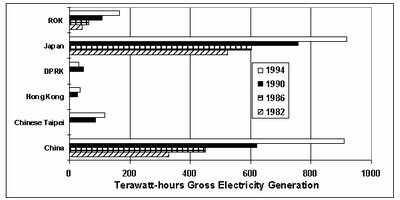
Two Scenarios of Nuclear Power and Nuclear Waste Production in Northeast Asia By David VON HIPPEL and Peter HAYES Nautilus Insitute Prepared for Yonsei University Department of Political Science December, 1997 Abstract As economic growth in the countries of Northeast Asia continues, there will be an increasing need for the services that energy, and particularly […]
Go to the articlePolicy Forum 97-23: North Korea’s Political Problem
This essay was originally prepared for the conference on “Korea In The 21st Century: In Search for Peace, Unification and Prosperity,” held at Chongju University, ROK, June 2-3, 1997, and appeared in the summer 1997 issue of “The Economics of Korean Unification.” The author, Young Whan Kihl, is a professor at Iowa State University. Kihl argues that the foremost political problem of the DPRK today is the survival of the Kim Jong-il regime. Ultimately, Kim will need to build his own charisma via achievement-oriented performance. The strategic goal of the DPRK continues to be forcing US troop withdrawal from the ROK, so as to enable the DPRK to realize its dream of Korean reunification in its own terms, i.e., the communization of the ROK by whatever means are deemed necessary, including the use of force.
Go to the articlePolicy Forum 97-22: Managing the Commons: The Future Direction of Environmental Sustainability in Southeast Asia
Argues that balancing the need for industrial development and environmental protection will require more than establishing green working groups or tightening anti-pollution standards; it will require a fundamental shift from a policy of pollution command-and-control to a system of environmental management as the basis of a regional sustainable development vision.
Go to the article