

RICHARD TANTER
SEPTEMBER 18 2026
I. INTRODUCTION
In this essay, Richard Tanter asks to which Australian defence facilities does the United States have significant access? The startling answer is that 17 nominally Australian bases are US-controlled; and the US military and US defense companies have access to 70% of 134 Australian-controlled military facilities. This level of US access raises questions about Australian strategic autonomy that focusing on legal ownership alone cannot answer.
The full version of the Special Report is available is available here [PDF 4 MB]
Richard Tanter is Senior Research Associate at the Nautilus Institute, and Honorary Professor in the School of Political and Social Sciences, University of Melbourne. He is co-author, with Desmond Ball and Bill Robinson, of the studies collated as the Pine Gap Project.
The views expressed in this report do not necessarily reflect the official policy or position of the Nautilus Institute. Readers should note that Nautilus seeks a diversity of views and opinions on significant topics in order to identify common ground.
This paper was co-published by the Nautilus Institute and the Australian Bases & US Involvement project here
Publication note: This report accompanies the Australian Bases & US Involvement database, which is available here. Its statistical findings use the frozen data release current at 28 August 2026. The results were first reported by the Guardian here
Acknowledgements: I am grateful to Vince Scappatura for advice and support throughout the long gestation of this work, and to Albert Palazzo for wise advice. Ben Doherty of The Guardian stimulated much thought by his questions, and I am grateful to his colleagues Nick Evershed and Andy Ball for stimulating thinking about the arrangement of data, and to all three for their remarkable work. I am deeply grateful to all participants in the work of this project. I am grateful to Luisa Macmillan for her generous patience.
Some images reproduced in this work appeared originally in United States Department of Defense and armed services sources. The appearance of U.S. Department of War (DoW) visual information does not imply or constitute DoW endorsement.
The views expressed in this report do not necessarily reflect the official policy or position of the Nautilus Institute. Readers should note that Nautilus seeks a diversity of views and opinions on significant topics in order to identify common ground.
This report is published under a 4.0 International Creative Commons License the terms of which are found here.
Banner image credits: Guardian graphic, in Ben Doherty, ‘The US has access to more than half Australia’s military bases–could it drag the country unwillingly into war?’, The Guardian, 7 September 2026, [interactive media] here
II. NAPSNET SPECIAL REPORT BY RICHARD TANTER
‘LOCATION, LOCATION, LOCATION’: UNITED STATES ACCESS TO AUSTRALIAN DEFENCE FACILITIES
SEPTEMBER 18, 2026
Summary
A few days before the publication of this report U.S. Air Force B-52 Stratofortress heavy bombers landed at RAAF Base Tindal at Katherine in the Northern Territory, as the first arrivals for the Bomber Task Force 26-3 to be deployed at Tindal for an unspecified time.[1] B-52s have been landing in Australia since the early 1980s, until the end of that decade at that time landing at RAAF Base Darwin for terrain avoidance training flights over northern Australia and for maritime surveillance missions in the western Indian Ocean.[2]
The arrival of the Bomber Task Force is not the first time US bombers, potentially including nuclear-capable B-52s, have been deployed to Australia since World War 2, but it is a clear marker of Australian participation in US force projection planning for what the US and Australian governments regard as ‘strategic deterrence’ aimed at China.[3]
The scale of United States military and corporate access to Australian defence facilities revealed by the data in this study is remarkable, most likely surprising or even shocking for many Australians.
The United States military presence in Australia is no longer adequately described as a collection of American bases. It is a distributed network of access, operational integration and technological dependence encompassing both US-controlled and Australian-controlled facilities.
Its expansion from intelligence and communications into force projection, training, logistics and weapons infrastructure raises questions about Australian strategic autonomy that legal ownership alone cannot answer.
This study set out to determine to which Australian defence facilities does the United States have significant access? To answer this question, by drawing on the database on the Australian Involvement and US Bases website, for each facility, the study asks three questions about dimensions of sovereignty and control:
- Who owns the base?
- Can Australia operate the facilities in the absence of US agreement?
- Can Australia keep a facility operating in the absence of permission from foreign companies or foreign-controlled supply chains?
The short empirical answer to the question of US access to Australian defence facilities is startling.
As shown in Table 1, for 151 facilities assessed with High (129) and Medium (22) confidence concerning judgements about US access:
- Seventeen nominally ‘joint’ military and intelligence facilities in Australia remain under US control, with varying degrees of Australian access;
- US military and/or US defence corporations now have access to 70% of 134 Australian-controlled military facilities; and
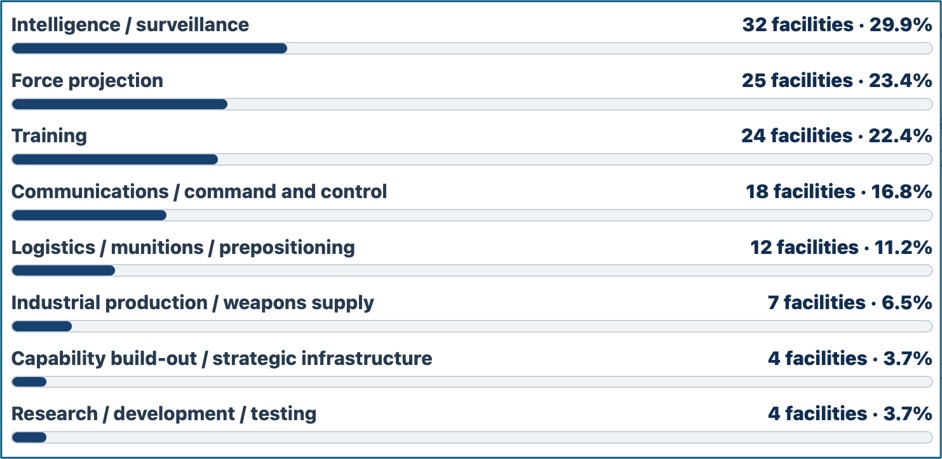
- The functions of US military activities at over a hundred facilities in Australia to which the US has access (including both those under either Australian- or US-control) are dominated by intelligence and communications, US military force projection capabilities from Australian bases, especially from airfields, and training involving all military domains (air, ground, maritime, space and cyber).
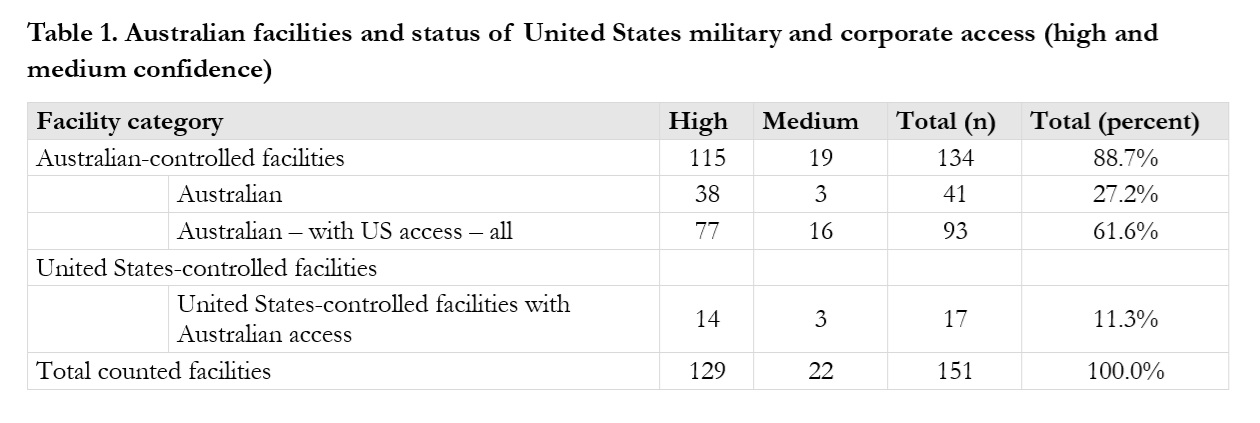 Notes to Table 1:
Tables are available in more detail at the Australian Bases & US Involvement website ‘Report’ page, based on the accompanying Database tab. The database will be updated periodically as new information becomes available: each database build is date-marked. Tables presented in this report are derived from the database as of 28 August 2026.
The database contains 177 facility records. 9 structurally excluded or out-of-scope records are omitted from statistical counts and listed in Table 16. Structurally excluded and out-of-scope facility records.
Confidence means confidence in the assessment of US-access status. This leaves 168 facilities in the comprehensive statistical population shown in Table 4. Table 3 displays the 151 facilities whose US-access status is assigned to its High- or Medium-confidence categories.
The remaining 17 facilities are not structurally excluded; their US-access status or confidence in that status assessment does not permit assignment to one of the simplified Table 3 categories.
Percentages in Table 3 use the 151 facilities displayed in this table as their denominator.
This pattern is not a matter of US penetration of a small number of Australian bases, but a pattern of saturation of the Australian defence eco-system by US access and influence that raises questions about Australian strategic autonomy that focusing on legal ownership alone cannot answer.
Outline of this Study
The aim of the Australian Bases & US Involvement Project is to provide transparent, authoritative and usable information to the Australian public on the issue of US access to Australian and intelligence facilities.
Unorganised and inaccessible knowledge is effectively unusable for practical purposes of policy debate. Public discussion of the issues of peace, security and sovereignty that should sit at the core of debate on Australian foreign and defence policy is severely constrained without reliable information about the fundamental issue of providing foreign military forces access to Australian facilities, including, in some cases conducting military operations from Australian territory.
All sources used in the database are publicly available and links to the sources are provided for verification.
This project’s contribution to public debate is to find those sources, organise them in a rational manner, and offer them to the public.
The first three sections of the report present findings concerning US access in brief, introduce the key issues of ‘what counts as a “base”?’, argue that simply insisting that juridical control (‘Who owns the base?) ignores more complex–and salient–issues of operational control (‘Can Australia operate the facilities in the absence of US agreement?’) and industrial/technological independence (‘Can Australia keep a facility operating in the absence of permission from foreign companies or foreign-controlled supply chains?’).
After a discussion of the methods used in the study, Section 4 presents a statistical approach to the questions How extensive is US access? And What US activities does this access enable? (Chart 1. The military-industrial complex in Australia)
Two long sections present answers to the question What does US access to Australian facilities enable?, firstly for US-controlled facilities and then for Australian-controlled facilities.
Section 7 addresses temporal dimensions of the issue of US access to Australian defence facilities, in three broad, albeit overlapping phases, accelerating over time, especially since 2014, in what amounts a time of explosive growth in US access.
The first phase focusses on the situation in the early 1980s revealed by Desmond Ball’s pioneering work A Suitable Piece of Real Estate: US Installations in Australia, followed by discussion of the remarkable continuities regarding most of those installations today or their technological successors. The highly militarised situation at the three separate facilities that now make up the Joint Defence Facility Pine Gap taken as a harbinger of shifts in the balance of functions demonstrated in the second and third phases.[4]
The second phase focusses on US access to Australian defence facilities affected by the 2014 Australia-United States Force Posture Agreement and the still unfolding Force Posture Initiatives.
The third phase, overlapping in time with the second, focusses on a new set of largely US-controlled facilities with Australian access involved in space domain awareness, the effect of which is to draw Australia into activities enabling space warfare.
Section 8 deals with Australia’s management of strategic risks embedded in this pattern of rapid and widespread US access to Australian defence facilities, apparently with few formal policy or institutional restrictions. Hosting foreign facilities, whatever the flag on the gate, or providing foreign access to national defence facilities may offer strategic advantage, but also carry risk. All defence postures and foreign policies bring benefits and costs–the key question in any given case concerns the balance between the two, and, if the issue of imbalance arises, the national capabilities to alter course.
Political and economic regimes always involve elements of path-dependencies–strategic choices, in the broadest sense of the term, that limit or permit possible changes of direction.
The key question is whether Australia can learn to manage simultaneous strategic risks arising from an alliance of this scale and complexity–with risks affecting Australians understood to involve both national interests and the inescapable wider human interest.
These issues are discussed in relation to five fields relating to US access to Australian defence facilities showing inhibiting path-dependency characteristics–with the danger of lock-in: strategic policy; the defence industrial eco-system; base construction and emerging political interests; systemic deficits in accountability; and institutional learned incapacity.
Section 9 looks at the reversal of the path-dependence examined in the previous section, briefly introduces possible pathways and requirements for transition away from heightened alliance path-dependence for each of the five fields–the transition towards unlocking these ‘locked-in’ elements of Australian defence.
One field where the question of an alliance-based path beyond lock-in to sovereignty is strongly espoused by the Australian government is defence industrial production, with the Guided Weapons Explosive Ordnance Enterprise at its core. The viability of the government’s pathway can be summarized by the paradox presented by a foundational policy aiming at first steps towards industrial sovereignty being undertaken with founding Strategic Partners Lockheed Martin and Raytheon, each of which publicly and repeatedly avers their support for the goal of Australia defence industrial sovereignty.
This report is not the place to explore in-depth either the obstacles such a contradiction sets up, or the adequacy of government plans to overcome that situation over time, as the plans in the Guided Weapons and Explosive Ordnance Plan, the Defence Industry Development Strategy and its annex on GWEO procurement and development maintain.
The plans are quite open, at a general level, on the need to overcome dependence, though less clear about the certainty of the pathway to what is repeatedly asserted to be a sovereign outcome.
Indeed the frequency with which ‘sovereign defence’ and ‘sovereign capability’ and similar terms are repeated, given the starting point the admitted and evident obstacles, feels rather like whistling past the graveyard.
Section 10 reviews the goals of the study, assessing the levels of urgency of the early 1980s with the current situation, and the fate of the two key conditions Ball suggested must be applied to US installations. At that time Ball suggested two conditions which must be met with respect to those installations. Firstly
‘the Australian government must be fully apprised of the operational details of each of the facilities, and that technical and strategic developments relating to the facilities be continually monitored and assessed, so as to ensure that no Australian interests are compromised…’
And secondly:
‘as much as possible of this information should be made available to the public’.
Ball’s remark on the first condition could still apply today–but quite possibly, as understatement:
‘One of the most disturbing features of the American installations is the lack of control exercised by the Australian government over their establishment, operation and maintenance.’ [5]
Section 11 presents a different way of asking ‘What does it mean? by way of an invitation to examine counterfactuals–the essential but forbidden fruit of social inquiry as Richard Ned Lebow called them–posed as a provocation.[6] Like most serious counterfactuals, the ‘What if?’ questions asked at first appear absurd, or worse.
Yet counterfactual propositions have a rich history in international relations thought, and even in small form can be useful for articulating unacknowledged assumptions in present policy based on the United States as an indubitably ‘trusted partner’, and for exploring critical turning points in path-dependency that may point to usable approaches to alternative futures.
What if, in the earlier discussion of ‘US corporate access to Australian defence facilities’, the relevant adjective was changed to ‘Chinese corporate access to Australian defence facilities’?
The findings in brief
It is now half a century since Desmond Ball first described many ‘United States installations’ in his book A Suitable Piece of Real Estate (1980), most notably the three large US intelligence facilities now titled the Harold E. Holt Naval Communications Station at North West Cape and the Joint Defence Facility Pine Gap, and the Joint Geological and Geophysical Research Station at Alice Springs.
Much has changed in Australia and in its alliance with the United States in those five decades, some for better, and rather more for worse. Faced with considerable political protests and electoral pressures, the Fraser coalition and Hawke Labor governments of the late 1970s and the 1980s clarified the juridical position by first stressing that all military bases were legally Australian, secondly by declaring that a number of previously United States facilities were rebadged as ‘joint Australian-United States facilities’, and third by promulgating and applying a doctrine of ‘Full knowledge and concurrence’ designed to ensure Australian control.
But 1980 was a long time ago, and the shape and character of the Australia-US alliance has also changed, and with it, the fundamental issue with which Ball wrestled–Australian control over defence decision-making–is even more seriously challenged by dramatic changes in both the extent and nature of US access.
The contemporary Australian embrace of the US alliance has brought not just a much larger number of bases with US access of one kind or another, encompassing both US-controlled and Australian-controlled facilities, in a distributed network of United States access to a majority of Australian defence facilities amounting to operational integration with, and systemic technological dependence on, United States military systems and giant US defence corporations, including the world’s largest.
And most importantly, that network expansion of US access to Australian defence facilities involves a shift in the activities of the US military in Australia beyond intelligence and communications functions into a systematic capability to project its ground, sea and air forces beyond Australia, unparalleled US access to geographically huge and technologically complex training lands, and to military logistics and weapons manufacturing infrastructure.
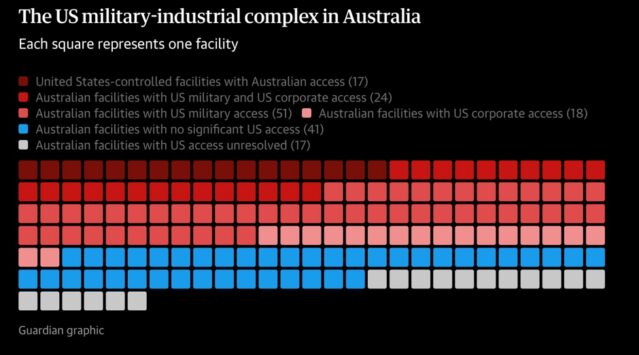
As summarized above, the study showed the extraordinary degree of access that they United States has to Australian military facilities. This access is summarized in Chart 1 below by type of access and number of facilities.
Chart 1. The military-industrial complex in Australia
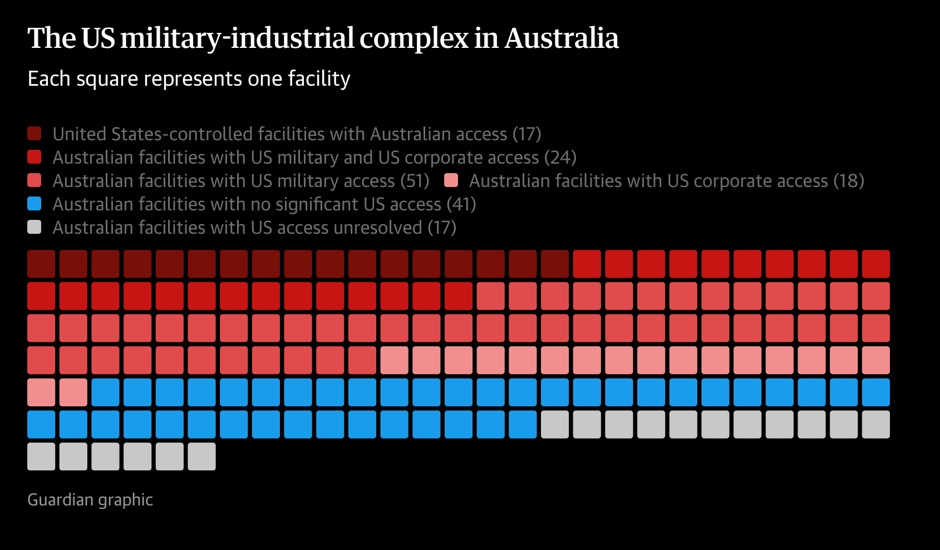
Source: Ben Doherty, ‘The US has access to more than half Australia’s military bases – could it drag the country unwillingly into war?’, The Guardian, 7 September 2026, [interactive media] here
Chart 2 1 below shows how the initially primarily intelligence and communication functions of this access has expanded both numerically but also by large-scale US military force projection and training roles from Australian bases.
Chart 2. Functions of US military activities from Australian facilities
Notes to Chart 2.
Facilities may have more than one recorded function. Function counts therefore overlap and do not sum to the total number of facilities.
Includes: Facilities with assessed US access and at least one recorded US military function.
Excludes: Facilities without assessed US access or a recorded function, and structurally excluded or out-of-scope records.
This shift is not a matter of US penetration of a small number of Australian bases, but a pattern of saturation of the Australian defence eco-system by US access and influence that raises questions about Australian strategic autonomy that focusing on legal ownership alone cannot answer.
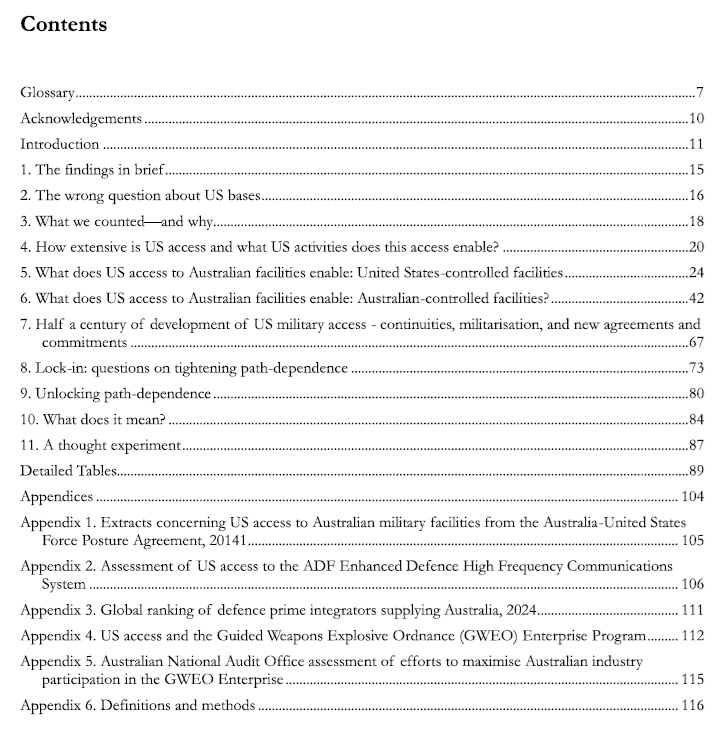
TABLE OF CONTENTS to the full report is found here
III. ENDNOTES
[1] Chris Gordon, ‘Task Force to Australia’s New BUFF Base’, Air & Space Forces Magazine, 3 September 2026, at https://www.airandspaceforces.com/b-52-bomber-task-force-australia-raaf-base-tindal/.
[2] See Vince Scappatura and Richard Tanter, B-52 strategic bombers in Australia, 1979 – 1991 and the nuclear heterodoxy of Malcolm Fraser, Nautilus Institute Special Report, 4 August 2025, at https://nautilus.org/wp-content/uploads/2025/07/B-52-operations-in-Australia-1979-1991.pdf; and
Vince Scappatura and Richard Tanter, Nuclear-capable B-52H Stratofortress strategic bombers: a visual guide to identification, Nautilus Institute Special Report, 4 August 2024, at https://nautilus.org/wp-content/uploads/2024/08/Nuclear-capable-B-52H-Stratofortress-Aug26-2024.pdf.
[3] Chris Gordon, ‘Task Force to Australia’s New BUFF Base’, Air & Space Forces Magazine, 3 September 2026, at https://www.airandspaceforces.com/b-52-bomber-task-force-australia-raaf-base-tindal/.
[4] On treatment of Joint Defence Facility Pine Gap as three separate facilities see the detailed discussion in Section 5 below. On the more general question of decisions about database entries for components of some, particularly large or complex facilities, see Appendix 6. Definitions and methods, including the list of selected case-by-case counting decisions (26 facility entries).
[5] Desmond Ball, A Suitable Piece of Real Estate, p. 153.
[6] Richard Ned Lebow, Forbidden Fruit: Counterfactuals and International Relations, (Princeton U.P., 2010).
IV. NAUTILUS INVITES YOUR RESPONSE
The Nautilus Asia Peace and Security Network invites your responses to this report. Please send responses to: nautilus@nautilus.org. Responses will be considered for redistribution to the network only if they include the author’s name, affiliation, and explicit consent.