

Dear colleague,
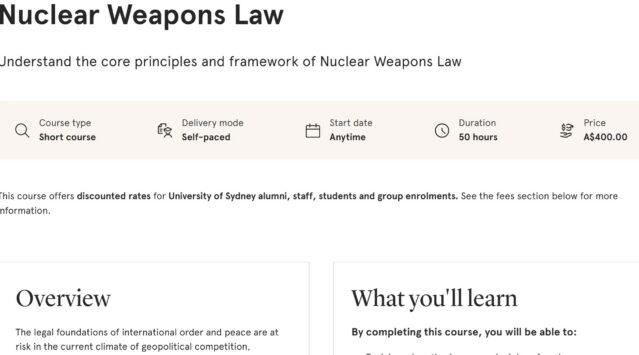
We are pleased to announce the on-line short course: Nuclear Weapons Law. Taught by some of the world’s foremost experts in the field, this course takes students through the diverse elements of laws governing armed conflict and the use of nuclear weapons. At a time when the risk of nuclear war is increasing, it explores how law may shape outcomes in the extreme circumstances of nuclear crisis.
The course is self-paced and suitable for officials and personnel dealing with nuclear weapons; legal, military, and security professionals; scholars and students; journalists; members of civil society organizations; and concerned citizens. The course costs A$400 (about US$288). Students may register and commence study immediately here.
Please circulate this announcement in your networks and ask any questions about the course by replying to this message.
Thank you,
Emily Crawford, Deputy Dean, Law Faculty, University of Sydney
James Der Derian, Director, Centre for International Security Studies, University of Sydney
Peter Hayes, Director, Nautilus Institute
***
NUCLEAR WEAPONS LAW ONLINE SHORT COURSE
The legal foundations of peace and security are at risk, especially in the critical area of nuclear weapons. The increased use of military force by existing and aspiring nuclear states raises the spectre of nuclear war in nuclear-prone conflict zones. International law remains one of the few institutional checks against the spread and use of nuclear weapons. It also provides a framework for building a more stable and just international order.
The University of Sydney’s Centre for International Security Studies (CISS) and Law School with the Nautilus Institute for Security and Sustainability have chosen this pivotal moment to create an on-line short course that explains how international law constrains states from seeking, preparing, threatening or using nuclear weapons. The course offers students a comprehensive overview of the applicability of international law to nuclear weapons, especially nuclear command, control, and communications (NC3) relevant to many different domains.
After examining the history and principles of sovereignty and jurisdiction, the course considers how international law applies to the use of nuclear force and to the conduct of nuclear operations during an armed conflict. International crimes, neutrality, and national doctrine are addressed. The relevance of the International Court of Justice is assessed. Non-partisan and policy-oriented, the course provides a balanced review of the Treaty on the Prohibition of Nuclear Weapons (TPNW), the future of NC3, and evolving legal issues associated with current and potential nuclear-armed states.
The course presents 18 lectures organized into five modules (outlined below). The lectures are supplemented with other resources, including expert interviews, readings exercises and a video- epilogue produced for the course. An open-access textbook developed in tandem with the course, The Law on Nuclear Weapons: An International Commentary (2025), provides historical and political context for the key legal documents. Some understanding of international law as it relates to conflict would be useful, but no prior knowledge is assumed for the course.
The online course is hosted by the University of Sydney and available at an affordable registration price anywhere with Internet access.
INTRODUCTORY VIDEO (click to view)

COURSE CONTENT
The course has 25 hours of self-paced lecture modules plus 25 hours of reading material.
- Module 1 – The legal architecture for nuclear weapons contexts
Examine the core international legal framework that governs nuclear weapons and build foundational concepts needed to analyse legality and responsibility in high-stakes scenarios. - Module 2 – Conduct of nuclear operations: Laws of Armed Conflict rules in practice
Understand how the laws of armed conflict operationalise legal constraints and questions about accountability. - Module 3 – Contested and evolving law: authorities, treaties, and change over time
Compare competing interpretations and craft a defensible view on the current status and possible future of the law on nuclear weapons. - Module 4 – Decision-making, command systems, and professional responsibility
Consider how law interfaces with real world decision-making, national NC3 systems, and individual and professional duties. - Module 5 – Epilogue: Will we see a nuclear weapon used in our lifetime?
Explore the growing risks of nuclear conflict, the devastating consequences of escalation, and alternatives that could prevent catastrophe in a video produced expressly for this course: The Shadow of the Next Bomb: Nuclear War in Our Time.
LECTURERS
William H. Boothby retired as Deputy Director of Royal Air Force Legal Services in July 2011. He took a Doctorate at the Europa Universität Viadrina, Frankfurt (Oder) in Germany and has published books on weapons law, targeting law, the law relating to conflict and on new and emerging technologies. With Wolff Heintschel von Heinegg, he published Nuclear Weapons Law (2021) and The Law on Nuclear Weapons (2025).
Geoffrey S. Corn is George R. Killam, Jr. Chair of Criminal Law and Director of the Center for Military Law and Policy, Texas Tech University School of Law. He is a retired U.S. Army Lieutenant Colonel and served as an intelligence officer, a military attorney, and as the US Army’s senior law of war advisor. He has published widely on law in war.
Emily Crawford is a Professor and Deputy Dean of the University of Sydney Law School, where she teaches and researches international law and international criminal law. She has published widely on international humanitarian law, most recently A Code of Conduct for Nuclear Command, Control, and Communication (2026).
Gareth Evans was a Cabinet Minister in the Australian government from 1983-96, including as Foreign Minister from 1988-96 where he played central roles in the Cambodian peace process, the creation of APEC and the ASEAN Regional Forum, and the Chemical Weapon Convention. He has written widely about nuclear weapons issues.
Peter Hayes is an Honorary Professor at the Centre for International Security Studies, Sydney University, Australia and Director of the Nautilus Institute in Berkeley, California. He has written many books and essays on nuclear weapons and related issues, especially in relation to East Asia.
Anna Hood is an Associate Professor at the University of Auckland Faculty of Law. She is a public international law academic whose research focuses primarily on international disarmament law, international law and security and the intersection between psychology and international law.
PROJECT MANAGER
Stuart Rollo is a postdoctoral research fellow at the Centre for International Security Studies at the University of Sydney, and author of Terminus: Westward Expansion, China, and the End of American Empire (2023).
VIDEO PRODUCER
James Der Derian is Michael Hintze Chair of International Security and Director of the Centre for International Security Studies at the University of Sydney. His most recent documentary is Project Q: War, Peace and Quantum Mechanics (2024).
ACKNOWLEDGEMENT
This course is supported by grants from Carnegie Corporation, MacArthur Foundation, Nautilus Institute, New Land Foundation, Ploughshares Fund, and Samuel Rubin Foundation and made possible with educational and technical support from the University of Sydney Centre for Continuing Education, Law School Educational Design and FASS Media Room.
Inquiries may be sent to short-courses@sydney.edu.au