- DETERRENCE: U.S. force posture strategy in the Asia Pacific region: an independent assessment
- DPRK: Troop deployment row halts China-N. Korean island project
- ENERGY SECURITY: India’s power network breaks down
- GOVERNANCE AND CIVIL SOCIETY: China protests highlight simmering unrest
- CLIMATE CHANGE ADAPTATION: The economic value of natural and built coastal assets, Part 2: built coastal assets
- CLIMATE CHANGE AND SECURITY: Global warming’s terrifying new math
Archives
Mutual Trust: Collective Hedge
by Roger Cavazos, DPRK Contributor
Mutual trust is an important part of today’s interconnected world. However, when applied to the security realm at the State-to-State level, mutual trust can become a weapon and an obstacle….
Extended Nuclear Deterrence in Northeast Asia
Jeffrey Lewis argues that US allies such as Japan have been mislead by the manner in which past administrations have sought to emphasize the strength of their extended deterrence commitments by reference to particular weapons systems in that role. Lewis writes that “there is no specific commitment to use any of those nuclear weapons in defense of Japan – or any other ally.”
Rather, Lewis states, “it is time to be honest that the primary source of nuclear deterrence for US allies comes from the strategic triad of intercontinental ballistic missiles, submarine launched ballistic missiles and bombers.” He concludes that “US nuclear weapons continue to play role, albeit a declining one, in meeting US security commitments. The US is committed to defending Japan, but the use of nuclear weapons neither necessary nor desirable in the current strategic environment.”
Jeffrey Lewis is an Adjunct Professor and Director of the East Asia Non-Proliferation Program at the Monterey Institute of International Studies.
A version of this report was originally presented at the East Asia Nuclear Security workshop held on November 11, 2011 in Tokyo, Japan.

Nautilus Peace and Security Weekly
- DETERRENCE: Seconds away from midnight: U.S. nuclear missile pioneers on Okinawa break fifty year silence on a hidden nuclear crisis of 1962
- DPRK: KJU named KPA Marshal, Hyon Yong Chol named Chief of General Staff
- ENERGY SECURITY: Powerless in India
- GOVERNANCE AND CIVIL SOCIETY: Philippines to boost defense, won’t yield to China
- CLIMATE CHANGE ADAPTATION: Climate change adaptation and the Australian urban water industry
- AUSTRAL PEACE AND SECURITY: Americans aghast at ally’s deep defence cuts
South Korea’s Long Bow
by Peter Hayes, NAPSNet Contributor
South Korea has long tried to obtain medium-range ballistic missiles. Today, conservatives in the ROK are outraged that the United States is not inclined to enable the ROK to obtain medium-range delivery systems……
Seconds Away From Midnight: U.S. Nuclear Missile Pioneers on Okinawa Break Fifty Year Silence on a Hidden Nuclear Crisis of 1962
Jon Mitchell states that “six months prior to the Cuban Missile Crisis…a parallel drama played out on the other side of the world as the U.S. secretly brought near-identical missiles to the ones the Russians stationed on Cuba to another small island — Okinawa. While the full facts of that deployment have never been officially disclosed, now for the first time three of the U.S. Air Force’s nuclear pioneers have broken the silence about Okinawa’s secret missiles, life within the bunkers and a military miscalculation of apocalyptic proportions — the targeting of unaligned China at a time when China-Soviet polemics were in full public view.”
Jon Mitchell is a Welsh-born writer based in Yokohama and represented by Curtis Brown Ltd., New York. He teaches at Tokyo Institute of Technology and is an Asia-Pacific Journal associate.
NAUTILUS PEACE AND SECURITY WEEKLY
- DETERRENCE: Nuclear proliferation – looking back, thinking ahead: how bad would the further spread of nuclear weapons be?
- DPRK: N. Korea replaces army chief
- ENERGY SECURITY: Heat wave adds to misery of storms, power outages in East
- GOVERNANCE AND CIVIL SOCIETY: Nuclear-free movement attracts new breed to massive Tokyo rally
- CLIMATE CHANGE ADAPTATION: Adaptation to climate change: formulating policy under uncertainty
- CLIMATE CHANGE AND SECURITY: US official: Higher ocean acidity is climate change’s ‘evil twin,’ major threat to coral reefs
Powerlessness – at the top and the bottom of the pyramid: Part I
Powerlessness – at the top and the bottom of the pyramid: Part I.
by Nikhil Desai, NAPSNet Contributor
Washington, DC area had an extreme climatic event June 29 night. On cue, reporters and editorials began arguing whether this was due to anthropogenic climate change….
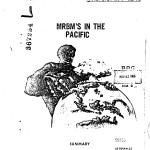
MRBM’s in the Pacific
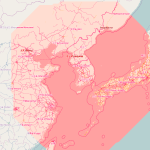
This 1965 report, commissioned by Secretary of Defense Robert MacNamara, was directed “to determine optimum characteristics and employment of MMRBM-type weapon systems for maximum effectiveness in the Pacific Theater… [and] define optimum and alternative weapon system characteristics, operational concepts, force sizes, deployment schemes and development schedules and costs.” The report concludes that “the Flexible Theater Missile provides the optimum capability to satisfy both the political and military requirements. If political considerations dictate an early deterrent and show of force, the A-1 missile system could be used as an interim capability.”
This report was released to the Nautilus Institute under the US Freedom of Information Act (FOIA).
Nautilus Peace and Security Weekly
- DETERRENCE: Should the US consider redeploying tactical nukes in South Korea? A tactical step that makes sense for South Korea
- DPRK: N. Korea’s top diplomat arrives in Cambodia for ASEAN Forum
- ENERGY SECURITY: Inquiry declares Fukushima crisis a man-made disaster
- GOVERNANCE AND CIVIL SOCIETY: Central government plans to buy Senkaku Islands
- CLIMATE CHANGE ADAPTATION: Climate change vulnerability assessments as catalysts for social learning: four case studies in South-Eastern Australia
- AUSTRAL PEACE AND SECURITY: Seeing red: ADF at the crossroads