“Yes I Can!” Byungjin and Kim Jong Un’s Strategic Patience

NAPSNET Special Report Peter Hayes and Roger Cavazos March 29, 2016 I.  INTRODUCTION North Korea upgraded its nuclear and military power and grew its economy slightly, thereby realizing Kim Jong Un’s byungjin line. It also attempted to open new external fronts and to coerce the South to cooperate on its terms, but failed. Instead, it […]

Cyber threats and the challenge of de-alerting US and Russian nuclear forces

Andrew Futter writes ‘A quarter of a century after the end of the Cold War, both the United States and Russia retain a significant number of nuclear weapons … capable of inflicting almost unimaginable damage, death and devastation.’

Futter argues that ‘the logic of de-alerting these nuclear forces and enhancing the safety and security of nuclear systems is becoming increasingly persuasive and urgent….. [T]his appears to be becoming particularly pronounced as we move into a era increasingly dominated by the threat of “cyber attacks”.’

A comprehensive agreement for security in Northeast Asia

by Morton Halperin 16 March 2015 Introduction In this Policy Forum Morton H. Halperin writes ‘A new approach is clearly needed to prevent the DPRK from testing and deploying its operational nuclear weapons capability and to persuade it to de-nuclearize.’ Halperin lays out a plan for achieving a comprehensive security agreement in Northeast Asia, ‘one […]

North Korea’s nuclear force roadmap: hard choices

by Peter Hayes and Roger Cavazos NAPSNet Special Report 2 March 2015 I. SUMMARY In this report Peter Hayes and Roger Cavazos lay out a possible roadmap for North Korea’s nuclear operational force. The authors state: “The laws of physics that determine how nuclear weapons and delivery systems perform are the same in North Korea […]

Nuclear command-and-control in the Millennials era

In this report Peter Hayes writes about the risk of nuclear war and complexity. He states that “very few leaders or even strategic scholars pay attention to the new complexity of the operating environment in which national nuclear command-and-control systems operate, or the new characteristics of the command-and-control systems and their supporting CISR systems that may contribute to the problem of loss-of-control and rapid escalation to nuclear war.

“Today, the underlying ground is moving beneath the feet of nuclear-armed states. The enormous flow across borders of people, containers, and information, and the growth of connectivity between cities, corporations, and communities across borders, is recasting the essential nature of security itself to a networked flux of events and circumstances that no agency or state can control. The meta-system of nuclear command-and control systems has emerged in this new post-modern human condition.”


China Goes Public on North Korea, Foreign Policy, Daniel W. Drezner

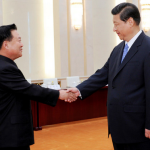
Chinese leader, Xi Jinping, right, greets North Korean envoy, Vice Marshal Choe, in Beijing on Friday. Rao Aimin/Xinhua, via Associated Press

In this case, even the publication of the sanctions list itself is something of an intelligence find for the United States — as Perlez notes:

“The list gives a good insight into what China knows about the missile and bomb development of North Korea,” said [Roger] Cavazos, the former Army intelligence officer who now works as an analyst at the Nautilus Institute, which studies international security issues. “From what I can tell, it lays out almost all China knows about North Korea’s missile and nuclear program.”