Rolling Reforms: Reflections on Visits to Kim Jong Un’s North Korea

Traffic jam in May 2013 in Pyongyang - youtube.

On visits to North Korea since Kim Jong Un came to power, Rudiger Frank has seen growing evidence of a more diverse and cash-based economy. These signs of creeping reform are evidence of North Korea’s desire for change, but achieving real transformation remains a long and delicate process.

Rudiger Frank is Chair Professor of East Asian Economy and Society at the University of Vienna and Head of the Department of East Asian Studies. He has visited North Korea numerous times.

This report was originally published by Global Asia in June of 2013 (V8N2).

The Case of the Rescinded Invite

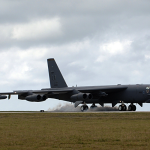
B-52 Stratofortress bomber from the 96th Expeditionary Bomb Squadron lands on Andersen AFB, Guam. Photo source: US Air Force

Roger Cavazos asks, “What happened to Ambassador Robert King’s invite to North Korea?”  How could things have gone so disastrously off-track in 72 hours and what does it mean for the future of the relationships between the U.S. and North Korea?   Roger Cavazos is a Nautilus Institute Associate and retired US military officer with assignments in the intelligence and policy communities.

A Regional Framework for a Comprehensive Security Settlement in the Korean Peninsula

James Goodby writes that if the Administration’s “pivot to Asia” is meant to signal a new era of American activism in the Asia-Pacific region, the president should describe to his partners in Asia how he sees the elements of a comprehensive security settlement coming together. A beginning can be made by defining the categories of security issues that need to be addressed, and by which states. The three main categories are:

(1) issues left over from the 1950-53 Korean War and the elements of a North-South peace regime (most of which have solutions that have been formally agreed upon in past statements issued by the North and South Korean Governments and many have been at least implicitly endorsed this year by Kim Jong-un)

(2) issues related to North Korea’s nuclear weapons program (and President Obama’s call for “a world without nuclear weapons” could be a device for placing a de facto nuclear weapons-free zone on the agenda to address this), and

(3) issues related to regional inter-state relations in Northeast Asia (one approach to solving these would be to organize something like an Organization for Security and Cooperation in Europe (OSCE) for Northeast Asia).

James Goodby is a Nonresident Senior Fellow at the Center for Northeast Asia Policy Studies, The Brookings Institution. Ambassador Goodby’s analysis does not necessarily reflect the opinions of the institutions with which he is affiliated.


Rising Sun, Morning Calm, Redeeming Step

Roger Cavazos writes “Both Japan and North Korea are presently taking concrete steps, and responding primarily to their own perceived national interest. The path to redemption is rarely linear and never easy. North Korea’s tentative reaching out should be met with reversible actions and Japan’s bold steps should be encouraged – maybe even followed.”

Roger Cavazos is a Nautilus Institute Associate and retired US military intelligence officer.

Rattling the American Cage: North Korean Nuclear Threats and Escalation Potential

Peter Hayes and Roger Cavazos write: “We do not believe that North Korea intends to attack South Korea, pre-emptively or otherwise, in the current cycle of threat projection. However, miscalculation, accidents, or “wild cards” can all activate an unstoppable chain of events that lead to uncontrollable escalation…Talk is cheap, valuable, and entails no concessions. In the current charged environment, the only way to obtain badly needed information about North Korean intentions and therefore, the real level of threat, is to talk to them.”

Peter Hayes is director of Nautilus Institute and Professor of International Relations at RMIT University in Melbourne. Roger Cavazos is an Associate of Nautilus Institute and retired US military intelligence officer.

Replacing the Armistice With A Peace Treaty in Korea

Leon V. Sigal: “Whether a peace treaty precedes or follows denuclearization, it is inconceivable that Pyongyang would curb its nuclear and missile programs, never mind give up its nuclear arms and missiles, without a peace process. As long as the United States and South Korea remain its foes, it will feel threatened and want a stronger “deterrent” to counter that threat.”

Leon V. Sigal is director of the Northeast Asia Cooperative Security Project at the Social Science Research Council in New York.

This report was originally presented at the New Approach to Security in Northeast Asia: Breaking the Gridlock workshop held on October 9th and 10th, 2012 in Washington, DC.

North Korea’s threats: Five things to know, Matt Smith, CNN, 24 March 2013

“Peter Hayes, director of the San Francisco-based Nautilus Institute, says there’s also a debate going on inside the North Korean leadership about the country’s future as a nuclear state. One side wants “to be a nuclear-armed state that is able to behave like the recognized, legal nuclear weapons states and play their game and turn the tables on them,” Hayes said. “That is, in my view, what is going on in the test and the rocket firing,” he said. “The other policy current is associated with the Ministry of Foreign Affairs and the international faction of the Korean Worker’s Party, which is to negotiate our way out of this mess.”

Tactically Smart, Strategically Stupid: Simulated B52 Nuclear Bombings in Korea

Peter Hayes states, “Deploying nuclear capable bombers accompanied by nuclear threat rhetoric will not quell regressive proliferation sentiment in Seoul. Nor will it persuade North Korea’s leaders to desist from nuclear aggression…..quiet actions will always speak louder in Pyongyang than aggressive words.”

Peter Hayes is the Director of the Nautilus Institute and the Deterrence contributor to the NAPSNet Weekly report.

Sustainable discussions

Roger Cavazos: “A war on the Korean Peninsula, even a limited one, would be an ecological disaster. Even an uneasy peace has taken an environmental toll. Discussing environmental topics is a low cost way to sow seeds for discussions between the parties on and around the Korean Peninsula. The fruits of those discussions are likely sustainable.”