

PETER HAYES
JULY 15 2026
I. INTRODUCTION
Peter Hayes summarizes USSTRATCOM Special Instruction 534-16 in 15 key points covering the mission of strategic early warning of attack on the United States with nuclear weapons delivered by missiles, the early warning command hierarchy and architecture, measures of effectiveness, procedures and measures to avoid and then manage errors or failures, and the procedures for reporting nuclear detonations. He concludes with a reflection on the implications for strategic early warning of increasing numbers of nuclear armed states and possible missile and other launch events such as bomber flights. “Sharing such procedures” between nuclear weapons states he suggests, “is a necessary and minimum starting point for compliance with the obligation under the laws of armed conflict to do everything possible to avoid a nuclear war.”
USSTRATCOM SI 534-16 may be downloaded here (PDF 2.1MB).
Peter Hayes is Director of the Nautilus Institute and Honorary Professor at the Centre for International Security Studies at the University of Sydney, and Senior Research Advisor of the Asia-Pacific Leadership Network
This special report is the third in a series of FOIA-released USSTRATCOM documents that pertain to NC3. The first, US STRATEGIC COMMAND ON NUCLEAR WEAPONS & LAWS OF ARMED CONFLICT is found here; the second, NUCLEAR WEAPON SYSTEM OPERATIONAL TESTING AND COMMAND AND CONTROL REQUIREMENTS, which should be read in conjunction with this third report, is found here
Acknowledgement: The research for this FOIA request and publication was funded by New Land Foundation and Ploughshares Fund. The author thanks reviewers Paul Davis, Herb Lin, and George Perkovich for their insight and suggestions. Any errors of fact or interpretation remain the responsibility of the author.
Perplexity AI was used in the production of this text for review and fact-checking of various issues. However, author is wholly responsible for the text posted in this Special Report.
The views expressed in this report do not necessarily reflect the official policy or position of the Nautilus Institute. Readers should note that Nautilus seeks a diversity of views and opinions on significant topics in order to identify common ground.
This report is published under a 4.0 International Creative Commons License the terms of which are found here.
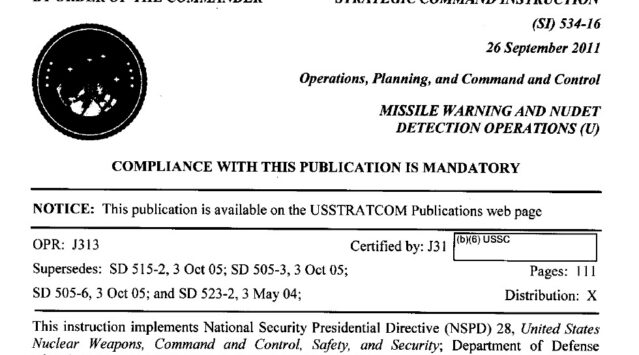
Banner image: USSTRATCOM Instruction SI 534-16
II. NAPSNET SPECIAL REPORT BY PETER HAYES
ANALYSIS OF USSTRATCOM STRATEGIC INSTRUCTION 534-16 “MISSILE WARNING AND NUDET DETECTION OPERATIONS”–IMPLICATIONS FOR NC3 EARLY WARNING
JULY 15 2026
Summary
This special report summarizes US Strategic Command’s (hereafter STRATCOM) instruction on missile warning and nuclear detonation detection operations hereafter SI 534-16. It first outlines fifteen key points derived from a close reading of the redacted instruction released under US Freedom of Information Act request. These are grouped into five sections. Section 1 covers the mission of strategic early warning (EW) for US nuclear command, control and communications (NC3) noting that it serves US and allies, and that a theater-level doctrine of “assured” warning that trades off possible false warnings for time to alert. Section 2 outlines EW’s command hierarchy, points to the missile warning functional manager office as a key player in ensuring compliance with EW performance standards, and notes the leading role of the US-Canadian NORAD and US space operators in realizing early warning functions. Section 3 describes the architecture of EW sensor and communication systems reliant first and foremost on space-based detection systems that sends information to both theater and US global EW centers, dependent upon relay ground and survival relays, recognizing the effective autonomy of theater event systems coupled with central systems based in the United States, and also availing them with direct downlink data streams to enable them to directly support theater command and control nodes with local processing. Section 4 describes how STRATCOM measures the effectiveness of its EW systems. These measures include taxonomies of missile types, the reliance on stereo coverage of space-based IR signatures, and reporting on EW system outages including backup modes in case of catastrophic system failure. Section 5 delineates STRATCOM’s use of dual phenomenology to determine the threat level associated with a possible missile event detected from space and the reporting chain including the use of a two-action reporting procedure (which will be explained below but readers should note now that this phrase does not refer to the two-person rule), and use of walkers in some circumstances. It ends with a description of the procedure to report nuclear detonations, the latter being an obvious indicator of possible intentional nuclear attack.
The essay concludes with a reflection on the implications for strategic EW of increasing numbers of nuclear armed states and possible missile and other launch events such as bomber flights. It suggests that sharing such procedures is a necessary and minimum starting point for compliance with the obligation under the laws of armed conflict to do everything possible to avoid a nuclear war.
Introduction
SI 534-16 was promulgated on September 26, 2011. It was released under a US Freedom of Information Act request on November 5, 2018 to Nautilus Institute. The 111 page document contains six chapters, shown below in the Table of Contents; and extensive attachments. It implements National Security Presidential Directive 28 and multiple US Department of Defense directives and Joint Chiefs of Staff instructions.
The Instruction may have been superseded and many of the procedures and supporting technical infrastructure, especially automatic data processing and communication systems, may have been modernized or supplanted by new systems. However, the overarching imperatives and key architectural design remain as relevant today as they were in 2011 and provide a good entry point to understand how the US early warning system works—and where it may not.
Table of Contents, SI 534-16
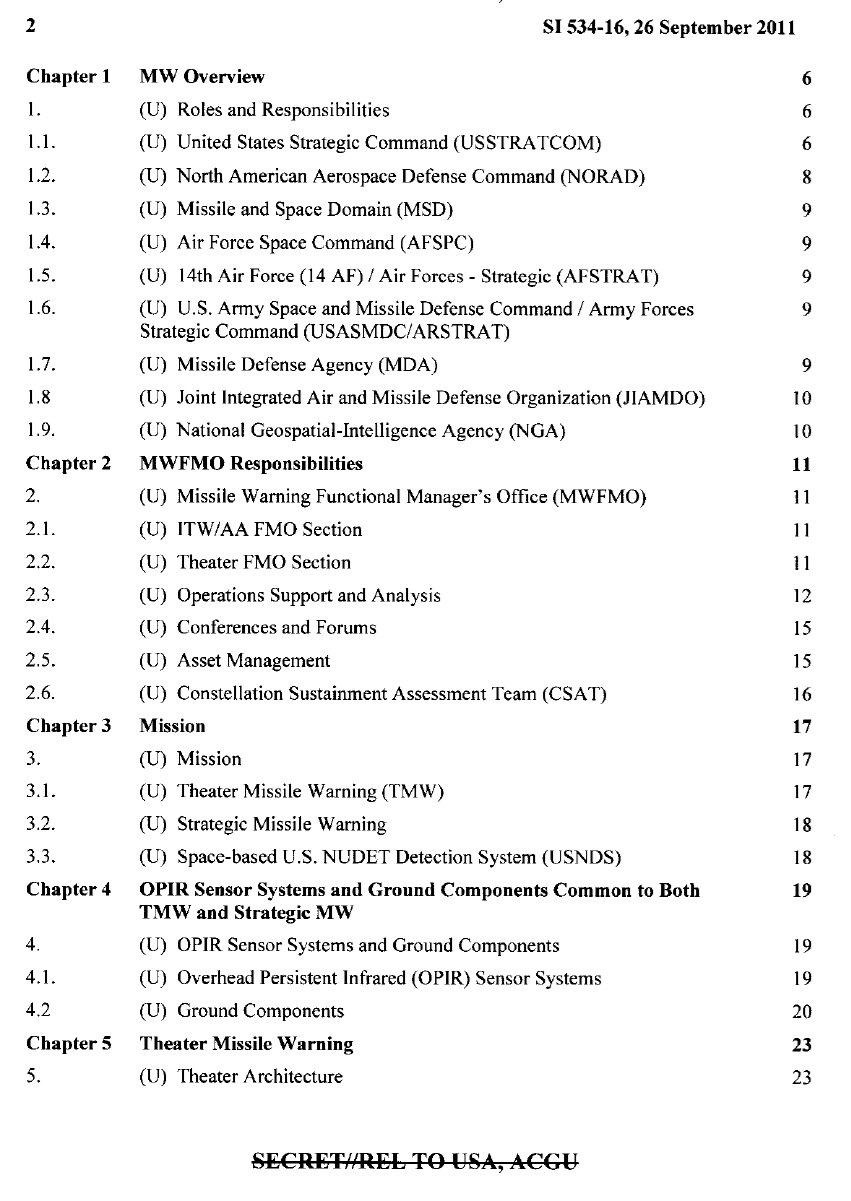
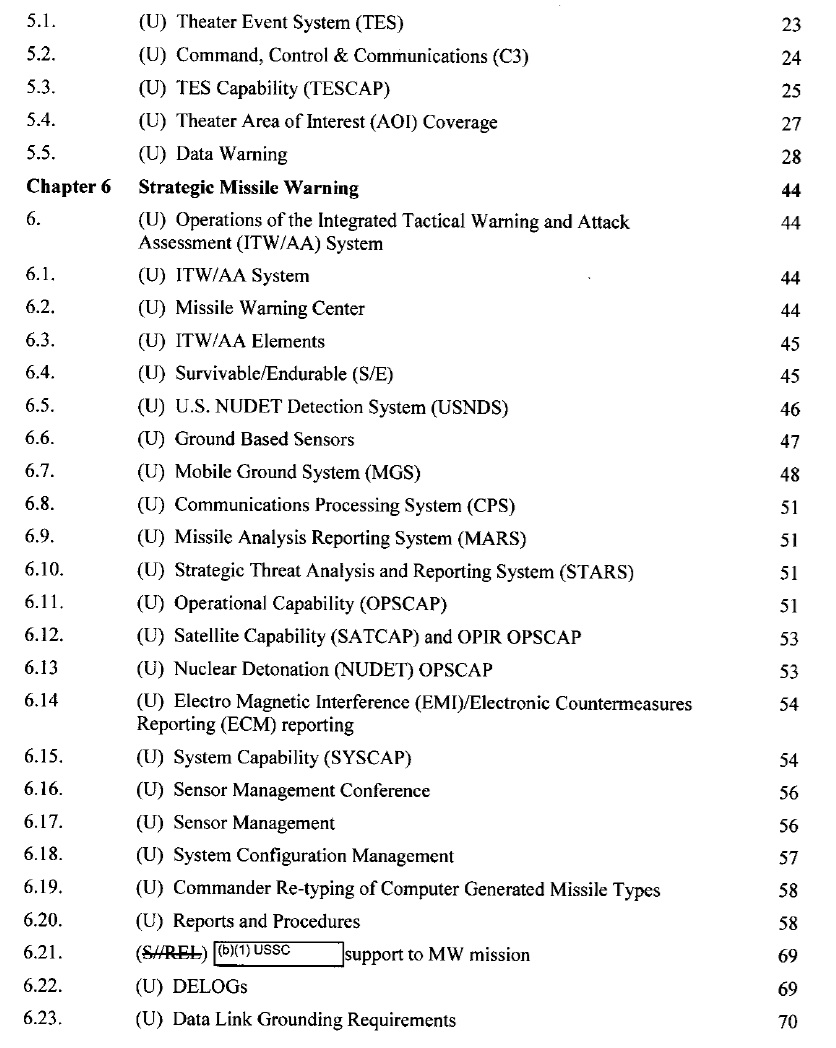
Table of Contents Source: SI 534-16, pp. 2-4.
1. EARLY WARNING WITHIN NC3: MISSION FRAMING
Key Point 1 – ITW/AA supports US and allied leadership with timely, accurate, continuous, unambiguous strategic missile warning
Instruction SI 534-16 defines strategic warning to be:
A notification that enemy-initiated hostilities may be imminent. It may be received minutes, hours, days, or longer before the start of hostilities. Intelligence sources would probably give this notification.”[1]
This definition of strategic warning differs from that used in standard nuclear strategic analysis wherein it usually refers to warning of a possible enemy action viewed with a longer-term framework in contrast to STRATCOM’s characterization of the action being “imminent,” that is, that an attack is pending and relatively soon—although STRATCOM extend “imminent” to be “longer” than days.[2]
As used by STRATCOM in this SI 534-16, “imminent” is also ambiguous because, as one reviewer of this report noted, “ it can mean “tactical warning of strategic missile attack” or “warning based on a variety of both technical but mostly non-technical indicators that attack of strategic significance is about to occur or will occur in the very near future”. These are both different concepts and operate on different timelines, the former on timelines measured in minutes and tens of minutes, the latter measured in (at least) hours and days.”[3] However, as will be seen below, SI-534 mashes these two concepts together in the way that it treats warning at a regional versus a global level of warning of missile attack.
SI 534-16 frames strategic warning as an NC3 function whose primary purpose is to support the highest national authorities with reliable decision inputs. It stresses that:
The ITW/AA [Integrated Tactical Warning and Attack Assessment] system provides unambiguous, timely, accurate, and continuous warning and characterization information to the POTUS [President of the United States], SECDEF [US Secretary of Defense], CJCS [Chairman Joint Chiefs of Staff], Canadian government, UK SpOCC [United Kingdom Space Operations Coordination Centre], duly designated CCDRs, and other users on a continuous basis during peacetime and throughout a conflict or other national crisis to support decisions necessary for situational awareness, force survival, force employment, and reconstitution.[4]
Because nuclear-related decisions are so consequential, “there is little room for error in strategic MW [Missile Warning],” and therefore strategic warning “must be timely, accurate, continuous, unambiguous, and adhere to ITW/AA standards.”[5]
The ITW/AA endurable missions require unambiguous, timely, accurate and continuous information. Endurable elements will endure through all phases of conflict with predictable and graceful performance degradation as the threat environment becomes increasingly hostile. [redacted] The ballistic missile warning/NUDET detection capabilities are required to have endurable elements.”[6]
SI 534-16 distinguishes between Survivable versus Endurable (S/E) Integrated Tactical Warning and Attack Assessment.
Survivable systems provide early warning support similar to that in peacetime or as crisis takes hold and during limited attacks, sometimes called “thick line:”
The ITW/AA survivable missions use facilities, equipment, and systems that are information sources, correlation nodes, forward user systems, personnel at those locations, and communications paths between all components. The ITW/AA survivable missions require unambiguous, accurate, and continuous information to the national leadership and forward users with potentially degraded timeliness until physically destroyed[7]
In contrast, endurable systems provide last‑ditch backbone early warning from start to finish of a nuclear war so that even if communications are damaged and nodes lost, leaders still receive accurate, unambiguous information, but likely slower, less often, and of lesser quality.
The ITW/AA endurable missions require unambiguous, timely, accurate, and continuous information. Endurable elements will endure through all phases of conflict with predictable and graceful performance degradation as the threat environment becomes increasingly hostile.[8]
SI 534-16 explains this distinction further:
Communications Processing System (CPS). CPS is the communications processor for handling incoming sensor event data and distributing outbound correlated data. Fundamental to this design are message tracking and journaling mechanisms supporting message accountability, message aging control, message addressing functions (IP networking), communications protocol conversion functions, and duplicate message elimination (DME) capability. DME is a critical message handling function driven by the communications architecture. The communications architecture incorporates transmission of event data over multiple media/communications paths, with the understanding that by utilizing multiple media in parallel, message delivery probability is improved. These media are further characterized by degree of survivability and operating data rates. Primary day-to day peacetime mission support is provided by the non-survivable path, which features higher data rates, while backup is provided by the slower data rate survivable path. Consequently, once the correlation center receives a high-speed message it is necessary to eliminate the duplicate message transmitted over the low speed survivable path and prevent it from being processed. DME accomplishes this function.[9]
The foundation of the US early warning system are ground-based radars first built in the 1950s to defend against Soviet long-range bombers. Today SI 534-16 explains that ground-based radars perform multiple missions at once, but that missile warning remains a core and protected function. According to the instruction, ground-based radar architecture is comprised of Early Warning Radars (EWRs) and Upgraded Early Warning Radars (UEWRs). It notes that although these radars have been upgraded to support missile warning, missile defense, and space situational awareness missions, the missile warning function remains unchanged.”[10] Two AN/FPS-123 Early Warning Radars are described as “dual-faced phased array radars located at Clear AFS, AK, and Cape Cod AFS, MA.” It states that their “primary mission is to provide warning of SLBM or ICBM attack against the CONUS, Alaska, and Canada,” while their “secondary mission is to provide space surveillance and tracking data” for the Space Surveillance Network. That is, these radars remain primarily to detect ballistic missile attack against North America.[11]
The Upgraded Early Warning Radars are located at “Thule AB, Greenland, Beale AFB, CA, and RAF Fylingdales, UK.” Their “co-primary mission…is to provide warning and assessment of a ballistic missile attack against the CONUS, Alaska, and Canada” and to provide “missile track data and state vectors to the BMDS for target engagement,” while also supporting space surveillance.[12] Thus UEWRs bridge strategic warning and missile defense, supplying both attack warning to the NC3 system and technical track data for defensive engagement.
These radars are supplemented by the AN/FPQ-16 Perimeter Acquisition Radar Attack Characterization System (PARCS). According to SI 534-16, PARCS
Primary mission is to provide warning and attack characterization of an SLBM or ICBM attack against the CONUS, Alaska, and Canada. The secondary mission is to provide space surveillance, tracking, reporting, and SOI [Space Object Identification on ESV [Earth Satellite Vehicle], and supports US nuclear attack submarines.[13]
The final layer, the Mobile Ground System, is referred to briefly in SI 534-16 although it is being replaced by the SBIRS Survivable Endurable Evolution (S2E2) mobile ground capability.[14]
In addition to the ground-based layered radars, the early warning system integrates the US NUDET Detection System (USNDS).
It states that “USNDS provides space-based sensor capability in support of p]re-, trans-, and post-attack scenarios” and explains that the Integrated Correlation and Display System (ICADS) “is the fixed site data processing and reporting system of the USNDS, which reports [redacted] that are sent to all Strategic MW users, AFTAC, and other selected users.”[15]
This means NC3 does not rely solely on launch detection; it also incorporates a dedicated nuclear detonation reporting pathway that can confirm use, support attribution, and sharpen post-detonation assessment. In practical terms, that layered sensing architecture reduces ambiguity about whether nuclear use has actually occurred.
This language effectively codifies the normative choice that positive and negative controls on the use of nuclear weapons at every point in the early warning-decision making chain and execution of strike orders by technical and procedural measures in the form of stringent ITW/AA standards precisely because it supports NC3 decision points where false positives or ambiguous indications could trigger catastrophic outcomes.
Key Point 2 – Theater missile “assured warning” doctrine
In contrast to strategic warning, theater missile warning (TMW) is explicitly optimized for speed, even at the cost of a higher false-alarm rate.
The document defines TMW as “the near real-time notification to operational command centers and the warfighter of a potential missile threat to a designated area of responsibility (AOR), Joint Operating Area, and/or area of interest (AOI),” and requires that TMW messages “include estimated time to impact and estimated impact point and/or geographic area(s) at risk,” with “updates and refined TMW data” provided as available.[16]
The document notes that TMW relies primarily on TES or theater-based early warning indicators from in-theater units and continental US (CONUS) ground sites, sensor data from satellite systems that are used to generate MW reports disseminated to theater users.[17]
This directive sits within an explicit doctrinal construct:
Due to relatively short flight times of Theater Ballistic Missile (TBM) events and the required reaction time for theater forces to respond and react to these threats, theater commanders have adopted a strategy known as ‘assured’ warning.[18]
Under this strategy, the system “emphasizes and establishes the need and priority for the most expedient reporting timeline for TBM threats vice [sic] unambiguous reporting, therefore, accepting the increased likelihood of false event reports.”[19]
In effect, the NC3 architecture reflects a policy choice: theater early warning systems are designed to accept more possible false positive events to save forces, while strategic early warning systems must remain nearly error-free to preserve nuclear stability.
2. GOVERNANCE, ROLES, AND MISSION INTEGRITY
Key Point 3 – USSTRATCOM as the central early warning backstop
The instruction locates STRATCOM at the global center of the early warning function, bridging geographic commands, NORAD, and allies. It states that the Commander, USSTRATCOM “supports Combatant Commanders (CCDR), North American Aerospace Defense Command (NORAD) and allies by providing the missile warning (MW), nuclear detonation (NUDET) detection, and space surveillance necessary to fulfill the U.S. commitment to the NORAD Agreement and provides assessment of missile attack if the appropriate Combatant Command is unable.”[20] STRATCOM also “provides warning and assessment of attack on space assets.”[21]
By explicitly granting STRATCOM the authority to “provide assessment of missile attack if the appropriate Combatant Command is unable,” SI 534-16 ensures a central NC3 backstop: if regional command structures are degraded or overloaded, STRATCOM can still furnish authoritative warning and assessment to national leadership and allies, thereby reducing the chance that early warning failure at theater level cascades into a strategic blind spot—or overrides a theater-level early warning error.
Key Point 4 – MWFMO as the architecture and standards gatekeeper
The Missile Warning Functional Manager’s Office (MWFMO) is tasked with controlling the architecture and procedures through which MW and NUDET data flow to top-level decision-makers. The instruction specifies that:
…the MWFMO is responsible for ensuring compliance with the UCP [Unified Command Plan] and CJCSI 6210.02B [Chairman Joint Chiefs of Staff Instruction (CJCSI) 6210.02B, Information And Operational Architecture Of The Integrated Tactical Warning And Attack Assessment System, cited on page 1 of SI 534-16] assigned missions of providing MW and NUDET detection data to the President of the United States (POTUS), Secretary of Defense (SECDEF), Chairman Joint Chiefs of Staff (CJCS), CCDRs, other U.S. agencies, allies, and coalition partners and advocating for MW and NUDET detection capabilities and characteristics.”[22]
This compliance is “ensured by the strict control of the architectures and operational procedures,” and “strict control of the operational procedures and architectures is ensured through publications, such as Operations Review Boards (SI 534-14) and Configuration Control Boards (CCB) (SI 534-21 and SI 534-22).”[23]
In organizational terms, this structure formalizes a centralized NC3 configuration-control regime for early warning, designed to prevent uncoordinated changes from undermining mission integrity, while also positioning MWFMO as the advocate for future capability upgrades first to US STRATCOM and then to the Joint Staff.[24]
Key Point 5 – NORAD and the Missile and Space Domain as validation and coordination nodes
The instruction clarifies how NORAD and the Missile and Space Domain (MSD) function as validation and correlation layers for North American warning, directly relevant to NC3 stability.
SI 534-16 describes NORAD as:
…a bi national U.S. and Canadian organization charged with the missions of aerospace warning, aerospace control, and maritime warning for North America. Aerospace warning consists of processing, assessing, and disseminating intelligence and information related to man-made objects in the aerospace domain and the detection, validation, and warning of attack against North America, whether by aircraft, missile, or space vehicles, utilizing mutual support agreements with other commands and agencies. Commander NORAD (CDRNORAD) validates, characterizes, assesses, and warns the governments of Canada and the U.S. of any aerospace event that threatens or has the potential to threaten North America.[25]
Complementing NORAD’s tasking, the MSD “will determine attack characteristics, correlate the event, and recommend in a timely, accurate, and unambiguous manner all source information to the CDRNORAD, USSTRATCOM, NMCC [National Military Command Center], CFICC [Canadian Forces Integrated Command Centre], and other key agencies” and “is directly responsible to the Command Center Director (CCD) for participation in the National Event and National Threat conferences.”[26]
SI 534-16 defines the early warning function as follows:
There are three warning roles. Each role has a relationship between the ability to accomplish the role and its anomalous report rate. This relationship is adjustable but the anomalous report potential can never be eliminated. The three roles are:
- U) Detection-The identification of a mission event (missile launch, NUDET, etc.) against a background of noise (Aurora, solar glare, interference, etc.), and the known satellite population. If the detected noise or satellite resembles or exhibits the characteristics of a mission event, the sensor system and or operator could generate and release a notification to command centers. This notification would be based on mission event phenomenology. The optimum detectionprobability is achieved by recognizing mission event characteristics and eliminating anomalous event reporting.
(U) Discrimination-Analytical processing of mission event data to differentiate between those mission events exhibiting characteristics (azimuth, location, etc.) threatening U.S. interests worldwide and those that do not.
(U) Notification-The transmission of the results of detection and discrimination to command centers. This notification can be made in various ways, (computer-to-computer, voice, etc.); and is designed to provide command centers with the event characteristics (who, what, when, and where) necessary for decision making.
Although the aerospace early warning function refers to “man-made objects in the aerospace domain” (including aircraft, spacecraft, and missiles), SI 534-16 primarily addresses early warning of missile attacks. Missile events are defined as:
(U) Missile Threat-A missile threat is any missile event that could potentially threaten North America and areas within 100 nautical miles (nm) of its coast, Hawaii, U.S. forces, national security interests, or allies.
(U) Non-Threat Missile Event-A non-threat missile event is any missile event that does not satisfy the criteria of a missile threat (i.e., does not threaten North America, Hawaii, U.S. forces, national security interests, or allies).
(U) Non-CONUS Threat-An event indicating an impact that is not a threat to the defined North America defended area.[27]
SI 534-16 excludes domestic rocket launches from the categories of threatening missile events:
Missile Event (Domestic)-Any pre-planned, U.S. or Canadian missile event originating in the U.S. or Canada or from a U.S. or Canadian platform. Controlled manned re-entry vehicles of domestic origin (e.g., Space Shuttles) will be processed as Domestic Missile Events. Domestic Missile Events also include scheduled foreign launches employing U.S. or Canadian test ranges.[28]
Such domestic and/or cooperative launch events are further broken down into those that might intrude into and alert Air Force Space Command’s monitoring system only some of which would be reportable events.
Launch Types-Domestic and cooperative launches are classed according to the following categories:
(U) Type I Launch: A domestic or cooperative launch which could become a reportable event whose detection by AFSPC sensors is probable.
(U) Type 2 Launch: A domestic or cooperative launch not having the capability to become a reportable event, whose detection by AFSPC sensors is probable.
(U) Type 3 Launch: (Sounding/Research Rockets): A domestic or cooperative launch whose detection by AFSPC sensors is not expected but possible.[29]
However, early warning sensors can and do pick up intense thermal signatures from many sources, including aircraft jet afterburners and nuclear detonations in past atmospheric nuclear testing and future testing or military use, both of which are explicitly referred to for reporting in SI 534-16.[30]
Together, these roles introduce institutionalized correlation and validation before warnings reach NC3 decision nodes and issuance of strike orders. The intention is to reduce false strategic alerts but also locks NC3 early warning into multi-agency coordination processes all of which must function reliably under crisis pressure and may also be subject to what NC3 experts have long referred to as operational and organizational pathologies that emerge in the transition from peacetime to nuclear-prone crisis conditions.[31]
3. SENSOR AND COMMUNICATIONS ARCHITECTURE
Key Point 6 – OPIR and SBIRS as the core space-based layer shared by TES and ITW/AA
The document identifies Overhead Persistent Infrared (OPIR) systems, especially SBIRS, as the primary space-based detection layer for both theater and strategic early warning. In the section on OPIR, it notes:
The 460 SW (Space Wing), located at Buckley AFB, CO, is responsible for operations of the SBIRS constellation and reports warning information to USSTRATCOM and NORAD early warning centers and MW forward users, theater CCDRs, the BMDS, allies, and other users.[32]
Sensor data from SBIRS and DSP “is certified for TES and ITW/AA by USSTRATCOM J65,” and the Mission Control Station (MCS) “supports both the TES and ITW/AA architectures,” releasing “applicable theater data over the TES communications architecture” and “applicable strategic data over the ITW/AA communications architecture.” [33]
The MCS fuses data to create event reports for transmission to forward users. The MCS itself is a composite entity:
The MCS is operated by the 14 AF through the 460 SW, 460 Operations Group. JFCC Space operates the SBIRS mission through the 2 SWS and 11 SWS, with manning support provided by the 8 SWS, an Air Force Reserve unit, and multiple foreign national partners. The MCS is comprised of the facilities and equipment located at Buckley AFB, CO.[34]
To ensure there are always parallel and/or backup operational options, SI 534-16 states that:
Two fixed ground SBIRS sites (MCS/lMCSB [Interim Mission Control Station Backup] and SMCS) [Survivable Mission Control Station] are operating at the same time. While two sites are operational (parallel), both are capable of releasing data simultaneously over appropriate data communications paths. This is a common occurrence during scheduled transfers. However, only one SBIRS site can be prime at anytime. The other operational SBIRS site will be in backup.[35]
Thus, the same satellite and ground infrastructure underpins both the NC3-critical strategic ITW/AA and the theater-oriented TES. Accordingly, architectural vulnerabilities, data-quality issues, or cyber-physical risks in SBIRS/OPIR could affect both domains simultaneously.
Key Point 7 – Relay ground stations and survivable relays as resilience mechanisms
To ensure continuity of early warning under degraded conditions, SI 534-16 describes a distributed set of relay ground stations, including survivable elements. For example, RGS-B is “a relay ground station co-located with the MCSB at Schriever AFB, CO,” equipped with “two SBIRS/DSP transmit/receive antennas (S-band, K-band, and Q-band compatible),” and RGSC-Contractor which is located at the Interim MSC and also at Boulder. RGS-E “is a relay ground station located near Menwith Hill, United Kingdom,” and RGS-C is “a relay ground station co-located with the IMCSB at Boulder, CO.” [36] The document also refers to RGS-P[Relay Pacific], the location of which is redacted but is in Guam;[37] and RGS-M, Relay Ground Station Mission Control Station, also redacted and of unknown location.[38]
Beyond these, the document references a “Survivable Relay Ground Station (SRGS)” from which “survivable data… is provided to the SMCS via a dedicated … link.”[39] This layered relay architecture, including a specifically fixed, survivable site intended to preserve the flow of missile warning and NUDET data into NC3 even under attack or severe outages, reinforcing survivability of the early warning function and enabling continued strategic decision-making despite infrastructure losses. It is distinct from SBIRS Survivable Endurable Evolution or SSE2 mobile ground system which is not referred to in SI 534-16.[40]
Key Point 8 – TES as a separate but coupled theater early warning system
As noted earlier, SI 534-16 portrays the Theater Event System as the principal mechanism for delivering OPIR-derived theater warning, distinct from but intertwined with ITW/AA.
States SI 534-16:
The TMW mission, including SEW, is largely accomplished by the TES and supports theater users primarily for passive defense, but also supports attack operations and active defense. The TES processes OPIR data from [redacted]… into mission event and situational awareness data in the form of MW events, [redacted] messages. These message are then sent over IBS-S, Integrated Broadcast Service-Interactive (IBS-and voice circuits.[41]
Crucially, it notes that “the TES is used to meet the theater users’ requirements for MW and OPIR information in support of situational awareness of the operational environment,” and that “the TES is not part of the ITW/AA system, although the two systems share some mission commonality and components.”[42] This separateness with shared components means that TES can operate semi-independently for regional operations, but any shared sensor or ground node failure, or mis-configuration can still spill over into the strategic warning infrastructure that feeds into the US global NC3 system.
Key Point 9 – JTAGS and in-theater ground processing and dissemination
JTAGS is described as the in-theater processing element that reduces latency between space detection and local users, thereby tightly coupling early warning to theater C2. The instruction explains that Joint Tactical Ground Station (JTAGS) is the in-theater element of the TES.
There are four operational employed JTAGS detachments: A Detachment in Germany, (JTAGS-EUR); B Detachment in Qatar, (JTAGS-CEN); C Detachment in South Korea, (JTAGS-KOR) and D Detachment in Japan, (JTAGS-JPN). A fifth suite of equipment located in Colorado Springs, CO, supports operator initial qualification training and may be used to replace a damaged or destroyed system.[43]
JTAGS receives and processes direct downlink DDL (Direct Downlink) data from up to three DSP satellites within its field of view. It also emphasizes JTAGS’s connectivity:
JTAGS can establish serial data feeds in Tactical Data Inter-Computer Message Format (TDIMF) and TAB 37 formats in addition to IBS-S and IBS-I dissemination in support of the TES. JTAGS can also provide data directly into theater LINK-16 networks via line of sight radio transmissions and/or serial connection.”[44]
By embedding OPIR-based warning into tactical data links like LINK-16,[45] JTAGS shortens the chain between detection and local defensive action but simultaneously increases the number of operational nodes and interfaces through which mis-reports, cyber interference, or operational misinterpretation can influence both conventional and nuclear decision-contexts.
4. PERFORMANCE, COVERAGE, AND CONTINUITY
Key Point 10 – Measures of Effectiveness (MOEs) and missile taxonomy as tools for calibrating performance
SI 534-16 highlights that theater and strategic warning performance is continuously analyzed using formal measures and a detailed missile categorization scheme. It notes that “MW analysis is conducted to evaluate system performance,” and that “the Theater FMO has established operational Measures of Effectiveness for event analysis and is the office of primary responsibility for MW Analysis.”
Evaluation reports “state performance according to the ten MOEs [these are redacted in the report but relate to criteria such as elapsed time between sensor receipt and report receipt relative to predicted missile impact time, time to obtain dual phenomenology, message latency to reach all network recipients, time to impact minus warning time (warning margin), time between significant state changes such as trajectory update, re‑typing of missile class etc. and dissemination of the updated message etc.]… provide an event analysis synopsis, and, when appropriate, give guidance to improve TES element operational performance.”[46]
For this analysis, missiles are classified using a structured schema shown in Figure 1.
Figure 1: SI 534-16 Ballistic Missiles
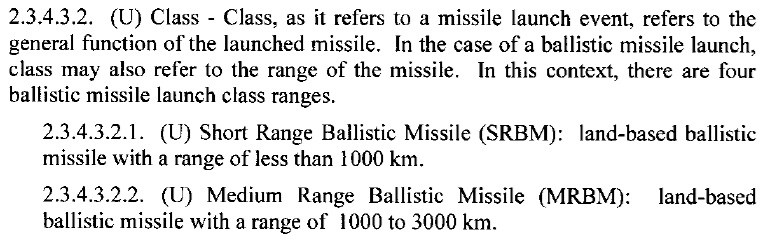
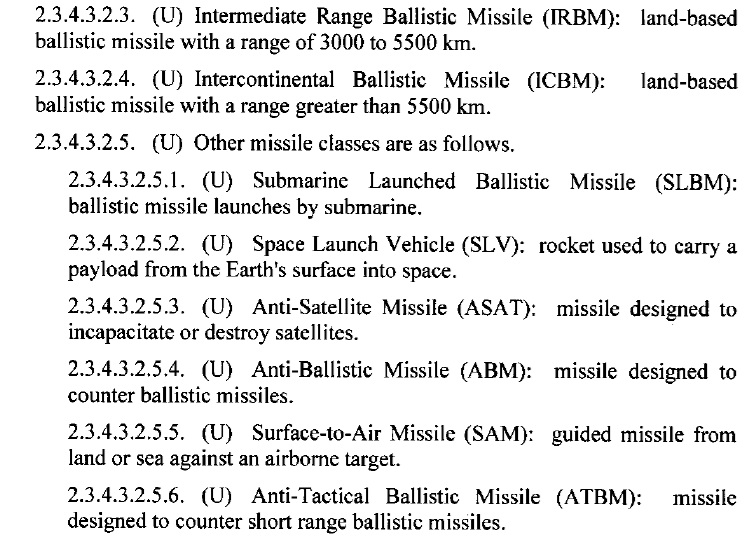
Source Figure 1: SI 534-16, pp. 14-15
This analytic approach provides nuanced assessments of warning performance and a basis for estimating confidence in NC3 early warning in various missile scenarios. It also relies heavily on correct classification and profiling, placing a premium on accurate, timely event characterization.
Key Point 11 – TESCAP, SATCAP, OPSCAP, and “stereo coverage” for assured performance awareness
SI 534-16 introduces a formal capability reporting framework—TESCAP or TES-Theater Event System Capability at the system level and OPSCAP/SATCAP at element and satellite levels—to inform commanders about the real-time operational status of the warning architecture. It defines TESCAP as “an overall assessment of the TES ability to meet TMW operational requirements,” determined “through a combination of the overall OPSCAP of the TES elements.”[47] Each element sets its own OPSCAP for an Area of Interest (AOI) “using the worst case status of three criteria: Sensor, Processor, and Communications.”[48]
For SBIRS/DSP, the instruction specifies that:
DSP sensor OPSCAP is based on the system receiving quality data from a sufficient number of DSP sensors to achieve the accuracies stated in system specifications. Additionally, for determination of AOI OPSCAP status ratings, 100% stereo coverage of an AOI is necessary for an AOI to be considered OPSCAP green. Minimum Detectible Signal (MDS) is used in lieu of SATCAP to determine OPSCAP for AO!s in which the SCUD B (SS-IC) is not the minimum detectable theater missile. In these instances, the MDS equates to the minimum detectable theater missile in that AOL MDS is automatically calculated by the SBIRS system and provides real-time, AOI-specific SATCAP.[49]
Thus, for “OPSCAP green” to be achieved, two separate OPIR sensors must see the same missile plume/trajectory from different angles, enabling better detection, 3‑D localization, and missile characterization. For NC3 as a whole, therefore, these constructs identify where early warning is robust and where it may be degraded or blind, which is vital when deciding how and when to respond when faced with incomplete coverage and/or less than stereo coverage when dismissing the possibility of false positives.
Key Point 12 – Outage reporting and catastrophic backup modes
SI 534-16 prescribes strict outage reporting and describes catastrophic backup modes to preserve at least minimal warning. In the case of TES, for example, “when an OPSCAP change occurs which exceeds, or is expected to exceed two minutes, TES elements will immediately report the outage, cause, and estimated time of return to operations (ETRO) to the MWC and other applicable entities.”[50] The Missile Warning Center will then “report the overall TESCAP to the affected theater(s),” and elements must also notify when “the outage no longer exists” and OPSCAP returns to normal.[51]
For strategic systems, the document acknowledges that “MCS and the SMCS are …” the primary processing sites, and that “in the event of a catastrophic failure (i.e. complete loss of capability to process and disseminate strategic MW) affecting both sites,” backup operations will use pre-defined “release rules, typing, and voice reporting timelines” in “a contingency mission.”[52] The exact modality of ensuring that such reporting is completed with the MCS and SMCS out of action is redacted.
However, it may be the use of humans designated as “Walkers” who are likely roving watch-floor officers or NCOs who physically move between consoles to collect, reconcile, and pass information during significant events, including early warning situations at a missile warning center (MWC) using VOICE TELL defined by SI 534-16 as:
VOICE TELL-Mission event data verbally passed in prescribed formats from the sensor units to the MWC if data lines or Cheyenne Mountain computer systems are inoperative.[53]
This explicit planning for catastrophic failure underscores that NC3 early warning is seen as a potential source of strategic failure and that procedural redundancy is an essential hedge against that risk of unknown efficacy. Short of war, such catastrophic and disabling events may seem improbable. However, such events have occurred in the past due to fires, power outages, and flooding at STRATCOM headquarters.[54]
Walkers also reflect the need to overcome disparate, fragmented digital data flows and human tunnel vision in routine operations. Walkers likely serve an important role on the STRATCOM Battle deck and at Missile Warning Centers by scanning across early warning systems, identifying anomalies, clarifying discrepancies, and connecting dots in ways that digital systems and compartmentalized human beings cannot, prefiguring the increased role of AI support systems in early warning systems.
5. PROCESSES, DUAL PHENOMENOLOGY, AND HUMAN PROCEDURES
Key Point 13 – Dual phenomenology and the detection–discrimination–notification chain
SI 534-16 highlights the long-standing US early warning practice of relying on “dual phenomenology: and a stepwise process from detection through notification of attack to decision-makers to safeguard against false or misinterpreted early warning. It states that “Warning Coverage is a reflection of the capability of the ITW/AA system to provide dual phenomenology detection of ICBM and SLBM launches. It is based on the IR and Radar SYSCAPs [System Capabilities.”[55] SYSCAPs are defined as:
SYSCAP-SYSCAP is the capability of a system (IR, NUDET or Radar) to cover a defined threat area. It is determined by the primary sensor manager and is categorized as Red, Yellow or Green. Red means less than 25 percent of the threat area is covered, Yellow means 25 to 74.9 percent of the threat area is covered and Green means 75 percent or greater of the threat area is covered.[56]
It then defines key stages: “Detection – The identification of a mission event (missile launch, NUDET, etc.) against a background of noise… If the detected noise or satellite resembles or exhibits the characteristics of a mission event, the sensor system and or operator could generate and release a notification to command centers.” “Discrimination” is “analytical processing of mission event data to differentiate between those mission events… threatening U.S. interests worldwide and those that do not,” followed by “Notification – The transmission of the results of detection and discrimination to command centers.”[57]
In NC3 terms, this chain, combined with dual phenomenology, is intended to ensure that only well-characterized and corroborated events drive nuclear-relevant alerts, though the document implicitly accepts that anomalous reports will still arise.
Key Point 14 – Voice reporting, FDFR conferences, and human summarization
Despite heavy automation, SI 534-16 emphasizes that human operators and structured voice procedures remain central in the early warning chain, particularly in theater contexts. It notes that “the MWC receives missile event voice reports simultaneously with theater users, via the First Detect First Report (FDFR) Conference,” and that the MWC is “responsible for theater event verification (characterization and false/real data determination). MWC personnel will use all available information to relay to theater users the true nature of a missile event, providing a ‘worst case’ scenario and identifying known false information.”[58]
A FDFR conference is to activated “for all ballistic missile launch activity and may be activated to provide amplifying missile event information.” The convenor normally will be the MWC (Missile Warning Center). [59] However, “If the MWC is not able to participate on the appropriate FDFR Conference for a real world event, the initiating TES element will assume control of the conference and must provide voice summarization.”[60]
Initial voice reports follow a strict pattern:
(U) Initial Voice Report Format. The initiating TES element will activate the appropriate FDFR [First Detect First Report] Conference and immediately pass the following:
This is (TES CALL SIGN), Standby for missile launch report. (Repeat 2 times) (Preface with “exercise, exercise, exercise,” if required).
This is (TES CALL SIGN) with (a Single or Multiple) launch(es) from (nearest country of launch origin).
Areas/Sectors at risk are: (When required by theater Concept of Operations (CONOPS), report Areas/Sectors at risk IAW supported theater CONOPS).
Note: Upon completion of the initial voice report, the initiating TES element or the MWC will poll the appropriate FDFR conferees.[61]
After TES elements report, “the MWC will accomplish the summary confirmation” and “report the most accurate information by providing the following summary,” then “conduct a final poll of the Tier I nodes.”[62]
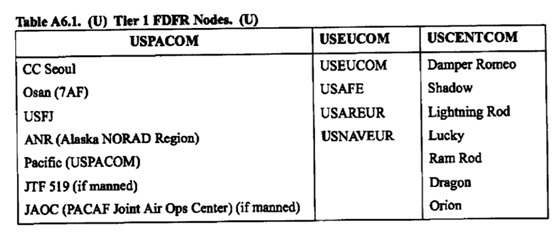
Tier 1 nodes are defined in SI 534-16 as “CCDR [Combatant Commander] designated site(s), which are the first independent recipients of missile warning data and voice warning.”[63] As the recipient users of reports, Tier 1 nodes referred to in SI 534-16 were located in USPACOM, USEUCOM, US CENTCOM, and AFRICOM).[64] Tier 1 nodes as of 2004 are shown in Table A6.1 below[65] and may no longer pertain. They are not listed in SI 534-16.
It is noteworthy that SI 534-16 recognizes that not all agents in this system may be able to participate:
If an FDFR conferee fails to acknowledge when polled, the reporting TES element will reply, “Nothing Heard,” and continue polling the remaining FDFR conferees. The method used to relay to missing conferees will normally be via an alternate direct line. It is at the discretion of all FDFR conferees whether to remain on a conference throughout the duration of the event. Operational necessity may require FDFR conferees to abort the FDFR Conference due to more critical tasks during a missile event. The MWC or TES element should expect no response from some users, particularly during real world events. In the event a Tier I user must drop from the FDFR Conference, the statement, “Break, Break, This is (TES callsign) Out” will be used to inform the MWC the Tier 1 user is departing the net and has all necessary information to complete in theater warning requirements.[66]
A “Two Action” procedure is used to avoid inadvertent sharing of first detection before it is validated.
Two Action Release. During peacetime operations, TES elements will implement two action release procedures to disseminate MW data messages. Two action release is defined as an operator being required to take two separate actions to release a missile event message (e.g., having to enter the release button twice prior to releasing a missile event message). Two action release is required to reduce the potential for inadvertent releases.[67]
However, this control measure to avoid inadvertent releases of possibly erroneous reports may lifted.
During a crisis or wartime situation, single action release may be implemented at the site commander’s discretion.[68]
This attempted ordering and standardization of human communications is intended to mitigate confusion and ensure that NC3-relevant recipients receive a consistent, vetted picture, but it also introduces human performance as a determinant of warning quality under time stress. Thus, SI 534-16 specifies anticipated reporting errors in these procedures:
False Report. A false report is a released missile event report not meeting the release criteria in Attachment 2, Table A2.12. or that did not occur. The TES element involved will immediately send an event cancellation data message, and initiate the FDFR Conference and report an event cancellation IAW section II, para 5.5.6.10.4.4.
Mission Failure. A mission failure is a missile event meeting defined release criteria in Attachment 2, Table A2.12. not released by an operator. A missed missile event constitutes mission failure.
Double Release. Release of a single valid missile event with two different track numbers from the same TES element constitutes a double release. To avoid confusion to users, the TES element involved will immediately send a Cancel Data Message for one of the messages, and immediately activate the appropriate FDFR Conference and report the valid missile IAW established procedures.
Event mistyping. Event mistyping is defined as the occurrence of one of the following at final report: (1) reporting a theater missile as a CEW [Combined Early Warning] event or vice versa (2) reporting a [redacted] or vice versa (3) reporting an event meeting [redacted]
Correct typing is critical as this prompts certain actions at the operational and strategic levels. If additional information presents itself, TES elements must update the initial report with the new data and reactivate the FDFR (reference para 5.5.6.10.2.). TES elements will provide comments in daily Situation Report (SITREP) to highlight mistyping causes when a known mistyping has occurred. Any additional information will otherwise be reported via the FDFR Conference using established procedures.[69]
Moreover, if a system-level problem is causing reporting errors, the Theater Event System (TES) must act to “prevent further release of false data.” [70]
“If necessary,” states SI 534-16, “the TES element will disable the dissemination systems to prevent further reporting errors until the problem is corrected.”[71]
Key Point 15 – Event and NUDET assessment responsibilities and redundancy
Finally, the instruction assigns and backs up assessment responsibilities for both missile events and nuclear detonations to avoid gaps during crises. It specifies that “CDRNORAD assesses attacks on North America only,” while “designated combatant commanders provide situation updates on attacks to U.S. forces, national security interests, and allies within their respective area of responsibility.” USSTRATCOM’s remit extends to space and nuclear phenomena: “CDRUSSTRATCOM assesses attacks on U.S. spacecraft, exoatmospheric nuclear detonations, and the likelihood that a space event is in progress or has occurred,” and critically, “CDRUSSTRATCOM will assume the assessment role if the appropriate COCOM is unable to provide missile event and NUDET assessments.” The instruction defines a missile event broadly as “any processed or voice-told ITW/AA or TES missile warning of a ballistic missile, surface-to-air missile, antiballistic missile, space launch, or space reentry object,” and insists that “each NUDET event must be assessed regardless of whether previous strategic missile events or NUDETs were assessed as YES.”[72]
This redundant, persistent assessment framework is designed so that no single command failure or ongoing attack precludes authoritative interpretation of events for NC3, with particular emphasis on ensuring that every NUDET—however many occur—is individually examined for its implications.
6. CONCLUSION
In the 1980s, a vastly simpler NC3 US early warning system relied on dual phenomenology to distinguish between missile launches that were possibly a threat to the United States and its allies, and those that were discarded as non-threatening. As the second Cold War took grip, the number of routine missile display conferences more than doubled relative to the late 1970s, while the number of conferences to evaluate possible threats increased four-fold. Only six of these events led to threat assessment conferences (see Table II below).
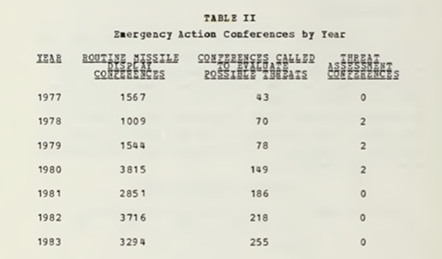
Source Table II: Marsh, Barbara Y. Diegel, “The probability of accidental nuclear war: a graphical model of the ballistic missile early warning system,” Naval Postgraduate School, Monterey, California, March 5, 1985, p. 62, at: https://apps.dtic.mil/sti/tr/pdf/ADA156963.pdf
Since then, the number of events of all kinds that are sensed and reported has increased vastly; the number of missiles launched, space objects tracked, and aircraft tracked has also proliferated massively (blessedly, the number of nuclear detonations tracked has gone to close to zero due to the largely universal nuclear test ban). Concurrently, the capacity of US early warning systems to track and report on these events has also expanded due to computing power, software, and improved sensor systems of all kinds with global reach, resulting in a firehose of continuous digital data to be evaluated following the procedures outlined above. However, whether this system focused as it is on ballistic missiles—even in its technically modernized state today supplemented no doubt with a variety of Artificial Intelligence applications—can track and provide early warning of the rapidly evolving means of delivery of warheads such as cruise missiles, drones and autonomous vehicles is dubious.
Concomitantly, the complexity of the early warning system and its reporting procedures has also increased, as has the speed of possible threatening missiles. During wars such as the Iran-Iraq war of the cities, the Ukraine war, the June 2025 Iran-Israel war, or the current US-Iran war, hundreds of missiles may be fired in a day compared with a typical volume of six and 20 missiles in an uneventful “cold shift” at Buckley Space Force Base.[73] However, no current data equivalent to that shown in the Table above is available in the public domain to determine just how many events are detected and dismissed each day.
Yet we know from SI 534-16 that STRATCOM itself recognizes that many events are ambiguous, that interpretive errors may be made, mistyped, false or “double” (duplicative reports that cause confusion) may be issued, and even that early warning systems may fail catastrophically.
To work around these problems, STRATCOM has implemented multiple checks and balances including requiring “stereo” coverage of IR signatures in areas of interest, dual phenomenology using satellite and radar sensors, a two action release mechanism for reporting missile events, and the likely use of walkers to deliver messages within missile warning centers should they be needed. It also elected to make it possible in theater missile warning centers to forego the second check in the dual action reporting procedure due to the short times associated with adversarial missile arrival against theater targets.
However, it is striking how often and in how many information contexts that SI 534-16 insists that the information that it processes and reports upwards must be “unambiguous.” [74] In the real world, it is normally the case that information is degraded and to base systems design, procedures, analysis and decisions on the notion that it is based on unambiguous information is likely often misleading if not delusional.
In the 1980s, NC3 experts took some solace from the fact that American NC3 was like the Olympic symbol, a set of linked regional commands whereby an error at the edge where friction might occur with a nuclear-armed adversary might result in an early warning error leading to inadvertent or accidental escalation to nuclear war would be dampened by the loosely coupled and relatively decentralized NC3 systems run by theater commands and forward-deployed services and not propagated instantly across the entire NC3 system.
Today, SI 534-16 leads to the impression that the United States is dancing on the edge of chaos with the constant risk that theater-level events may escalate in seconds and minutes and be transmitted to and amplified by a now globally centralized and operated early warning system. Whereas the United States NC3 system co-evolved by its early warning systems with two nuclear armed adversaries during the Cold War, it must now also worry about the DPRK and the state-of-play of five other nuclear weapons states whose nuclear-prone conflicts may cascade across regions to involve the United States or its direct nuclear adversaries.
Ironically, the fitness of the NC3 system and its early warning component are as much in the hands of US adversaries as each “tunes” its NC3 systems to match the behavior of their nuclear adversaries to maintain adaptive stability that avoids descent into the chaos of nuclear war caused by acting on the fantasy of nuclear warfighting on the one hand and a regimented order that so rigid that it is unable to match the complexity of the real world on the other leading to inadvertent or accidental nuclear war.
As worrisome is that the many arcane terms employed in SI 534-16’s procedures in search of precision and control (and blessedly, mostly defined in its glossary[75]) are unique to STRATCOM, and are unknown in US public discourse on nuclear weapons, let alone to its adversaries. Consequently, there is no organizational shared vocabulary nor much common knowledge on strategic early warning between the United States and its nuclear-armed adversaries, or even its allies in many critical respects. Indeed, one wonders how supreme nuclear commanders and heads of state would react if they were required to read and understand this document.[76]
Without such reference points, the leaders and personnel who operate nuclear weapons systems lack shared conceptual frameworks and language that are necessary for effective communication, coordination and collaboration to realize mutual goals such as nuclear war risk reduction, non-proliferation, or disarmament.
It is in this spirit that this Special Report on US strategic early warning is offered to readers, in the hope that other nuclear weapons states may begin to unveil their own early warning procedures and to share them with their nuclear armed adversaries.
III. ENDNOTES
[1] United States Strategic Command (USSTRATCOM), Strategic Command Instruction (SI) 534-16: Missile Warning and NUDET Detection Operations, 26 September 2011, p. 83, downloadable here Hereafter, the citations refer to this document as SI 534-16.
[2] Paul Davis, review comments, April 15, 2026.
[3] Herb Lin, review comments, April 15, 2026.
[4] SI 534-16, p. 18.
US STRATCOM Strategic Command Directive SD-523-2 “THEATER EVENT SYSTEMS (TES) ARCHITECTURE AND OPERATIONS” June 2004 (redacted) is available at: https://www.stratcom.mil/Portals/8/Documents/FOIA/FOIA%2014-070%20-%20SD%20523-2%20Theater%20Event%20Systems%20Architecture%20and%20Operations.pdf?ver=2016-10-17-114022-087
[5] SI 534-16, ibid.
[6] SI 534-16, p. 46
[7] SI 534-16, p. 45
[8] SI 534-16, p. 46
[9] SI 534-16, p. 51
[10] SI 534-16, p. 47
[11] SI 534-16, p. 47
[12] SI 534-16, p. 48
[13] SI 534-16, p. 48
[14] SI 534-16, p. 48d
[15] SI 534-16, p. 36
[16] SI 534-16, Ibid, p. 17
[17] SI 534-16, Ibid, p. 17
[18] SI 534-16, Ibid, p. 17
[19] SI 534-16, Ibid, p. 17
[20] SI 534-16, Ibid, p. 6
[21] Ibid
[22] SI 534-16, p. 11
[23] SI 534-16, p. 9
[24] SI 534-16, p. 9
[25] SI 534-16, Ibid, pp. 8-9
[26] SI 534-16, Ibid, p.9
[27] SI 534-16, p. 82
[28] SI 534-16, p. 82
[29] SI 534-16, p. 81
[30] SI 534-16, pp. 101-102 The early DSP satellites picked up many such infrared events and in one case, led to creation of a special PROJECT FAST WALKER to exploit such data from Soviet Backfire bombers. J. Richelson, “Space-Based Early Warning: From MIDAS to DSP to SBIRS,” National Security Briefing Book, November 9, 2007 at: https://nsarchive2.gwu.edu/NSAEBB/NSAEBB235/20130108.html
[31] P. Kronenberg, “Command and control as a theory of interorganizational design,” Defense Analysis, 4:3, October 1988, pp. 229-252, at: https://www.tandfonline.com/doi/abs/10.1080/07430178808405355 See also: P. Bracken, The Command of Strategic Forces, Dissertation, Yale University, 1982; Ashton Carter, “Sources of Error and Uncertainty,” in A. Carter, J. Steinbruner, and C. Zraket, ed, Managing Nuclear Operations, 1987, pp. 611-640; : Scott Sagan, The Limits of Safety, Organizations, Accidents, and Nuclear Weapons, Princeton, New Jersey 1993; D. Ball, Can nuclear war be controlled? Adelphi Papers, 1981, at: http://www.tandfonline.com/doi/abs/10.1080/05679328108457385 Blair, Strategic Command and Control: Redefining the Nuclear Threat, Brookings, 1985; B. Blair, J. Steinbruner, The Effects of Warning on Strategic Stability, Occasional Paper, Brookings Institution, Washington DC, January 1, 1991, at https://www.brookings.edu/books/the-effects-of-warning-on-strategic-stability/
[32] SI 534-16, p. 19
[33] SI 534-16, op. cit., p. 20
[34] SI 534-16, op. cit., p. 20
[35] SI 534-16, ibid, p. 20
[36] SI 534-16, ibid, p. 21
[37] “The US NIWC Pacific [US Naval Information Warfare Center headquartered in San Diego with a detachment in Guam] will also develop six antennas, which will be deployed to Guam, for RGS-A. After being deployed, the antennas will be remotely monitored from the US. The antennas will allow geosynchronous orbit operations of the legacy satellites by the Space Systems Command (SSC) Next Generation Space Based Infrared System (SBIRS) Ground System.“ “Northrop Grumman to develop relay ground station for US NIWC Pacific,”, April 20, 2022, at: https://www.naval-technology.com/news/northrop-grumman-to-develop-relay-ground-station-for-us-niwc-pacific/?cf-view In fact, open source researchers have identified the site with precision as being at NCTS Station Finegayan, Guam, at 13.571308°, 144.840581° and have monitored the radome construction from satellite photos since November 2024. Personal communication, Richard Tanter, April 8, 2026. Many of the redactions in the FOIA release of SI 534-16 are similarly easily controverted by publicly available data, much of it from STRATCOM itself.
[38] The RGS acronyms are spelled out in “Abbreviations and Acronyms,” SI 534-16, p. 78.
[39] SI 534-16, op. cit., pp. 21-22
[40] See US Air Force, “Space-Based Infrared System Program, High Component (SBIRS HIGH),” 2016, at: https://www.dote.osd.mil/Portals/97/pub/reports/FY2016/af/2016sbirs.pdf?ver=2019-08-22-105431-450 “USSF reinforces resilience of National missile warning architecture through SBIRS Survivable Endurable Evolution Operation Acceptance,” Press Release, April 30, 2025, at: https://www.ssc.spaceforce.mil/Newsroom/Article/4170656/ussf-reinforces-resilience-of-national-missile-warning-architecture-through-sbi “US Space Force strengthens missile warning network with acceptance of next generation SBIRS S2E2 system,” Space War, May 2, 2025 at: https://www.spacewar.com/reports/US_Space_Force_strengthens_missile_warning_network_with_acceptance_of_next_generation_SBIRS_S2E2_system_999.html
[41] SI 534-16, op. cit., p. 23
[42] SI 534-16, ibid
[43] SI 534-116, pp. 23-24
[44] SI 534-116, p. 24
[45] LINK 16 is not in itself part of the TES system. Nonetheless, JTAGS has the ability to provide TMW data via LINK-16; see SI 534-16, p. 25. LINK 16 is a secure, jam‑resistant military tactical data link network used by the United States, NATO, and partners to share real‑time tactical information. BAE Systems, “Link 16 Terminals, no date, at: https://www.baesystems.com/en/product/link-16-terminals
[46] SI 534-16, op. cit., p. 13
[47] SI 534-16, op. cit., p. 25
[48] SI 534-16, ibid
[49] SI 534-16, p. 26
[50] SI 534-16, p. 27
[51] SI 534-16, ibid
[52] SI 534-16, p. 36
[53] SI 534-16, p. 84
[54] At Offut Air Force Base, for example, the nuclear command center had been built in 1989, before modern computers and communication systems existed. As General Robert Kohler stated in 2012, the then existing nuclear command and control center and NC3 node was unable to support current mission demands; it was often self-disabling due to heating and cooling problems, electrical failures, and other outages. As Kohler reported, “[I]n December 2010 and January 2011, two water pipe ruptures caused significant system outages and dislocated staff for several days,” demanding extraordinary workarounds and “a small army of outside emergency help…” Not only did the command center leak; but when aging fans quit, they caught fire, about once a month until 2010. Under the floor, he continued, is a “riot of multicolored wires, all added over the decades to accommodate new technologies as they were introduced.” This center required cooling to operate the thousands of computers in the building. It had three chillers, all of which had to work to keep up with the cooling demand, there being no backup. “If any of the three chillers goes off,” he noted, “we have to start shutting down computers.” Prepared Statement by Gen. C. Robert Kehler, HEARINGS Before The COMMITTEE ON ARMED SERVICES, U.S. Senate, 112th Congress, 1st Session on S.1253,DEPARTMENT OF DEFENSE AUTHORIZATION FOR APPROPRIATIONS FOR FISCAL YEAR 2012 AND THE FUTURE YEARS DEFENSE PROGRAM, Part 7, Strategic Forces, MARCH 30; APRIL 6, 13; MAY 11; JUNE 3, 2011, at: http://www.gpo.gov/fdsys/pkg/CHRG-112shrg68090/html/CHRG-112shrg68090.htm Steve Liewer, “At worksite at Offutt, $1.2 billion StratCom HQ taking shape,” Omaha-World, March 16, 2015, at: http://www.omaha.com/news/military/at-worksite-at-offutt-billion-stratcom-hq-taking-shape/article_5687667c-2ee2-5492-87f1-0b466d262c03.html D. Miles, “New Complex to Support Stratcom’s 21st-century Missions,” American Forces Press Service, April 1, 2013, at: https://www.dvidshub.net/news/508576/new-complex-support-stratcoms-21st-century-missions
STRATCOM moved into a new command center in mid-2018. By STRATCOM’s own admission, the construction delayed due to mould in ductwork and flood and fire events, in part due to building the facility in a site with groundwater surrounding the underground facility. U.S. Strategic Command Public Affairs, “USSTRATCOM’s New Command and Control Facility Transitions to Phase II,” June 15, 2018, https://www.stratcom.mil/Media/News/News-Article-View/Article/1548783/usstratcoms-new-command-and-control-facility-transitions-to-phase-ii/
Like the old command center, the new site remains at-risk from groundwater due to its proximity to the Missouri River flood plan as flooding and groundwater height varies by season, elevation, and fluctuation of the Missouri River. FINAL ENVIRONMENTAL ASSESSMENT, Offutt Air Force Base Nebraska 55th Wing, February 2013, p. 8, at: https://apps.dtic.mil/sti/tr/pdf/ADA614560.pdf STRATCOM encountered this risk less than a year after the new nuclear command center opened when the Missouri River inundated much of Offut Air Force Base. 55th Wing Public Affairs, “Team Offutt battling flood waters,” March 17, 2019 at: https://www.stratcom.mil/Media/News/News-Article-View/Article/1788472/team-offutt-battling-flood-waters/ T. Rogoway, “Home Of Strategic Command And Some Of The USAF’s Most Prized Aircraft Is Flooding (Updated),” The TWZ Newsletter, July 16 2019, at: https://www.twz.com/26991/home-of-strategic-command-and-some-of-usafs-most-prized-aircraft-is-flooding
[55] SI 534-16, p. 84
[56] SI 534-16, p. 83
[57] SI 534-16, pp. 84-85
[58] SI 534-16, p. 7
[59] SI 534-16, p.34
[60] SI 534-16, p.34
[61] SI 534-16, p. 34
[62] SI 534-16, p. 35.
[63] SI 534-16, p. 83
[64] SI 534-16, p. 96
[65] US STRATCOM Strategic Command Directive SD-523-2, op. cit. p. 58.
[66] SI 534-16, pp. 34-35
[67] SI 534-16, p. 34
[68] SI 534-16, p. 34
[69] SI 534-16, pp. 31-32 Note: Paragraph numbers have been removed in this excerpt.
[70] SI 534-16, p. 32
[71] SI 534-16, p. 32
[72] SI 534-16, p. 61
[73] “How America Detects Every Missile Launch On Earth,” Access Granted, November 9 2025, minutes 10-11 at: https://www.youtube.com/watch?v=qSoepoVfB7U
[74] Paul Davis, review comments, April 15 2026.
[75] SI 534-16, “Abbreviations and Acronyms,” pp. 72-80, and “Terms, pp. 80-85.
[76] George Perkovich, review comments, April 21, 2026.
IV. NAUTILUS INVITES YOUR RESPONSE
The Nautilus Asia Peace and Security Network invites your responses to this report. Please send responses to: nautilus@nautilus.org. Responses will be considered for redistribution to the network only if they include the author’s name, affiliation, and explicit consent.