

GARETH EVANS
AUGUST 31 2026
I. INTRODUCTION
Gareth Evans argues that it is imperative to educate government policymakers and military practitioners–and those advising or influencing them–on all the ways in which existing international law constrains both the use and threat of use of nuclear weahttps://nautilus.org/announcements/books/the-law-on-nuclear-weapons/pons, and the critical importance of restoring its salience. “An online course on Nuclear Weapons Law now on offer at the University of Sydney, open to all comers worldwide, is an admirable new initiative aimed at doing just that,” he concludes.
Gareth Evans was Australian Foreign Minister 1988-96, President of the International Crisis Group 2000-09, and Chancellor of the Australian National University 2010-19. He initiated the Canberra Commission on the Elimination of Nuclear Weapons, co-chaired the Australia-Japan International Commission on Nuclear Non-Proliferation and Disarmament, was founding convenor of the Asia Pacific Leadership Network on Nuclear Non-Proliferation and Disarmament (APLN), and co-authored Nuclear Weapons: The State of Play (ANU, 2013 and 2015).
The course Nuclear Weapons Law referred to in this report may be accessed here
The course is a joint initiative of University of Sydney, developed by its Centre for International Security Studies (CISS) and its Law School, along with the Nautilus Institute for Security and Sustainability and funded by the Ploughshares Fund and MacArthur Foundation.
The expert legal manual used by the course, The Law on Nuclear Weapons: An International Commentary is available Open Access (free download) here
This report is published simultaneously by Nautilus Institute here, by Asia Pacific Leadership Network here, and in an abridged version by The Conversation here
The views expressed in this report do not necessarily reflect the official policy or position of the Nautilus Institute. Readers should note that Nautilus seeks a diversity of views and opinions on significant topics in order to identify common ground.
This report is published under a 4.0 International Creative Commons License the terms of which are found here.
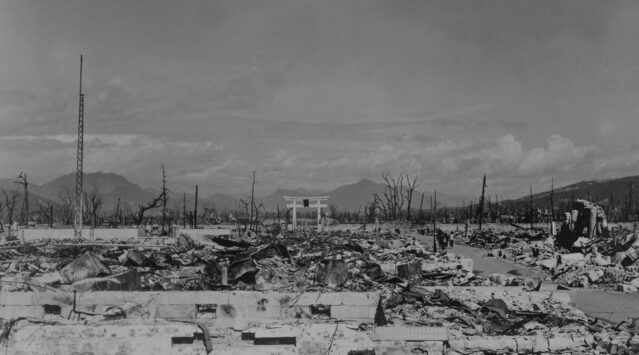
Banner image: Source: Post-nuclear attack Nagasaki, US National Archives here
II. NAPSNET SPECIAL REPORT BY GARETH EVANS
NUCLEAR SANITY: RECOGNISING AND RESTORING THE SALIENCE OF INTERNATIONAL LAW
AUGUST 31 2026
There could be few more worthwhile enterprises than educating government policymakers and military practitioners, and those advising or influencing them, on all the ways in which existing international law constrains both the use and threat of use of nuclear weapons, and the critical importance of restoring its salience. An online course on Nuclear Weapons Law now on offer at the University of Sydney, open to all comers worldwide, is an admirable new initiative aimed at doing just that.
The uncomfortable reality, however, is that while this educational objective has never been more necessary, it has also probably never been more difficult to realize, with both nuclear arms control and respect for international law currently under more stress than they have been for many decades.
In the case of nuclear arms control, in all three of its dimensions – risk reduction, non-proliferation and outright elimination – the outlook is desolate. The important agreements of the past are dead or on life support. And the recent behaviour of the actors that matter most – the United States, Russia and China – has fed concerns that things can only get worse.
The nine nuclear-armed states possess between them over 12,200 nuclear warheads, with a combined destructive capacity of more than 145,000 Hiroshima bombs. Some 9000 of these are militarily active or deployed. Alarmingly, some 2000 US and Russian weapons remain on high alert, ready to be launched within a decision window for each president of four to eight minutes. The United States and Russia, holding between them 90 per cent of the global stockpile, dramatically downsized their inventories after the end of the Cold War, but that momentum has completely stalled. Every nuclear-armed state is now modernising or increasing its arsenal, especially China, whose inventory has doubled in a few short years to nearly 600 weapons, with new land- and seaborne delivery systems.
More troubling still, the longstanding taboo against the use of nuclear weapons may be weakening, with Russia’s President Vladimir Putin in particular talking up this prospect in the Ukraine war in language not heard since the height of the Cold War. A number of states are considering using nuclear weapons – especially so-called “tactical” weapons – not just for deterrence but for warfighting.
The big arms control agreements of the past, which – at least between the United States and Russia – banned certain systems outright, set constraints on deployments and built confidence through transparency, are now dead, including the Anti-Ballistic Missile and Intermediate-range Nuclear Forces treaties. With the expiry in February 2026 of New START, the 2010 Strategic Arms Reduction Treaty, Russia and the United States are without any limits on their nuclear forces for the first time in over fifty years.
Moreover, crucial multilateral treaties are only barely alive. Both the United States and Russia have withdrawn from the Open Skies Treaty. The Comprehensive Nuclear-Test-Ban Treaty, though operating in practice, has still not been finally ratified, and President Trump has, alarmingly, floated the prospect of the United States ignoring its prohibitions. And the Treaty on the Non-Proliferation of Nuclear Weapons is in as fragile a condition as it has ever been. The loss of confidence in Washington’s willingness to deliver on its extended nuclear – or even conventional – deterrence commitment to close allies has led to serious discussion in South Korea, and even in some quarters in Japan, about the need to acquire their own nuclear weapons, with such conversations also now beginning in Europe.
The safeguards system of the International Atomic Energy Agency is still reasonably functional, as are less formal restraint mechanisms such as the Nuclear Suppliers Group and Missile Technology Control Regime. But about the only other good news on the non-proliferation agreement front is that regional nuclear-weapon-free zone treaties are continuing to hold their own in South-East Asia (with China recently, at long last, agreeing to join), the South Pacific, Latin America, Africa and the Antarctic.
When it comes to nuclear disarmament, new heart has been given to campaigners by the Treaty on the Prohibition of Nuclear Weapons, agreed by 122 UN member states in 2017 and in force since 2021, which bans nuclear weapons outright. But there is less to this treaty than meets the eye. There is no prospect, for the foreseeable future, of it being signed or ratified by the states that matter – the nuclear-armed states, or the “umbrella” states (like Australia) believing themselves to be sheltering under their protection. Moreover, nuclear disarmament discussion has become more complicated in recent years with ever more dual-use systems in operation, especially ballistic or cruise missiles which could carry either nuclear or conventional weapons, and the emergence of real concerns about the development of weapons in space, hypersonic weapons, lethal autonomous weapons, cyberwarfare and the impact of artificial intelligence generally. Multilateral agreements for most of these new areas have not been even conceptualized, let alone negotiated.
Of course, there is much more international law applicable to the threat or use of nuclear weapons than just the various nuclear-specific treaties that are for the most part now dead or on life support. There is the large body of law, starting with the UN Charter, relating to the threat or use of force, prohibiting any cross-border aggression except in legitimate self-defence or with Security Council approval. There is the 1996 Advisory Opinion of the International Court of Justice which decided (albeit by the narrowest of majorities) that “the threat or use of nuclear weapons would generally be contrary to the rules of international law applicable in armed conflict, and in particular the principles and rules of humanitarian law”.
There is the mass of international humanitarian law, or law of armed conflict, both customary and embodied in treaties like the Geneva Conventions, which – particularly in its emphasis on necessity and proportionality – has huge implications for the conduct of nuclear operations: targeting policy, and other dimensions of NC3 (nuclear command, control and communications) generally. International human rights law, especially as embodied in the International Covenant on Civil and Political Rights, has some potential application, as does international law relating to wanton destruction of the natural environment. And there is the large body now of international criminal law, relating to genocide and other crimes against humanity, and war crimes, which sets important new constraints on the freedom of action of individual nuclear decision-makers subject to it.
However, when it comes to the application of all this additional constraining international law – critically important as it is protecting the world from the insanity of nuclear conflict breaking out, or doing at least something to mitigate its horror if it does – the unhappy reality we have to face is that the whole concept of international law is under greater stress than it has been within any of our living memories.
Russia’s invasion of Ukraine in brazen defiance of Article 2(4) of the UN Charter – and in total abdication of its responsibility as a permanent member of the Security Council – is only the most serious example of what has become all too common behaviour by states who should know better, including China with its militarization of the South China Sea in complete disregard of the international law of the sea, and the United States with its 2025 strikes against Iran’s nuclear sites, without any pretence of a legally defensible imminent threat to Israel or anyone else, and its more recent body-snatch of Venezuelan President Maduro. Of all the outrageous assaults on decency perpetrated by President Trump, the nadir was possibly his New York Times interview in January 2026, when he said that “I don’t need international law” and that the only constraint on his power as president of the US was “my own morality, my own mind.”
Depressing as all this may be, the last thing the world can afford to do – and that anyone with half an instinct for sanity and decency in the conduct of international affairs should want to do – is give up on international law. Of course, this body of rules has always had its detractors – on the ground of its inherent unenforceability without the cooperation of multiple national actors, or the challenge it poses to extreme realist theories of international relations. But it is hard to argue against the proposition that everyone’s national interests are ultimately best served by a rule-based rather than realpolitik-based international order. conducting international life either without principled standards, or with double standards.
There is no more important time than now than to reinforce, for a new generation of policymakers, practitioners and their advisers and influencers, the perception that there is huge ongoing utility in understanding the critical role that international law has played in the past, and can and should play in the future, in constraining the use of these weapons, the most indiscriminately inhumane ever invented and the only ones currently posing an existential risk to life on this planet as we know it.
As will be made clear in the ground-breaking new course now on offer at the University of Sydney, there are strong foundations on which to build. The whole history of nuclear force development, design of delivery systems and warheads, weapons testing, deployment decision-making, and stockpile security and reduction owes a great deal to perceptions of the salience of international law. And looking to the future, an immediate focus for this educational effort will be on those working – or who should be working – on the revision and strengthening of nuclear armed states’ NC3 systems, which are crucial in ensuring that their nuclear weapons are only ever used as an absolutely last resort, and in strict accordance with all the other prohibitions and restrictions demanded by international law.
Participants in this course, developed by the University’s Law Faculty and Centre for International Security Studies in partnership with the Nautilus Institute, will be guided by eminent global experts in this field, led by Retired RAF Air Commodore Professor William Boothby. And they will benefit by having, as the basic textbook for the series of eighteen online lectures comprising the course, the magnificently comprehensive new open access manual, The Law on Nuclear Weapons: An International Commentary, jointly edited by Professor Boothby with his equally distinguished German colleague Wolff Heintschel von Heinegg, in a project guided to fruition by the Nautilus Institute’s Peter Hayes. Other expert lecturers in the course include Professors Emily Crawford at the Sydney University Law Faculty, Anna Hood at the University of Auckland Law Faculty and Geoff Corn at Texas Tech University School of Law.
The initiation of this course on ‘Nuclear Weapons Law’ is a long overdue enterprise, one from which I am now acutely aware that I and my own generation of policymakers and practitioners would unquestionably have benefited.
I hope it gets the global attention and take-up it deserves.
III. NAUTILUS INVITES YOUR RESPONSE
The Nautilus Asia Peace and Security Network invites your responses to this report. Please send responses to: nautilus@nautilus.org. Responses will be considered for redistribution to the network only if they include the author’s name, affiliation, and explicit consent.