The Case of the Rescinded Invite

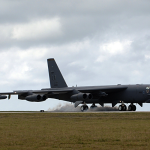
B-52 Stratofortress bomber from the 96th Expeditionary Bomb Squadron lands on Andersen AFB, Guam. Photo source: US Air Force

Roger Cavazos asks, “What happened to Ambassador Robert King’s invite to North Korea?”  How could things have gone so disastrously off-track in 72 hours and what does it mean for the future of the relationships between the U.S. and North Korea?   Roger Cavazos is a Nautilus Institute Associate and retired US military officer with assignments in the intelligence and policy communities.

A New Day in Northeast Asia?

James Goodby and Markku Heiskanen assess the significance of the recently reached agreement to reopen the Kaesong Industrial Complex. They write: “it shows a readiness to negotiate on both sides and could be seen as a first success for “trustpolitik,” President Park’s description of her hopes for North-South relations. Perhaps it signals the beginning of a new day in Korea.”
James Goodby is a former US ambassador to Finland now affiliated with Stanford University’s Hoover Institution and with the Center for Northeast Asian Policy Studies at the Brookings Institution.

Markku Heiskanen is a retired Finnish diplomat, now program director of The Asia Institute in Seoul.

Defining denuclearization

In this Policy Forum Roger Cavazos explores the definition of ‘denuclearization’. He writes “Denuclearization …

South Korea can get more than symbols from Beijing, Peter Hayes, Global Times

Peter Hayes writes: Whether South Korean President Park Geun-hye’s “trustpolitik” is merely a slogan or a solid policy strategy will be revealed during her visit to China starting on Thursday.

Superficially, the combined US and North Korean hard lines leave little space for Park to obtain more from China than a similar joint statement to that issued by Chinese President Xi Jinping and his US counterpart Barack Obama at their recent summit.

Although useful to Park for domestic consumption, a joint statement that a nuclear-armed North Korea is not acceptable will do nothing to resolve the fundamental nuclear problem with North Korea.

Park Geun-Hye’s China Challenge

Is it possible for President Park to get China to commit to more than a symbolic statement regarding North Korea’s nuclear weapons program during her upcoming meeting with President Xi Jinping? According to Peter Hayes, “The answer is definitely yes. South Korea can propose at least three types of “three party talks” at the Summit that would put South Korea in the driver’s seat, and break the deadlock with North Korea. These are all consistent with the eventual resumption of the Six Party Talks, although they do not depend upon this happening to have positive effects.” He goes on to state that, “At this juncture, only President Park can provide the necessary leadership to move this agenda forward.”

Peter Hayes is the Executive Director of the Nautilus Institute and a Professor at RMIT University.

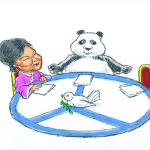
A Regional Framework for a Comprehensive Security Settlement in the Korean Peninsula

James Goodby writes that if the Administration’s “pivot to Asia” is meant to signal a new era of American activism in the Asia-Pacific region, the president should describe to his partners in Asia how he sees the elements of a comprehensive security settlement coming together. A beginning can be made by defining the categories of security issues that need to be addressed, and by which states. The three main categories are:

(1) issues left over from the 1950-53 Korean War and the elements of a North-South peace regime (most of which have solutions that have been formally agreed upon in past statements issued by the North and South Korean Governments and many have been at least implicitly endorsed this year by Kim Jong-un)

(2) issues related to North Korea’s nuclear weapons program (and President Obama’s call for “a world without nuclear weapons” could be a device for placing a de facto nuclear weapons-free zone on the agenda to address this), and

(3) issues related to regional inter-state relations in Northeast Asia (one approach to solving these would be to organize something like an Organization for Security and Cooperation in Europe (OSCE) for Northeast Asia).

James Goodby is a Nonresident Senior Fellow at the Center for Northeast Asia Policy Studies, The Brookings Institution. Ambassador Goodby’s analysis does not necessarily reflect the opinions of the institutions with which he is affiliated.