

PETER HAYES
FEBRUARY 22 2026
I. INTRODUCTION
This special report written and edited by Peter Hayes summarizes and provides copies of 10 documents released under the US Freedom of Information Act on legal guidance on STRATCOM’s compliance with the laws of armed conflict in relation to nuclear weapons.
Peter Hayes is Director of the Nautilus Institute and Honorary Professor at the Centre for International Security Studies at the University of Sydney, and Senior Research Advisor of the Asia-Pacific Leadership Network
Acknowledgement: The research for this FOIA request and publication was funded by New Land Foundation and Ploughshares Fund.
This report is dedicated to the memory of William Burr, nuclear historian extraordinary at the National Security Archive.
The views expressed in this report do not necessarily reflect the official policy or position of the Nautilus Institute. Readers should note that Nautilus seeks a diversity of views and opinions on significant topics in order to identify common ground.
This report is published under a 4.0 International Creative Commons License the terms of which are found here.
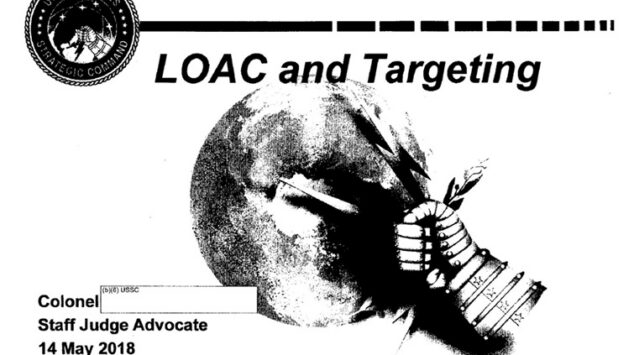
Banner image: STRATCOM briefing paper, Document 4 in this special report
II. NAPSNET SPECIAL REPORT BY PETER HAYES
US STRATEGIC COMMAND ON NUCLEAR WEAPONS & LAWS OF ARMED CONFLICT
FEBRUARY 22 2026
1. OVERVIEW
Ten documents released by US Strategic Command on June 29 2019 under a US Freedom of Information Act request to Nautilus Institute sketch how USSTRATCOM lawyers between the late 1990s and mid‑2010s framed nuclear weapons, targeting, and the law of armed conflict (LOAC) and gave legal guidance to senior commanders and targeteers.
A December 19 2017 email (Document 1) addresses presidential succession and nuclear release, grounding nuclear command authority in statutory rules on who may exercise the powers of the presidency and noting Congress’s limited but real role (for example, authorizing transfer of nuclear weapons from DOE to DoD). An April 10 2015 information paper (Document 2) applies LOAC to “infrastructure,” affirming civilian objects’ protection in both nuclear and conventional conflicts, explaining when objects lose protection, and treating “economic infrastructure” based only on tax revenue as normally civilian but controversially targetable, subject to rigorous intelligence‑driven military‑objective and proportionality analysis.
Several internal memoranda (Documents 3, 5, 7, 8) and briefings (Documents 4, 6) ranging from 1995 to 2019 elaborate a consistent core argument there is no per se prohibition on nuclear weapons in treaty or customary law; nuclear operations are governed by the same LOAC principles as conventional operations—military necessity, distinction, proportionality, and unnecessary suffering. These texts explain U.S. positions on overflight (ICBMs/SLBMs in space need no overflight consent; bombers and cruise missiles do), detail political launch‑notification and risk‑reduction arrangements with Russia, and walk through the Nuclear Non‑Proliferation Treaty, negative security assurances, nuclear‑weapon‑free zones, mutual defence treaties, and how these shape—but do not eliminate—U.S. nuclear options.
Documents 5, 7, and 8 focus on Additional Protocol I and customary law: they accept AP I’s definition of “military objective” and core civilian‑protection rules as customary, stress that civilians may never be made the object of attack, and insist that nuclear attacks must meet military‑objective and proportionality tests, even while maintaining that AP I as a treaty does not apply to nuclear weapons. They also treat the 1996 ICJ advisory opinion as influential but limited—the ICJ imposed no categorical ban; allowed for possible legality in extreme self‑defence; and reaffirmed that any nuclear use must comply with LOAC.
Two large teaching/briefing slidedecks (Documents 4 and 6) translate these legal principles into operational targeting practice: defining military objectives and dual‑use targets, explaining “no‑strike entities,” restricted targets, target‑list management, economic‑target validation, and nuclear‑targeting rules. They repeatedly emphasize that nuclear weapons are lawful weapons, that targeting must be intelligence‑driven, and that legal advisors must review plans and targets as part of routine validation.
Finally, the “Warfighter’s Guide to WMD Policy & Agreements” and Colonel Dunlap’s article “Taming Shiva” (Documents 9 and 10) broaden the canvas. The guide surveys WMD history, treaty regimes (NPT, CWC, BWC, test bans, arms‑control and risk‑reduction agreements), and U.S. policy on nuclear, chemical, and biological weapons. “Taming Shiva” directly responds to moral critiques of nuclear weapons, argues that LOAC is fully applicable and practically implemented through doctrine, modeling, and integrated legal review, and claims that compliance with law is both a legal and moral foundation for credible nuclear deterrence.
Together, the ten documents depict USSTRATCOM’s coherent internal view: nuclear weapons are not inherently illegal, but their planning and use are tightly framed by LOAC, arms‑control commitments, and intense concern with legitimacy, coalition politics, and deterrence credibility.
For a contrasting view of the full complexity and nuance of international law and nuclear weapons, readers may wish to consult The Law on Nuclear Weapons: An International Commentary (ed. William H. BOOTHBY and Wolff Heintschel von HEINEGG, Edward Elgar Publishing, 2025) which draws on the insight and input of a group of 15 experts from around the world and in so doing provides an authoritative text that sets out not only the positions of a number of states but a carefully articulated guide to this complex area of law, available for free download here
2. LIST OF STRATCOM DOCUMENTS ON NUCLEAR WEAPONS AND LAWS OF ARMED CONFLICT
Note: links to each document are provided in the titles in section 3.
LETTER, General Daniel Karber to Nautilus Institute June 28 2019 responding to Nautilus Institute Freedom of Information Act request of September 19, 2018.
DOCUMENT 1: Memo to VADM Charles A. Richard, STRATCOM, “Delegation of Authority,” December 19, 2017, 2 pages.
DOCUMENT 2: “Information Paper—Law of War Restrictions on Targeting Infrastructure, April 19 2015, 1 page.
DOCUMENT 3: “Essential Points and Issues in Providing Legal Support to the Global Operations Center, Nuclear Warfare Issues,” updated 7 April 2005, 8 pages.
DOCUMENT 4: Staff Judge Advocate, “LOAC and Targeting,” 21 briefing slides, May 14, 2018.
DOCUMENT 5: “Proposed Targeting Strategies for Nuclear Posture Review,” Memorandum for J512, “This document dates back to the late 1990s, note inserted by the Command FOIA Manager, 19 June, 2019, 3 pages.
DOCUMENT 6: Chief, Operations Law, Office of the Staff Judge Advocate, United States Strategic Command, “Targeting Legal Perspective”, no date, 35 slides
DOCUMENT 7: “Targeting Issues Relating to [redacted],” Memorandum for J5211, February 24, 2000, 6 pages.
DOCUMENT 8: “MEMORANDUM FOR THE STRATCOM SENIOR STAFF, Subject: The Role of the Law of Armed Conflict (LOAC) in USSTRATCOM Operations (U), October 31, 1995, 14 pages
DOCUMENT 9: Gary D. Brown, USAF, Chief, International and Operational Law, United States Strategic Command, “A Warfighter’s Guide to WMD Policy and Agreements,” no date but partly based on a 1993 USSTRATCOM paper, 30 pages.
DOCUMENT 10: Charles J. Dunlap Jr., “Taming Shiva: Applying International Law to Nuclear Operations,” copy of the essay published in Air Force Law Review, Vol. 42 (1997), pp. 157–186, 13 pages.
3. THE DOCUMENTS
LETTER, General Daniel Karber to Nautilus Institute June 28 2019 responding to Nautilus Institute Freedom of Information Act request of September 19, 2018, here [PDF 1MB]
DOCUMENT 1: Memo to VADM Charles A. Richard, STRATCOM, “Delegation of Authority,” December 19, 2017, 2 pages, here [PDF 0.5MB]
This document is a short SECRET-level email from the USSTRATCOM Staff Judge Advocate to VADM Charles A. Richard, providing legal guidance on presidential succession and authority related to nuclear weapons release and control.
Summary
The email, dated 19 December 2017, responds to a question from VADM Charles A. Richard about the delegation of nuclear release authority. The Staff Judge Advocate (SJA) offers an answer along with legal background on two key issues: (1) who may exercise the powers of the Office of the President if there is no President or Vice President, and (2) how the person exercising those powers is to be authenticated for command-and-control purposes.
Much of the detailed legal analysis is redacted under classification and attorney–client privilege exemptions, but the unclassified portions identify the statutory framework for presidential succession and certain congressional actions regarding nuclear weapons. The SJA notes that Section 19 of Title 3 of the U.S. Code “lays out the line of succession in the event there is neither a President nor a Vice President to execute the powers of the Office of the President by reason of death, resignation, removal, inability, or failure to qualify.” This establishes who may lawfully exercise presidential powers, including nuclear command authority, in extreme contingencies.
The email also emphasizes that Congress is “not directly involved in the C2 of nuclear forces,” but has nonetheless taken certain actions regarding nuclear weapons beyond authorizing their development and procurement. In particular, the SJA cites Section 2121 of Title 42, in which Congress granted the President authority to direct the Department of Energy to transfer nuclear or atomic weapons to the Department of Defense “for such use as he deems necessary in the interest of national defense.” The message closes with the SJA indicating readiness to answer follow‑up questions, underscoring that this is tailored legal advice to a senior operational commander on nuclear command authority, succession, and control over the physical custody of nuclear weapons.
Key points
- Secret email from USSTRATCOM Staff Judge Advocate to VADM Charles A. Richard, dated 19 December 2017.
- Subject is “Delegation of Authority,” specifically nuclear release authority and presidential succession/authentication.
- Cites 3 U.S.C. § 19 as governing the line of succession when there is neither a President nor a Vice President.
- Notes that Congress is “not directly involved in the C2 of nuclear forces” but has taken related legislative actions.
- Cites 42 U.S.C. § 2121, authorizing the President to direct DOE to transfer nuclear weapons to DoD “for such use as he deems necessary in the interest of national defense.”
- Substantial analytical content is redacted under classification and attorney–client privilege.
- SJA remains available for follow‑up questions, indicating this is part of an ongoing legal advisory dialogue.
Selected quotes
- “In response to the question about delegation of nuclear release authority, I provide the following answer and some background on succession to and authentication of the person exercising the powers of the Office of the President.”
- “Section 19 of Title 3, U.S. Code, lays out the line of succession in the event there is neither a President nor a Vice President to execute the powers of the Office of the President by reason of death, resignation, removal, inability, or failure to qualify.”
- “While Congress is not directly involved in the C2 of nuclear forces, they have taken some actions with respect to nuclear weapons in addition to authorizing their development and procurement by the US Government.”
- “In Section 2121 of Title 42, Congress has granted the President the authority to direct the Department of Energy to transfer nuclear or atomic weapons to the Department of Defense ‘for such use as he deems necessary in the interest of national defense.’”
DOCUMENT 2: “Information Paper—Law of War Restrictions on Targeting Infrastructure, April 19 2015, 1 page, here [PDF 0.5MB]
This document is a SECRET information paper dated 10 April 2015 that outlines law of war (LoW) constraints on targeting infrastructure, with a particular focus on economic infrastructure and its contested status as a lawful military objective.
Summary
The paper, titled “Information Paper – Law of War Restrictions on Targeting Infrastructure,” begins by affirming that, under the law of war, civilian objects are protected from attack, and notes that the U.S. State Department takes the view that this protection applies in both nuclear and conventional conflicts, citing the U.S. written statement to the ICJ of 10 June 1994. It explains that objects normally protected as civilian can lose that protected status when they are used to further military or hostile objectives. In such cases, warnings or notice should be given to the adversary before striking, subject to recognized exceptions for time‑sensitive targets or situations where friendly forces are in contact with enemy forces located in or using the protected object, with a cross‑reference to CJCSI 3160.01, enclosure C.
The paper defines “military objective” using the standard law of war formula: objects which by their nature, location, purpose, or use make an effective contribution to military action, and whose destruction, capture, or neutralization offers a definite military advantage under the circumstances at the time, referencing JP 3‑60 and Additional Protocol I, Article 52(2).
A substantial portion is devoted to “economic infrastructure,” described as facilities whose only contribution to the military effort is through tax revenue. Such infrastructure is “normally thought of as civilian” and thus normally protected from attack. The paper notes that some DoD LoW deskbooks and handbooks consider targeting these objects lawful, but that this is controversial and challenged internationally by U.S. and allied law of war experts. If the United States were to plan such strikes, the paper lists detailed intelligence questions that must be answered to support an informed decision, including ownership, economic impact, links to enemy military operations, distinctiveness from other civilian objects, expected military advantage, and anticipated collateral damage for proportionality analysis. It concludes that analysis must be intelligence‑driven, not speculative.
Key points
- Secret USSTRATCOM information paper dated 10 April 2015 on “Law of War Restrictions on Targeting Infrastructure.”
- Affirms that civilian objects are protected from attack in both nuclear and conventional conflicts.
- Protected objects can lose protection if used to further military or hostile objectives.
- Notice to the adversary is generally required before striking such objects, with exceptions for time‑sensitive targets or troops in contact.
- “Military objective” defined by contribution to military action and definite military advantage, per JP 3‑60 and AP I Article 52(2).
- “Economic infrastructure” whose only military contribution is tax revenue is normally civilian and thus protected.
- Legality of targeting such economic objects is treated as controversial and disputed by U.S. and allied LoW commentators.
- Before targeting economic infrastructure, intelligence must answer specific questions on ownership, economic impact, military nexus, distinctiveness, advantage, and collateral damage.
- Emphasizes that targeting analysis must be intelligence‑driven, not speculative.
Selected quotes
- “Under the law of war, civilian objects are protected from attack.”
- “U.S. State Dept. says this protection applies to nuclear and conventional conflicts.”
- “When protected objects are used to further military or hostile force objectives, they may lose protected status.”
- “ ‘Military objective’ is a legal term: ‘those objects which by their nature, location, purpose, or use make an effective contribution to military action and whose total or partial destruction, capture, or neutralization, under the circumstances ruling at the time, offers a definitive military advantage.’ ”
- “‘Economic infrastructure’ – composed of facilities whose only contribution to the military is the contribution of tax revenue – is normally thought of as civilian. As such, it is normally protected from attack.”
- “Targeting such objects is considered lawful when discussed in some DoD law of war desk books and handbooks, but is controversial – the legality of such strikes is challenged internationally by US and Allied law of war expert commentators.”
- “Analysis should not be based on speculation, but should be driven by intelligence.”
DOCUMENT 3: “Essential Points and Issues in Providing Legal Support to the Global Operations Center, Nuclear Warfare Issues,” updated 7 April 2005, 8 pages, here [PDF 2.1MB]
This document is a SECRET USSTRATCOM legal guidance paper (updated 7 April 2005) titled “Essential Points and Issues in Providing Legal Support to the Global Operations Center,” focusing on nuclear warfare legality, overflight, risk‑reduction agreements, the NPT and negative security assurances, nuclear‑weapon‑free zones, and mutual defense treaties.
Summary
The paper begins by asserting that there is no international law making the use of nuclear weapons per se illegal, and that nuclear employment is assessed under traditional LOAC principles of military necessity, proportionality, and minimizing collateral damage. It notes that treaties and political agreements can constrain how, when, and where a nuclear attack may be executed, and adds that, because of the controversy surrounding nuclear weapons, U.S. policy has been to avoid explicit nuclear threats, instead stating it will “consider all options available” in response to WMD use.
On overflight, the paper distinguishes ICBMs/SLBMs from bombers and cruise missiles. Because ICBMs and SLBMs transit outer space, no overflight permission is required under international law. By contrast, bomber or cruise missile overflight without consent violates the target state’s sovereignty and is considered an aggressive act under the Chicago Convention.
The discussion of risk‑reduction agreements explains U.S.–Russian political (non‑treaty) agreements to provide advance notification of peacetime ICBM and SLBM launches, intended to prevent inadvertent escalation; they do not apply to bombers and cruise missiles. The section on the NPT reviews obligations of nuclear‑weapon states (not to transfer nuclear weapons/technology) and non‑nuclear‑weapon states (not to seek them), and explains negative security assurances (NSAs) offered to induce NNWS participation. It recounts the 1995 U.S. NSA pledge not to use nuclear weapons against NNWS parties except in specific circumstances, and then notes subsequent U.S. efforts to restate the NSA to emphasize that it will not limit options in response to WMD attacks, raising disputes over whether the U.S. can modify its NSA while NNWS remain bound. The paper stresses that the U.S. claims an inherent right of self‑defense, including preemption of imminent WMD attack, but that any nuclear use must still satisfy LOW/LOAC.
Further sections address nuclear‑weapon‑free‑zone treaties (Tlatelolco, Rarotonga, Pelindaba), their varied legal versus political binding force for the U.S., their implications for transit, basing, and overflight, and the U.S. reservation of “all options” against WMD attacks. On mutual defense treaties, it rejects any legal obligation to respond with nuclear weapons, affirms U.S. discretion in choosing an “appropriate response,” and discusses when unilateral action or action without the ally’s request may be justified under Article 51 self‑defense and traditional practice.
Of particular interest in this era of burgeoning nuclear threat rhetoric and allusion is that “U.S. policy has always been to avoid making a direct threat to use nuclear weapons…, because of the controversy associated with nuclear weapons.” Wrote the legal advisor: “The U.S. traditional response to the possibility of Weapons of Mass Destruction (WMD) has been to state that we will ‘consider all options available to us in response to an attack using WMD.” In other words, “all options are on the table.”
Key points
- SECRET guidance updated 7 April 2005 for lawyers supporting the Global Operations Center on nuclear warfare issues.
- States that use of nuclear weapons is not per se illegal under international law; legality is assessed under LOAC (necessity, proportionality, minimizing collateral damage).
- Notes U.S. policy of avoiding explicit nuclear threats, instead vowing to “consider all options” in response to WMD attacks.
- Overflight: ICBMs/SLBMs need no overflight permission (space transit), while bomber/cruise missile overflight without consent violates sovereignty and constitutes an aggressive act.
- Describes U.S.–Russian launch notification/risk‑reduction agreements as political, not treaty‑binding under U.S. law, aimed at preventing inadvertent escalation.
- Explains NPT obligations of NWS and NNWS and the role of negative security assurances in inducing NNWS to join/extend the treaty.
- Details U.S. 1995 NSA limiting nuclear use against NNWS, and later efforts to restate that the U.S. will not limit options in responding to WMD, generating legal controversy.
- Affirms U.S. view that it retains inherent self‑defense, including preemptive action against imminent WMD attack, subject to LOAC.
- Reviews nuclear‑weapon‑free‑zone treaties (Tlatelolco, Rarotonga, Pelindaba), distinguishing those ratified (legally binding) from those only signed (politically binding) and their implications for transit, basing, and overflight.
- Emphasizes that the U.S. reserves “all options” against states that attack the U.S. or its interests with WMD, even within NWFZs.
- Clarifies that mutual defense treaties do not allow allies to dictate the means of response; the U.S. decides what is “appropriate,” and may act unilaterally when its own interests are threatened under Article 51, while typically needing the attacked state’s request absent direct U.S. interests.
Selected quotes
- “There is no international law that makes the use of nuclear weapons per se illegal.”
- “We apply the traditional LOAC analysis of military necessity, proportionality, and minimizing collateral damage.”
- “The U.S. traditional response to the possibility of Weapons of Mass Destruction (WMD) has been to state that we will ‘consider all options available to us in response to an attack using WMD.’ ”
- “Since ICBMs and SLBMs travel through space to reach their targets, NO overflight permission is required under international law.”
- “Overflight… without that country’s permission would be a violation of that nation’s sovereignty and considered an aggressive act.”
- “In 1995, The U.S. stated, as part of its negative security assurance… that it would not use nuclear weapons against a NNWS except in the case of an invasion or an attack on the U.S., its territories, its armed forces, its allies or a State with which the U.S. has a security commitment, carried out or sustained by a NNWS in association or alliance with a NWS.”
- “Again, the U.S. position is that it has always reserved its inherent right of self‑defense and does not have to wait until an actual attack, but can preempt an imminent WMD attack. A nuclear attack must be evaluated using LOW/LOAC principles.”
- “The Treaty of Tlatelolco… The U.S. ratified this treaty and is legally prohibited under U.S. law from using or threatening to use a nuclear weapon against a treaty signatory.”
- “Sometimes, the question comes up… whether we are obligated to respond with nuclear weapons if a signatory is attacked with WMD. There is no provision under international law that allows one country to dictate the manner and method of mutual defense to another.
DOCUMENT 4: Staff Judge Advocate, “LOAC and Targeting,” 21 briefing slides, May 14, 2018, here [PDF 8.4MB]
This document is an UNCLASSIFIED USSTRATCOM Staff Judge Advocate briefing from 14 May 2018 titled “LOAC and Targeting,” explaining how the law of armed conflict (LOAC) applies to deterrence, nuclear employment policy, and targeting decisions.
Summary
The briefing opens with the Commander’s vision and intent: the command’s priorities are to provide strategic deterrence, be prepared to deliver a decisive response if deterrence fails, and maintain a resilient, equipped, and trained combat‑ready force. It links LOAC directly to deterrence, quoting JP 3‑0’s classic triad of capability, credibility, and communication, and a 1995 USSTRATCOM SJA observation that LOAC compliance underpins confidence that personnel will obey nuclear execution orders, thereby avoiding dissension at a crucial time.
The slides highlight high‑level U.S. policy commitments: the 2013 Report on Nuclear Employment Strategy requires all plans to be consistent with LOAC, to apply distinction and proportionality, minimize collateral damage, and not intentionally target civilian populations or civilian objects. The 2018 Nuclear Posture Review reiterates that nuclear operations, if deterrence fails, must adhere to LOAC and the UCMJ and aim to end conflict at the lowest damage level possible while minimizing civilian harm consistent with mission objectives.
The briefing then reviews the principles of joint operations (objective, economy of force, restraint, legitimacy, etc.) and connects them to LOAC’s core principles: military necessity, unnecessary suffering, proportionality, and distinction. It elaborates a structured LOAC targeting analysis: determine whether a proposed target is a military objective (either categorically military or, by nature, location, purpose, or use, contributing effectively to enemy action) and whether attacking it offers a definite, non‑speculative military advantage supported by intelligence. It notes that objects like power plants and oil infrastructure often, but not automatically, meet these criteria.
Several slides expound proportionality and feasible precautions, emphasizing assessment of risks to civilians, adjusting timing and weaponeering, and cancelling attacks as needed. The briefing stresses that expected incidental harm must not be excessive, that the judgment is “highly open‑ended” and partly moral, and that a “clearly excessive” standard is used for criminal liability. It closes with guidance on refusing clearly illegal orders, presuming lawfulness absent contrary knowledge, the SJA’s advisory role, and backup material including Justice Jackson’s Youngstown concurrence and additional NPR text on “extreme circumstances” and significant non‑nuclear strategic attacks.
Key points
- UNCLASSIFIED SJA briefing “LOAC and Targeting,” dated 14 May 2018, by the USSTRATCOM Staff Judge Advocate.
- Frames command priorities: strategic deterrence, decisive response if deterrence fails, and a combat‑ready force.
- Argues LOAC compliance supports deterrence credibility and obedience to nuclear execution orders.
- 2013 Nuclear Employment Strategy: all plans must follow LOAC, apply distinction and proportionality, minimize collateral damage, and not intentionally target civilians or civilian objects.
- 2018 NPR: any nuclear operations must comply with LOAC and UCMJ and aim to end conflict at the lowest damage level while minimizing civilian harm consistent with objectives.
- Reviews principles of joint operations and general LOAC principles: military necessity, unnecessary suffering, proportionality, distinction.
- Sets out a LOAC targeting test: is the object a military objective, and does attacking it provide a definite, non‑speculative military advantage backed by intelligence.
- Notes key infrastructure (power, oil) often qualifies but not categorically; case‑by‑case analysis is required.
- Details proportionality, feasible precautions, and how to weigh expected civilian harm versus military advantage, including the “clearly excessive” standard for criminal violations.
- Clarifies duties regarding illegal orders: refuse clearly illegal orders, presumef lawfulness absent specific contrary knowledge, and rely on commanders’ and legal advisers’ judgments on proportionality.
- Describes the SJA’s role in advising on LOAC compliance in planning and operations.
Selected quotes
- “Above all else, we will provide Strategic Deterrence. If deterrence fails, we are prepared to deliver a Decisive Response. We will do this with a resilient, equipped, and trained Combat‑Ready Force.”
- “Another little‑understood aspect of the importance of LOAC to STRATCOM is the role it plays in deterrence. Among other things, compliance with LOAC helps to ensure that military personnel would obey an order given to execute a nuclear option.”
- “[A]ll plans must also be consistent with the fundamental principles of the Law of Armed Conflict… The United States will not intentionally target civilian populations or civilian objects.”
- “If deterrence fails, the initiation and conduct of nuclear operations would adhere to the law of armed conflict and the Uniform Code of Military Justice.”
- “However, the contribution must be real and not speculative and be supported by available intelligence or other information.”
- “The expected loss of civilian life and injury to civilians should be given greater consideration than the expected damage to civilian objects.”
- “Subordinates ordinarily do not have an obligation to second‑guess the judgments of their superiors in relation to the principle of proportionality… and may, absent specific knowledge to the contrary, presume that orders have been lawfully issued.”
DOCUMENT 5: “Proposed Targeting Strategies for Nuclear Posture Review,” Memorandum for J512, “This document dates back to the late 1990s, note inserted by the Command FOIA Manager, 19 June, 2019, 3 pages, here [PDF 1.3MB]
This document is a SECRET USSTRATCOM Staff Judge Advocate memorandum from the late 1990s (with a 2019 FOIA note) on “Proposed Targeting Strategies for Nuclear Posture Review (NPR),” explaining how DoD’s law of war obligations and the concept of “military objective” apply to nuclear targeting, with particular reference to Additional Protocol I.
Summary
The memorandum, from USSTRATCOM/J060 to J512, situates nuclear targeting within the broader Department of Defense Law of War Program. It emphasizes that DoD has an unambiguous policy that U.S. forces will comply with the law of war in all military operations, citing DoDD 5100.77 (9 Dec 1998) and CJCSI 5810.01A (27 Aug 1999). DoDD 5100.77 defines the law of war as that part of international law regulating armed hostilities, encompassing all binding treaties, agreements, and applicable customary international law. The directive requires component heads to ensure compliance in all armed conflicts “however such conflicts are characterized,” and to follow the principles and spirit of the law of war in all other operations. It mandates legal review of all plans, policies, directives, and rules of engagement, and CJCSI 5810.01A further requires that all operational plans and preplanned targets be reviewed by legal advisors for domestic and international law compliance, expressly noting that there are no exceptions for nuclear weapons.
The memorandum then turns to the concept of “military objective.” Historically grounded in customary international law, the term was defined in Additional Protocol I to the 1949 Geneva Conventions. Additional Protocol I is described as an effort to strengthen civilian protection from incidental or collateral damage. While many of its rules codify existing custom, the U.S. and others objected to provisions they believed went beyond custom; the U.S. therefore signed but did not ratify the Protocol. A Joint Staff Review identified which provisions reflect customary law and which do not, and the memorandum underscores that the U.S. is bound only insofar as provisions mirror current customary international law. It quotes the AP I definition that military objectives are limited to objects which by their nature, location, purpose, or use make an effective contribution to military action and whose destruction, capture, or neutralization offers a definite military advantage.
The memorandum stresses that determining “military objective” is central when reviewing attacks affecting civilians. Customary law requires distinction between combatants and non‑combatants and forbids making civilians the object of attack, citing Article 51(2) of AP I: “The civilian population, as well as individual civilians, shall not be made the object of attack,” and Article 51(5) on prohibiting indiscriminate attacks. It notes that negotiators understood before AP I that its rules would not apply to nuclear weapons, but nonetheless references U.S. Army Field Manual 27‑10, which affirms the generally recognized rule that civilians must not be made the object of attacks directed exclusively against them. The memo closes by expressing willingness to continue working with the recipient on these issues and identifies the SJA point of contact.
Key points
- SECRET USSTRATCOM SJA memorandum (late 1990s) on “Proposed Targeting Strategies for Nuclear Posture Review (NPR).”
- Reiterates DoD’s unambiguous policy that U.S. forces will comply with the law of war in all military operations, per DoDD 5100.77.
- Defines law of war (from DoDD 5100.77) as all binding international law on hostilities, including treaties, agreements, and applicable customary law.
- Requires component heads to ensure compliance in all armed conflicts and adherence to the principles and spirit of the law of war in all other operations.
- Mandates legal review of all plans, policies, directives, ROE, and all operational plans and preplanned targets; there are no exceptions for nuclear weapons.
- Explains that “military objective” was historically customary but codified in Additional Protocol I; AP I sought greater civilian protection from incidental/collateral damage.
- Notes the U.S. signed but did not ratify AP I, objecting to some rules as exceeding customary law.
- Cites Joint Staff Review identifying which AP I rules reflect customary international law; U.S. considers itself bound only to that extent.
- Quotes AP I’s definition of military objectives as objects that effectively contribute to military action and whose destruction offers a definite military advantage.
- Emphasizes the need to distinguish combatants from non‑combatants and never make civilians the object of attack, citing AP I Article 51(2) and (5).
- Notes an understanding among AP I negotiators that its rules would not apply to nuclear weapons, yet cites FM 27‑10 affirming the rule against targeting civilians.
Selected quotes
- “The Department of Defense (DoD) has established an unambiguous policy that US forces will comply with the law of war during all military operations.”
- DoDD 5100.77 defines the law of war as “that part of international law that regulates the conduct of armed hostilities… [encompassing] treaties and international agreements to which the United States is a party, and applicable customary international law.”
- Heads of DoD Components must ensure members “comply with the law of war during all armed conflicts, however such conflicts are characterized, and with the principles and spirit of the law of war during all other operations.”
- CJCSI 5810.01A states that “all operational plans (including preplanned… targets) are to [be] reviewed by the Command legal advisor… to ensure compliance with domestic and international law… and the DOD Law of War Program. There are no exceptions for nuclear weapons in either the DoD Directive or the CJCSI.”
- Additional Protocol I’s military‑objective definition: objects “limited to those… which by their nature, location, purpose or use make an effective contribution to military action and whose total or partial destruction, capture or neutralization, offers a definite military advantage.”
- Article 51(2): “The civilian population, as well as individual civilians, shall not be made the object of attack.”
- Indiscriminate attacks include “those which are not directed at a specific military objective… [or] employ a method or means of combat which cannot be directed at a specific military objective… [or] cannot be limited as required by this Protocol.”
- FM 27‑10: “however, it is a generally recognized rule of international law that civilians must not be made the object of attack directed exclusively against them.”
DOCUMENT 6: Chief, Operations Law, Office of the Staff Judge Advocate, United States Strategic Command, “Targeting Legal Perspective”, no date, 35 slides, here [PDF 9MB]
This document is an UNCLASSIFIED USSTRATCOM Staff Judge Advocate briefing titled “Targeting – Legal Perspective,” presented by the Chief of Operations Law, which explains how law of war principles, “no‑strike” entities, economic targets, and nuclear weapons legality integrate into the joint targeting process and target validation.
Summary
The briefing identifies key existing targeting authorities—JP 3‑60 on Joint Targeting and CJCS 3370.01 on Target Development Standards—and emphasizes that international law considerations affect all phases of the joint targeting cycle. Target planners must understand and apply basic international law principles to targeting. Legal requirements are framed around directing attacks only at “military objectives,” defined as objects which by their nature, location, purpose, or use make an effective contribution to military action and whose destruction, capture, or neutralization offers a definite military advantage. Civilian populations and civilian/protected objects may not be intentionally targeted, and belligerents must distinguish combatants from civilians and military objects from civilian objects.
The presentation highlights the challenge of dual‑use systems: objects used for both civilian and military purposes. It states that an object cannot simultaneously be a civilian object and a military objective; civilian objects can lose protection when used for military purposes. If there is doubt as to a military purpose, the default is to treat the object as civilian. Commanders must balance military necessity and civilian harm, ensuring anticipated collateral loss is not excessive relative to the concrete and direct military advantage expected.
A substantial portion addresses “No‑Strike Entities” (NSEs) under CJCS 3160.01A. NSEs are objects on which kinetic or non‑kinetic operations are prohibited to avoid violating law or harming political relations, categorized by sensitivity (CAT I/CAT II) and represented through CATCODEs. NSEs are generally not lawful targets but can lose protected status if used to advance military or hostile objectives, in which case they may be attacked and removed from the No‑Strike List (NSL). Restricted targets are distinguished from NSEs: restricted targets are valid military objectives but subject to engagement limitations, documented on a Restricted Target List (RTL) separate from the NSL. The briefing explains NSL approval responsibilities, deconfliction among NSL/JTL/RTL, and how restrictions may range from nuanced timing/method limits to prohibitions driven by operational, political, or collateral concerns.
The briefing then applies LOAC principles to economic targets, stating they are generally civilian and protected from attack. An exception arises when there is a nexus between the economic object and the adversary’s military operations and a definite military advantage from attack. In such cases, the military advantage must outweigh anticipated collateral consequences, and “military advantage” is explicitly distinguished from “coercive value.” To validate an economic target, intelligence must support the nexus and a subjective assessment must conclude that severing it yields sufficient military advantage relative to collateral effects.
A key slide addresses nuclear targeting, declaring that nuclear weapons are lawful weapons, with neither customary nor treaty law imposing a per se prohibition on their use. It reiterates that the U.S. has long held that the law of war governs nuclear weapons use just as it does conventional weapons. The briefing’s backup slides provide a broader law of war overview, listing sources (Hague Regulations, Geneva Conventions, treaties, customary law) and reiterating the four fundamental principles—military necessity, distinction, proportionality, unnecessary suffering—as all applying to targeting decisions. It explains why compliance with the law of war matters: enhancing discipline and effectiveness, supporting legitimacy, promoting reciprocity, and avoiding war crimes, international incidents, and policy constraints.
The presentation then walks through each LOAC principle. Military necessity is defined as measures not forbidden by international law that are indispensable for securing the enemy’s submission as soon as possible, justifying force needed for a lawful mission and limiting attacks to military objectives. Distinction prohibits indiscriminate attacks and reiterates the dual‑use analysis and civilian‑in‑doubt default. Proportionality requires that collateral damage not be excessive relative to concrete and direct military advantage; collateral damage, including indirect effects, can bar attacks on otherwise lawful targets. Unnecessary suffering is described as avoiding gratuitous violence, ensuring weapons do not cause superfluous suffering and are used consistently with treaty obligations.
Finally, the briefing outlines how these principles inform targeting questions: Is the proposed object a lawful target, is it necessary to destroy, what weapon is appropriate, and will the attack cause disproportionate collateral damage. It stresses the need to integrate rules of engagement and command targeting guidance. Target validation is presented as an operations and legal function ensuring targets meet commander’s guidance and comply with ROE and law of war; a candidate becomes a “target” only upon validation. The process distinguishes between placing targets on the Joint Target List (JTL) when unrestricted versus the Restricted Target List (RTL) when engagement limitations are imposed, and describes how target nomination lists feed into a Joint Integrated Prioritized Target List via the Joint Targeting Coordination Board. Additional “No‑Strike Entities” slides reiterate that NSEs can be both traditional (e.g., medical, educational, diplomatic, cultural, religious, historical sites) and non‑traditional, and that they are protected so long as they do not effectively contribute to the enemy’s war‑fighting or war‑sustaining capability. If they do, they may lose protection and be removed from the NSL.
Key points
- UNCLASSIFIED USSTRATCOM SJA “Targeting – Legal Perspective” briefing by the Chief of Operations Law.
- Stresses that international law considerations affect all phases of the joint targeting cycle; target planners must apply basic law of war principles.
- Legal requirements: attacks only against “military objectives,” defined by effective contribution to military action and definite military advantage; civilians and protected objects may not be intentionally targeted.
- Dual‑use objects cannot be both civilian and military; civilian protections can be lost if used for military purposes; in case of doubt, treat as civilian.
- Commanders must balance military necessity against civilian harm, ensuring collateral loss is not excessive relative to concrete and direct military advantage.
- “No‑Strike Entities” (NSEs) are objects where kinetic/non‑kinetic operations are prohibited to avoid legal violations or political damage; they have protected status, categorized by sensitivity and tracked via CATCODEs.
- NSEs are generally not lawful targets but can lose protected status if used to advance military or hostile objectives; NSL and Restricted Target List (RTL) are distinct tools.
- Restricted targets are valid military objectives with engagement limitations; restrictions can range from timing/method constraints to outright prohibitions based on operational, political, or collateral concerns.
- Economic targets are generally civilian and protected; may be struck only if intelligence shows a nexus to adversary military operations, a definite military advantage, and that advantage outweighs collateral consequences; “military advantage” is differentiated from “coercive value.”
- Declares nuclear weapons to be lawful weapons; no per se prohibition exists in treaty or customary law; their use is governed by the same law of war principles as conventional weapons.
- Restates LOAC’s four key principles (military necessity, distinction, proportionality, unnecessary suffering) and applies them directly to targeting questions, including target validation, ROE integration, and use of JTL/RTL/NSL and JIPTL processes.
Selected quotes
- “Military attacks will only be directed at Military Objectives – ‘objects which by their nature, location, purpose, or use make an effective contribution to the military action and whose total or partial destruction, capture or neutralization, in the circumstances ruling at the time, offers a definite military advantage.’ ”
- “Civilian populations and civilian/protected objects may not intentionally be target.”
- “Civilian object and a military objective cannot co‑exist; an object is either one or the other. Civilian objects can lose their LOW protections. If there is doubt as to the military purpose… then default is to treat as a civilian object.”
- “No Strike entities (NSEs) are those designated by the appropriate authority upon which kinetic or non‑kinetic operations are prohibited to avoid violating international law, conventions, agreements, or damaging relations with coalition partners and indigenous populations.”
- “Generally are not lawful targets under normal circumstances; however, if used to advance military or hostile force objectives, NSEs lose their protected status and may be subject to attack.”
- “Economic Targets… Generally civilian and protected from attack. Exception: Permissible to strike if a nexus exists between the civilian object and the adversary’s military operations; there is a definitive military advantage to be gained… The military advantage to be gained must out‑weigh the anticipated collateral consequences. The ‘military advantage to be gained’ is different from ‘coercive value.’ ”
- “Nuclear weapons are lawful weapons. Neither international customary law nor treaty law contain a per se prohibition on the use of nuclear weapons as such. The United States has long shared the view that the law of war governs the use of nuclear weapons, just as it governs the use of conventional weapons.”
- “Target Validation is an operations and legal function… A candidate target does not become a ‘target’ until it is validated by the designated validation authority.”
DOCUMENT 7: “Targeting Issues Relating to [redacted],” Memorandum for J5211, February 24, 2000, 6 pages, here [PDF 2.6MB]
This document is a SECRET USSTRATCOM Staff Judge Advocate memorandum dated 24 February 2000 on “Targeting Issues” related to a specific (redacted) target set, explaining how military necessity, Additional Protocol I, proportionality, and nuclear weapons law apply, and concluding there are no per se legal prohibitions on attacking the category of targets at issue.
Summary
The memo from USSTRATCOM/J060 to J5211 cites a prior J5211 memorandum and the Joint Staff Review of Additional Protocol I as background. It begins with “Military Necessity,” identifying the first question in any legal review as whether the facility or object is a legitimate military target. It traces the concept to the 1907 Hague Convention IV, noting Article 23’s limit that destruction or seizure of enemy property must be “imperatively demanded by the necessities of war.” Historically, what counted as a legitimate military objective was governed by customary international law until codified in 1977 Additional Protocol I. As customary law evolved, certain facilities (hospital zones under Geneva, cultural and religious buildings under Hague) were protected from attack, provided they are properly marked and not used for military purposes. The memo notes growing international concern about attacks causing “severe” incidental or collateral civilian damage.
Additional Protocol I is presented as a key attempt to enhance civilian protection from incidental damage. While many provisions codify existing custom, others are contested; the U.S. signed but did not ratify AP I due to concerns that some rules went beyond customary law. The memorandum stresses that negotiators understood AP I’s rules would not apply to nuclear weapons and that the U.S. is bound only where provisions reflect current custom. Article 52’s definition of “military objective” is quoted and accepted as customary: objects which by nature, location, purpose, or use make an effective contribution to military action and whose destruction, capture, or neutralization offers a definite military advantage. The Joint Staff Review recommended, if AP I were ratified, an understanding that military advantage must be considered “as a whole,” and that civilian losses are excessive only when tantamount to total disregard for civilian safety—an important gloss for proportionality.
The memorandum discusses concerns with Article 56 of AP I (on works and installations containing dangerous forces), viewing it as ambiguous and contrary to customary law, especially due to the undefined threshold of “severe” consequences. It quotes ICRC commentary that “severe” is equivalent to “important” or “heavy” and requires context‑specific, good‑faith assessment based on factors like proximity and population density.
Turning to the specific (redacted) target category, the memo states that, under current international law, there are no per se restrictions on targeting that category, so normal targeting rules apply. First, the commander must determine whether attacking yields a definite military advantage; if not, the object is not a legitimate military target. If there is a definite advantage, the commander must then assess proportionality—whether incidental or collateral damage clearly outweighs the expected military advantage—considering surrounding circumstances and with a responsibility to limit such damage. Proportionality is grounded in Hague Articles 22 and 23, limiting means of injuring the enemy and forbidding weapons calculated to cause unnecessary suffering, while recognizing that legitimate attacks may still cause collateral harm.
A key section, “Nuclear Weapons,” reiterates that no customary or conventional rules prohibit nuclear weapons per se. It summarizes the 1996 ICJ advisory opinion: the Court could not definitively rule on the lawfulness of nuclear threat or use in an extreme self‑defence case where state survival is at stake, but unanimously held any nuclear threat or use must be compatible with international humanitarian law and nuclear‑specific treaty obligations. The memo notes the ICJ did not address AP I, likely recognizing it did not apply to nuclear weapons. It concludes that, while no specific treaty bans nuclear use, any such use must comply with military necessity and proportionality, a point the United States accepts, and that existing treaties (e.g., NPT, nuclear‑weapon‑free‑zone treaties) do not limit nuclear use in relation to the particular targets discussed.
The memo’s conclusion states that U.S. policy is that there are no per se legal restrictions on attacking the identified target category. The CINC must determine, considering all circumstances and after efforts to limit collateral damage, whether anticipated incidental harm clearly outweighs the military advantage. An attached “Targeting Cheat Sheet” distills core targeting rules: attacks only against military objectives; attacker responsibilities (lawful weapons, training, proper intelligence, warnings); defender responsibilities (separating civilians from military objects); the four LOAC principles (military necessity, proportionality, unnecessary suffering, distinction); and a four‑step targeting board analysis (lawful target, necessity, appropriate weapon, proportionality), including a short note on economic targets.
Key points
- SECRET SJA memorandum dated 24 February 2000 on targeting issues for a specific (redacted) set of targets, addressed from USSTRATCOM/J060 to J5211.
- Frames “military necessity” as the first legal question: is the object a legitimate military target, tracing the concept to Hague IV Article 23’s “necessities of war” limit.
- Explains that “military objective” was customary until codified in 1977 Additional Protocol I; notes protection for hospital zones and cultural/religious buildings if not used militarily.
- Describes Additional Protocol I as a modern effort to protect civilians from incidental/collateral damage; U.S. and others objected to some provisions as non‑customary, leading to signature but non‑ratification.
- Emphasizes that negotiators understood AP I’s rules would not apply to nuclear weapons, and that the U.S. is bound only by AP I provisions reflecting customary international law.
- Accepts AP I Article 52’s definition of “military objective” as customary and notes Joint Staff’s proposed understanding: military advantage must be assessed “as a whole,” and civilian losses are excessive only when tantamount to total disregard for civilian safety.
- Flags concerns with AP I Article 56 as ambiguous and contrary to custom, particularly regarding undefined “severe” consequences; cites ICRC commentary equating “severe” with “important” or “heavy” and requiring good‑faith, context‑based judgment.
- States that, under current international law, there are no per se restrictions on targeting the specific (redacted) target type; normal targeting rules apply.
- Lays out targeting test: if no definite military advantage, object is not a legitimate target; if definite advantage exists, commander must evaluate proportionality, asking whether collateral damage clearly outweighs expected advantage.
- Grounds proportionality in Hague provisions limiting means of warfare and prohibiting unnecessary suffering, while accepting that attacks on legitimate objectives may cause collateral civilian harm.
- On nuclear weapons, affirms there is no per se customary or treaty prohibition; summarizes ICJ’s inability to definitively rule on legality in extreme self‑defence but its unanimous requirement that any nuclear threat/use comply with IHL and nuclear‑specific obligations.
- States U.S. accepts that law of armed conflict principles apply to nuclear weapons and notes existing nuclear treaties (e.g., NPT, NWFZ treaties) do not limit nuclear use against the targets at issue.
- Concludes there are no per se legal restrictions on attacking the redacted target category; legality depends on commander’s military advantage and proportionality assessment after efforts to limit collateral damage.
- Attached “Targeting Cheat Sheet” reiterates: attacks only against military objectives; LOAC principles (military necessity, proportionality, unnecessary suffering, distinction); four‑step targeting analysis; and criteria for economic targets (nexus to adversary operations, definite military advantage, collateral harms outweighed).
Selected quotes
- “The first issue in any legal review of a target is to determine whether the facility or object to be targeted is a legitimate military target.”
- Article 23 Hague Annex: a belligerent may not “destroy or seize an enemy’s property, unless such destruction or seizure be imperatively demanded by the necessities of war.”
- “Additional Protocol I highlights the current debate concerning what is a legitimate military objective… The United States signed, but never ratified, Additional Protocol I… the United States and others… had an understanding… that the rules would not apply to nuclear weapons.”
- Military objective definition (AP I Art. 52): “limited to those objects which by their nature, location, purpose or use make an effective contribution to military action and whose total or partial destruction, capture or neutralization, offers a definite military advantage.”
- Joint Staff understanding: “the military advantage anticipated from an attack must be considered as a whole… and that incidental civilian losses are excessive only when tantamount to the total disregard for the safety of the civilian population.”
- ICRC commentary: “ ‘severe’ is equivalent to ‘important’ or ‘heavy’… [and] must be applied in good faith on the basis of objective elements as the proximity of populated areas, the density of the population, the lie of the land, etc.”
- “Since, based on current international law, there are no per se restrictions on targeting [redacted] the normal rules on targeting apply.”
- “The concept of proportionality… provides that a belligerent can only use that much force necessary to accomplish the military objective… The question is whether the incidental or collateral damage clearly outweighs the expected military advantage gained.”
- ICJ advisory opinion: “the Court cannot conclude definitely whether the threat or use of nuclear weapons would be lawful or unlawful in an extreme circumstance of self-defence, in which the very survival of the state would be at stake.”
- ICJ requirement: the threat or use of nuclear weapons must be “compatible with the requirements of international law applicable in armed conflict… as well as the specific obligations under treaties and other undertakings which expressly deal with nuclear weapons.”
- “The United States does not dispute the fact that any use of nuclear weapons must comply with these principles and has long taken the position that various principles of international law of armed conflict would apply to the use of nuclear weapons.”
- “The United States position is that there are no per se legal restrictions on attacking [redacted]… The CINC must make a determination… whether the anticipated incidental or collateral damage clearly outweighs the military advantage to be gained.”
DOCUMENT 8: “MEMORANDUM FOR THE STRATCOM SENIOR STAFF, Subject: The Role of the Law of Armed Conflict (LOAC) in USSTRATCOM Operations (U), October 31, 1995, 14 pages, here [PDF 7.8MB]
This document is a SECRET USSTRATCOM Staff Judge Advocate memorandum dated 31 October 1995, titled “The Role of the Law of Armed Conflict (LOAC) in USSTRATCOM Operations,” which argues that LOAC fully applies to nuclear operations, is integral to deterrence and readiness, and must be embedded in STRATCOM culture, planning, and theater support.
Summary
Addressed “FOR THE STRATCOM SENIOR STAFF,” the memo’s purpose is to give a frank appraisal of LOAC’s role in STRATCOM operations and to supplement separate unclassified material on LOAC and nuclear operations. Reading the memo and the annexed unclassified material is stated to fulfill annual LOAC training requirements under SAJ 400‑5 and DoDD 5100.77. The author notes that, with senior‑level support, significant progress has been made in integrating LOAC into STRATCOM operations but that law’s role remains underappreciated, particularly as STRATCOM’s responsibilities have broadened post‑Cold War and its paradigm shifts toward theater support and limited missions.
The memorandum describes how multilateral operations, fragile coalitions, pervasive media, and heightened congressional oversight have “legalized” military operations, making law central to building coalitions and sustaining public support. It cites Colin Powell’s observation that decisions in the Gulf War were impacted by legal considerations at every level and stresses that failure to abide by LOAC—or even the perception of non‑compliance—can jeopardize operations, using the Al Firdos bunker strike and the “Highway of Death” as examples where perceived civilian harm constrained further action.
A major section, “The Myths,” identifies recurring misconceptions: that LOAC does not apply to nuclear operations; that the President’s commander‑in‑chief power is virtually unlimited; that STRATCOM’s only job is to execute NCA decisions; and that legal review delays time‑sensitive operations. The memo calls the claim that LOAC doesn’t apply to nuclear operations “flatly wrong,” citing the U.S. 1994–95 written submissions to the ICJ stating that “various principles of the law of armed conflict would apply to the use of nuclear weapons,” and DoD Directive 5100.77’s directive that the armed forces comply with the law of war in all conflicts, with no nuclear exception. It also notes that STRATCOM, as the author of nuclear options, cannot hide behind NCA orders; individuals must refuse patently illegal orders, as established in Nuremberg and the Calley case.
The memo then explores LOAC’s role in deterrence, arguing that compliance enhances deterrence by assuring personnel of the lawfulness of nuclear orders and by giving moral legitimacy to deterrence. It warns that deliberate targeting of non‑combatants, contrary to current U.S. interpretation of international law, would likely be resisted by troops, citing the 1983 U.S. Catholic Bishops’ letter that no Christian can carry out orders aimed at killing non‑combatants and scholarship on crisis of conscience among Catholic service members. The memo stresses that doubts about legality or morality at the moment of execution could degrade readiness and undermine deterrence, and that LOAC training is essential to create a perception that STRATCOM complies with LOAC, thereby sustaining confidence and readiness.
In its practical section on theater nuclear support, the memo applies LOAC’s three major criteria—necessity, proportionality, and avoidance of unnecessary suffering—to STRATCOM’s theater support demonstration for the CJCS. It accepts AP I Article 52(2)’s definition of “military objective” as customary law and explains that nuclear weapons, like all weapons, must meet LOAC criteria. It emphasizes proportionality: commanders must avoid attacks where expected collateral damage is excessive relative to concrete and direct military advantage, must take all feasible precautions in choice of means and methods, and should select options with the fewest civilian casualties and collateral damage consistent with military necessity, taking advantage of STRATCOM’s casualty/fragility modeling capabilities. The memo underscores that LOAC does not obligate limiting casualties among bona fide enemy combatants, but does forbid disproportionate civilian harm.
The memorandum also addresses rules of engagement and coordination with foreign governments in theater nuclear operations, arguing that foreign coordination is primarily the responsibility of the supported geographic CINC (with POLAD assistance), and that ROE must authorize attacks wherever enemy forces are located and designate them hostile under CJCS standing ROE while respecting sovereignty and neutrality rules. It notes that many states regard nuclear weapons as unlawful, points to UNGA resolutions condemning nuclear weapons and the pending ICJ advisory proceedings, and warns that these legal and moral perceptions may affect coalition willingness to support nuclear use even though the United States does not treat such resolutions or the ICJ decision as binding in this context. Nonetheless, the memo stresses that U.S. submissions to the ICJ reiterate the applicability of LOAC to nuclear weapons, and that whether in SIOP or theater support, the law is the same: LOAC principles govern nuclear use.
The memo also discusses the limits of presidential power, referencing Youngstown Sheet & Tube Co. v. Sawyer to argue that even in wartime the President cannot act without constitutional or statutory authority, and notes continuing debates over the War Powers Resolution and whether nuclear use might require a declaration of war. It concludes that the President clearly has inherent authority to “repel sudden attacks,” potentially including nuclear use, but that authority is less clear in major regional contingencies without direct attack on U.S. territory. It cautions that conflicting directions from the President and Congress could harm civil–military relations, but states that absent patently illegal orders, commanders may presume NCA orders lawful even if Congress objects, while still bearing responsibility for ensuring the legality of options they propose.
In its conclusion, the memo argues that, properly applied, LOAC does not diminish war‑fighting capability but reflects classic military principles such as economy of force and concentration, and supports Clausewitzian alignment of military means with political ends. It observes that many perceived “legal” constraints in Vietnam were actually policy decisions, not LOAC requirements. The author emphasizes that raising LOAC consciousness has improved but not completed the task of integrating law into STRATCOM readiness, and calls for continued senior‑leader support and deeper incorporation of J060 into planning processes.
Key points
- SECRET internal memorandum (31 Oct 1995) from the USSTRATCOM Staff Judge Advocate to the senior staff on the role of LOAC in STRATCOM operations.
- Intended as a candid assessment for senior leaders and to fulfill annual LOAC training requirements alongside a separate unclassified LOAC/nuclear annex.
- Argues that post‑Cold War changes, multilateral operations, media visibility, and congressional oversight have “legalized” military operations, making LOAC central to coalition building and public support.
- Emphasizes that LOAC fully applies to nuclear operations; calls contrary views “flatly wrong.”
- Cites the U.S. 1994 and 1995 written submissions to the ICJ as stating that “various principles of the law of armed conflict would apply to the use of nuclear weapons,” and notes DoD Directive 5100.77 has no nuclear exception.
- Identifies myths: LOAC doesn’t apply to nuclear operations; the President as commander in chief “can do what he wants”; STRATCOM’s job is merely to execute NCA orders; legal review delays time‑sensitive operations.
- Uses Youngstown Sheet & Tube Co. v. Sawyer to show presidential national‑security power is not unlimited and depends on statutory/constitutional authority.
- Discusses War Powers Resolution debates and the argument that nuclear use might require a formal declaration of war; concludes the President clearly may “repel sudden attacks,” possibly with nuclear weapons, but authority is less clear in non‑attack scenarios.
- Reaffirms that military personnel must refuse patently illegal orders; the Nuremberg precedent and the Calley case show obedience is no defence to orders to kill clearly protected civilians.
- Argues STRATCOM has a special responsibility because it authors nuclear employment options; receipt of an NCA order does not absolve STRATCOM of ensuring options themselves comply with law of war.
- Explains that non‑compliance—or even the perception of non‑compliance—with LOAC can abruptly curtail operations, citing Al Firdos bunker and the “Highway of Death” controversies.
- Presents LOAC as integral to deterrence: compliance reassures personnel of the lawfulness of nuclear orders, reduces risk of dissension or refusal at the critical moment, and provides moral legitimacy for deterrence.
- Notes that many religious and moral authorities view any nuclear use as immoral; highlights the 1983 U.S. Catholic Bishops’ letter, which allows deterrent possession but expresses “profound skepticism” about any use, and states no Christian may execute orders deliberately aimed at non‑combatants.
- Warns that orders to deliberately target non‑combatants, contrary to current U.S. legal interpretation, would likely spark conscience‑based refusal and degrade readiness.
- Argues LOAC training and a visible culture of compliance help ensure troops perceive STRATCOM’s plans as lawful, supporting readiness and deterrence.
- Recognizes that many states consider nuclear weapons unlawful, referencing UNGA resolutions condemning nuclear weapons and the then‑pending ICJ advisory case; notes U.S. does not regard these as binding but acknowledges they will influence international perceptions and coalition support for nuclear operations.
- In a practical theater support example, applies LOAC’s three criteria—necessity, proportionality, and avoidance of unnecessary suffering—to a theater nuclear strike option presented to the CJCS.
- Accepts AP I Article 52(2)’s “military objective” definition as customary law and applies it to determine lawful targets.
- Emphasizes proportionality: commanders must avoid attacks where expected collateral damage is excessive relative to concrete and direct military advantage, and must take all feasible precautions in weapon/means selection to minimize incidental harm, using STRATCOM’s modeling capabilities to choose options with lowest civilian casualties consistent with necessity.
- Clarifies that LOAC does not require limiting casualties among bona fide enemy combatants, but does require restraint in expected civilian harm and adherence to proportionality.
- Stresses the importance of ROE that designate enemy forces hostile and authorize engagement wherever they are located, while being consistent with neutrality and sovereignty rules.
- Notes foreign policy coordination (especially with host and coalition states) for nuclear use is primarily a supported CINC/State Department responsibility; STRATCOM should treat necessary permissions as planning assumptions rather than directly negotiate them.
- Observes that many nations treat nuclear weapons as unlawful and may refuse cooperation in nuclear operations even if they support conventional operations, due to legal and moral concerns.
- Concludes that properly applied LOAC does not diminish war‑fighting capability; rather, it reflects classic military principles, supports Clausewitzian alignment of means and political ends, and avoids “self‑inflicted” policy constraints being misattributed to law (as in some Vietnam air campaign narratives).
- Calls for continued senior support to deepen integration of J060 into planning and ensure LOAC awareness remains a fully developed element of STRATCOM readiness.
Selected quotes
- “The purpose of this monograph is to provide the senior staff with a very frank appraisal of the role of LOAC in STRATCOM’s operations.”
- “LOAC doesn’t apply to nuclear operations. This is flatly wrong.”
- U.S. submission to the ICJ: “various principles of the law of armed conflict would apply to the use of nuclear weapons as well as to other means and methods of warfare.”
- DoD Directive 5100.77: “the Armed Forces of the United States shall comply with the law of war in the conduct of military operations and related activities in armed conflict, however such conflicts are characterized.”
- “Failure to abide by LOAC, and even the perception that LOAC is not being observed, can jeopardize contemporary military operations.”
- On Nuremberg/Calley: the law does not allow personnel to act in a moral vacuum; “the presumption of lawfulness does not attach to orders ‘patently unlawful.’ ”
- “Another little‑understood aspect of the importance of LOAC to STRATCOM is the role it plays in deterrence. Among other things, compliance with LOAC helps to ensure that military personnel would obey an order given to execute a nuclear option.”
- “We should not underestimate the moral issues that might arise among our own forces if tasked to execute a nuclear option.”
- Quoting the U.S. Catholic Bishops: “no Christian can rightfully carry out orders or policies deliberately aimed at killing non‑combatants.”
- “It should be emphasized that when properly applied, LOAC does not diminish our capability to wage war, nuclear or otherwise. In many respects it incorporates classic military axioms such as economy of force and concentration of effort.”
DOCUMENT 9: Gary D. Brown, USAF, Chief, International and Operational Law, United States Strategic Command, “A Warfighter’s Guide to WMD Policy and Agreements,” no date but partly based on a 1993 USSTRATCOM paper, 30 pages, here [PDF 13MB]
This document is an unclassified USSTRATCOM paper, “A Warfighter’s Guide to WMD Policy & Agreements,” by Major Gary D. Brown, providing a concise doctrinal overview for commanders of the history, international law, treaties, and U.S. policy governing nuclear, chemical, and biological weapons, plus a short treaty glossary.
Summary
The introduction defines nuclear, chemical, and biological weapons as “weapons of mass destruction” and frames them as a primary concern of U.S. policymakers due to their destructive potential and ease of employment. It stresses the need for commanders to understand U.S. rights and responsibilities in NBC warfare, referencing the Iraqi chemical and biological threat in the Gulf War as indicative of future operational environments.
The nuclear weapons section begins with a brief history: development in the Manhattan Project, the 1945 Hiroshima and Nagasaki attacks (the only wartime nuclear uses), subsequent U.S.–Soviet Cold War nuclear buildup, and the post‑Cold War arsenals of major nuclear states including the U.S., Russia, China, France, the UK, India, Pakistan, and Israel. The international law subsection argues that the use of nuclear weapons in armed conflict is not unlawful per se. It explains that while Additional Protocol I and the Hague Regulations prohibit weapons causing superfluous injury or unnecessary suffering, the U.S. signed AP I with an understanding that its rules do not regulate or prohibit nuclear weapons and never ratified it, though many of its rules are regarded as customary law. It notes UN General Assembly resolutions against nuclear use are non‑binding, and summarizes the ICJ advisory opinion as concluding nuclear use would generally be illegal but might be lawful in an extreme self‑defence case where state survival is at stake, emphasizing that the Court did not find nuclear weapons categorically illegal. Nuclear weapons remain constrained by general law‑of‑war rules, including protections for civilians and civilian objects, and cannot be used primarily to terrorize or kill civilians. The paper reviews and critiques arguments that poison, gas, genocide, and environmental conventions prohibit nuclear weapons, concluding these instruments do not amount to a total ban.
Subsequent sections catalogue nuclear‑related treaties and agreements: non‑proliferation accords (NPT, MTCR, Nuclear Material Convention), regional nuclear‑weapon‑free zones (Tlatelolco, Rarotonga, Pelindaba, others), and demilitarization treaties (Antarctic, Outer Space, Seabed) with U.S. understandings on navigation and security assurances. It then surveys U.S.–Soviet/Russian risk‑reduction instruments (hotline, nuclear accident measures, prevention of nuclear war, Nuclear Risk Reduction Centers, launch notification, exercise notification, detargeting), strategic arms control agreements (ABM, SALT I/II, INF, START I/II, anticipated START III, Cooperative Threat Reduction, Open Skies, unilateral U.S. nuclear initiatives), and nuclear test‑ban regimes (LTBT, TTBT, PNET, CTBT).
The “United States Law and Policy” section discusses domestic arms‑control structures (Arms Control and Disarmament Agency), non‑proliferation statutes, and stringent nuclear control measures (permissive action links, Personnel Reliability Program, two‑person rule, presidential launch authority). It explains negative security assurances to NPT NNWS (no nuclear use except in specified circumstances involving association with a nuclear‑weapon state) and treaty‑based NSAs in nuclear‑weapon‑free zones, while noting more recent U.S. assertions about responding to any WMD use may weaken perceived NSAs. It notes there is no declared U.S. policy renouncing first use; the U.S. claims a right of anticipatory self‑defence under customary international law.
Chemical weapons sections outline their historical use (WWI, Iran–Iraq war), the Geneva Gas Protocol’s “no first use” ban on gas (but not on development/stockpiling), U.S.–Soviet verification and destruction agreements, and the Chemical Weapons Convention’s comprehensive prohibitions on development, production, stockpiling, use, and preparation to use, including bans on riot control agents as methods of warfare and requirements to destroy stockpiles. It sets out U.S. policy on RCAs and herbicides in war and peace, including presidential approval and strict constraints on first‑use scenarios.
The biological weapons section reviews historical examples (Kaffa plague corpses, Amherst’s smallpox blankets, WWII programs, Iraq’s agents) and stresses that biological weapons have long been prohibited under international law, including the Geneva Gas Protocol’s ban on bacteriological methods and customary law. The Biological Weapons Convention prohibits development, production, stockpiling, acquisition, or retention of biological agents and toxins, with U.S. policy having renounced offensive biological programs while maintaining only defensive capabilities; domestic statutes tightly regulate transport, testing, deployment, and disposal.
The paper concludes that the WMD legal landscape is evolving, urging commanders to maintain a working understanding of existing regimes. An appended “WMD Treaties & Agreements” list summarizes major WMD‑related treaties (ABM, NWFZs, NPT, INF, START, CWC, BWC, Open Skies, etc.) and a treaty terminology glossary clarifies terms such as accession, ratification, signature, and succession.
Key points
- Unclassified USSTRATCOM “Warfighter’s Guide to WMD Policy & Agreements” for commanders, covering nuclear, chemical, and biological weapons law, policy, and agreements.
- Frames WMD as a primary contemporary threat and underscores the need for commanders to understand U.S. NBC rights and obligations, highlighting the Gulf War as an early WMD‑threat case.
- Nuclear section: brief history from WWII use through Cold War arms races to 1990s arsenals of nuclear powers including U.S., Russia, China, France, UK, India, Pakistan, and Israel.
- States that use of nuclear weapons in armed conflict is not per se unlawful; AP I’s superfluous‑injury rule was accepted by U.S. with an understanding that AP I does not regulate or prohibit nuclear weapons, and AP I was never ratified.
- Notes many AP I rules are considered customary law and that nuclear weapons remain constrained by general law‑of‑war rules (e.g., protection of civilians, limits on means and methods, prohibition on weapons whose primary purpose is terrorizing civilians).
- Summarizes the ICJ advisory opinion as finding nuclear use generally illegal but possibly lawful in extreme self‑defence where state survival is at stake, stressing that the Court did not deem nuclear weapons universally illegal.
- Reviews and rejects arguments that poison, gas, genocide, or environmental treaties categorically prohibit nuclear weapons, concluding these do not amount to a total ban.
- Catalogues nuclear‑related treaties and agreements, including NPT, MTCR, nuclear material convention, NWFZs (Tlatelolco, Rarotonga, Pelindaba, others), Antarctic, Outer Space, Seabed treaties, and the criteria guiding U.S. support for NWFZs.
- Describes U.S.–Soviet/Russian nuclear risk‑reduction arrangements (hotline, accident measures, prevention of nuclear war, Nuclear Risk Reduction Centers, launch and exercise notification, detargeting), and notes their largely stabilizing but sometimes symbolic nature.
- Outlines strategic arms control treaties (ABM, SALT I/II, INF, START I/II, prospective START III, Cooperative Threat Reduction, Open Skies, and President Bush’s 1991 initiatives) and their impact on numbers and posture of nuclear forces.
- Discusses nuclear test‑ban instruments (LTBT, TTBT, PNET, CTBT), highlighting scope (atmospheric/space/underwater bans, underground yield limits, eventual comprehensive test ban) and verification provisions.
- Explains U.S. domestic law and policy: arms‑control institutions, non‑proliferation laws, strict control and safety mechanisms (PALs, PRP, two‑person rule, presidential authorization).
- Describes negative security assurances to NPT NNWS and to NWFZ treaty parties (binding when protocol‑based) and positive security assurances via UN Security Council; notes more recent U.S. statements on responding to any WMD use may complicate perceptions of NSAs.
- Clarifies there is no U.S. renunciation of first use; the U.S. asserts a right of anticipatory self‑defence under customary international law.
- Chemical weapons section covers their modern history, Geneva Gas Protocol’s gas ban (with U.S. “no first use” reservation), subsequent U.S.–Soviet verification and destruction agreements, and the CWC’s comprehensive ban and destruction requirement, including RCA‑as‑method‑of‑war prohibition.
- Outlines U.S. wartime and peacetime policy on RCAs and herbicides, requiring presidential approval and limiting first use to narrow defensive scenarios.
- Biological weapons section traces historical uses and underscores that biological and toxin weapons are considered prohibited by the Geneva Gas Protocol and BWC, with the prohibition now customary.
- Notes U.S. renunciation of offensive biological warfare, retention of only defensive research, and domestic legal controls on biological weapons activities.
- Concludes that WMD law is dynamic, and provides a treaty catalogue and glossary of treaty terminology for quick reference by commanders.
Selected quotes
- “Nuclear, chemical and biological weapons, collectively referred to as ‘weapons of mass destruction,’ are widely considered to be the greatest current threat to military and civilian targets.”
- “Recognizing that WMD could be used against the US, at home or abroad, at any time, it is important for commanders fully to understand US rights and responsibilities in the area of nuclear, biological and chemical (NBC) warfare.”
- “The use of nuclear weapons in armed conflict is not unlawful.”
- U.S. AP I understanding: “the rules established by this protocol were not intended to have any effect on and do not regulate or prohibit the use of nuclear weapons.”
- “The ICJ concluded that use of nuclear weapons would generally be illegal, but that the use might be legal if the survival of a state were at stake.”
- “Accordingly, no weapons, including nuclear weapons, may be used for the primary purpose of killing, injuring or terrorizing civilians.”
- “The Treaty of Tlatelolco established Latin America as a nuclear weapons free zone.”
- “Despite US understandings and declared intentions, some nations may believe that NWFZs preclude navigation of US platforms with nuclear weapons aboard.”
- “In the nuclear arena, the US has made several security assurances to other nations. The more important of these are negative security assurances (NSAs).”
- “Despite almost five decades of nonuse, no declared US policy would preclude a first use of nuclear weapons.”
- “The Chemical Weapons Convention… prohibited parties from developing, producing, acquiring, stockpiling and using or preparing to use chemical weapons.”
- “Because of their indiscriminate and uncontrollable nature, use of biological weapons has long been prohibited by international law.”
DOCUMENT 10: Charles J. Dunlap Jr., “Taming Shiva: Applying International Law to Nuclear Operations,” copy of the essay published in Air Force Law Review, Vol. 42 (1997), pp. 157–186, 13 pages, here [PDF 6.9MB]
This document is Colonel Charles J. Dunlap Jr.’s article “Taming Shiva: Applying International Law to Nuclear Operations,” which defends the legality and moral defensibility of U.S. nuclear deterrence, explains how LOAC applies to nuclear planning and targeting, and describes how legal advice is integrated into USSTRATCOM nuclear operations (including lessons from GLOBAL GUARDIAN 97).
This document was already in the public domain (here). Presumably STRATCOM attached it because it was viewed internally as an important document in STRATCOM’s files, although this is speculative.
Readers will note that Dunlap takes aim specifically at STRATCOM’s first commander, General Lee Butler. Readers of this essay may therefore wish to consult Butler’s own account of his attempts to tame Shiva in his Uncommon Cause – Volume II. A Life at Odds with Convention. The Transformative Years, Outskirts Press, 2016, in particular, “Masters of the Nuclear Weapons Enterprise,” by Franklin Miller available here
Summary
The introduction frames nuclear weapons through the metaphor of the Hindu deity Shiva—both “destroyer” and “creator”—arguing that, despite their destructive potential, nuclear weapons have coincided with an era free of world wars that previously cost over 87 million lives. Dunlap responds to former CINCSTRAT George Lee Butler’s claim that nuclear weapons are “morally indefensible,” warning that such assertions, if unanswered, could undermine deterrence by fostering moral uncertainty among those responsible for executing nuclear orders. He notes that deterrence depends on the perceived likelihood of retaliation; if adversaries believe U.S. forces are too morally encumbered to respond, deterrence may fail. The article’s three purposes are to rebut Butler’s moral critique by explaining legal/ethical norms governing U.S. nuclear forces, introduce key legal issues and planning procedures, and present lessons from the GLOBAL GUARDIAN 97 strategic nuclear exercise.
In the legality section, Dunlap reiterates that the U.S. has always insisted nuclear weapons are not inherently unlawful. He reviews UN General Assembly resolutions condemning nuclear weapons and then analyzes the ICJ’s 1996 advisory opinion. The ICJ found no existing rule categorically prohibiting nuclear use, stated that nuclear employment would “generally” be contrary to IHL, yet could not conclude that use would be unlawful in extreme self‑defence where the survival of a state is at stake. Dunlap notes the ICJ’s reference to “a State” suggests legality could extend to collective self‑defence of allies, not just survival of the nuclear state itself. He acknowledges ambiguity over what “survival” means but argues it could reasonably encompass freedom from WMD coercion or overwhelming conventional threat, making the ICJ’s view not necessarily at odds with U.S. doctrine. The key implication he draws is that international views on nuclear propriety diverge widely; some allies may support conventional operations but refuse to back any nuclear mission.
The LOAC section stresses that, despite misconceptions, nuclear weapons are amenable to LOAC. The ICJ unanimously held that any nuclear use must comply with IHL, including discrimination, necessity, and proportionality. This aligns with long‑standing U.S. policy that LOAC applies to nuclear weapons as to other means of warfare. Dunlap contests the belief that nuclear destructive capacity makes LOAC inapplicable, pointing to modern technology and doctrine that allow discrimination and collateral‑damage reduction. Joint Pub 3‑12.1 is cited for methods to minimize collateral damage: tailoring yield, improving accuracy via delivery system choice, using multiple smaller weapons, adjusting height of burst, and offsetting ground zero. USSTRATCOM’s Strategic War Planning System (SWPS) can model probability of arrival, damage expectancy, casualties, fatalities, and population at risk using database inputs, giving planners quantitative tools to inform LOAC assessments, though Dunlap cautions against mechanistic reliance on models at the expense of holistic judgment.
He underscores that even with mitigation, some nuclear targets may still yield significant civilian casualties. However, LOAC places responsibilities on defenders too: they must separate civilians from military objectives; failure to do so shifts primary culpability for collateral casualties to the defender, provided the attacker takes practicable precautions. Dunlap highlights U.S. policy of not targeting populations per se but notes that the U.S. reserves a limited right of belligerent reprisal, insisting that Additional Protocol I does not apply to nuclear weapons and thus its prohibition on reprisals against civilians does not bind U.S. nuclear operations. He cites James W. Child’s view that civilians who fail to restrain a government from nuclear aggression undermine their absolute immunity as non‑combatants. Dunlap also discusses the psychological dimension: while terrorizing civilians is unlawful, affecting adversary morale and will is a legitimate objective, though difficult to quantify in LOAC terms. U.S. doctrine therefore treats effects on perception of U.S. resolve as an “employment” consideration, not a targeting justification; targets must first be valid military objectives independent of any psychological message.
A “Special Issues” section surveys arms‑control and related agreements that constrain nuclear operations. START I limits the types and numbers of strategic systems; the Outer Space and Seabed treaties ban emplacement, but not transit, of nuclear weapons in space and on the sea‑bed. Dunlap notes U.S. participation in nuclear‑weapon‑free‑zone treaties for Antarctica, Latin America, Africa, the South Pacific, and the sea‑bed, generally committing not to test, use, threaten to use, or station nuclear weapons in the zones, while maintaining that these do not compromise navigation and overflight rights. He cautions that some states interpret NWFZs more restrictively, potentially complicating transit and overflight. The NPT section focuses on “negative security assurances”: U.S. declaratory policy not to use nuclear weapons against NNWS NPT parties except in specified cases (e.g., invasion or attack on the U.S., its forces, allies, or security partners by a NNWS allied with a NWS). He emphasizes that this assurance is policy, not a binding treaty commitment in the U.S. view, that some commentators disagree, and that the U.S. does not consider the NSA to preclude belligerent reprisal in response to unlawful WMD use.
On overflight, Dunlap explains that violating national airspace infringes sovereignty and may provoke neutral states to react militarily, but does not per se constitute aggression under UN Charter Article 2(4). Overflight permissions should ordinarily be sought, yet divergent international views on nuclear legality may make securing such permissions difficult. Overflight of ballistic missiles raises questions because the vertical limit of sovereignty is undefined; consensus places orbiting systems beyond territorial jurisdiction, making high‑altitude missile overflight primarily a political, not legal, issue. Legal advisors must therefore understand the geopolitical context.
A section on civilian control reaffirms that U.S. nuclear employment requires the explicit decision of the President, in line with other nuclear‑armed states that have centralized nuclear control and technical safeguards (e.g., PALs) to prevent unauthorized use. The Atomic Energy Act cements civilian control over nuclear weapons production.
The practicum section describes how a 1995 USSTRATCOM legal study led to enhanced integration of legal advice into nuclear planning, culminating in GLOBAL GUARDIAN 97. Key lessons include: (1) operators must recognize that legal reviews for nuclear operations are required on the same basis as for conventional plans; CJCSI 5810.01 now explicitly mandates legal review of preplanned and adaptively planned strategic targets for compliance with domestic and international law and DoD LOAC policy. Joint Pub 3‑12.1, published in 1996, reinforced LOAC’s importance, orienting planners toward legal advisors. (2) The unique nature of nuclear operations demands customized LOAC training for operators and legal staffs; USSTRATCOM revamped training, developed advanced classified curricula, trained 96% of personnel before the exercise, and briefed task force commanders. Legal personnel also received specialized instruction on nuclear‑specific guidance (NSDs, Policy Guidance for Nuclear Weapons Employment, JSCP Annex C) and theater plans, with in‑house sessions and glossaries. USSTRATCOM JAGs briefed geographic‑CINC legal counterparts by phone to align perspectives.
(3) To provide timely advice, legal advisors must be embedded and continuously available: during GLOBAL GUARDIAN 97, judge advocates and paralegals staffed the Senior Battle Staff, Mobile Consolidated Command Center, and Support Battle Staff around the clock, and joined the Nuclear Planning Element, enabling real‑time LOAC input for adaptive planning. Reserve JAGs augmented coverage once properly cleared. (4) Effective legal support to theater nuclear operations requires coordination with geographic combatant command legal staffs; during the exercise, JAGs were integrated into the supported CINC’s exercise cell, improving the flow of theater‑specific legal information and ensuring LOAC and special nuclear issues were highlighted for theater staffs.
In conclusion, Dunlap argues that nuclear weapons are “amenable” to LOAC in theory and practice; robust structures ensure plans conform to law. He links law and morality, quoting Geoffrey Best that the law of war began in ethics and still carries ethical weight, so conformity with law reflects moral standards. Whether nuclear weapons are “morally indefensible” depends on purpose and manner of use; Child is invoked to argue that societies have a moral right to self‑defence and to signal that right to deter aggression. Dunlap closes with John Stuart Mill’s argument that war, while ugly, is not the worst thing; moral apathy that believes nothing is worth fighting for is worse. He contends that committed men and women manning the deterrent must be confident that the nuclear plans they may execute “honor the highest ideals” of the country, and thus deserve leaders who ensure full conformity with law.
Key points
- Authored article “Taming Shiva: Applying International Law to Nuclear Operations” by Col Charles J. Dunlap Jr., USSTRATCOM SJA, aimed at operations‑law practitioners and broader military audiences.
- Introduces nuclear weapons as having dual roles—destructive and deterrent—arguing their existence has coincided with the absence of major global wars since 1945.
- Responds to former CINCSTRAT George Lee Butler’s assertion that nuclear weapons are “morally indefensible,” warning that such claims can erode deterrence by fostering moral uncertainty among personnel.
- Emphasizes that deterrence requires adversaries to perceive retaliation as likely; if U.S. forces are seen as too morally conflicted to employ nuclear weapons, an adversary may risk attack.
- States three goals: rebut Butler’s critique by explaining legal/ethical norms, introduce key legal issues and planning processes, and present lessons from the GLOBAL GUARDIAN 97 exercise.
- Reaffirms U.S. insistence that nuclear weapons are not inherently unlawful; notes non‑binding UNGA resolutions condemn nuclear weapons but lack legislative force.
- Analyzes the ICJ’s 1996 advisory opinion: no categorical legal ban on nuclear use, general unlawfulness under IHL, but no definitive ruling on legality in extreme self‑defence when state survival is at stake; interprets “a State” as potentially encompassing collective self‑defence of allies.
- Argues “survival” may reasonably include freedom from WMD coercion or overwhelming conventional threats, aligning ICJ reasoning with U.S. doctrine that nuclear forces deter WMD and hedge against overwhelming conventional threats.
- Highlights that international views on nuclear propriety vary; allies may join conventional operations yet refuse to support any nuclear mission.
- Emphasizes that the ICJ unanimously required any nuclear use to comply with IHL, including discrimination, military necessity, and proportionality; this is consistent with U.S. policy that LOAC applies to nuclear weapons.
- Rejects the myth that nuclear weapons are beyond LOAC; modern technology and doctrine (e.g., Joint Pub 3‑12.1) allow tailoring yield, accuracy, height of burst, and weapon numbers to minimize collateral damage.
- Describes USSTRATCOM’s SWPS modeling system, which estimates probability of arrival, damage, casualties, fatalities, and population at risk; warns against treating model outputs as substitutes for holistic legal judgment.
- Notes that LOAC responsibilities apply to defenders as well: they must separate civilians from military objectives; failure shifts primary culpability for collateral harm to the defender if the attacker takes feasible precautions.
- Reiterates U.S. policy not to target populations per se but asserts a reserved right to belligerent reprisal, arguing AP I does not apply to nuclear weapons and that AP I’s prohibition on reprisals against civilians is thus not applicable to U.S. nuclear operations.
- Cites James W. Child’s argument that civilians who fail to restrain their government’s nuclear aggression weaken their absolute immunity as non‑combatants.
- Discusses psychological effects: terrorizing civilians is unlawful, but degrading enemy morale and will can be legitimate objectives; because such effects are hard to quantify, Joint Pub 3‑12.1 treats perception of U.S. resolve as an “employment” consideration, not a targeting justification.
- Surveys arms‑control and related agreements: START I limits strategic systems; the Outer Space and Seabed treaties bar emplacement of nuclear weapons in space and sea‑bed but allow transit.
- Notes U.S. participation in NWFZ agreements for Antarctica, Latin America, Africa, South Pacific, and sea‑bed; commitments include no testing, use, threat, or stationing of nuclear weapons in zones, while preserving navigation and overflight rights; warns that some states read NWFZs more restrictively.
- Details NPT‑related negative security assurances: U.S. policy not to use nuclear weapons against NNWS NPT parties except in specified circumstances involving association with a NWS; treats NSAs as declaratory policy rather than treaty obligations, and does not see them as barring belligerent reprisals for unlawful WMD use.
- Addresses overflight: unauthorized overflight violates sovereignty, may provoke neutral states, but is generally not aggression under UN Charter Article 2(4); ballistic‑missile overflight at orbital altitudes is mainly a political issue.
- Reaffirms strict civilian control: only the President can authorize nuclear use, consistent with other nuclear states’ practice and backed by technical safeguards (PALs) and the Atomic Energy Act’s civilian control of production.
- Explains that CJCSI 5810.01 now explicitly requires legal review of preplanned and adaptive strategic targets, placing nuclear operations on the same legal‑review footing as conventional plans.
- Notes Joint Pub 3‑12.1 repeatedly references LOAC, helping orient nuclear planners toward legal advisors.
- Describes revamped LOAC training for USSTRATCOM operators and legal personnel before GLOBAL GUARDIAN 97, including advanced classified curricula and theater‑specific briefings for geographic‑CINC legal staffs.
- Reports that during GLOBAL GUARDIAN 97, JAGs and paralegals were embedded in the Senior Battle Staff, Mobile Consolidated Command Center, Support Battle Staff, and Nuclear Planning Element, enabling continuous real‑time legal advice; reserve JAGs augmented coverage.
- Emphasizes the need for tight coordination between USSTRATCOM JAGs and geographic‑CINC legal staffs to handle theater nuclear support issues and ensure theater‑specific legal factors inform USSTRATCOM planning.
- Concludes that nuclear operations are fully subject to LOAC and that robust legal structures ensure plans conform to law; asserts a link between compliance with law and moral rectitude, arguing nuclear weapons’ moral defensibility depends on purpose and manner of use, and that self‑defence and deterrence can be morally justified.
- Ends by asserting that personnel responsible for nuclear deterrence must be confident that the plans they may execute honor the nation’s highest ideals and moral standards.
Selected quotes
- “Like the Hindu deity Shiva, a nuclear weapon has inherent duality: it can be a ‘destroyer,’ as was demonstrated at the end of World War II, or a ‘creator,’ as has been proven thereafter.”
- “General Butler’s allegation of moral indefensibility, if unanswered, has the dangerous potential to undermine America’s nuclear deterrent.”
- “To deter a nuclear attack, retaliation must be perceived as likely.”
- “The ICJ determined that no existing rule of international law prohibits the use of nuclear weapons in conflict.”
- The ICJ found it could not say nuclear use was necessarily illegal “in self-defense in which the very survival of a State would be at stake.”
- “However ambiguous the ICJ was in other areas, there was no equivocation on its conclusion that any use of nuclear weapons must conform to applicable requirements of international law, and these would include the LOAC concepts of discrimination, military necessity, and proportionality.”
- The U.S. “has long taken the position that various principles of the international law of armed conflict would apply to the use of nuclear weapons as well as other means and methods of warfare.”
- Joint Pub 3‑12.1 notes that adjusting yield, accuracy, number of weapons, height of burst, and ground‑zero offset can “minimize collateral damage consistent with military objectives.”
- “USSTRATCOM’s Strategic War Planning System (SWPS) can… project expected numbers of casualties, fatalities, and population‑at‑risk… (but) must not become a substitute for a holistic LOAC analysis.”
- “The U.S. does not target populations per se, but reserves the right to do so under the limited circumstance of belligerent reprisal.”
- On NPT NSAs: the U.S. “reaffirms that it will not use nuclear weapons against any non‑nuclear‑weapon States Parties… except in the case of invasion or any other attack” on the U.S., its forces, allies, or security partners by such a state allied with a NWS.
- “Directing the employment of U.S. nuclear weapons ‘requires the explicit decision of the President.’ ”
- CJCSI 5810.01 “specifically requires combatant command legal advisors to review ‘pre‑planned and adaptively planned strategic targets.’ ”
- “This article demonstrates that nuclear weapons, like other sophisticated instrumentalities of modern war, are amenable to the law of armed conflict in both a theoretical and practical sense.”
- “Where society’s law is observed, one may rightly contend that society’s moral standards are likewise respected.”
- “Whether or not nuclear weapons are ‘morally indefensible’ as General Butler claims wholly depends upon the purpose for which they might be employed and the manner of such employment.”
III. NAUTILUS INVITES YOUR RESPONSE
The Nautilus Asia Peace and Security Network invites your responses to this report. Please send responses to: nautilus@nautilus.org. Responses will be considered for redistribution to the network only if they include the author’s name, affiliation, and explicit consent.