

Rio+20 – The Future We Want
by Saleem Janjua– Climate Change Adaptation Contributor
The Rio+20 UN conference on sustainable development ended with an ineffectual and hollow document, titled ‘The Future We Want’……
Rio+20 – The Future We Want
by Saleem Janjua– Climate Change Adaptation Contributor
The Rio+20 UN conference on sustainable development ended with an ineffectual and hollow document, titled ‘The Future We Want’……
Rowing between two reefs: China, the United States and containment revenant
by—Richard Tanter, NAPSNet Contributor
This year’s Shangri-La Security Dialogue had all the hallmarks of a dialogue of the deaf. Indonesian president Susilo Bambang Yudhoyono keynote address put a strong case….
Mutual Trust: Collective Hedge
by Roger Cavazos, DPRK Contributor
Mutual trust is an important part of today’s interconnected world. However, when applied to the security realm at the State-to-State level, mutual trust can become a weapon and an obstacle….
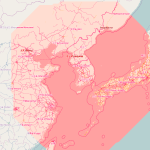
South Korea’s Long Bow
by Peter Hayes, NAPSNet Contributor
South Korea has long tried to obtain medium-range ballistic missiles. Today, conservatives in the ROK are outraged that the United States is not inclined to enable the ROK to obtain medium-range delivery systems……
Powerlessness – at the top and the bottom of the pyramid: Part I.
by Nikhil Desai, NAPSNet Contributor
Washington, DC area had an extreme climatic event June 29 night. On cue, reporters and editorials began arguing whether this was due to anthropogenic climate change….
New Line of East Asia: Can Japan return to Asia?
by —Yi Kiho – Governance and Civil Society Contributor
Japanese Prime Minister Noda confirmed that the central government will purchase the Senkaku islands…
Nuclear Corruption 2012 to Date
by Richard Tanter – Climate Change and Security Contributor
Fukushima will teach many lessons, but one that does not seem to have sunk in yet is the global link between nuclear power and corruption…
Haksoon Paik observes that over the past months, Kim Jong Un has displayed several new leadership styles characterized by more openness and transparency, which could potentially lead to reform. Paik notes that Kim Jong Un’s new leadership style “seems to have attained popularity among North Koreans…[his] imitation of his grandfather’s style also appears to have given people hope for a better future, reminding them of “those old good days” of the Kim Il Sung era…”. Paik concludes that it is inevitable, under the circumstances, for Kim Jong Un’s policies to be as independence (juche)-seeking, military-first and defensive against external security threats as his predecessors’, but that Kim Jong Un shows signs of being more sensitive and responsive to the demands of the people from below in the domestic realm.
Haksoon Paik is the Director of Inter-Korean Relations Studies Program and the Director of the Center for North Korean Studies at the Sejong Institute, an independent think tank in South Korea.
Georgy Toloraya considers the implications of Russia’s recent decision to forgive 90% North Korea’s 11 billion dollar debt (USD). According to reports, the remainder will be transferred to the Russian Vnesheconom bank account at the North Korean Bank of Foreign Trade, to be used for projects that will promote the development of educational and health care systems and the energy industry. Toloraya notes that the absence of the debt problem will make financial arrangements for future projects, like the proposed gas pipeline, easier, but that the fate of such projects now depends on Seoul’s position, not on Pyongyang’s credit rating.
Georgy Toloraya is the Director of Korean research programs at the Institute of Economy at the Russian Academy of Science.
Nautilus Peace and Security Weekly Report—Contributor’s blog entry for Climate Change Adaptation.
The environment is becoming a noteworthy reason for migration in Asia and the Pacific, especially in low-lying coastal zones and eroding river banks. In the year 2010 alone, climate related disasters and weather extremities forced around 31.3 million people in this region to relocate their dwellings…