

EMILY CRAWFORD
MARCH 16 2026
I. INTRODUCTION
Emily Crawford argues that nuclear command, control and communications (NC3) systems are beset by vulnerabilities, including susceptibility to cyber and other remote attacks, as well as weaknesses due to obsolete legacy technologies and complex command and communication structures.” She concludes: “For NC3 systems to effectively and accurately fulfil their objectives, States need to adopt a code of conduct, similar to the Hague Code of Conduct against Missile Proliferation, to outline both the relevant international law and the appropriate best practice that governs and should govern State NC3, to ensure that there is never an intentional or accidental wrongful launch of a nuclear weapon.” To this end, she proposes 15 rules that might be incorporated into a global NC3 code of conduct for consideration by nuclear and non-nuclear weapon states alike.
Emily Crawford is Professor at the University of Sydney Law School, where she teaches and researches in international law, international humanitarian law, and international criminal law.
Acknowledgements. This research was supported with funding from Nautilus Institute. This essay was posted first by the Journal for Peace and Nuclear Disarmament here and has been updated hereunder. It prefigures the forthcoming book A Code of Conduct for Nuclear Command, Control and Communication (Routledge). It is posted under Creative Commons license 4.0 the terms of which are found here
The views expressed in this report do not necessarily reflect the official policy or position of the Nautilus Institute. Readers should note that Nautilus seeks a diversity of views and opinions on significant topics in order to identify common ground.
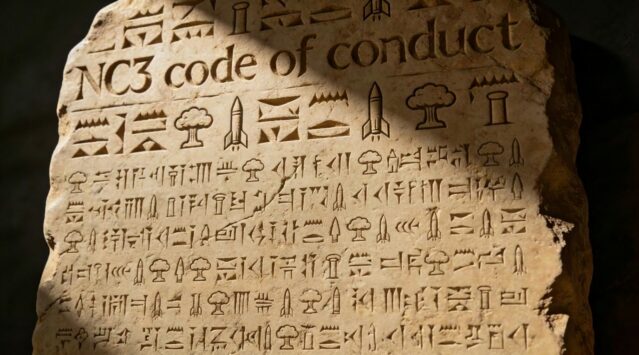
Banner image: Nautilus Institute generated by Perplexity AI.
II. NAPSNET SPECIAL REPORT BY EMILY CRAWFORD
THE NEED FOR AN INTERNATIONAL LAW-INFORMED CODE OF CONDUCT FOR NUCLEAR COMMAND, CONTROL AND COMMUNICATION (NC3)
MARCH 16 2026
Abstract
Nuclear command, control and communications (NC3) systems comprise a complex arrangement of people, policy, procedures, infrastructure, and law that governs when, why, how, and by who, the decision to launch a nuclear weapon will be made and executed. At its core, NC3 is designed to ensure that a nuclear weapon is only launched when sanctioned by proper authorities, and that no unsanctioned launch, either intentionally or accidentally, takes place. To be effective, NC3 systems must fulfil certain critical functions including detection, warning, and attack characterization; nuclear planning and targeting; decision-making; receiving orders; and enabling the management and direction of forces. Current NC3 systems are beset by vulnerabilities, including susceptibility to cyber and other remote attacks, as well as weaknesses due to obsolete legacy technologies and complex command and communication structures. For NC3 systems to effectively and accurately fulfil their objectives, States need to adopt a code of conduct, similar to the Hague Code of Conduct against Missile Proliferation, to outline both the relevant international law and the appropriate best practice that governs and should govern State NC3, to ensure that there is never an intentional or accidental wrongful launch of a nuclear weapon.
1. Introduction
In the realm of nuclear weapons, nuclear command, control, and communication (NC3) is the framework that, simply put (perhaps simplistically put) governs the entire chain from when a decision is made to launch a nuclear weapon to the actual launch of such a weapon, including all advance planning for the use of such weapons, as well as the maintenance of NC3 systems. Nuclear command, control and communications systems comprise a complex arrangement of people, policies, procedures, infrastructure, and law that governs when, why, how, and by who, the decision to launch a nuclear weapon will be made and executed. At its core, NC3 is designed to ensure that a nuclear weapon is only launched when sanctioned by proper authorities, and that no unsanctioned launch, either intentionally or accidentally, takes place. To be effective, NC3 systems must fulfil certain critical functions including detection, warning, attack characterization, nuclear planning and targeting, decision-making, receiving orders, and the management and direction of forces.[1]
Given the potentially devastating effects of nuclear attack, NC3 systems must ensure that any attack is appropriately and correctly characterised as one that gives rise to a right and/or need to respond with nuclear force. NC3 must also be robust and secure, hardened against any attack that would diminish its ability to fulfil its objectives, and strong enough that cyber incursions or similar attacks would not degrade the ability to detect and appropriately characterise incoming attacks. Any use of nuclear weapons must also comply with the manifold international laws that govern, inter alia, the use of force, the conduct of hostilities, the protection of the natural environment, the law of neutrality, and international criminal law.
All nuclear weapons States have their own unique NC3 systems. However, as explored in this paper, and drawing on comprehensive studies of national NC3 systems, there is little uniformity regarding how NC3 systems are and should be established and operated.[2] There are no rules at international law that dictate how a nuclear weapons State should structure its NC3 system in order to meet both legal obligations and policy objectives. Moreover, current NC3 systems find themselves under increasing practical strain: some existing NC3 hardware is decades old, creating vulnerabilities due to mechanical and/or operator failure,[3] while emerging threats like cyber-attacks[4] and AI-driven autonomous weapons and AI decision-making algorithms[5] threaten the resilience of NC3 systems, posing the threat of conflict escalation.
Given the lack of clarity and uniformity regarding State NC3, the current and increasing risk of nuclear conflict, and the proliferation of external and internal threats to nuclear systems, it is time that the international community consider the adoption of rules to better regulate how NC3 systems are established and maintained. However, a complication in achieving this aim is that States have, in recent years, shown some reluctance to engage with formal law-making processes, particularly in the realm of armed conflict and security issues. The likelihood of the adoption of an NC3 treaty seems remote. Luckily, there is ample precedent in State practice regarding the successful adoption and application of non-binding instruments to govern State security practice – for example, with the Hague Code of Conduct on Missile Proliferation. Therefore, this paper proposes that a non-binding ‘Code of Conduct on Nuclear Command, Control, and Communication’ should be adopted, to better guide and regulate the entire NC3 infrastructure, as guided by international law and best practice.
This paper is written with its primary focus on the relevant international law that applies to nuclear operations, employing legal terms and principles that are grounded in international legal doctrine and which, to a security studies and/or disarmament expert reader, may carry different meanings and connotations. This paper is intended to provide an understanding of the international legal framework that must be observed when designing and implementing NC3 frameworks; care has been taken to ensure that the terms are explaining within this framework but with the understanding that this framework does not exist to the exclusion of practical and policy-driven understandings of the area. The first substantive portion of this paper – Part Two – explains the importance of NC3 and surveys the current known NC3 systems of the nuclear weapons States (NWS). Part Three of the paper then surveys the relevant international law that needs to inform any NC3. Part Four of the paper looks to how and why a non-binding code of conduct would be useful, using the Hague Code of Conduct as a template. Finally, the paper concludes by exploring how and why an NC3 Code of Conduct is necessary in today’s security landscape.
2. Nuclear Command, Control and Communication and Current State Nuclear Weapons Architecture
To understand the centrality of NC3 to the nuclear weapons landscape, it is necessary to understand what NC3 is: the framework that governs the process that, as its ultimate outcome, results in the launch of a nuclear weapon. As Peter Hayes explains:
NC3 combines wetware (people), hardware (sensor, communications, and control technology), and software (digital code that enables the digital elements to connect people with machines, although much of the technology is analog inherited from a pre-digital era in the older nuclear-armed states). The purpose of this combination is to enable commanders to target, operate, control, and use nuclear weapons by receiving data and advice from sensor systems and people tasked with interpreting it, to make decisions, and to send orders to nuclear forces to move, go on alert, or to strike targets.[6]
Nuclear command, control and communication thus governs the entire chain from when a decision is made to launch a nuclear weapon to the actual launch of such a weapon, including all advance planning for the use of such weapons, as well as the maintenance of NC3 systems, to ensure that the planning and execution are done according to stated doctrine and policy. Nuclear command, control and communications systems thus comprise a complex arrangement of people, policy, procedure, infrastructure, and law that governs when, why, how, and by whom, the decision to launch a nuclear weapon will be made and executed.[7]
NC3 systems are, in essence, “the medium by which the use of nuclear weapons can enter into military operations.”[8] As Boothby and Heintschel von Heinegg point out, a central purpose of an NC3 system is to ensure that, if used, nuclear weapons are only ever launched subject to legitimate authority and to, inter alia:
ensure that the threat or use of nuclear weapons is an absolutely last resort; that every less violent alternative to their use is pursued; that the resort to nuclear weapons is indeed prevented; and that confusion, ambiguity, uncertainty, mis-communication and any other factor that may lead to strategic misunderstanding is, as far as possible, prevented.[9]
Any State NC3 is necessarily informed by distinct but interrelated objectives, namely its legal obligations, and its strategic and policy objectives. Ideally, NC3 infrastructure should be structured in such a way as to ensure that only lawful orders are carried out, that unlawful or unverifiable orders are not executed, and that all steps are taken to eliminate the possibility of accidental or unauthorised deployment. For NC3 to be effective, to meet its legal and policy objectives, it should ideally ensure that it is robust, hardened against external incursion from bad faith actors of any stripe (such as cyber attackers) and from internal failures and shortcomings with either the technology of the chain of decision-making.[10]
At the date of writing, the declared and undeclared nuclear weapons States – the US, UK, France, China, Russia, India, Pakistan, Israel, and the Democratic People’s Republic of Korea (DPRK) – are known or believed to possess amongst themselves a total inventory of over 12,000 nuclear weapons,[11] of which nearly 10,000 are considered operationally available. Some States, like the US[12] and Russia[13] rely on the so-called nuclear triad (by which nuclear weapons may be launched by aircraft, submarine, or from land-based silos), with other states reliant on land-based[14] or aircraft[15] or submarine[16] launching platforms (or some combination falling short of the full triad).
Each of the nuclear weapons States (NWS) necessarily has their own NC3 infrastructure. However, there is seemingly no uniform practice or policy among these States regarding how best to configure NC3 – as Hayes et al note, ‘there are no common standards of NC3 performance … [n]ational NC3 capabilities are technically dissimilar and operate in different governance and cultural systems’.[17] Some States enshrine authority to launch with a single decision maker,[18] while others require at least two high-ranking State officials make the decision jointly.[19] Some States endorse a no-first launch policy,[20] while others retain the right to strike first.[21] Adding to the complicated NC3 landscape, the various NWS also employ have a mix of differing types of technology. For example, the US NC3 system is largely a mix of legacy Cold War systems and more modern technologies,[22] while China’s system is believed to be one integrating 21st century technology.[23]
Finally, while the NWS are the primary international actor that must consider NC3 infrastructure, it is also necessary to note that NWS are also bound to “nuclear umbrella”[24] arrangements and other security arrangements, either for the use (or non-use) of nuclear weapons. These arrangements include NATO, which in its 2022 Strategic Concept[25] emphasized that ‘as long as nuclear weapons exist, NATO will remain a nuclear alliance’.[26] Of the NATO States, five are NATO nuclear delivery States: Belgium, Germany, Italy, the Netherlands, and Türkiye, each of which maintains their own NC3 system[27] that would be activated after wartime transfer by the United States of nuclear weapons for delivery on their bombers.[28] The remaining NATO States rely on the US (via NATO) for extended nuclear deterrence. In addition, ANZUS – the Australian, New Zealand and US security alliance[29] – while not specifically mentioning nuclear weapons in its foundational text, is nonetheless a security alliance treaty and is treated, in practice, as such.[30] Finally, bi-lateral and multilateral security agreements between nuclear States and Japan,[31] the Republic of Korea (ROK),[32] Armenia, Belarus, Kazakhstan, Kyrgyzstan, Tajikistan, and Ukraine[33] also inform the current NC3 landscape.
Some of these States have in place nuclear transparency and confidence building measures (NCBMs) – ‘measures that address, prevent, or resolve uncertainties among states. Designed to prevent wanted and especially unwanted escalations of hostilities and build mutual trust, CBMs can be formal or informal, unilateral, bilateral, or multilateral, military or political, and can be state-to-state or non-governmental.’[34] In the nuclear realm, this can take the form of ‘expanded doctrinal dialogues and joint threat assessment exercises’, and pre-notification and de-alerting measures.[35] These measures can assist in ensuring the rigour and reliability of NC3 infrastructure in the nuclear weapons States.
However, as noted by experts in the field, too few nuclear States have active CBMs,[36] with recent research undertaken by the International Institute for Strategic Studies noting that ‘CBM fatigue’[37] seems to be prevalent in many nuclear States.[38] Collectively, this mix of differing technologies and differing governance structures, coupled with the intricate network of multi-lateral and bilateral security arrangements, creates a landscape of enormous complexity in an arena where complexity increases, rather than decreases, opportunities for malicious or accidental launch or escalation.
2.1 Current Challenges to NC3 Security and Reliability
The complexity that is ‘increasing, within and among NC3 systems’[39] is made even more complex and potentially problematic when one considers that current NC3 faces two distinct though interrelated challenges – modernisation, and the place of cyber and artificial intelligence in NC3 systems. With regards to modernisation, the NC3 of many of the current nuclear weapons States – particularly those States that acquired nuclear weapons during the Cold War – is based on legacy systems. In practice, old analog systems sit alongside digital systems, onto which nuclear States ‘are superimposing and grafting on rapidly emerging technologies including drones, cyberwarfare, and highly automated data processing now moving into artificial intelligence and early applications of quantum computing and communications’.[40] The amalgamation of legacy and new systems creates fertile ground for systems errors and vulnerabilities, that could lead to, for example, false positive launch warnings or inadvertent or unauthorised launches.[41]
However, even newer NC3 systems are not impervious to vulnerabilities that could be exploited – cyber threats in particular present the risk that NC3 integrity could be jeopardised by cyber-attacks. Possible cyber-attacks against NC3 could include spoofing or jamming early warning radars and satellites, unauthorised or accidental launches (or failed launches) following attacks on NC3 computer architecture, and mistargeting or guidance failure because of cyber-attacks against NC3 telemetry.[42]
The advent and rise of artificial intelligence (AI) also presents unique threats with which any NC3 system must grapple.[43] AI obviously presents appealing strategic benefits for militaries – AI is able to ‘source massive amounts of data across a complex network, process that data at machine speed, and then output a simple, understandable recommendation to human operators — or in some circumstances execute tasks without any human involvement.’[44] For armed forces, the ability to acquire, process, analyse, and act on pertinent data at faster-than-human speed is presents obvious strategic advantages. However, AI presents unique challenges, particularly in the nuclear realm.[45] An AI-enabled, autonomous NC3 system could fail catastrophically if it were operating in response to insufficient or corrupted data, data that was incomprehensible to the AI algorithm, or if the AI (or those tasked with carrying out AI decisions) were subject to biased decision-making processes.[46] These biases include when ‘human decision makers placing too little or too much trust in AI results, referred to as either a “trust gap” or “automation bias,” respectively. The other type of bias is associated with inherent bias in data sets or rulemaking that is transferred from human behavior, likely unwittingly’,[47] such as gender or racial biases.[48]
A robust and resilient NC3 system is vital to preventing accidental or malicious launch of nuclear weapons. New technologies thus add an additional layer of complexity in the process of designing fit-for-purpose NC3 systems. When these technological vulnerabilities and threats are combined with NC3 systems that, for example, contain analog technology that is unreliable, or where the NWS has only one ultimate launch decision-maker, there is clear potential for problematic, even catastrophic outcomes. The need for clarity and for enshrining best practice in NC3 is clear. As explored in the next section of this paper, that best practice must be informed by international law.
3. The Current International Law Relevant for NC3
Nuclear command, control and communication in any State is governed by several levels of international and domestic law and policy. However, it should be noted that, in international law, there is no specific mention of NC3 qua NC3 in any extant treaty. The absence of explicit reference to NC3 does not mean that NC3 is ungoverned by international law. Rather, several international law treaties, as well as a body of customary law, exist that have direct relevance for any NC3 system. Therefore, any NC3 code must emphasise that for NC3 to fulfil its purpose, it must ensure and enshrine not just the technical and policy objectives of the State, but also be compliant with existing international law obligations that might relate to NC3.
3.1 Foundational Rules of International Law for NC3
The foundational rule of international law is that States enjoy sovereignty over their territory. Sovereignty over territory imparts sovereign authority to govern activities that take place on that territory (by way of enacting and enforcing laws and regulations).[49] With regards to nuclear weapons and NC3, a State has sovereignty over any ‘nuclear weapons and facilities that are located on their territory and over any activities that are connected with such weapons and facilities.’[50] States therefore have:
[t]he sovereign right and, arguably, responsibility to enact legislation to prescribe which nuclear-weapons related activities are prohibited, to criminalise prohibited activities, to provide for the arrangements that are needed to secure nuclear weapons sites and equipment and the information related to nuclear weapons and to implement other necessary arrangements.[51]
What this essentially amounts to is that a State has sovereignty over its territory in the broadest sense of the term – that the State is ‘the supreme authority within a territory or the ultimate power within that territory’[52] and that the State retains ‘ultimate authority and competence over all people and all things within its territory, and in particular to the correlated principles of territorial and personal jurisdiction and integrity, and of non-intervention.’[53] Sovereignty is a complex concept but in the context of NC3, it is most obviously understood in the admittedly simplistic dyad of international sovereignty vs internal sovereignty – that on the international plane, a State is considered independent and free to conduct its internal affairs without external interference from other States: ‘international external sovereignty entails the rights that can guarantee sovereign independence, but also the duties that correspond to those rights in a community of equal sovereigns where all rights are reciprocal.’[54] Internally, a State may exercise sovereign powers over all persons and objects within its territory, through the exercise of civil and criminal jurisdiction – as Besson notes, ‘[t]he primary right of a sovereign State corresponds to the independence of that State and absence of subordination to any other State or entity (albeit not to international law). It protects the plenary jurisdiction of that sovereign State over its territory and the people on it.’
In the context of NC3, State sovereignty means that a State is responsible for its own acts or omissions regarding nuclear weapons under its control as well as the acts of persons within their jurisdiction or otherwise under their control. A State may exercise jurisdiction over nuclear weapons and nuclear weapons operations on its territory, either through the weapons or operations being located on a States territory; by having an connection with the State, due to ‘the nationality of the person undertaking the [nuclear] operation; the nationality of the victim; [or] the threat that the operation creates to the national security of the State’.[55] Jurisdiction may encompass land territory, as well as ships, aircrafts or other platforms – such as those located on the high seas.[56] States must not to allow their territory to be used for acts that adversely and unlawfully affect other States.[57] At the same time, States are under an obligation to take suitable steps to protect the rights of other States;[58] and must take reasonable and appropriate steps ‘to prevent or minimise’[59] harm to other States’ interests. A failure by the State to comply with certain standards of conduct may raise issues of due diligence, which is usually ‘perceived as an international minimum standard providing a test whereby a State’s conduct is compared to what a ‘reasonable’ or ‘good’ government would do in a specific situation. Since the principle is an international minimum standard, its requirements are context-specific, requiring different measures in different circumstances.’[60] In the context of NC3, this would suggest that States must take steps to minimise the risk of accidental or negligent access to or launching of nuclear weapons. It might also form the basis of an obligation to warn States of an inadvertent incoming strike.
Additionally, a State is responsible for any acts that breach international law,[61] even if such acts are carried out contrary to instructions or in excess of authority.[62] This is known as the law of State responsibility – that a State is responsible at international law for any act or omission that amounts to a breach of an international obligation. Moreover, as noted by James Crawford, ‘[c]ertain consequences flow as a matter of law from the commission of an internationally wrongful act… [t]hese consequences fall into two categories: the obligation of cessation and non-repetition and the obligation to make reparation.’[63] It is the responsibility of the State that ensure that any person acting on behalf of the State, either under the instructions of, or the direction of control of the State, is properly and appropriately supervised. Such supervision should extend to provision of training and implementation of proper disciplinary arrangements for members of the armed forced, as well as to any person serving in security and intelligence roles that may be connected to NC3 or nuclear weapons related duties. Therefore, any breaches of international law, such as those outlined in the Code of Conduct proposed below, may give rise to a claim under the law of State responsibility.
3.2 The International Law on the Use of Force
Turning now to more specialised fields of international law, any State NC3 must be compliant with the law on the use of force, as codified in the United Nations Charter[64] and part of customary international law,[65] which prohibits the use of force by one State against another. As outlined in Article 2(4) of the UN Charter,[66] both threats of force and uses of force directed against the territorial integrity or political independence of another State are prohibited: States must not threaten or use force to violate existing State boundaries or to annex territory and must not threaten or use force to intervene in the domestic affairs of another State to, for instance, politically influence or even overthrow an existing government.[67] While neither threat of force nor use of force is defined in the UN Charter, in practice it has been understood to that a State will violate the prohibition on the use of force if it uses either direct armed force (i.e., through its own military) or “indirect force”[68] – that is, where a State uses a non-State group such as irregular forces, or mercenaries[69] to organise, instigate, assist, or participate in ‘acts of civil strife or terrorist acts in another State or acquiescing in organized activities within its territory directed towards the commission of such acts’.[70] A threat to use force is equally prohibited under international law.[71] Therefore, if a threat, if carried out, could be classified as a use of force, then the threat itself would be illegal.[72] However, to be unlawful, a threat must be specific – the mere acquisition or retention of weapons in itself would not be considered a threat.[73] As noted by the International Court of Justice (ICJ) in the Nuclear Weapons Advisory Opinion, there must be ‘a signalled intention to use force if certain events occur’, or ‘the declared readiness of a State to use force’.[74] The prohibition contained in Article 2(4) is not absolute – there are exceptions which allow for a State to use force in (a) self-defence[75] or (b) pursuant to action authorised by the Security Council.[76] However, a lawful use of force in self-defence requires observing certain rules, including that the act in self-defence is carried out in response to an armed attack; that the response is necessary to repel the attack; and that the use of force is proportionate for the purpose of repelling the armed attack.[77] Under Article 51, there is also the requirement to report an act of self-defence to the Security Council. Finally, if acting in collective self-defence (for example, defence of another State or States), there must have been a declaration by the victim State that it has been the victim of an armed attack and is requesting assistance.[78]For any NWS NC3, compliance with the law on the use of force requires an understanding that, as noted by the ICJ in the 1996 Nuclear Weapons Advisory Opinion,[79] the prohibition on the use of force, and the exceptions contained in the Charter apply to any use of force, ‘regardless of the weapons employed’,[80] but that the Charter ‘neither expressly prohibits, nor permits, the use of any specific weapon, including nuclear weapons’.[81] Additionally, there is likely no customary prohibition on the use of nuclear weapons when used in ‘an extreme circumstance of self-defence, in which the very survival of a State would be at stake’,[82] and that mere possession of nuclear weapons for the purposes of deterrence cannot be considered a threat of a use of force.[83] However, for those States party to the Treaty on the Prohibition of Nuclear Weapons,[84] any use of nuclear weapons would breach that treaty. Additionally, any State NC3 would need to account for the various verbal and written declarations made by nuclear weapons States in which they pledge not to use or threaten to use nuclear weapons – known as unilateral negative security assurances. As noted by Hood and Cormier, there is debate ‘about whether [the assurances] constitute legally binding commitments or mere political declarations’;[85] however, for those States that have made qualified or unconditional assurances, this would need to be accounted for in any State NC3 architecture.
3.3 The International Law Relating to Armed Conflicts and the Conduct of Hostilities, including the Law of Neutrality
In addition to the law relating to the use of force, any NC3 framework would also need to take into account the international laws that govern the conduct of hostilities. If, during an armed conflict, the decision is made to deploy nuclear weapons, it is necessary for any such deployment to be executed in accordance with the extant laws governing the conduct of hostilities, applicable both in treaty law for the State in question, as well as the equivalent customary international law. Failure to observe the laws of armed conflict in armed conflict may result in a State being held responsible under the general law of State responsibility, as well as bringing individual criminal sanction for perpetrators of breaches of international criminal law. The rules on the conduct of hostilities, known collectively as the law of armed conflict (LOAC), govern the permissible behaviour of parties to an armed conflict. There are over a dozen treaties that comprise LOAC, containing hundreds of provisions, as well as an expansive body of customary law.[86] For the most part, LOAC rules can be largely reduced to two general, though not mutually exclusive, categories. One body of rules essentially aims to protect civilians and civilian objects during times of armed conflict. The second body of law largely relates to protecting and governing persons who take direct part in the hostilities (such as combatants or any other person who takes direct part in hostilities such as, for instance, use of a weapon or weapons system), or who otherwise accompany or assist those who take part in hostilities (such as medical personnel), outlining permissible and impermissible acts for such participants. The laws of armed conflict are framed around certain fundamental principles – that it is impermissible to directly target civilians and civilian objects;[87] or to launch attacks that employ indiscriminate weapons or tactics;[88] that States must take precautions in attack, to ensure that the civilian population, as well as civilian and civilian objects are spared as far as possible from the harmful effects of the armed conflict;[89] that there are limitations on the choice of means or methods of warfare;[90] and that certain kinds of object cannot be targeted, such as cultural property,[91] the natural environment, [92] or objects indispensable for the survival of the civilian population (like water supplies and foodstuffs).[93] Any nuclear hostilities would need to abide by these provisions.
States are also bound by the law of neutrality, which provides that, upon commencement of an armed conflict, all States that are not party to the conflict must choose whether to remain separate from or join in the hostilities – with specific rights and obligations that follow consequent to such a choice. States that choose to abstain from hostilities and remain neutral, must have that neutrality respected, most obviously by their territory remaining inviolable – neutral States may not be attacked.[94] Belligerent parties must respect the neutrality of such nations. In the context of nuclear warfare and nuclear weapons, it is generally accepted[95] that parties to an armed conflict must take all feasible measures to ensure that no harmful effects have an impact on neutral territory. Therefore, a nuclear-launching State would have to be aware of the degree to which, for instance, the release of radiation following a nuclear attack would have an impact on neutral States.
3.4 International Criminal Law
Finally, any NC3 infrastructure must take into account that any decision to use a nuclear weapon may trigger the application of international criminal law. Specifically, the use of nuclear weapons could be classified as a genocidal act, if an attack was carried out with the ‘intention of destroying, in whole or in part, a national, ethnical, racial or religious group.’[96] Likewise, use of nuclear weapons could amount to a crime against humanity if it was ‘committed as part of a widespread or systematic attack directed against any civilian population, with knowledge of the attack’.[97] Finally, certain nuclear attacks if carried out in wartime could amount to a war crime.[98] Therefore, any State NC3 would need to ensure that operators involved in nuclear launch decision-making are aware of the relevant aspects of international criminal law, and possible international criminal culpability if nuclear weapons are used in such a way as to render them an act of genocide, a crime against humanity, or a war crime. Moreover, international criminal law provides not just that the perpetrator of the act is criminally responsible, but that a commander or superior officer may find themselves culpable if they either order subordinates to carry out an act criminalised under international criminal law, or if they fail to prevent or repress the commission of an illegal attack by subordinates.[99] Any State NC3 would need to ensure that nuclear weapons personnel were thus appropriately instructed in the law on international criminal law, including the law on command responsibility.
4. Lessons from International Soft Law – The Hague Code of Conduct
As explored in the previous sections of this paper, there are clear international rules governing the use of nuclear weapons, including on permissible targets, precautions in attack, and obligations to take constant care while targeting. There are also extensive rules governing when a state may legally have the right to use force (potentially including the use of nuclear weapons) and rules governing criminal sanction for when acts amount to a war crime, a crime against humanity, or an act of genocide. However, as noted, there is no specific international law – either treaty or custom – that dictates how a State should configure its NC3, to both comply with international law obligations, and to fulfil the aims and objectives of NC3 systems. While some States follow what may be considered good practice regarding NC3 – for example, a two-person rule for all launch decisions – there is no existing international law that obligates nuclear weapons States to follow such practice.
It should be noted that, in recent years, there has been a marked trend of States choosing to move away from adopting binding multi-lateral treaties, and instead embracing instruments of less-than-treaty status, particularly in the realm of security and conflict issues.[100] As observed by Hughes and Shereshevsky, ‘formal international lawmaking has reached a nadir’[101] due to ‘global stagnation and great power competition increasingly [precluding] access to the formal methods of international lawmaking’.[102] Research has demonstrated that in the past quarter of a century or more, States seem increasingly less likely to engage with treaty-making processes.[103] If this trend is particularly marked regarding security and conflicts issues, given the culture of confidentiality that exists surrounding State NC3, it seems unlikely that States would agree to an international treaty prescribing how to configure their NC3 systems.
Therefore, if there is to be any hope for consistent systematisation of NC3 among nuclear States, other sources of international instruction and guidance should be called upon. It is here that non-binding instruments, may have a part to play. Non-binding instruments are generally considered in the category of ‘soft law’[104] or part of the realm of informal international lawmaking.[105] Non-binding, informal international instruments are those instruments, documents, and provisions that do not create binding legal obligations for their addressees, but which aim to encourage a particular course of action. Non-binding instruments and non-binding norms are considered by scholars as ‘those international norms, principles, and procedures … outside the system of formal sources of Article 38, paragraph 1 of the ICJ Statute … [that lack] the requisite normative content to create enforceable rights and obligations’.[106] Non-binding agreements or instruments do not engage the ‘legal responsibility’[107] of their addressees, but ‘have the characteristics of “law” in their directive effect to influence the will … of those to whom the “soft law” is addressed’.[108] While non-binding instruments have no legally binding force, they ‘nevertheless may have practical effects’.[109]
Non-binding instruments have been and continue to be central part of international law in general,[110] and the law of armed conflict in particular.[111] Indeed, non-binding instruments have played pivotal roles in the progressive development of several international law fields, including international environmental law[112] and international human rights law.[113] Therefore, ff States are proving reluctant to adopt or develop new binding norms to guide behaviour, it would seem logical to turn to other methods of rulemaking to address existing gaps. A non-binding code of conduct would arguably present the best opportunity for the international community to set down basic rules for what is best and recommended practice in NC3. Fortunately, there is precedent for State adopting such non-binding instruments precisely in this arena – with the adopting in 2002 of the Hague Code of Conduct against Ballistic Missile Proliferation (HCoC).
4.1 The Hague Code of Conduct against Ballistic Missile Proliferation (HCoC)
The HCoC, adopted in 2002, came about as the result of ‘efforts of the international community to internationally regulate the area of ballistic missiles capable of carrying weapons of mass destruction.’[114] The HCoC was the initiative of the partner States of the Missile Technology Control Regime (MTCR),[115] aimed at addressing the ‘increasing proliferation of nuclear weapons by addressing the most destabilizing delivery system for such weapons.’[116] The MCTR achieves these aims through a commitment to export controls on equipment, software, and technology, through regular partner meetings, and through dialogue and outreach.[117] Thirty-five States are partners to the MCTR, including the nuclear States of the US, Russia, India, the UK, and France, as well as several States under NATO and US nuclear umbrellas. As of this writing, one hundred and forty-four States have subscribed to the HCoC,[118] including the nuclear States of France, India, Russia, the UK, and the US.
As with the MCTR, the HCoC monitors compliance with regular meetings, information exchange, and voluntary reporting mechanisms, including providing pre-launch notifications on:
ballistic missile and space-launch vehicle launches (SLVs) and test flights via the “Restricted Website”. Subscribing States also commit themselves to submit an annual declaration (AD) of their country’s policies on ballistic missiles and space-launch vehicles, including information on the number and generic class of ballistic missiles and space launch vehicles launched during the preceding year.[119]
Together the MTCR and the HCoC exist as the:
only multilateral transparency and confidence building instrument concerning the spread of ballistic missiles. By subscribing to the HCoC, members voluntarily commit themselves politically to provide pre-launch notifications (PLNs) on ballistic missile and space-launch vehicle launches (SLVs) and test flights. Subscribing States also commit themselves to submit an annual declaration (AD) of their country’s policies on ballistic missiles and space-launch vehicles.[120] The HCoC has been welcomed in State practice through endorsement in[121] and at the UN,[122] by the EU,[123] in the practice of NATO[124] and ASEAN,[125] and in the practice of States including Japan,[126] Germany,[127] the Republic of Korea,[128] and Norway.[129]
The adoption of and support for the HCoC suggests that a similarly aimed document regarding NC3 could gain traction internationally. Given that the HCoC governs somewhat similar territory to that of NC3 (that of weapons proliferation) and given that five nuclear weapons States have endorsed and participated in the HCoC, there are compelling grounds to submit that a similar code of conduct on NC3 could likewise be adopted and endorsed by, at the very least, most of the nuclear weapons States. Indeed, the MCTR partners might present themselves as a viable sponsor for any code of conduct for NC3, having already achieved success with the MCTR and the HCoC – adopting a best practice code on NC3 would seem a logical and reasonable next step. However, as with the HCoC, any process to negotiate an NC3 code of conduct would need a draft instrument to discuss and debate. Therefore, this study now turns to examine possible rules for an NC3 code of conduct, and why such rules would be beneficial.
5. A Code of Conduct for NC3: Possible Rules and Recommendations
This paper now turns to apply the previously analysed legal and policy framework to the specific task of developing a code of conduct for NC3, to outline what is lex lata, lex ferenda, and best practice, for a nuclear weapon State’s NC3 architecture. It is worthwhile now to remember what NC3 systems are for, and why they are necessary. As explored at the beginning of this paper, NC3 systems are, in essence, “the medium by which the use of nuclear weapons can enter into military operations.”[130] To that end, it is worthwhile revisiting the central requirements of NC3 systems. Namely, as Boothby and Heintschel von Heinegg point out, a central purpose of an NC3 system is to ensure that, if used, nuclear weapons are only ever launched subject to legitimate authority and to, inter alia:
ensure that the threat or use of nuclear weapons is an absolutely last resort; that every less violent alternative to their use is pursued; that the resort to nuclear weapons is indeed prevented; and that confusion, ambiguity, uncertainty, mis-communication and any other factor that may lead to strategic misunderstanding is, as far as possible, prevented.[131]
Any State NC3 is necessarily informed by distinct but interrelated objectives – its legal obligations, and its strategic and policy objectives. Any legal obligations borne by the State will assert an influence on that States’ NC3 architecture. For example, obligations under nuclear-weapon-free zone treaties, and existing laws on the use of force, the conduct of hostilities, and international criminal law, will necessarily shape how any State structures its NC3 and related policies and practice. State NC3 must ensure that all international law obligations are complied with, in particular with regards to when such weapons may be lawfully used, both in the context of a use of force in self-defence, and in the context of an on-going armed conflict. NC3 architecture should be structured on the understanding of both the rules on State responsibility for internationally wrongful acts, as well as any individual criminal responsibility that might result from illegal use of nuclear weapons.
Secondly, States have policy and strategic aims relating to nuclear weapons, that its NC3 architecture will necessarily have to address. Those policy and strategic objectives will likely find expression in more ‘practical’ ways – that any NC3 infrastructure should be structured in such a way as to ensure that only lawful orders are carried out, that unlawful or unverifiable orders are not executed, and that all steps are taken to eliminate the possibility of accidental or unauthorised deployment. As noted by Ildo Hwang:
When a legitimate decision is made to use a nuclear weapon, the weapon system must be delivered and used without error. On the other hand, there should never be any accidental or erroneous use of nuclear weapons in all the other illegitimate cases. The problem is that there could be a fundamental trade-off between these two policy goals. This concern, often described as the “always/never dilemma,” can be cited as reasons why each country has built and developed its own command and control with characteristics that slightly differentiate it from other countries.[132]
A robust NC3 system can meet these requirements by demonstrating the qualities of tightly held, exclusive civilian control, responsive to a highly centralised hierarchy, with nuclear weapons are physically protected from unauthorised assembly or detonation.[133] NC3 should be hardened against external incursion from bad faith actors of any stripe, such as cyber attackers. Meeting these practical requirements can be achieved through means such as ensuring:
- The correct, unambiguous and authenticated identification of the NCA, a correctly formatted and authenticated firing message, with authenticated verification of both elements at every human interaction within the communications chain between the NCA and the SSBN command;
- A system architecture beneath the NCA which has no single point of failure, nor any possibility of a firing message being generated by any other than the NCA. Invulnerable and specific encryption of the necessary signals is an important element of this;
- A system which has multiple possible, and preferably simultaneous, transmission paths across the radio spectrum. This multiplicity of paths and frequencies is sufficient to achieve transmission and reception in the presence of all foreseeable threats, physical and electronic. All elements of the system must have the necessary physical and electronic protection appropriate to the strategic situation;
- The NC3 must be capable of operating in the most hostile environment foreseeable. In order to deter, the system must be capable of achieving its mission after a major nuclear strike, with attendant electromagnetic pulse (EMP) and destructive effect.[134]
With this strategic, policy, and legal background in mind, what rules should therefore make up a NC3 code of conduct? Any proposed code should clearly indicate which rules are binding international legal obligation, and which rules are recommended best practice, in light of the objectives of NC3. Additionally, any NC3 code would contain ideally a list of short, straightforward rules that are both clear enough and flexible enough that they can be universally applied by relevant stakeholders. However, it is imperative that the straightforward rules are accompanied by more comprehensive and detailed commentary and explanation regarding why such a rule has been included, and the specifics of how such a rule should be implemented, including examples of possible situations to which the rule would apply, as well as additional reference to further documentation (such as treaty law) where needed.
The proposed draft code is divided into two parts – Part One being rules relating to salient international law obligations, and Part Two being rules prescribing recommended best practice. The code is devised to outline the basic rule in a single sentence, followed by more specific explanation and commentary, explaining what a more detailed State NC3 would require to ensure that the rule is properly implemented. It should be noted that the first part of the proposed code draws heavily on the NC3 recommendations outlined by Boothby and Heintschel von Heinegg’s work in Nuclear Weapons Law, in particular Part L on implications of international law for NC3,[135] and this paper is indebted to the outstanding work undertaken by Boothby and Heintschel von Heinegg.
Part I – Legal Obligations
Rule 1: All States are under an obligation to refrain from threats or use of nuclear force contrary to the UN Charter and the customary international law prohibition on the threat or use of force.
- Individual State NC3, whether publicly available or classified, should outline each States’ doctrine on what amounts to a threat or use of nuclear force and what amounts to an armed attack, as well as what criteria they would consider determinative of the existence of a threat of force, use of force, and/or an armed attack.
- State NC3 should clearly indicate whether the State in question believes that it is legal to use force against an imminent armed attack, including, potentially, any definition of imminence adopted by the State.
- State NC3 should also note the requirements for acts in collective self-defence under the Charter, which must include a prior request for assistance, and timely reporting to the UN Security Council.
Rule 2: In the conduct of nuclear hostilities, all States are bound by the customary international law of armed conflict, as well as any LOAC treaty obligations that bind their State. Additional States must observe any other international law treaty obligations binding upon them, whether bi-lateral or multi-lateral, including regarding nuclear weapons-free zones.
- Any State NC3 must be drafted in compliance with that State’s obligations under the law of armed conflict. As a starting point, it is recommended that any State NC3 should outline the parameters for the existence of an international armed conflict and a non-international armed conflict, as well as when such situations are deemed to have ended.
- Documentation accompanying State NC3 should clearly indicate in their guidance what is considered to be binding legal obligations and what is non-binding but nonetheless adopted by the State as policy or best practice.
- Any NC3 documentation should make particular note of the rules that relate to those persons and objects specially protected under international law. In particular, the law of armed conflict enshrines protections for persons who do not (or no longer) take direct part in the hostilities, as well as objects that are not considered, prima facie, military objects or military objectives – this is broadly known as the principle of distinction. Staes, when conducting nuclear hostilities, must be aware that the law of armed conflict contains protections for, inter alia, civilians, children, journalists, medical and religious personnel, objects, and installations, protected persons or objects connected to the UN or the ICRC, cultural property, works and installations containing dangerous forces, objects indispensable for the survival of the civilian population, and the natural environment.
- NC3 documentation should also ensure that protected subjects and objects that are at risk in nuclear targeting are documented and considered in the course of pre-conflict targeting and in nuclear strike decision-making. In the course of pre-conflict targeting and nuclear strike decision-making, NC3 documentation and those who rely upon it should ensure that appropriate legal expertise is available to assist in planning legally compliant operations.
Rule 3: In the conduct of nuclear hostilities, States should be particularly aware of obligations regarding distinction and proportionality in attack, and the prohibition on indiscriminate attack, as well as any prohibitions on particular means or methods of attack.
- State NC3 should include clear rules on the principle of distinction regarding persons and objects. State NC3 should outline clearly whether a State has a particular position on what kinds of acts would, during time of armed conflict, render a civilian as directly participating in hostilities, such that they could be targeted under the law of armed conflict. In particular, States should ensure that any civilian personnel engaged in nuclear weapons operations on behalf of the State are made aware of the consequences of such participation – i.e., that they may be targeted for such participation during an armed conflict.
- State NC3 should clearly outline how military objectives are defined, including their State’s position on so-called ‘dual use’ objects, whether they accept the US position that war-sustaining or war-supporting industries are legitimate targets under LOAC.
- State NC3 should outline the kinds of attacks and/or the kinds of circumstances that would be render the attack prima facie indiscriminate.
- State NC3 should clearly state the rule on proportionality in attack. As with the rule on distinction, in the course of pre-conflict targeting and nuclear strike decision-making, NC3 documentation and those who rely upon it should ensure that appropriate legal expertise is available to assist in planning legally compliant operations.
- Any State NC3 mechanism should clearly set forth the precautionary measures that the State is bound to apply in targeting situations, including the obligation to take constant care and the obligations to take precautions in attack. NC3 documentation should clearly outline who is under an obligation to take constant care before and during operations (understood as a general and continuing obligation to ensure that the civilian population and civilian objects are protected during military operations), and when and what kinds of precaution in attack are necessary, such as the provision of warnings. NC3 documentation should clearly spell out how and why targets are selected and how collateral damage and proportionality assessments are to be made, what provisions exist for the cancellation or suspension of nuclear attacks, and whether advance warnings of attack are to be given. The provision of rules of engagement (ROEs) and/or standard operation procedure (SOPs) documentation to all persons in involved in nuclear operations is recommended.
- State NC3 should clearly states rules on permissible and impermissible means and methods of attack, as outlined in the relevant applicable treaties, including those specifically on prohibited weapons, and the treaty provisions which outline prohibited methods of warfare.
Rule 4: States are under an obligation under international law to ensure that all nuclear weapons personnel are properly instructed in the law of armed conflict. For persons in command of nuclear weapons operations, they should be properly instructed in their obligations under the law of armed conflict, and in particular, under the law of command responsibility,
- Persons responsible for carrying out nuclear strikes – commanders of SSBNs, pilots of nuclear aircraft, those in charge of land-based launch facilities – must be secure in the knowledge that any order to launch transmitted to them is compliant with the law of armed conflict. Therefore, as appropriate to their station and rank, all personnel involved in nuclear launches must be trained in the law of armed conflict.
- Commanders involved in nuclear weapons operations should be properly instructed in LOAC, in particular regarding command responsibility, as commanders may be responsibility for either ordering an illegal attack or failing to properly supervise or punish subordinates who carry out an illegal attack.
- In order to ensure that only legal orders are issued in times of armed conflict involving nuclear weapons, legal advisers trained in the law of armed conflict should be involved at all stages of the decision-making process that leads to a nuclear launch.
Rule 5: All nuclear weapons operators should be made aware of their obligations under international criminal law, in particular the obligation under international law to not obey manifestly illegal orders to strike using a nuclear weapon.
- Under international criminal law, a subordinate has an obligation to disobey manifestly unlawful orders. Accordingly, there is no defense of obeying a superior order, if the subordinate should have known that the act ordered was manifestly unlawful.
- Orders to commit genocide or crimes against humanity are always considered manifestly unlawful.
- To ensure that nuclear weapons operators are aware of which kinds of orders are considered manifestly unlawful, and for such operators to be certain that any orders they are given are lawful, training in the law of armed conflict should be provided to all nuclear weapons operators.
Rule 6: Parties to an armed conflict, including those conflicts where nuclear weapons are employed, must respect the neutrality of States not party to the armed conflict. Neutral States must ensure that they observe the law of neutrality as failure to observe the law of neutrality may result in the State being considered a party to the conflict and liable to targeting, including with nuclear weapons.
- During time of armed conflict, commanders and other high-ranking military and civilian personnel engaged in the overall strategy and execution of the armed conflict should be aware, where appropriate, of the law of neutrality, and not engage in any acts that violate the rights of neutral States.
- Likewise, commanders and other high-ranking military and civilian personnel in neutral States should also be well-versed in the law of neutrality, and refrain from any acts that would result in loss of neutral status (unless such acts are intentionally undertaken with the aim of becoming a party to the conflict).
Part II – Recommended/Best Practice
Part II of the draft code of conduct now turns to look at practical means and measures that nuclear States can take to ensure that NC3 systems operate at peak functionality. The rationale for the rules listed below is the same. Any nuclear weapons States’ NC3 must be able to fulfil the strategic and policy aims of ensuring that nuclear weapons are used lawfully and without error and that there is no accidental, mistaken, or unlawful use. To facilitate this aim, there are a number of practical measures that should be implemented, which will have the additional benefit of avoiding unnecessary escalation leading to the employment of nuclear weapons, and to provide avenues for de-escalation. Likewise, facilitating the ultimate aims of NC3 can be achieved through ensuring that all avenues for communication between nuclear States should remain secure and open, with due attention paid to ensuring that both physical and technological measures for protecting lines of communication are maintained in both peacetime and war. The rules outlined in the section are drawn from the known practice of nuclear States, but are not found in law, but rather sensible policy based on acknowledged aims for NC3.
Rule 7: All nuclear States should establish a legitimate and accountable national command authority for all nuclear forces, including implementing a two-person rule for all launch decisions and implementation steps in NC3 operations.
- A legitimate and accountable national command should be established, tasked with ensuring that that any and all nuclear decisions are made in accordance with existing international law.
- At a minimum, nuclear States should institute a two-person launch rule – that at least two authorized delegated persons are required to agree to launch a nuclear weapon, whether in attack or defence. A two-person launch rule would assist in ensuring that an authorized launcher, if such a launcher ‘went rogue’ and decided to illegally use a nuclear weapon, would be physically and technically prevented from undertaking such an illegal launch, which could be an important security mechanism to prevent unauthorized usage of a weapon.
- At present, it is not recommended that there be any involvement of automation or artificial intelligence in place of the two-person rule, or as a substitute for having two people sole launch-initiators (see also Rule 15).
Rule 8: Nuclear weapons should not be co-located with the nuclear weapons State’s high command post, or any other early warning interpretation sites or sensors.
- In order to ensure the survivability of a State’s NC3 mechanisms, States should ensure that nuclear weapons are not co-located with either the high command post, or any early warning sensors or intelligence posts.
- In any armed conflict involving the use of nuclear weapons, it would be logical to assume that a primary target would be an adverse party’s nuclear weapons stockpiles and launching sites. Were such weapons stored in the same locale as any pivotal NC3 infrastructure, the inevitable destruction of such NC3 infrastructure would necessarily diminish, if not outright destroy, the ability of the attacked State to detect incoming launches, and to take measures to prevent or mitigate the impact of an attack (or indeed, to accurately detect whether an attack is incoming at all). By not co-locating stockpiles and high command and/or early warning infrastructure, States can ensure that vital NC3 infrastructure retains its survivability, even during a nuclear weapons exchange.
Rule 9: NC3 communications should have dedicated systems that are not shared by conventional military systems.
- NC3 communications should be conducted on dedicated systems, separate from conventional military systems. Military communications would be a primary target during any armed conflict (whether nuclear weapons are involved or not).[136]
- In order to prevent launches of nuclear weapons occurring due to incorrect or absent intelligence (as a result of degraded or destroyed communications systems), open and unfettered communication between nuclear weapons installations and nuclear high command is vital and should therefore not be at risk of targeting.
Rule 10: All nuclear weapons States and nuclear armed states should implement an open source, best practice secure nuclear hotline such as CATALINK with other nuclear armed states.
- Modern NC3 systems are often based on a mix of new and old technology, with some of the older systems vulnerable to disruption, degradation, or destruction through cyber or other modern malicious attack mechanisms. If such NC3 systems do fail, the risk of unnecessary escalation of hostilities is clearly present.
- A resilient and secure communications system would be a critical element to assist in de-escalation and to keep lines of communication open. A system such as CATALINK or other hardened and secure hotline system would serve an important backup should existing NC3 systems fail.
Rule 11: In nuclear operations, to facilitate accurate and lawful decision-making and to enable de-escalation, national high command of a nuclear weapons state or nuclear armed state should not be subject to attack or interference with a nuclear weapons State’s national technical means.
- Accurate, lawful, and timely communications and intelligence in relation to a nuclear State’s conduct during an armed conflict is central to prevent unnecessary escalation of hostilities due to, say, inaccurate intelligence. Given the centrality of communications systems to nuclear (and nuclear-dependent) States, any State engaged in conflict with nuclear States should not target a nuclear State’s national technical means.
Rule 12: In order to ensure that nuclear States have accurate intelligence and sufficient time to process any intelligence on nuclear operations, countermeasures or other measures of reprisal should not be taken against a nuclear States NC3.
- In the conduct of hostilities, there are international laws that limit permissible objects of reprisal. There are no specific rules under international law that prohibit targeting a State’s communications systems. However, accurate and timely communications and intelligence in relation to a nuclear State’s conduct during an armed conflict are imperative to prevent unnecessary escalation due to inaccurate intelligence or unnecessarily shortened decision-making processes. To facilitate optimal decision-making, State’s engaged in conflict with nuclear States should not target a nuclear State’s NC3 in reprisal or as a countermeasure. Precedent for a rule prohibiting targeting vital NC3 components can be found in preexisting agreements between the US and Russia, and NATO, prohibiting and preventing attacks that interfere with a State’s national technical means of verification (NTM).[137]
Rule 13: To ensure reliability of NC3 systems, and to limit or prevent opportunities for illegal access to NC3, technologies essential to NC3 operation should not be shared or proliferated beyond those strictly required for NC3 systems.
- Accurate information is pivotal in any nuclear operations. Given the potential vulnerability of certain legacy NC3 systems, the software and hardware that is unique to State NC3 should not be shared with other domestic non-NC3 systems or with any other State’s NC3.
- Proliferation of the software and/or hardware beyond NC3 increases the risk that the software and/or hardware could be accessed and exploited for vulnerabilities by bad faith actors, which in turn would undermine the reliability of any NC3 information.
Rule 14: To avoid the risk of false positives, NC3 systems should always employ humans on the decision chain. Any decision to launch a nuclear weapon should not be left to artificial intelligence software.
- Artificial intelligence systems are being increasingly integrated into State military operations, and seem to offer the advantage of providing timely intelligence, free from the kinds of emotive and irrational decisions that humans can make in times of stress or crisis – such as impending or unfolding nuclear operations.
- However, AI systems have been shown to be imperfect and prone to programming bias. AI also lacks the very human element of situational awareness and the ability to engage in self-reflexive decision-making processes. For example, a State’s NC3 could, whether through system error or external manipulation, register an incoming nuclear attack where no such attack exists (as with the famous Petrov incident in 1983, where Russian early warning systems misidentified a meteorological phenomenon as an incoming US missile attack).[138] Ensuring that AI systems are never allowed to make nuclear launch decisions would contribute to ensuring false positives are not actioned.
Rule 15: States should create a monitoring and compliance body to ensure that the legal obligations and recommended State practice outlined in the Code are being implemented and respected.
- A monitoring body, like the Missile Technology Control Regime (MTCR) in regards to the Hague Code of Conduct should be established as a way to encourage and support compliance with the relevant international law applicable to nuclear operations, and to facilitate and develop best practice regarding NC3.
6. Concluding Comments
In the practice of the nuclear weapons States, and in the literature on State NC3, it is encouraging to see that most nuclear weapons States seem to adopt many of the acknowledged best practices regarding establishing a robust and resilient NC3 infrastructure, such as the two-person rule. However, it is also clear that all nuclear weapons States could benefit from knowing that they were all committed to pursuing all acknowledged best practices regarding NC3. In as much as any non-binding instrument can effect change, a Code of Conduct for Nuclear Command, Control and Communication could make significant strides towards ensuring that nuclear weapons are only used as an absolute last resort, that their accidental or mala fides use is prevented as far as possible, and that any use is done strictly in accordance with international law. In the absence of all States committing to the prohibition on the possession and use of nuclear weapons, committing to a code to ensure use in only strictly limited and extreme circumstances could go some way to ensuring a safer world.
III. ENDNOTES
[1] Adapted from United States NC3 – see further Office of the Secretary of Defence, Nuclear Matters Handbook (2020), available at https://www.acq.osd.mil/ncbdp/nm//NMHB2020rev/.
[2] See the 45 papers reviewing the status of national NC3 systems and related issues from the 22-23 January 2019 workshop on NC3 and Global Stability at Stanford University are found at: https://securityandtechnology.org/ist-policy-lab/successes/nc3-systems-and-strategic-stability/.
[3] For discussion of the issues with legacy NC3 systems, see further Peter Hayes, Binoy Kampmark, Philip Reiner, and Deborah Gordon, ‘Synthesis Report, NC3 Systems and Strategic Stability: A Global Overview’, Tech4GS Special Reports, 6 May 2019, https://www.tech4gs.org/nc3-systems-and-strategic-stability-a-global-overview.html.
[4] For the potentially devastating impact of cyber-attacks against State NC3, see for example Michael Ceccarelli, Rachael Harris, Bader Mahmoud, Diego Perez, and Shyla Sharma, ‘Impact of Cyberattacks on Functionality of NC3 Systems and Strategic Deterrence’, Carnegie Mellon University, https://kilthub.cmu.edu/articles/report/Impact_of_Cyberattacks_on_Functionality_of_NC3_Systems_and_Strategic_Deterrence/21964826; Shane Smith, ‘Cyber Threats and Weapons of Mass Destruction’, Proceedings of the Centre for the Study of Weapons of Mass Destruction, National Defence University, June 2021, https://inss.ndu.edu/Portals/68/Documents/wmd-proceedings/CSWMD%20Proceedings%20Jun%2021%20PQ.pdf.
[5] For issues regarding AI and NC3, see further Anthony Aguirre, Emilia Javorsky, and Max Tegmark, ‘Artificial Escalation: Imagining the Future of Nuclear Risk’, The Bulletin of the Atomic Scientists, 17 July 2023, https://thebulletin.org/2023/07/artificial-escalation-imagining-the-future-of-nuclear-risk/; Bryce Farabaugh, ‘Bad Idea: Integrating Artificial Intelligence with Nuclear Command, Control, and Communications’, Defence 360: Center for Strategic and International Studies, 3 December 2019, https://defense360.csis.org/bad-idea-integrating-artificial-intelligence-with-nuclear-command-control-and-communications/.
[6] Peter Hayes, ‘Nuclear Command, Control, and Communications (NC3) in Asia-Pacific’, NAPSNET Special Reports, 22 September 2021, https://nautilus.org/napsnet/napsnet-special-reports/nuclear-command-control-and-communications-nc3-in-asia-pacific/.
[7] Ibid.
[8] Hans Born, National Governance of Nuclear Weapons: Opportunities and Constraints, Geneva Centre for the Democratic Control of Armed Forces (DCAF) (Geneva, 2007), 15, https://www.dcaf.ch/sites/default/files/publications/documents/PP15_Born.pdf.
[9] William Boothby and Wollf Heintschel von Heinegg, Nuclear Weapons Law: Where Are We Now? (Cambridge University Press 2022), 214.
[10] Sébastien Miraglia, ‘Deadly or Impotent? Nuclear Command and Control in Pakistan’ (2013) 36 Journal of Strategic Studies 841.
[11] SIPRI, ‘World Nuclear Forces’, SIPRI Yearbook 2022: Armaments, Disarmament and International Security, 248, https://www.sipri.org/sites/default/files/YB23%2007%20WNF.pdf. See also Federation of American Scientists, Status of World Nuclear Forces, 29 March 2024, https://fas.org/initiative/status-world-nuclear-forces/.
[12] Darius Watson, ‘Rethinking the US Nuclear Triad’ (2017) 11 Strategic Studies Quarterly 134, 134.
[13] Hans M. Kristensen, Matt Korda & Eliana Johns, ‘Russian Nuclear Weapons, 2023’ (2023) 79 Bulletin of the Atomic Scientists 174.
[14] Hans M. Kristensen, Matt Korda & Eliana Johns, ‘Chinese Nuclear Weapons, 2023’ (2023) 79 Bulletin of the Atomic Scientists 108, 125-127.
[15] Hans M. Kristensen, Matt Korda & Eliana Johns, ‘French Nuclear Weapons, 2023’ (2023) 79 Bulletin of the Atomic Scientists 272, 274-278.
[16] Hans M. Kristensen & Matt Korda, ‘United Kingdom Nuclear Weapons, 2021’ (2021) 77 Bulletin of the Atomic Scientists 153, 155-157.
[17] Peter Hayes, Binoy Kampmark, Philip Reiner, and Deborah Gordon, ‘Synthesis Report, NC3 Systems and Strategic Stability: A Global Overview’, Tech4GS Special Reports, 6 May 2019, https://www.tech4gs.org/nc3-systems-and-strategic-stability-a-global-overview.html, 1.
[18] Hans M. Kristensen & Matt Korda, ‘United States Nuclear Weapons, 2023’ (2023) 79 Bulletin of the Atomic Scientists 28, 30-31.
[19] Feroz Hassan Khan, ‘Nuclear Command, Control and Communications (NC3): The Case of Pakistan’, NAPSNet Special Reports, 26 September 2019, https://nautilus.org/napsnet/napsnet-special-reports/nuclear-command-control-and-communications-nc3-the-case-of-pakistan/.
[20] Hans M. Kristensen & Matt Korda, ‘Indian Nuclear Weapons, 2022’ (2022) 78 Bulletin of the Atomic Scientists 224, 228-233.
[21] Feroz Hassan Khan, ‘Nuclear Command, Control and Communications (NC3): The Case of Pakistan’.
[22] John R. Harvey, ‘U.S. Nuclear Command and Control for the 21st Century’, NAPSNet Special Reports, 22 May 2019, https://nautilus.org/napsnet/napsnet-special-reports/u-s-nuclear-command-and-control-for-the-21st-century/.
[23] Hayes et al, Synthesis Report, 1.
[24] ‘Nuclear umbrella’ is a term used to describe security arrangements between nuclear States and non-nuclear States, whereby the non-nuclear State relies on ‘extended nuclear deterrence arrangements with a nuclear-armed patron from whom they have received a nuclear security guarantee’ (Tytti Erästö, ‘The Role of Umbrella States in the Global Nuclear Order’, SIPRI Insights, June 2023, https://www.sipri.org/publications/2023/sipri-insights-peace-and-security/role-umbrella-states-global-nuclear-order. Non-nuclear States parties to such arrangements are often called ‘umbrella States’.
[25] NATO 2022 Strategic Concept, adopted by Heads of State and Government at the NATO Summit in Madrid, 29 June 2022, https://www.nato.int/cps/en/natohq/topics_210907.htm.
[26] Ibid, 1.
[27] See for example the NC3 of Türkiye – Can Kasapoğlu, ‘Turkey and Nuclear Command, Control and Communications,’ Tech4GS Special Reports, 27 June 2019, https://www.tech4gs.org/nc3-systems-andstrategic-
stability-a-global-overview.html.
[28] Peter Hayes et al, Synthesis Report, 25.
[29] Security Treaty between Australia, New Zealand and the United States of America (opened for signature 1 September 1951, entered into force 29 April 1952), 131 UNTS 84.
[30] 2016 Defence White Paper, Australian Government Department of Defence, https://www.defence.gov.au/about/strategic-planning/defence-white-paper, para 5.20.
[31] Treaty of Mutual Cooperation and Security between the United States and Japan, 19 January 1960, 11 UST 1632.
[32] Mutual Defense Treaty Between the United States and the Republic of Korea, 1 October 1953, 5 UST 23602376.
[33] Charter of the Collective Security Treaty Organization, 7 October 2002, https://en.odkb-csto.org/documents/documents/ustav_organizatsii_dogovora_o_kollektivnoy_bezopasnosti_/#loaded
[34] ‘Confidence-Building Measures’, Centre for Strategic and International Studies, https://www.csis.org/programs/international-security-program/isp-archives/asia-division/confidence-building-measures; see also the UN Office for Disarmament Affairs, https://disarmament.unoda.org/convarms/military-cbms/
[35] Lora Saalman and Petr Topychkanov, ‘Reinvigorating South Asian Nuclear Transparency and Confidence-Building Measures’, SIPRI Insights on Peace and Security, No. 2021/4, September 2021, 3.
[36] See generally UN Office for Disarmament Affairs, https://disarmament.unoda.org/convarms/military-cbms/
[37] Saalman and Topychkanov, ‘Reinvigorating South Asian Nuclear Transparency and Confidence-Building Measures’, 1.
[38] Antoine Levesques, Desmond Bowen, and John H. Gill, Nuclear Deterrence and Stability in South Asia: Perceptions and Realities, International Institute for Strategic Studies, May 2021, https://www.iiss.org/globalassets/media-library—content–migration/files/research-papers/nuclear-deterrence-and-stability-in-south-asia—perceptions-and-realities.pdf, 49.
[39] Hayes, et al, Synthesis Report, 3.
[40] Peter Hayes, ‘Nuclear Command, Control, and Communications (NC3) in Asia Pacific,’.
[41] See e.g. John Harvey, ‘U.S. Nuclear Command and Control for the 21st Century,’ Tech4GS Special Reports, 23 May 2019, https://www.tech4gs.org/nc3-systems-and-strategic-stability-a-globaloverview.html, 10, for examples of system vulnerabilities and possible outcomes.
[42] For a more detailed examination of the kinds of cyber vulnerabilities, see Jon Lindsay, ‘Cyber Operations and Nuclear Weapons’, Tech4GS Special Reports, June 20 2019, https://www.tech4gs.org/nc3-systems-and-strategic-stability-a-global-overview.html; Page O. Stoutland and Samantha Pitts-Kiefer, Nuclear Weapons in the New Cyber Age: Report off the Cyber-Nuclear Weapons Study Group, Nuclear Threat Initiative, September 2018, https://www.nti.org/analysis/articles/nuclear-weapons-cyber-age/; and Beyza Unal and Patricia Lewis, Cybersecurity of Nuclear Weapons Systems: Threats, Vulnerabilities and Consequences, Chatham House, January 2018, https://stanleycenter.org/publications/cybersecurity-of-nuclear-weapons-systems-threats-vulnerabilities-and-consequences/.
[43] See generally Jill Hruby and M. Nina Miller, Assessing and Managing the Benefits and Risks of Artificial Intelligence in Nuclear-Weapon Systems, Nuclear Threat Initiative, 2021, https://www.nti.org/analysis/articles/assessing-and-managing-the-benefits-and-risks-of-artificial-intelligence-in-nuclear-weapon-systems/.
[44] Risks of Artificial Intelligence in Nuclear Command, Control and Communications (NC3): Primer & Policy Options for Risk Mitigation, Future of Life Institute, July 2023, 2, https://futureoflife.org/fli_ai_nc3_policy_primer/.
[45] See further Vincent Boulanin, et al, Artificial Intelligence, Strategic Stability and Nuclear Risk, Stockholm International Peace Research Institute, 2020, https://www.sipri.org/publications/2020/policy-reports/artificial-intelligence-strategic-stability-and-nuclear-risk.
[46] Hruby and Miller, Assessing and Managing the Benefits and Risks, 7-8.
[47] Ibid, 8.
[48] Ibid, but see also the Australian Human Rights Commission, Using Artificial Intelligence to Make Decisions: Addressing the Problem of Algorithmic Bias, 24 November 2020, https://humanrights.gov.au/our-work/technology-and-human-rights/publications/technical-paper-addressing-algorithmic-bias.
[49] Samantha Besson, ‘Sovereignty’, Max Planck Encyclopedia of Public International Law, online, https://opil.ouplaw.com/display/10.1093/law:epil/9780199231690/law-9780199231690-e1472?rskey=PEszU3&result=1&prd=MPIL.
[50] Boothby and Heintschel von Heinegg, Nuclear Weapons Law, 16.
[51] Ibid, 17.
[52] Customs Régime between Germany and Austria (Protocol of March 19th, 1931), Advisory Opinion, PCIJ Series A/B No 41, ICGJ 287 (PCIJ 1931), 5th September 1931, Individual Opinion of Judge Anzilotti, 57.
[53] Samantha Besson, ‘Sovereignty’, Max Planck Encyclopedia of Public International Law, MPEPIL 1472.
[54] Ibid
[55] Ibid, 18.
[56] Ibid, 19.
[57] Corfu Channel case, Judgment of April 9th, 1949, ICJ Reports 1949, 4, 22.
[58] United States Diplomatic and Consular Staff in Tehran, Judgment, ICJ Reports 1980, 3, paras 67-68 (though in this case, it is discussed in terms of due diligence obligations arising under treaty law).
[59] Anne Peters, et al, ‘Due Diligence in the International Legal Order Dissecting the Leitmotif of Current Accountability Debates’ in Heike Krieger, Anne Peters and Leonhard Kreuzer (eds.), Due Diligence in the International Legal Order (Oxford University Press 2020), 5.
[60] Timo Koivurova and Krittika Singh, ‘Due Diligence’, Max Planck Encyclopedia of Public International Law, MPEPIL 1034.
[61] Art. 4, Articles on the Responsibility of States for Internationally Wrongful Acts (ARSIWA) (UN Doc. A/56/10): ‘The conduct of any State organ shall be considered an act of that State under international law, whether the organ exercises legislative, executive, judicial or any other functions, whatever position it holds in the organization of the State, and whatever its character as an organ of the central Government or of a territorial unit of the State’; and Article 8: ‘The conduct of a person or group of persons shall be considered an act of a State under international law if the person or group of persons is in fact acting on the instructions of, or under the direction or control of, that State in carrying out the conduct.’
[62] Art. 7, ARSIWA.
[63] James Crawford, ‘State Responsibility’, Max Planck Encyclopedia of Public International Law, MPEPIL 1093.
[64] Charter of the United Nations, opened for signature on 26 June 1945, entered into force 24 October 1945, 1 UNTS XVI.
[65] Military and Paramilitary Activities in and against Nicaragua, Jurisdiction and Admissibility, ICJ Reports 1984, 392 (Nicaragua Jurisdiction), para 73; Military and Paramilitary Activities in and against Nicaragua, (Nicaragua v. United States of America), Merits, Judgment, ICJ Reports 1986, 14, paras 187–90 (‘Nicaragua Merits’); Legal Consequences of the Construction of a Wall in the Occupied Palestinian Territory, Advisory Opinion, ICJ Reports 2004, 136, para 87 9 (‘Israeli Wall’).
[66] UN Charter, art. 2(4).
[67] See e.g., Declaration on the Inadmissibility of Intervention in the Domestic Affairs of States and the Protection of their Independence and Sovereignty of 21 December 1965 (UNGA Res 2131 [XX]), and Definition of Aggression of 14 December 1974 (UNGA Res 3314 [XXIX]).
[68] Declaration on Principles of International Law concerning Friendly Relations and Co-operation among States in accordance with the Charter of the United Nations, UNGA Res 2625 [XXV].
[69] Ibid., para. 8.
[70] Ibid., para. 9.
[71] Legality of the Threat or Use of Nuclear Weapons, Advisory Opinion, [1996] ICJ Rep 226, para. 47 (‘Nuclear Weapons Advisory Opinion’).
[72] See further Russell Buchan and Nicholas Tsagourias, Regulating the Use of Force in International Law (Edward Elgar Publishing 2021), 33-35.
[73] Ibid, 34.
[74] Nuclear Weapons Advisory Opinion, para. 47. See also Guyana v Suriname, Award, ICGJ 370 (PCA 2007), 17th September 2007, Permanent Court of Arbitration, paras. 432, 445, where the arbitral tribunal found that, in a situation where Surinamese Navy gunboats demanded that a Guyanese-licensed oil rig in disputed waters, the statement that the oil rig ‘leave the area in 12 hours [or] the consequences will be yours’, was a threat of force.
[75] UN Charter, art. 51.
[76] Pursuant to UN Charter, arts. 39 and 42.
[77] See further Dapo Akande and Thomas Liefländer. ‘Clarifying Necessity, Imminence, and Proportionality in the Law of Self-Defense’ (2013) 107 American Journal of International Law 563; and Chris O’Meara, Necessity and Proportionality and the Right of Self-Defence in International Law (Oxford University Press 2021).
[78] See also Article 21 of ARSIWA which provides that ‘The wrongfulness of an act of a State is precluded if the act constitutes a lawful measure of self-defence taken in conformity with the Charter of the United Nations’. Lawful in this context refers to the law on self-defence as outlined in article 51 of the UN Charter and customary rules on self-defence, such as requirements of necessity and proportionality. See further Oil Platforms (Islamic Republic of Iran v. United States of America), Judgment, [2003] ICJ Rep 161 (‘Oil Platforms’).
[79] Nuclear Weapons Advisory Opinion, para. 1.
[80] Ibid, para. 39.
[81] See ibid.
[82] Ibid.
[83] See Boothby and Heintschel von Heinegg, Nuclear Weapons, 190.
[84] Treaty on the Prohibition of Nuclear Weapons, 20 September 2017, 3379 UNTS 1, entered into force 22 January 2021.
[85] Anna Hood and Monique Cormier, ‘Nuclear Threats Under International Law Part I: The Legal Framework’, Journal for Peace and Nuclear Disarmament, https://www.tandfonline.com/doi/epdf/10.1080/25751654.2024.2317489?needAccess=true, 3.
[86] The main relevant treaties include Convention (IV) respecting the Laws and Customs of War on Land and its annex: Regulations concerning the Laws and Customs of War on Land, opened for signature on 18 October 1907, entered into force 26 January 1910, 205 CTS 277 (‘Hague Regulations 1907’); Convention (V) respecting the Rights and Duties of Neutral Powers and Persons in Case of War on Land, opened for signature on 18 October 1907, entered into force 26 January 1910, 205 CTS 299; Hague Convention (XIII) concerning the Rights and Duties of Neutral Powers in Naval War, opened for signature on 18 October 1907, entered into force 26 January 1910, 205 CTS 395 (‘Hague XIII 1907’); Convention for the Amelioration of the Condition of the Wounded and Sick in Armed Forces in the Field, opened for signature on 12 August 1949, entered into force 21 October 1950, 75 UNTS 31 (‘GC I’); Convention for the Amelioration of the Condition of Wounded, Sick and Shipwrecked Members of Armed Forces at Sea, opened for signature on 12 August 1949, entered into force 21 October 1950, 75 UNTS 85 (‘GC II’); Convention Relative to the Treatment of Prisoners of War, opened for signature on 12 August 1949, entered into force 21 October 1950, 75 UNTS 135 (‘GC III’); and Convention Relative to the Protection of Civilian Persons in Time of War, opened for signature on 12 August 1949, entered into force 21 October 1950, 75 UNTS 287 (‘GC IV’); Protocol Additional to the Geneva Conventions of 12 August 1949, and Relating to the Protection of Victims of International Armed Conflicts, opened for signature on 8 June 1977, entered into force 7 December 1978, 1125 UNTS 3 (‘API’); and Protocol Additional to the Geneva Conventions of 12 August 1949, and Relating to the Protection of Victims of Non-International Armed Conflicts, opened for signature on 8 June 1977, entered into force 7 December 1978, 1125 UNTS 609 (‘APII’); Convention for the Protection of Cultural Property in the Event of Armed Conflict, opened for signature on 14 May 1954, entered into force 7 August 1956, 249 UNTS 215 (‘Hague Cultural Property Convention’); Convention on the Prohibition of Military or Any Other Hostile Use of Environmental Modification Techniques, opened for signature on 10 December 1976, entered into force 5 October 1978, 1108 UNTS 151 (‘ENMOD’); Convention on the Prohibition of the Development, Production and Stockpiling of Bacteriological (Biological) and Toxin Weapons and on Their Destruction, opened for signature on 10 April 1972, entered into force 25 March 1975, 1015 UNTS 163; Convention on the Prohibition of the Development, Production, Stockpiling and Use of Chemical Weapons and on Their Destruction, opened for signature on 13 January 1993, entered into force 29 April 1997, 1974 UNTS 45, 1975 UNTS 3.
[87] API, art. 48.
[88] API, art. 51(4).
[89] API, art. 57(1); see also art. 51(5)(b).
[90] API, art. 57(3). Hague Regulations 1907, art. 22; see also API, art. 35(1) and ENMOD, art. 1(1).
[91] Hague Regulations 1907, art. 27; Hague Convention IX, art. 5; API, art. 53; APII, art. 16; Hague Cultural Property Convention, art. 4.
[92] API, art. 35(3) and art 55.
[93] API, art. 54(2).
[94] Hague Convention (V), art. 1.
[95] Boothby and Heintschel von Heinegg, Nuclear Weapons, 150.
[96] Rome Statute, art. 6(1).
[97] Rome Statute, art. 7(1).
[98] For example, attacking civilians and civilian objects (Rome Statute, art. 8(2)(b)(i) and art. 8(2)(b)(ii)) or causing excessive incidental death, injury or damage (Rome Statute, art. 8(2)(b)(iv)).
[99] Rome Statute, art. 28.
[100] Pauline Charlotte Janssens and Jan Wouters, ‘Informal International Law-Making: A Way Around the Deadlock of International Humanitarian Law?’ (2022) 104 International Review of the Red Cross 2111, 2112.
[101] David Hughes and Yahli Shereshevsky, ‘State-Academic Lawmaking’ (2023) 64 Harvard International Law Journal 253, 257.
[102] Ibid, 253.
[103] For further analysis of this trend, see Curtis Bradley et al, ‘The Rise of Nonbinding International Agreements: An Empirical, Comparative, and Normative Analysis’ (2023) 90 University of Chicago Law Review 1281 and Andreas M. Kravik, ‘An Analysis of Stagnation in Multilateral Law-Making – and Why the Law of the Sea Has Transcended the Stagnation Trend’ (201) 34 Leiden Journal of International Law 935.
[104] For an assessment of the differing approaches to and definitions of soft law, see further RR Baxter, ‘International Law in “Her Infinite Variety”’(1980) 29 ICLQ 549; Jaye Ellis, “Shades of Grey: Soft Law and the Validity of Public International Law” (2012) 25 Leiden J Int’l L 313, 315-23; and Andrew Guzman and Timothy Meyer, ‘Soft Law’, in Eugene Kontorovich and Francesco Parisi (eds), Economic Analysis of International Law (Elgar 2015) 123-127.
[105] See further Joost Pauwelyn, Ramses Wessel, and Jan Wouters (eds), Informal International Lawmaking (Oxford University Press 2012).
[106] Francesco Francioni, ‘International “Soft Law”: A Contemporary Assessment’ in Vaughan Lowe and Malgosia Fitzmaurice (eds), Fifty Years of the International Court of Justice: Essays in Honour of Sir Robert Jennings (Cambridge University Press 1996) 168.
[107] Oscar Schachter, ‘The Twilight Existence of Nonbinding International Agreements’ (1977) 71 American Journal of International Law 296, 300.
[108] AJP Tammes, ‘Soft Law’ in TMC Asser Institute and Board of the Netherlands International Law Review (eds), Essays on International and Comparative Law in Honour of Judge Erades (TMC Asser 1983) 187.
[109] Francis Snyder, ‘Soft Law and Institutional Practice in the European Community’ in Stephen Martin (ed), The Construction of Europe: Essays in Honour of Emile Noël (Kluwer 1994) 198; see also Snyder, ‘The Effectiveness of European Community Law: Institutions, Processes, Tools and Techniques’ (1993) 56 Modern Law Review 19, 32.
[110] See for example General Assembly Resolutions (UN Charter, art 10: ‘The General Assembly may discuss any questions or any matters within the scope of the present Charter or relating to the powers and functions of any organs provided for in the present Charter, and, except as provided in Article 12, may make recommendations to the Members of the United Nations or to the Security Council or to both on any such questions or matters.’); draft articles or reports of the International Law Commission; and recommendations of UN organs (for example General Comments made by UN human rights bodies, such as the Human Rights Committee, General Comment No. 36 on Article 6: Right to Life, 3 September 2019, UN Doc. CCPR/C/GC/36).
[111] See, for example, the proliferation of non-binding instruments adopted in the last 30 years including the San Remo Manual on International Law Applicable to Armed Conflicts at Sea (Louise Doswald-Beck (ed), San Remo Manual on International Law Applicable to Armed Conflicts at Sea (Cambridge University Press 1995)) ; the Montreux Document on Pertinent International Legal Obligations and Good Practices for States related to Operations of Private Military and Security Companies during Armed Conflict (Swiss Federal Department of Foreign Affairs FDFA 2009); the Manual on International Law Applicable to Air and Missile Warfare (Program on Humanitarian Policy and Conflict Research at Harvard University, HPCR Manual on International Law Applicable to Air and Missile Warfare (Cambridge University Press 2013)); the Copenhagen Process Principles and Guidelines on the Handling of Detainees in International Military Operations (Copenhagen Process Principles and Guidelines <https://um.dk/en/~/media/UM/English-site/Documents/Politics-and-diplomacy/Copenhangen%20Process%20Principles%20and%20Guidelines.pdf>) and the Tallinn Manual 2.0 on the International Law Applicable to Cyber Operations (Michael Schmitt (ed), Tallinn Manual 2.0 on the International Law Applicable to Cyber Operations (Cambridge University Press 2017)).
[112] For example, the Rio Declaration on Environment and Development, Rio de Janeiro, 14 June 1992, Report of the United Nations Conference on Environment and Development, UN Doc. A/CONF.151/26 (Vol. I), 12 August 1992 (‘Rio Declaration’).
[113] Such as the Universal Declaration of Human Rights, UN Doc. A/RES/217(III), 10 December 1948 (‘UDHR’).
[114] https://www.hcoc.at/.
[115] Itself a 1987 initiative of the G7 States (Canada, France, Germany, Italy, Japan, the UK, and the United States) – for the origins of the HCoC, see further Vann H. Van Diepen, Origins and Development of the Hague Code of Conduct, HCOC Research Papers, No. 11, October 2022, https://www.nonproliferation.eu/hcoc/origins-and-development-of-the-hague-code-of-conduct/#:~:text=The%20HCoC%20was%20adopted%20in,Technology%20Control%20Regime%20(MTCR).
[116] https://www.mtcr.info/en; see also https://www.state.gov/remarks-and-releases-bureau-of-international-security-and-nonproliferation/missile-technology-control-regime-mtcr-frequently-asked-questions/#:~:text=There%20are%20currently%2035%20countries%20that%20are%20members,United%20Kingdom%20%281987%29%3B%20United%20States%20of%20America%20%281987%29.
[117] https://www.mtcr.info/mtcr-annex.
[118] https://www.hcoc.at/subscribing-states/list-of-hcoc-subscribing-states.html.
[119] https://www.hcoc.at/what-is-hcoc/frequently-asked-questions.html.
[120] https://www.hcoc.at/what-is-hcoc/description-of-hcoc.html.
[121] Statement by Permanent Representative Ambassador Merete Fjeld Brattested of Norway in the General Debate of The First Committee, 3 October 2023 https://www.norway.no/en/missions/un/statements/general-assembly-plenary/2023/statement-in-the-general-debate/1c-opening-statement/; Statement by the Micronesian Delegation 76th Session of the United Nations General Assembly Agenda item 124: Strengthening of the United Nations system, 8 June 2022, https://unmission.fm/wp-content/uploads/2022/06/Micronesia-DPRK-item-124.pdf.
[122] The UN General Assembly has passed a supporting resolution regarding the Hague Code of Conduct against Ballistic Missile Proliferation biannually since 17 December 2004 (UN Doc. A/RES/59/91). Most recent was on 7 December 2022 (UN Doc. A/RES/77/58); see also UN Committee on the Peaceful Uses of Outer Space, Voluntary implementation of the Guidelines for the Long-term Sustainability of Outer Space Activities: Report by Italy, UN Doc. A/AC.105/C.1/2023/CRP.11, 6 February 2023, at B.5.
[123] The Council of the European Union, Council Decision (CFSP) 2023/124 of 17 January 2023 – in support of the Hague Code of Conduct and ballistic missile non-proliferation in the framework of the implementation of the EU Strategy against Proliferation of Weapons of Mass Destruction; The Council of the European Union, Council Decision 2012/423/CFSP of 23 July 2012 – in support of ballistic missile non-proliferation in the framework of the implementation of the EU Strategy against Proliferation of Weapons of Mass Destruction; Notices from European Union Institutions, Bodies, Offices and Agencies: Annual Progress Report on the implementation of the European Union Strategy against the proliferation of weapons of mass destruction (2019), Official Journal of the European Union (2020/C 341/01), para 46-49.
[124] Mentioned as an Official Text of NATO – https://natolibguides.info/missiledefence/documents; as well as in NATO Standard AJP-3.23 – Allied Joint Doctrine for Countering Weapons of Mass Destruction in Military Operations, September 2023, at Annex C, C11.
[125] Statement by chairman of ASEAN, Chairmans’ Statement, Tenth Meeting of ASEAN Regional Forum https://asean.org/speechandstatement/chairmans-statement-the-tenth-meeting-of-asean-regional-forum/.
[126] Ministry of Foreign Affairs, Japan – Diplomatic Bluebook 2023, at Footnote 27 (https://www.ec.emb-japan.go.jp/files/100406514.pdf); see also Statement by Japan, Speech by Minister for Foreign Affairs Yoriko Kawaguchi to the Conference on Disarmament, 4 September 2003 https://www.disarm.emb-japan.go.jp/Statements/030904CD.htm.
[127] Germany’s Global Role in Nuclear Disarmament and Non-Proliferation – WD 2 – 3000 – 044/18, 11 April 2018, at para 3.4 https://www.bundestag.de/resource/blob/557668/d9de6462b82653652b18fbb914834e82/WD-2-044-18-pdf-data.pdf.
[128] 2010 Defence White Paper, at 11, 103 and 402 https://www.files.ethz.ch/isn/155720/South%20Korea%202010_eng-1.pdf
[129] https://www.regjeringen.no/no/dokumenter/meld.-st.-10-20192020/id2682361/?ch=8.
[130] Hans Born, National Governance of Nuclear Weapons: Opportunities and Constraints, Geneva Centre for the Democratic Control of Armed Forces (DCAF) (Geneva, 2007), 15, https://www.dcaf.ch/sites/default/files/publications/documents/PP15_Born.pdf.
[131] Boothby and Heintschel von Heinegg, Nuclear Weapons, 214.
[132] Ildo Hwang. ‘North Korea’s Nuclear Command and Control Estimate: Variables and Trends’ (2021) 33 Korean Journal of Defense Analysis 617, 618.
[133] Sébastien Miraglia, ‘Deadly or Impotent? Nuclear Command and Control in Pakistan’ (2013) 36 Journal of Strategic Studies 841.
[134] https://securityandtechnology.org/wp-content/uploads/2020/07/gower_uk_nc3_report_IST.pdf.
[135] Boothby and Heintschel von Heinegg, Nuclear Weapons, 214.
[136] Indeed, the US is moving away from having NC3 satellites serving both nuclear and non-nuclear missions – which would suggest that this disaggregation is gaining traction as a sound policy. See further Robert Samuel Wilson and Russell Rumbaugh, ‘Reversal of Nuclear-Conventional Entanglement in Outer Space’ (2023) 47 Journal of Strategic Studies 64.
[137] Including the Strategic Arms Limitation Talks (SALT) I Treaty of 1972, the Intermediate Range Nuclear Forces (INF) Treaty, the Treaty on the Reduction and Limitation of Strategic Offensive Arms (START I), and the Conventional Forces in Europe Treaty. Non-interference measures are designed to preserve from attack or interference national technical means of verifying treaty compliance, including space-orbiting means. It would be a violation of the provisions on noninterference with national means of verification in the INF and START I treaties to use weapons against any early warning, imaging, or intelligence satellite and, by extension, against any ocean surveillance, signals, intelligence, or communications satellite.
[138] See further Zachary Kallenborn, ‘Giving an AI control of Nuclear Weapons: What Could Possibly Go Wrong?’, Bulletin of the Atomic Scientists, 1 February 2022, https://thebulletin.org/2022/02/giving-an-ai-control-of-nuclear-weapons-what-could-possibly-go-wrong/.
IV. NAUTILUS INVITES YOUR RESPONSE
The Nautilus Asia Peace and Security Network invites your responses to this report. Please send responses to: nautilus@nautilus.org. Responses will be considered for redistribution to the network only if they include the author’s name, affiliation, and explicit consent.